
Whether you are moving to Australia for a new opportunity or you are an Australian heading overseas, your financial world takes on a new dimension. When it comes to expats and taxes, one question sits at the centre of everything: what is your tax residency status?
Your answer to that question may determine whether the Australian Taxation Office (ATO) considers your income from all over the world, or only what you earn in Australia. Clarifying this is often the first, most crucial step in managing your finances with quiet confidence.
Understanding Your Australian Tax Journey
The rules for expats may seem complex, but they are generally built on logical principles grounded in Australian law. This guide is intended to bring clarity for professionals, business owners, and new migrants seeking to understand their obligations.
We will explore several core ideas, breaking them down into practical, understandable concepts:
- Tax Residency: How the ATO determines your status.
- Income Rules: The difference between worldwide and Australian-sourced income.
- Double Taxation: How international agreements may prevent you from being taxed twice.
Our goal is to provide a foundational understanding so you can make informed decisions. Managing your tax obligations can be a seamless part of your life abroad, built on a foundation of thoughtful planning. For those establishing a new venture, understanding the essentials of starting a business in Australia as a foreigner is another key piece of the puzzle.
Determining Your Australian Tax Residency
When managing your finances as an expat, understanding your Australian tax residency status is fundamental. This is not about your citizenship or current address; it is a specific legal concept defined by the Australian Taxation Office (ATO). It dictates whether you may be taxed on your worldwide income or only on income from Australian sources.
To determine this, the ATO uses four distinct tests. You generally only need to meet one of them to be considered an Australian resident for tax purposes. These tests are designed to look past temporary visits to establish the nature of your connection to Australia.
This decision tree helps visualise some of the initial questions on that journey.
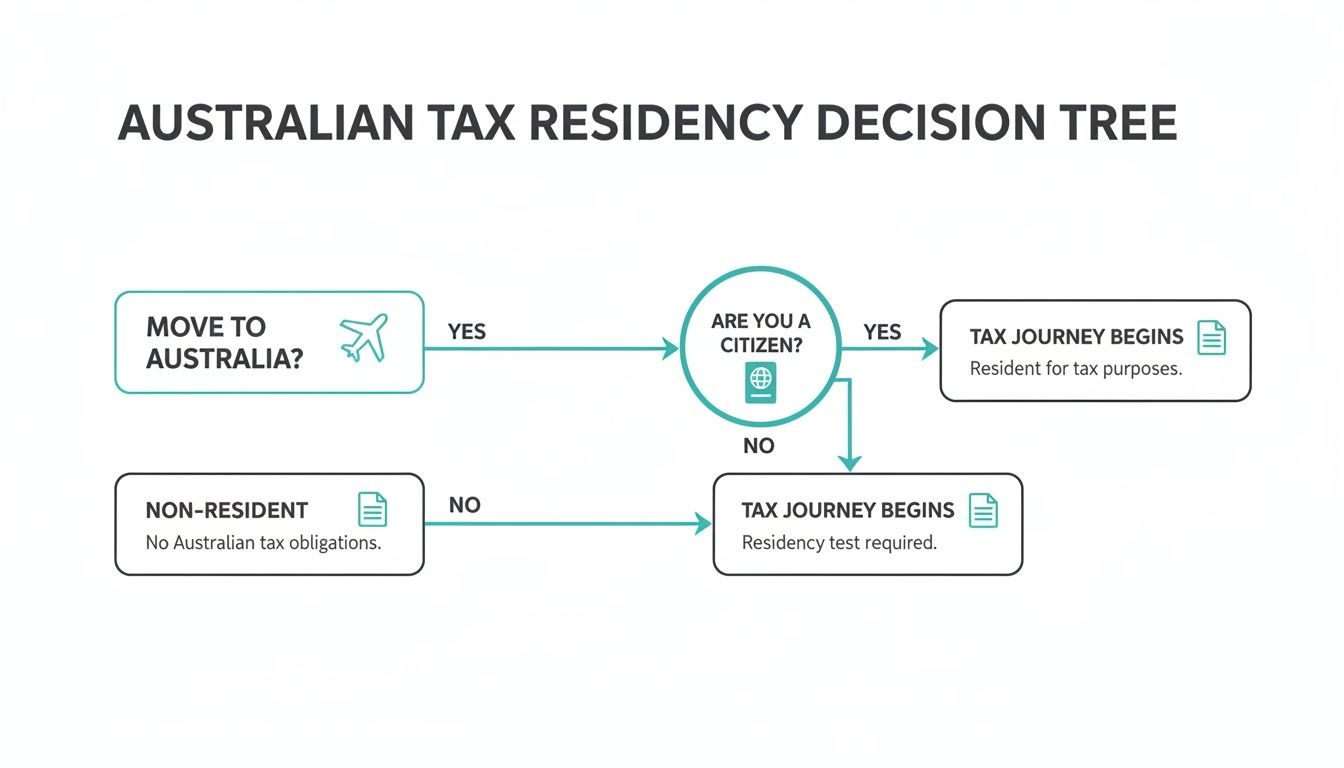
As you can see, determining your tax status begins with a series of factual questions about your life, movements, and intentions. The answers form the bedrock of your potential financial obligations in Australia.
The Four Key Residency Tests
The ATO will look at your unique situation and measure it against these four criteria:
- The Resides Test: This is the primary test. It considers the ordinary meaning of the word ‘reside’ and looks at factors like your intentions, physical presence, family and business ties, and living arrangements.
- The Domicile Test: This test asks whether your permanent home—your legal domicile—is in Australia. If it is, you are considered a resident unless the ATO is satisfied that your permanent place of abode is outside Australia.
- The 183-Day Test: You may be considered a resident if you are physically in Australia for more than half the financial year (183 days), continuously or intermittently. An exception may apply if your usual home is overseas and you have no intention of taking up residence here.
- The Commonwealth Superannuation Test: This is a specific test for Australian Government employees working overseas who are members of certain public sector superannuation schemes.
How The Tests May Apply in Practice
Let's consider a practical example. A software engineer from Canada accepts a three-year contract in Melbourne. She and her family lease a home, and her children attend a local school. Under the resides test, her actions suggest an intention to live in Australia for a significant period, which could make her a tax resident.
Now, consider an Australian business owner who moves to London to oversee a company expansion. He is overseas for more than 183 days, but he maintains his family home in Perth, where his spouse and children continue to live. Because of these strong, continuing ties, his domicile likely remains Australian, and he could continue to be a tax resident. For a deeper exploration of this status, you may wish to explore the specifics of being a non-resident for tax purposes in Australia.
The distinction is significant because it may directly impact your financial outcome. Being classified as a non-resident could result in a different tax treatment from your first dollar of Australian-sourced income.
Financial Implications Of Your Residency Status
To provide a clearer picture of why this matters, the following table outlines some core differences between the main residency statuses. It highlights what income may be taxed and how.
Tax Residency Status Key Implications
| Attribute | Australian Resident for Tax Purposes | Non-Resident for Tax Purposes | Temporary Resident |
|---|---|---|---|
| Income Scope | Taxed on worldwide income | Taxed on Australian-sourced income only | Taxed on Australian-sourced income. Most foreign income is generally exempt. |
| Tax-Free Threshold | Yes, the first $18,200 is tax-free | No tax-free threshold | Yes, the first $18,200 is tax-free |
| Medicare Levy | Generally liable to pay the 2% levy | Exempt from the Medicare levy | Exempt from the Medicare levy |
| Tax Rates | Progressive rates (0% to 45%) | Different, often higher, flat or progressive rates | Same rates as Australian residents |
As the table shows, the differences can be stark. Understanding your status is critical because Australia's tax system creates a significant financial distinction between residents and non-residents.
A non-resident, for example, is taxed at 32.5% from their first dollar of Australian-sourced income up to $120,000. In contrast, an Australian tax resident benefits from the $18,200 tax-free threshold and then pays 19% on income between $18,201 and $45,000.
Worldwide Income and Foreign Sourced Income
Once your tax residency is clarified, the next step is understanding which income to declare to the Australian Taxation Office (ATO). The answer hinges on the residency status we just covered, creating different obligations for different expats.
Getting this right is not just about compliance; it is the foundation of sound financial management when living and working across borders.
For anyone considered an Australian resident for tax purposes, you are generally required to declare your worldwide income. This term means precisely what it suggests: income from all sources, both inside Australia and from any other country.

What May Constitute Assessable Income?
The scope of worldwide income is broad. Keeping clear records for each category is a disciplined practice that may help you report accurately.
Common examples of foreign-sourced income that you may need to declare include:
- Employment Income: Salary, wages, bonuses, or director's fees earned from an overseas job while you are an Australian tax resident.
- Investment Returns: This covers dividends from foreign company shares, interest from overseas bank accounts, or distributions from foreign trusts.
- Overseas Rental Properties: The net rental income from a property you own in another country.
- Capital Gains: Any profit realised from selling overseas assets, like shares or real estate. For some Australian expats, understanding the tax implications of selling your UK home and living abroad can be a key part of financial planning.
The Foreign Income Tax Offset (FITO)
A valid concern for anyone earning worldwide income is the possibility of being taxed twice—once overseas where the money was earned, and again in Australia. The system has a built-in mechanism to address this: the Foreign Income Tax Offset (FITO).
The FITO may allow you to claim a credit for the foreign tax you have already paid on your overseas income. This offset can directly reduce your Australian tax liability. There are, of course, rules and limits. The offset generally cannot be more than the Australian tax you would have otherwise paid on that income.
The FITO acts as a balancing mechanism. It is not designed to eliminate your tax liability, but to create a more equitable outcome across different tax jurisdictions, acknowledging the reality of a global workforce.
Non-Residents and Temporary Residents
This is where the obligations can change significantly, highlighting why clarifying your residency status from the outset is so important.
- Non-Residents: If you are classified as a non-resident for tax purposes, your reporting obligations are generally narrower. You typically only need to report your Australian-sourced income. This could include wages for work physically performed in Australia, rent from an Australian property, or capital gains on certain Australian assets. Your income from other countries is usually outside the ATO's purview.
- Temporary Residents: This is a special category that may apply to skilled migrants on certain temporary visas. While you are still taxed on your Australian-sourced income, you are often exempt from paying Australian tax on most foreign-sourced income, such as returns from overseas investments. Professional advice may be appropriate to confirm eligibility.
If you would like clarity on how these principles may apply to your own circumstances, you may wish to speak with a qualified adviser. You can contact Everglow on 1300 913 929 or email contact@everglow.au to arrange a discussion.
General Advice Warning
The information provided in this article is general in nature and does not take into account your personal objectives, financial situation, or needs. Before acting on any information, you should consider the appropriateness of the information provided and seek personal advice from a suitably qualified professional.
Navigating Double Tax Agreements and ATO Compliance
A primary concern for many Australians working abroad is the possibility of being taxed twice on the same income—once in their country of residence, and again by the ATO.
Fortunately, Australia has a network of Double Tax Agreements (DTAs), or tax treaties, with over 40 countries, including common expat destinations like the UK, USA, Singapore, and many nations across Europe and Asia. These are legally binding treaties that set out the rules for which country has the right to tax certain types of income. Their purpose is to prevent double taxation and create a predictable system for expats and businesses.
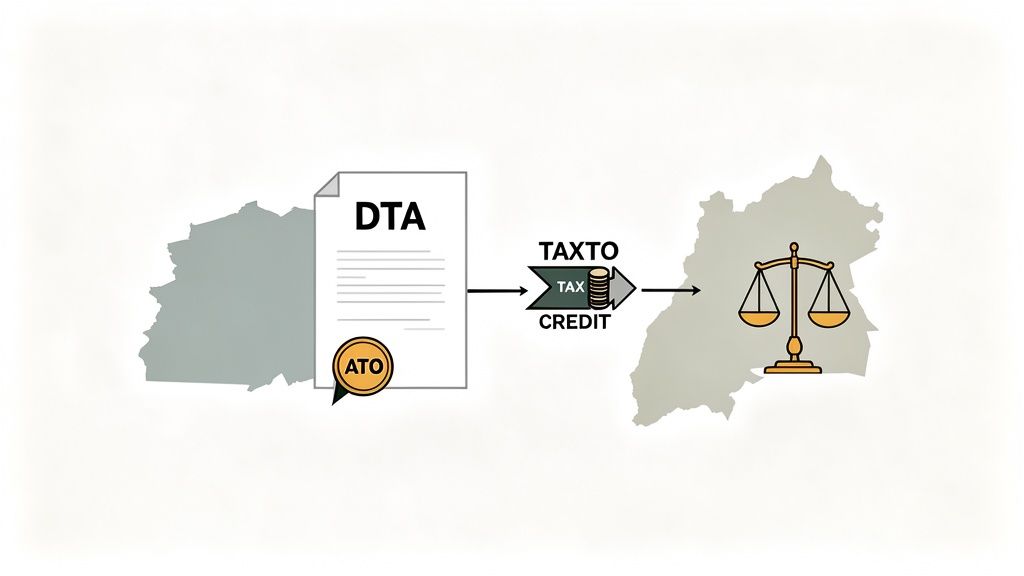
How Double Tax Agreements Work
DTAs function in two main ways. First, they establish 'tie-breaker' rules to determine which country has the primary right to tax your income. For rental income, the country where the property is located nearly always has the primary taxing right. For employment income, it often depends on where the work is physically performed.
Second, if both countries retain a right to tax the same income, the DTA provides a mechanism for relief, most commonly a tax credit. In simple terms, your country of tax residence (for example, Australia for an Australian tax resident) may provide a credit for the tax you have already paid overseas. This credit directly reduces the Australian tax you owe on that same income.
These agreements are a cornerstone of international tax law for individuals. They provide a clear, predictable framework for managing obligations across borders, turning a potentially complex issue into a more manageable compliance process.
An Australian Professional Working in Singapore
Let's consider a practical example. An Australian marketing consultant, who is a resident for tax purposes in Australia, undertakes a one-year project in Singapore.
- Under the Australia-Singapore DTA, Singapore has the first right to tax the income she earned while physically working there. She pays Singaporean income tax on her earnings.
- As an Australian tax resident, she must still declare this income as part of her worldwide income on her Australian tax return.
- She can then claim a foreign income tax offset (FITO) for the amount of tax paid in Singapore. This credit reduces her Australian tax liability, ensuring she is not taxed twice on the same income.
This system ensures that while she meets her reporting duties in both countries, her final tax burden is fair.
Your Fundamental ATO Compliance Duties
While DTAs offer protection, they do not remove your core responsibilities to the ATO. Sound financial stewardship involves being organised and proactive, regardless of your location.
Your key duties may include:
- Lodging Your Tax Return: If you are an Australian resident for tax purposes and your worldwide income exceeds the tax-free threshold, you must generally lodge a return. Non-residents may also need to lodge if they have Australian-sourced income.
- Declaring All Foreign Income: As a tax resident, you must report all income from all sources, even if tax was paid on it in another country. This includes your salary, investment returns, and capital gains. Property owners should also understand specific rules like foreign resident capital gains withholding.
- Meeting Deadlines: The standard tax deadline is 31 October. Missing it without making alternative arrangements can lead to penalties.
Navigating the rules for expats and taxes involves understanding your rights under DTAs and your responsibilities to the ATO. A disciplined, organised approach is key to managing your obligations with confidence. If you need support, our firm provides a range of tax and accounting services.
Risks, Responsibilities, and Practical Next Steps
Living and working internationally offers significant opportunities, but it also carries a clear set of financial responsibilities. In the context of expats and taxes, navigating the rules is not just good practice—it is essential. The Australian tax system is precise, and the consequences of misinterpretation can be significant. A thoughtful approach means understanding potential risks from the outset.
Getting Compliance Right
One of the most common errors is the incorrect determination of tax residency status. This could lead to the under-declaration of income, as an Australian tax resident is taxed on their worldwide earnings. Failing to declare all foreign-sourced income is another serious oversight.
The Australian Taxation Office (ATO) has sophisticated data-matching systems and shares information with tax authorities globally through various agreements. It is prudent to assume the ATO has a clear view of your financial activities.
Good record-keeping is a form of financial discipline. Maintaining clear, organised documents for your income, assets, and tax payments is a practical way to handle inquiries and ensure you are meeting your obligations correctly.
The Consequences of Non-Compliance
When compliance obligations are not met, the ATO can apply penalties and interest charges. These can accumulate, turning a small oversight into a larger financial issue.
Common consequences include:
- Failure to Lodge Penalties: Applied when a tax return is not filed by the due date.
- Interest Charges: The General Interest Charge (GIC) may be applied to unpaid tax liabilities.
- Penalties for Incorrect Statements: If incorrect statements are made on a tax return, penalties can apply, with the amount often depending on the nature of the error.
These measures are in place to uphold the integrity of the tax system.
The Value of Professional Guidance
Given the complexity of international tax law, seeking professional guidance can be a wise investment. An experienced adviser can bring clarity to how Australian tax laws and any relevant Double Tax Agreements apply to your unique situation, helping you manage your responsibilities with confidence.
This is not about finding ways to avoid tax. It is about managing your affairs correctly and responsibly, providing peace of mind as you build your life across borders. Thoughtful planning and disciplined action are the cornerstones of good financial stewardship.
Concise Takeaway
Your Australian tax residency status is the critical starting point that determines your tax obligations on either worldwide or Australian-sourced income. Understanding this, along with the function of Double Tax Agreements and your compliance duties, forms the basis of responsible financial management for any expat. Patience, disciplined record-keeping, and seeking professional advice where appropriate are key to navigating your tax affairs with confidence.
If you would like clarity on how these principles may apply to your own circumstances, you may wish to speak with a qualified adviser. You can contact Everglow on 1300 913 929 or email contact@everglow.au to arrange a discussion.
General Advice Warning
The information provided in this article is general in nature and does not take into account your personal objectives, financial situation, or needs. Before acting on any information, you should consider the appropriateness of the information provided and seek personal advice from a suitably qualified professional.
