

Embarking on a business venture in Australia is a significant undertaking. Before considering the operational aspects, two foundational decisions require careful, unhurried consideration: securing the correct visa and establishing the appropriate business structure.
These elements are the twin pillars upon which your entire enterprise will rest. Your immigration status dictates your legal right to conduct business in Australia, while your chosen structure defines your personal liability, tax obligations, and ongoing compliance responsibilities. A thoughtful, well-advised approach at this initial stage is a cornerstone of prudent financial stewardship.
Your Foundational Steps for an Australian Business

Starting a business on new soil requires a calm, measured approach. Before your first transaction, the legal and structural groundwork must be laid. This is not a stage to be rushed; patient, informed decisions here may provide stability for years to come.
Your first port of call should be the Department of Home Affairs. You must hold a visa that permits you to engage in business activities. A standard tourist visa is insufficient for this purpose. Pathways such as the Business Innovation and Investment Program are specifically designed for entrepreneurs, but eligibility criteria and availability can change. Seeking professional migration advice is critical to ensure your status is, and remains, compliant with Australian law.
Choosing Your Business Structure
With your legal right to operate confirmed, your attention must turn to the business structure. This is arguably one of the most significant decisions you will make, as it directly shapes your financial and legal responsibilities in Australia.
The common structures you may consider are:
- Sole Trader: You are legally synonymous with the business. It is the simplest structure to establish, often suitable for consultants or small service providers. However, this simplicity means you are personally responsible for all business debts.
- Partnership: Two or more individuals or entities run a business together. Profits, losses, and liabilities are generally shared between the partners according to their agreement.
- Company: A proprietary limited company (Pty Ltd) is a separate legal entity. This structure limits your personal liability, but it also imposes more significant compliance duties under the Corporations Act 2001.
- Trust: A trust is a structure where a trustee holds assets or income for the benefit of others (beneficiaries). It may offer asset protection and tax flexibility but involves complex administrative duties.
Your residency status can directly impact which structures are available or practical for you. For instance, to register a proprietary limited company with the Australian Securities and Investments Commission (ASIC), at least one director must ordinarily reside in Australia. This is a strict legal requirement.
To clarify these options, the following table summarises how they relate to a foreign entrepreneur.
Australian Business Structures at a Glance for Foreign Entrepreneurs
| Structure Type | Legal Liability | Residency Requirement Example | Typical Use Case |
|---|---|---|---|
| Sole Trader | Unlimited | Must have work rights; linked to your personal TFN. | Freelancers, consultants, or small online businesses for new migrants. |
| Partnership | Unlimited | At least one partner typically needs to be a resident. | Joint ventures or professional services with multiple owners. |
| Company (Pty Ltd) | Limited | At least one director must be an Australian resident. | Ventures seeking investment, liability protection, or long-term establishment. |
| Trust | Varies (often limited) | Complex; usually requires a resident trustee or corporate trustee with a resident director. | Asset protection, family businesses, and sophisticated investment holding. |
As the table shows, residency rules, particularly for companies, represent a significant consideration for many non-residents. This is often where engaging local, professional expertise becomes essential.
A thoughtful choice of business structure does more than satisfy a legal requirement; it creates a framework for managing risk, planning for tax, and building a resilient financial future. It is a cornerstone of good stewardship.
Understanding these initial steps is vital. Your visa and your business structure are interconnected decisions that lay the groundwork for everything that follows, including your ABN registration and understanding your tax obligations. Careful planning at this stage helps ensure your new Australian venture begins on a stable, compliant footing.
Securing Your Visa and Foreign Investment Approval
For any individual who is not an Australian citizen, the right to operate a business here is contingent on two critical factors: your visa and your compliance with foreign investment regulations. These are not mere administrative tasks; they are the legal foundations that legitimise your entire venture. A clear understanding of these obligations from the outset is non-negotiable for building a sustainable business in line with Australian law.
Your first action is always to secure the appropriate visa. A tourist visa is not suitable for commercial activities. The Australian government provides specific pathways for entrepreneurs, such as the Business Innovation and Investment Program (BIIP). As visa categories and their rules are subject to change, it is vital to seek current advice on which stream—such as the subclasses 188 and 888—is appropriate for your business plan and personal circumstances.
Every business visa carries conditions, which can shape how you operate. These may specify your level of day-to-day involvement, set a minimum turnover you must achieve, or require you to maintain certain asset levels. Adherence to these conditions is critical, as any breach could jeopardise both your business and your right to remain in Australia.
The Foreign Investment Review Board (FIRB)
In addition to your personal visa, certain business activities require approval from the Foreign Investment Review Board (FIRB). This is a significant checkpoint, particularly if you are planning to acquire an interest in an existing Australian company, purchase commercial real estate, or establish a new business in a sector deemed "sensitive."
FIRB’s function is to advise the Treasurer to ensure that significant foreign investments are not contrary to the national interest, a process guided by the Foreign Acquisitions and Takeovers Act 1975. It is a common misconception that FIRB review applies only to large corporate takeovers.
For investments in sensitive national security sectors such as media, telecommunications, or defence-related industries, the monetary threshold for requiring FIRB approval can be $0. This means that even a small investment could require notification. Determining early whether your business idea falls within one of these sectors is a crucial part of your initial due diligence.
Understanding FIRB Thresholds and Recent Changes
Australia's foreign investment framework is dynamic. The policy, primarily driven by the Foreign Acquisitions and Takeovers Act 1975 and administered by FIRB, generally requires foreign investors to seek approval before acquiring a substantial interest in a business or starting certain new ventures, especially if the investment value exceeds a set monetary threshold or involves sensitive sectors. It is worth noting that recent reforms aim to streamline processes for lower-risk investments, with a goal to process half of all applications within 30 days. To understand the latest developments, you can review a deeper analysis of the recent foreign direct investment review changes in Australia.
Navigating FIRB obligations is an exercise in foresight and diligence. You should be clear on your obligations long before signing contracts or transferring funds. Approaching this step with careful planning helps to avoid costly delays and protects your investment's legal standing from day one.
The rules are even more stringent for foreign government investors, where the level of scrutiny is higher. If any of your funding can be traced to a foreign government entity, you may require FIRB approval at a much lower ownership threshold. This highlights the importance of transparency regarding your capital sources.
Your visa, foreign investment obligations, and tax residency are all interconnected. How you are taxed in Australia will be influenced by these factors. Our guide on taxes in Australia for expats can serve as a useful starting point for understanding these implications. Ultimately, adhering to these rules demonstrates respect for the regulatory landscape you are entering and builds a compliant foundation that will serve your business for years to come.
Bringing Your Business to Life: The Formal Registration Process
Once your business structure is determined and your visa is in order, the next phase involves formal registration with the Australian government. This is more than paperwork; it is the sequence of steps that legally establishes your business and integrates it into the nation's regulatory and tax systems. A methodical approach here is the foundation of sound financial management.
As the visual guide below illustrates, your visa and business structure are the essential groundwork upon which this registration phase is built.
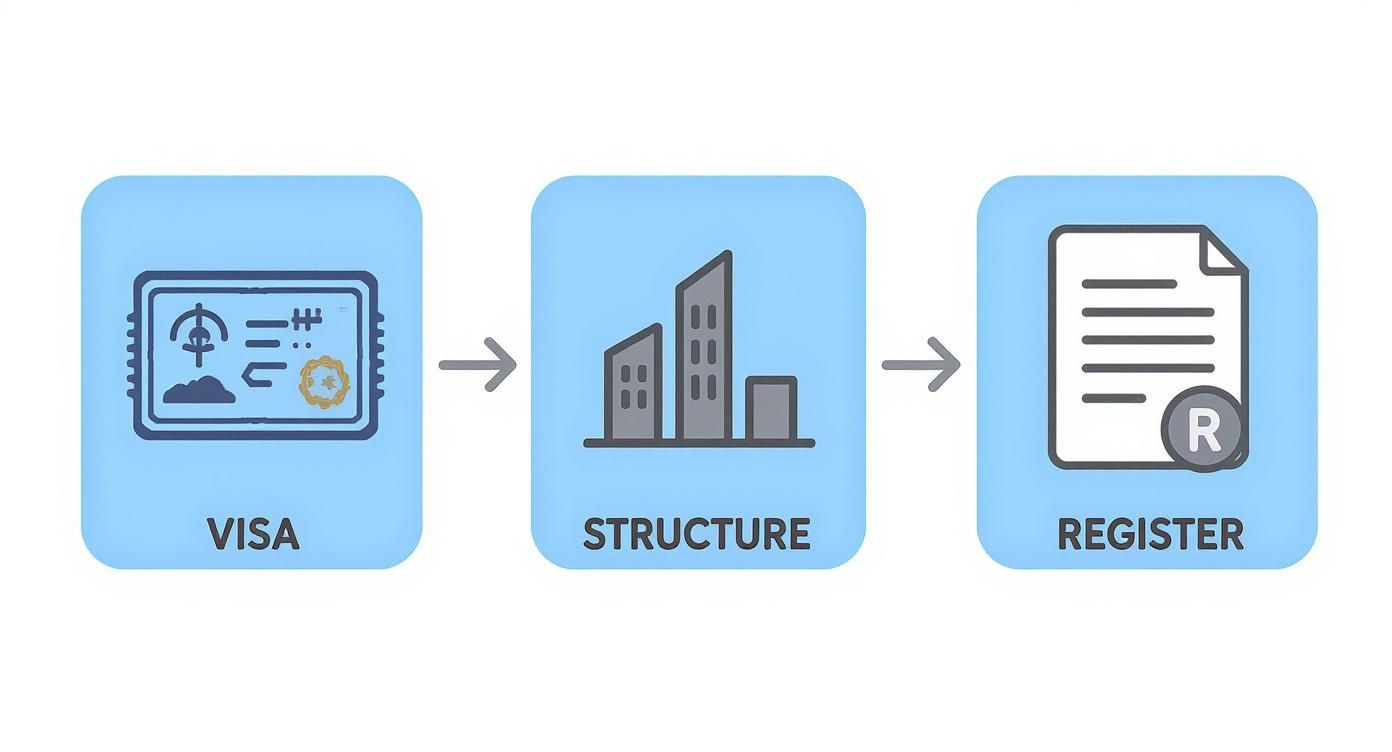
Each step follows logically from the last, reinforcing the importance of a disciplined process.
Securing Your Key Business Numbers
Your first practical step is to obtain an Australian Business Number (ABN). This unique 11-digit number is the primary identifier for your venture in all dealings with the government, other businesses, and the public. It is required for invoicing, claiming tax credits, and interacting with the Australian Taxation Office (ATO).
When applying for an ABN, you may also be prompted to register for a Tax File Number (TFN) for your business entity. The exception is a sole trader, who uses their personal TFN for all business-related tax matters, which simplifies administration. You can explore further considerations in our guide on the advantages of a sole trader.
Registering Your Name and Company Structure
If you intend to trade under a name that is not your own personal name (for sole traders) or the legal name of your partnership or company, you must register it. This business name registration is managed by the Australian Securities and Investments Commission (ASIC) and prevents others in your state from using it.
For those establishing a company, the process is more involved. You must formally register the company with ASIC, which establishes it as a separate legal entity.
This is a point where many foreign entrepreneurs encounter a significant hurdle. Under the Corporations Act 2001, a proprietary limited company must have at least one director who ordinarily resides in Australia. This is a non-negotiable legal requirement and a major consideration if you have not yet relocated.
Appointing a resident director is a decision with material consequences. They have specific legal duties and are responsible for the company's compliance, a matter that demands careful thought and, depending on your circumstances, professional legal advice.
Sorting Out Your Tax Registrations
Beyond your ABN and TFN, you will likely need to address other tax registrations. These are not optional and depend on your turnover and whether you plan to hire employees.
- Goods and Services Tax (GST): You must register for GST if your annual business turnover is expected to be $75,000 AUD or more. If you are below this threshold, registration is optional, but it is a decision that should be weighed carefully. Registering allows you to claim back the GST paid on your business expenses.
- Pay As You Go (PAYG) Withholding: If you plan to hire employees, you must register for PAYG withholding. This legally obligates you to withhold tax from your employees' wages and remit it to the ATO on their behalf.
Working through these registrations methodically cements your business as a compliant and legitimate participant in the Australian economy. It requires patience, but establishing these correctly from day one provides a solid platform from which to build.
Meeting Your Ongoing Tax and Compliance Duties
Establishing your business is a significant achievement, but the true measure of a durable enterprise lies in the quiet, disciplined management of its ongoing obligations. Long-term success is built not only on innovative ideas but also on the steady rhythm of meeting your responsibilities to the Australian Taxation Office (ATO) and other regulatory bodies.
Consider these tasks not as administrative burdens, but as the foundation of your business’s good standing and financial health. Building robust compliance systems from the beginning integrates these duties into your natural operations, rather than allowing them to become recurring challenges.
Lodging Your Business Activity Statement
For most Australian businesses, the Business Activity Statement (BAS) is the regular, crucial point of contact with the ATO. It is the primary vehicle for reporting and remitting several key taxes simultaneously.
If you are registered for Goods and Services Tax (GST), your BAS is where you report total sales and the GST collected. Concurrently, you declare the GST paid on business purchases, which can generally be claimed as a credit. The net amount is what you either pay to the ATO or receive as a refund. For a clear breakdown of what registration involves, you can review our guide on how to register for GST in Australia.
If you have employees, your BAS is also where you report the Pay As You Go (PAYG) tax withheld from their wages. This is the legal mechanism for remitting your employees' income tax contributions to the government.
Meeting Superannuation Obligations
One of the most important responsibilities for any Australian employer is paying superannuation for eligible employees. This is known as the Superannuation Guarantee (SG) and is a mandatory retirement savings scheme governed by federal law.
Currently, you must contribute a set percentage of an employee's ordinary time earnings into their nominated superannuation fund. This payment is made in addition to their wages, not deducted from them. These contributions must be made at least quarterly into a compliant super fund, and the deadlines are strict.
Missing a superannuation payment or paying it late can result in significant penalties from the ATO, including the Superannuation Guarantee Charge (SGC). This charge is not tax-deductible and includes interest and an administration fee, making it far more costly than timely payment.
Annual Reporting and Reviews
Beyond regular BAS lodgements, there are several key obligations to manage each year, depending on your business structure.
Annual Income Tax Return: Every business, regardless of its structure, must lodge an annual income tax return. This is where you declare your total income, claim allowable deductions, and determine your final tax liability for the financial year. The specific requirements of the return differ for sole traders, partnerships, trusts, and companies.
ASIC Annual Review: If you operate as a company, you must also complete an annual review with the Australian Securities and Investments Commission (ASIC). This involves confirming that your company details—such as director information and registered addresses—are current and paying an annual review fee to maintain the public register's accuracy.
Underpinning all of these duties is meticulous record-keeping. Maintaining clear, organised, and accurate financial records is not just good practice; it is a legal requirement. It simplifies the lodgement of returns, substantiates your claims in the event of an audit, and provides the clear financial oversight necessary for informed business decisions.
Practical Steps for Operating in the Australian Market

With your company registered and tax affairs in order, your focus can shift from legal structure to day-to-day operations. This is where your business plan meets the practical realities of the market. Addressing these foundational steps with discipline is about building a resilient and well-managed business from the start.
A non-negotiable first step is opening a local Australian business bank account. For companies, partnerships, and trusts, this is a legal requirement. Even if you are a sole trader, it is highly advisable. Keeping your business and personal finances separate will simplify accounting and tax compliance significantly.
To open an account, banks will require your Australian Business Number (ABN), business registration documents, and identification for all account signatories. Due to strict verification processes, this can sometimes take longer than anticipated, so it is prudent to initiate this process early.
Securing Business Funding and Capital
For many, the next question is capital. While Australia presents opportunities for foreign entrepreneurs, securing local funding requires an understanding of how Australian lenders assess risk. They focus heavily on trading history, cash flow projections, and available assets for security.
For a new business with no local track record, this can be a challenge. Lenders will expect a robust business plan, credible financial projections, and, in many cases, personal guarantees from the directors. Your visa and residency status may also be factors in their risk assessment. It is wise to approach these discussions with realistic expectations and meticulously prepared documentation.
The path to securing finance is often a measure of your venture's clarity and preparedness. Lenders look for evidence of stability, a deep understanding of the market, and a credible plan for repayment.
Beyond traditional banks, other funding options may be available depending on your industry. Venture capital and angel investors actively seek opportunities, particularly in the technology sector. Crowdfunding has also proven to be a viable option for businesses with a strong consumer focus. For a deeper examination of these options, you may find our guide to business financing helpful.
Navigating Sector-Specific Licences and Permits
Finally, you must ensure your day-to-day operations are fully compliant. Australia has three tiers of government—federal, state, and local—and each may have its own set of rules and required licences for your specific industry. These are not optional; they are legal prerequisites for operation.
Consider a few examples relevant to new business owners:
- Hospitality: A café typically needs a food business licence from the local council, must adhere to food safety standards, and may require a liquor licence from the state authority.
- Professional Services: An accountant or financial adviser must be registered with professional bodies and, depending on the services offered, may need to hold an Australian Financial Services Licence (AFSL).
- Construction Trades: Electricians and plumbers cannot operate without specific state-based licences that verify they meet national safety and competency standards.
A valuable starting point is the Australian Business Licence and Information Service (ABLIS). It is a government tool designed to help you identify the specific permits and licences applicable to your business. Diligence in this area protects you from potential fines and demonstrates your commitment to operating as a responsible member of the business community.
By methodically establishing your banking, securing your funding strategy, and obtaining all necessary licences, you are building a solid foundation for your business—one that is not only legally compliant but also prepared for sustainable growth.
Common Questions for Foreign Entrepreneurs
Establishing a business in Australia from overseas naturally raises several key questions. This is a common part of the journey as you navigate a new regulatory environment. Let's address some of the most frequent queries with clear, grounded answers.
Do I Need to Be in Australia to Register a Company?
This is often the first hurdle. In short, a local presence is required. Under the Corporations Act 2001, a proprietary limited company must have at least one director who ordinarily resides in Australia. This is a strict, non-negotiable rule enforced by the Australian Securities and Investments Commission (ASIC).
"Ordinarily resides" implies a substantial presence in the country; it does not necessarily require citizenship or permanent residency. If you are not yet physically in Australia, you will need to appoint a local resident director before your company registration can proceed. This is a significant decision with legal implications for the appointee.
Can I Get an ABN on a Temporary Visa?
Your eligibility for an Australian Business Number (ABN) is directly linked to the conditions of your visa. Some temporary visas grant work rights that permit you to operate a business, thereby making you eligible for an ABN. Others, such as a standard tourist visa, strictly prohibit it.
It is critical to verify your specific visa conditions with the Department of Home Affairs. Attempting to operate a business in breach of your visa conditions can lead to severe consequences, including visa cancellation. This is an area where assumptions should not be made.
The right to run a business in Australia is a privilege granted by your visa, not a default entitlement. Understanding its limits is the first step toward building a compliant and successful venture.
What’s the Main Difference Between a Sole Trader and a Company?
The primary difference lies in legal liability. As a sole trader, you and your business are considered a single legal entity. This means that if the business incurs debt, your personal assets—such as your home or vehicle—could be at risk.
A company, by contrast, is a separate legal entity. This creates a protective "corporate veil," generally limiting your personal liability for business debts to the value of your shares. This protection, however, comes with increased administrative duties and stricter compliance obligations with both ASIC and the Australian Taxation Office (ATO). Your choice should be a deliberate one, based on your risk tolerance, business vision, and professional advice on structuring your business for success.
When Do I Have to Register for GST?
Registering for the Goods and Services Tax (GST) becomes mandatory once your business reaches an annual turnover of AUD $75,000 or more (or is projected to do so). Below this threshold, registration is optional, but it is a strategic decision that requires careful consideration.
A notable exception applies to those providing taxi, limousine, or ride-sourcing services, who must register for GST from their first day of operation, regardless of turnover. Once registered, you must add GST to your prices and can claim back the GST included in your business expenses. This directly affects your pricing and cash flow, so the decision must align with your financial strategy.
A Concluding Takeaway
Launching a business in Australia as a foreigner is a journey that demands careful planning and a clear-eyed approach to compliance. From securing the correct visa to ensuring you meet your obligations to the Australian Taxation Office (ATO), each step builds the foundation for a stable and lawful enterprise.
The path forward requires patience, attention to detail, and an understanding of the local regulatory landscape. By establishing sound legal and financial structures from the outset, you are not merely fulfilling requirements—you are positioning your new business for sustainable growth. This is the essence of responsible stewardship and the cornerstone of long-term success.
Navigating these complexities is where trusted guidance can make a significant difference. The team at Everglow Prosperity provides integrated financial services designed to help new migrants and foreign businesses establish a secure footing in Australia. Plan your successful entry into the Australian market with us.
General Advice Warning: The information provided in this article is general in nature and does not take into account your personal objectives, financial situation, or needs. Before acting on any information, you should consider the appropriateness of the information to your own circumstances and seek professional advice from a qualified financial adviser. We have not taken your personal situation into consideration.
Want help applying this to your situation?
Every situation is different. Book a time with our team to talk it through, or call us on 1300 913 929.