

Quick Answer: Depending on whether you meet any of the ATO’s residency tests—Resides, 183-Day, Domicile or Superannuation—you may be classified as a non-resident for tax purposes. In that case, you could pay tax only on income sourced within Australia, generally at non-resident rates.
How Non-Resident Tax Status Works
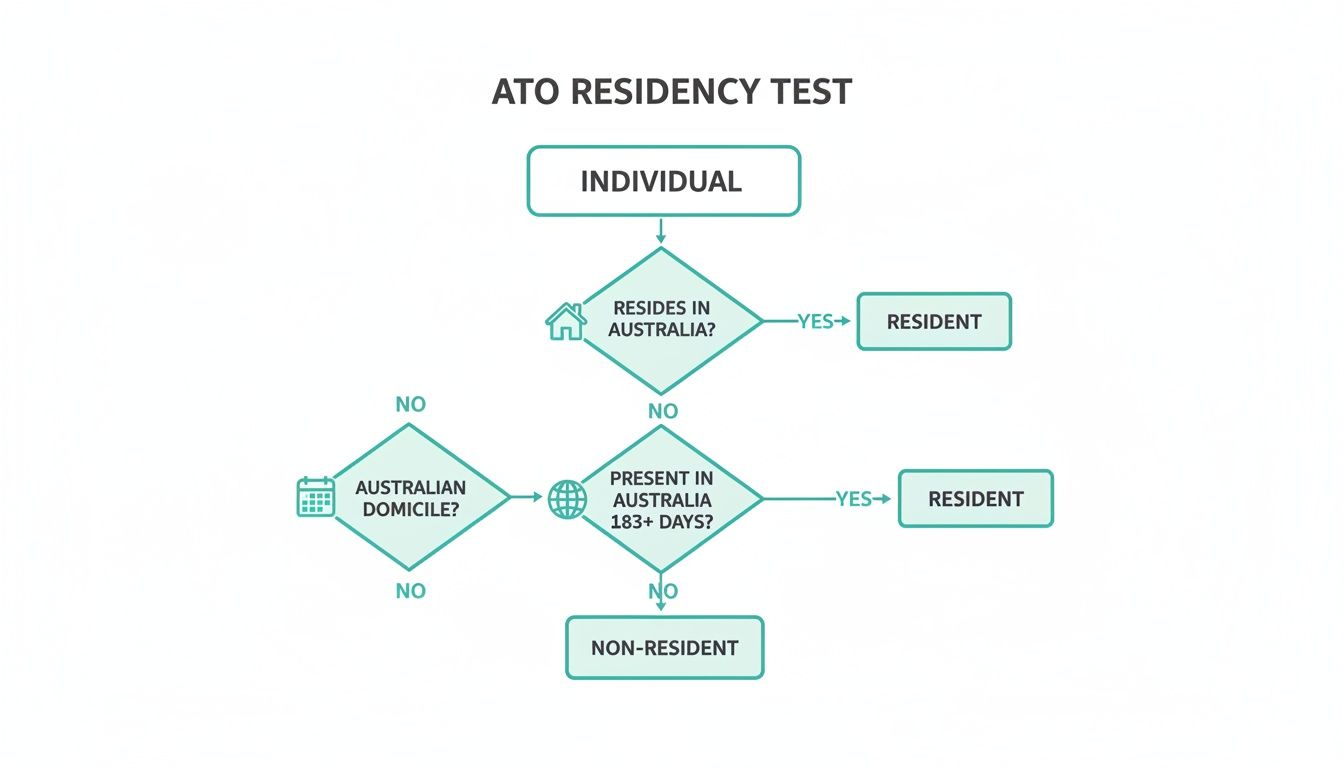
Think of the ATO’s four residency tests as different routes on a map. Each examines specific facts—where you live, how long you stay, where your permanent home lies and whether you remain in an Australian superannuation scheme—to determine your tax position.
- Resides Test looks at your day-to-day life in Australia
- 183-Day Test considers whether you spend more than 183 days here in a year
- Domicile Test asks where your permanent home is located
- Superannuation Test applies to Australian government employees abroad

| Test Name | Key Focus | Potential Outcome |
|---|---|---|
| Resides Test | Facts of daily life (home, social ties) | May be resident |
| 183-Day Test | Presence over 183 days in a financial year | May indicate residency |
| Domicile Test | Location of your permanent home | Resident unless permanent abode abroad |
| Superannuation Test | Membership in Australian public super fund abroad | Treated as resident |
For a detailed overview of cross-border tax principles, you could consult our guide on taxes in Australia for expats.
Understanding the Four ATO Tests
Each test sheds light on different aspects of your connection to Australia. Together, they establish whether you lodge as a resident or non-resident.
Factual Residence Test
This test asks whether Australia feels like home. Factors may include:
- Setting up utilities, enrolling children in school
- Joining local community groups or clubs
- Maintaining a primary place of accommodation
Example: Emma, a project manager from Perth, rents a Sydney flat, joins a professional networking group and opens a local bank account. Even with frequent trips overseas, her on-ground ties suggest she resides here.
183-Day Presence Test
A calendar-driven approach: if you spend more than 183 days in Australia in a single tax year (1 July–30 June), you may meet this test.
- Keep a travel diary with entry and exit dates
- Count all days on-shore, including arrivals and departures
- Note that absences under six continuous months may not reset the count
A simple tally could quickly flag a potential residency outcome.
Domicile Test
This focuses on your permanent home. You might retain an Australian domicile if you:
- Own property or personal assets here
- Vote in federal elections
- Retain strong family or business ties
Example: Raj, an IT consultant, lives in Berlin but keeps a Melbourne townhouse, votes by mail and maintains Australian memberships. The ATO may view Australia as his permanent base.
Superannuation Test
Applies to Commonwealth public servants posted overseas:
- Continued contributions to an Australian government super fund
- Ongoing membership while abroad
Example: Dr. Nguyen, seconded to Singapore by the Department of Health, remains in her Australian super scheme. She may still be treated as a resident for tax purposes.
Determining Non-Resident Status in Practice
Assessing your status can feel like fitting together pieces of a puzzle. It often requires gathering:
- Travel Records showing entry/exit dates
- Accommodation Proof such as leases or school enrolments
- Employment Details including contracts and super statements
- Domicile Evidence like property deeds or electoral enrolment
Case Examples
- 180-Day Contractor: Luke signs a six-month contract in Melbourne, rents a flat in Fitzroy and keeps weekend visits to family in Queensland. His daily routine and lease suggest he may pass the Resides Test, despite 180 days on-shore.
- International Student: Mia studies for one semester in Adelaide, lives in campus housing, returns home during breaks and holds no fixed lease. Her short stays could point away from residency.
- Seconded Professional: Omar spends nine months in Sydney, joins a local football club, hosts visiting family and logs 270 days on-shore. He may satisfy multiple tests indicating residency.
Tax Implications of Non-Resident Status
Non-residents generally pay tax only on Australian-sourced income and are exempt from the Medicare levy. Important considerations include:
- Withholding Rates:
• Dividends often attract 30% withholding
• Interest may have 10% withholding
• Royalties typically incur 30% withholding - Capital Gains Tax:
• Loss of main residence exemption on property sales
• CGT still applies to Australian real estate and business assets
| Status | Tax-Free Threshold | Rate From First Dollar | Top Marginal Rate |
|---|---|---|---|
| Resident | $18,200 | 0% up to $18,200 | 45% above $190,000 |
| Non-Resident | $0 | 30% from $0 | 45% above $190,000 |
Non-residents are taxed only on Australian-sourced income and do not pay the Medicare levy.
Employers must confirm written residency declarations, apply the correct rates and report via Single-Touch Payroll or PAYG summaries. Electronic lodgement may streamline the process.
Risks and Responsibilities
Navigating non-resident status calls for disciplined record-keeping and regular reviews. Common pitfalls include:
- Miscounting days under the 183-Day Test
- Overlooking family or property ties affecting domicile
- Failing to declare all Australian-sourced income
Treat your documents—travel logs, lease agreements, super statements—as a financial passport. Clear records could reduce audit risk and support your position if the ATO makes inquiries.
Responsibilities once you decide your status:
- Lodge your return by 31 October (or note agent extensions)
- Apply correct withholding rates
- Retain records for at least five years
- Respond promptly to any ATO queries
Practical Next Steps
- Collate travel and accommodation records in one folder.
- Tally your days on-shore against the 183-Day Test quarterly.
- Assess domicile factors—family, assets and community ties.
- Gather proof of superannuation memberships if you’re a public servant abroad.
- Seek professional advice when ATO tests produce mixed signals.
- Schedule an annual review or after major life changes.
You may also find it helpful to explore tailored support through our Tax Advisory Services or revisit the ATO Residency Guidance for official details.
Concise Takeaway
Determining non-resident status for tax purposes often hinges on a blend of days-counted, living arrangements, intent and connections. Disciplined planning, clear records and informed analysis could help you manage obligations and opportunities with confidence over time.
If you would like clarity on how these principles may apply to your own circumstances, you may wish to speak with a qualified adviser. You can contact Everglow on 1300 913 929 or email contact@everglow.au to arrange a discussion.
General Advice Warning: The information in this article is of a general nature and does not take into account your personal objectives, financial situation or needs. You should consider whether the information is appropriate to your circumstances and seek professional advice before acting.
Want help applying this to your situation?
Every situation is different. Book a time with our team to talk it through, or call us on 1300 913 929.
Book a free meetingAustralian tax guide →Estimate your fees →
Keep exploring