
Embarking on a new business venture in Australia often begins with a foundational decision: choosing the right business structure. For many professionals, consultants, and artisans taking their first steps, the path of a sole trader presents a clear and direct route.
In this structure, you and your business are regarded as a single legal entity. It is a straightforward approach, common for those starting out, allowing focus to remain on the craft and the client, rather than on complex administrative burdens. This guide explores the nature of the sole trader structure, grounded in the Australian legal and financial landscape.
The Sole Trader Structure: An Overview
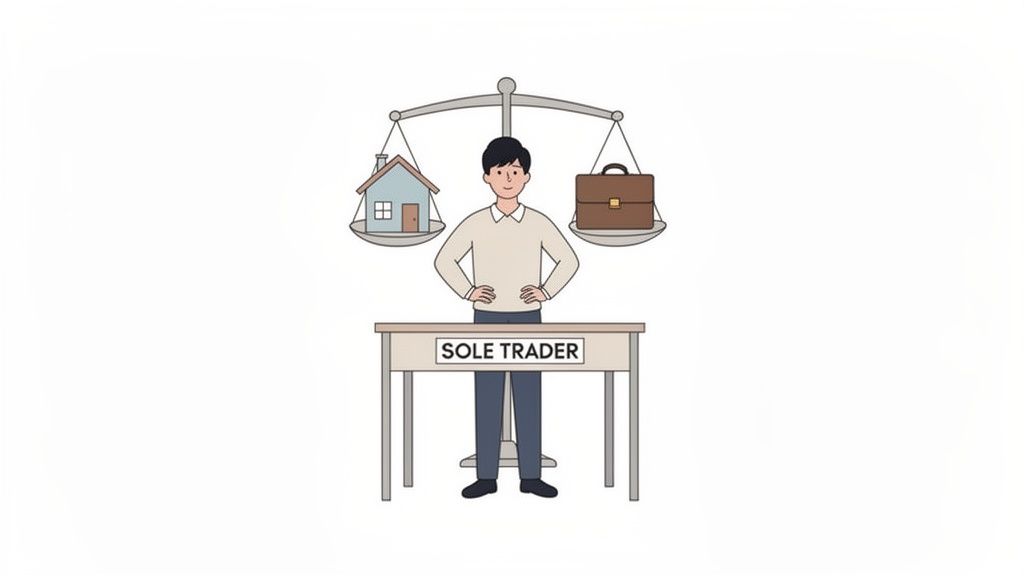
At its core, being a sole trader means there is no legal separation between the individual and the business they operate. This simplicity is a significant reason for its popularity. Often, obtaining an Australian Business Number (ABN) is all that is required to commence trading.
This path is a natural starting point for many. Consider a freelance graphic designer in Melbourne securing their first contract, or a skilled migrant in Sydney establishing a consultancy. As sole traders, they can issue invoices, claim eligible business expenses, and manage their finances without navigating intricate corporate regulations. However, this simplicity comes with responsibilities that require careful consideration.
Key Characteristics of a Sole Trader
The sole trader structure is defined by several features that shape both the opportunities and the obligations of the business owner. Understanding these fundamentals is a crucial step in sound financial stewardship.
The table below outlines these core characteristics.
Sole Trader at a Glance
| Feature | Description for Sole Traders |
|---|---|
| Legal Identity | You and your business are considered a single entity under the law. |
| Taxation | Business profits are treated as your personal income. You report this on your individual tax return and pay tax at your personal marginal rate. |
| Liability | You are personally responsible for all business debts and obligations. This is known as unlimited liability, meaning personal assets could be at risk. |
As illustrated, the ease of establishment is balanced by significant considerations, particularly concerning personal liability. This structure also influences other financial duties. For instance, if your business turnover reaches a certain threshold, you may be required to register for Goods and Services Tax (GST). For those seeking a deeper understanding, our guide on how trusts work provides context on alternative structures.
While the administrative ease is an advantage, a firm grasp of your responsibilities is the first—and most important—step in building a resilient enterprise.
Establishing Your Sole Trader Business
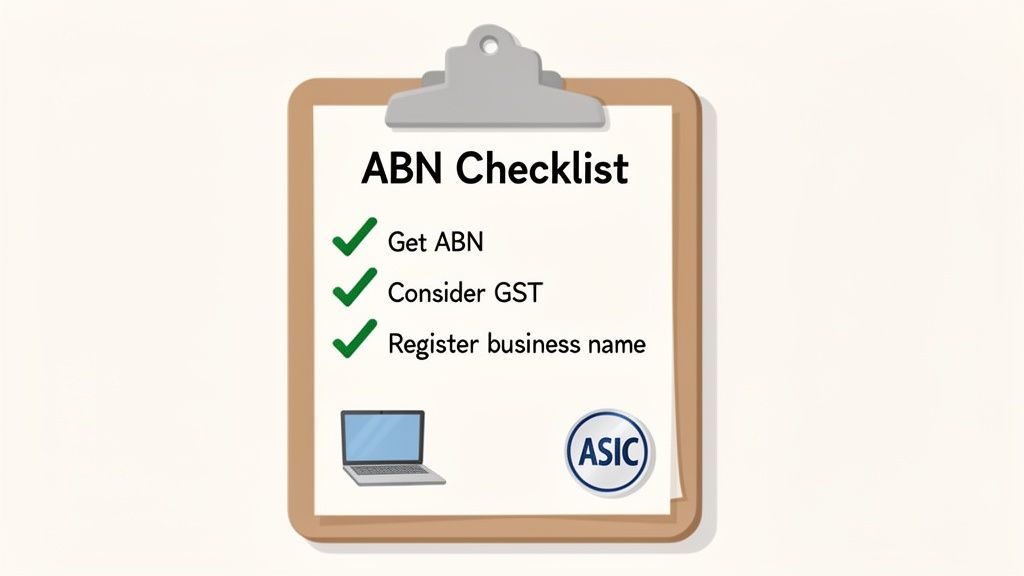
The process of setting up as a sole trader in Australia is refreshingly direct. It involves laying a few simple, solid foundations to ensure you are operating in accordance with regulatory guidelines from the outset. Each step is a practical measure that establishes your business within the Australian economic landscape.
Securing an Australian Business Number (ABN)
The first step is to obtain an Australian Business Number (ABN). This unique 11-digit number identifies your business to the government and other enterprises. It is essential for issuing compliant invoices, claiming tax credits, and interacting with the Australian Taxation Office (ATO). The application for an ABN can be completed online through the Australian Business Register (ABR).
Considering GST and PAYG Obligations
As your business operates, two key tax systems may become relevant depending on your turnover and income.
- Goods and Services Tax (GST): You are required to register for GST once your annual business turnover reaches or is expected to reach $75,000. Below this threshold, registration is optional, though in some circumstances it may be beneficial.
- Pay As You Go (PAYG) Instalments: This system allows you to manage your income tax obligations throughout the year. If your business and investment income reaches a certain level, the ATO may place you into the PAYG instalment system. This involves making regular prepayments towards your expected annual tax liability, which can help avoid a single, large tax bill.
Understanding these thresholds is a key aspect of prudent financial management. You can explore our educational resources to learn more about how to register for GST in Australia.
Registering a Business Name
While you may trade under your own name, you might prefer a more descriptive name for your business. For example, a physiotherapist, David Chen, may wish to trade as “Bayside Physio Care.” To do this, the business name must be registered with the Australian Securities and Investments Commission (ASIC). This registration provides the right to use that name for your business in Australia; it does not create a separate legal entity.
Taking these deliberate steps helps build a compliant and solid foundation, providing the quiet confidence needed to focus on growing your business.
Managing Tax, Superannuation, and Personal Liability

Operating as a sole trader means you are in control of your financial world. This is a shift from employment, where tax and superannuation are managed on your behalf, to a position where you are responsible for your obligations to the Australian Taxation Office (ATO) and for your long-term financial security.
The central principle is that your business income is your personal income. There is no legal distinction. Your net business profit is added to any other assessable income and is taxed at your individual marginal tax rate. This direct link requires a disciplined and organised approach to financial management.
Navigating Tax and Superannuation
Effective tax management begins with understanding your entitlements and obligations. As a sole trader, you may be able to claim deductions for legitimate business expenses directly related to earning your income. These could include vehicle costs, home office expenses, or professional development.
Meticulous record-keeping is not just about compliance; it is an act of good financial stewardship. It provides clarity over your cash flow and ensures you are prepared for your obligations to the ATO, allowing you to plan with foresight rather than reacting to surprises.
Professionals such as IT contractors or consultants may need to consider the Personal Services Income (PSI) rules, which can affect the types of deductions that can be claimed. If you believe the PSI rules could apply to your circumstances, professional advice may be appropriate.
For retirement planning, the responsibility rests with you. While employers are obligated to pay superannuation for their employees, sole traders must make their own provisions. Making personal superannuation contributions can be a prudent strategy for two main reasons:
- Building Retirement Savings: Regular contributions can grow into a substantial sum over time, benefiting from compounding returns.
- Potential Tax Benefits: Depending on your circumstances, personal superannuation contributions may be tax-deductible, which could reduce your taxable income.
The Reality of Unlimited Personal Liability
The greatest simplicity of the sole trader structure is intrinsically linked to its most significant risk: unlimited personal liability. This means that if the business incurs debts or faces legal action, your personal assets—such as your family home or savings—could be used to settle those claims. The protective barrier that a company structure can provide does not exist.
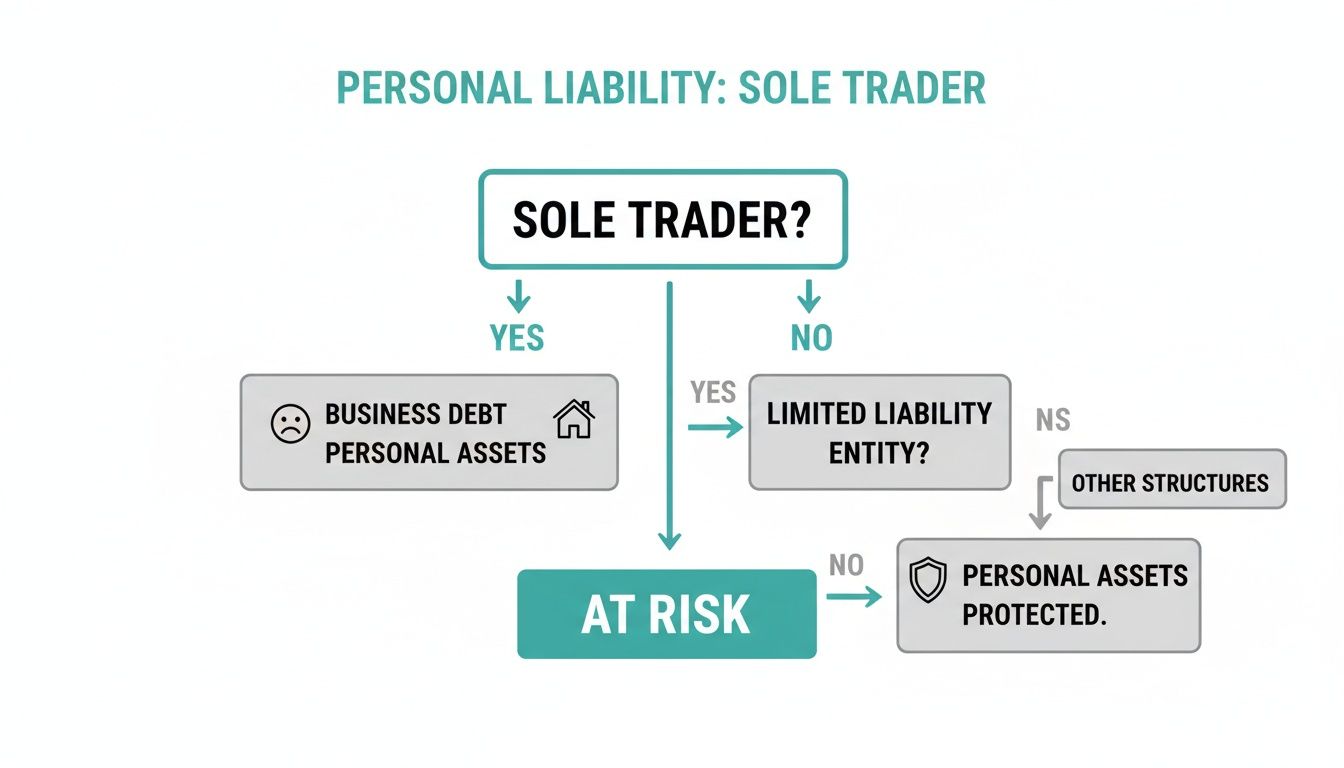
To illustrate, consider a builder operating as a sole trader whose work is found to be defective, leading to a significant damages claim. If the business assets are insufficient to cover the liability, the claimant's creditors could legally pursue the builder's personal assets, including the equity in their family home.
Understanding this risk is not a cause for alarm, but a call for diligent planning. Appropriate business insurance, such as public liability and professional indemnity cover, is an essential tool for managing this exposure. They are not merely expenses, but important safeguards. As a business grows, it may be prudent to consider transitioning to a structure that offers greater asset protection.
Practical Next Steps and Concluding Thoughts
The sole trader structure offers a clear and accessible pathway into business. Its defining feature is simplicity, where you and your enterprise are legally one. This unity simplifies administration but introduces the responsibility of unlimited personal liability. Navigating this path successfully requires a commitment to careful stewardship from the beginning.
Key Considerations for Your Journey
Balancing the freedom gained with the responsibilities undertaken is the essence of being a sole trader. Key principles to keep in mind include:
- Personal Liability: Acknowledge that personal assets are exposed to business risks and take practical steps to manage this, such as obtaining appropriate insurance.
- Tax and Superannuation: Maintain disciplined records and proactively plan for income tax and personal superannuation contributions.
- Planning for Growth: Recognise that the sole trader structure is an excellent starting point, but may not be suitable for the entire life of your business. Being prepared to evolve is a key strategic decision.
The wisdom in choosing a business structure lies not just in its immediate convenience, but in its suitability for the long-term journey. Patient, disciplined action and thoughtful planning are the cornerstones of enduring prosperity.
Deciding on the right structure is a pivotal moment. It is a decision that should be approached with patience and careful consideration, aligning your business not just with where you are today, but where you thoughtfully plan to be in the future.
If you would like clarity on how these principles may apply to your own circumstances, you may wish to speak with a qualified adviser. You can contact Everglow on 1300 913 929 or email contact@everglow.au to arrange a discussion.
General Advice Warning: The information provided in this article is general in nature only and does not take into account your personal objectives, financial situation, or needs. Before acting on any information, you should consider the appropriateness of the information provided and seek personal advice from a qualified professional.
