

A trust is a relationship built on stewardship. In simple terms, it is a formal structure where a person or a company holds assets for the benefit of others. It is not a separate legal entity like a company, but rather a legal obligation recognised under Australian law, designed to hold, manage, and protect assets like property, investments, or business interests for specific individuals or organisations.
Understanding how a trust works is a key step in thoughtful financial planning. It is a structure that, when properly managed, may offer a way to steward wealth through different seasons of life.
The Core Elements of a Trust
A trust operates on a fundamental principle: the separation of legal ownership from beneficial ownership. The person who legally owns the assets (the trustee) does so not for their own gain, but for the good of others (the beneficiaries). This distinction is what gives a trust its capacity for asset protection and long-term wealth management.
The entire relationship is governed by a legal document called the Trust Deed. This is the rulebook. It is a critical document that outlines the trustee’s powers, identifies the beneficiaries, and defines the trust’s purpose. Every action the trustee takes must align with the terms of this deed.
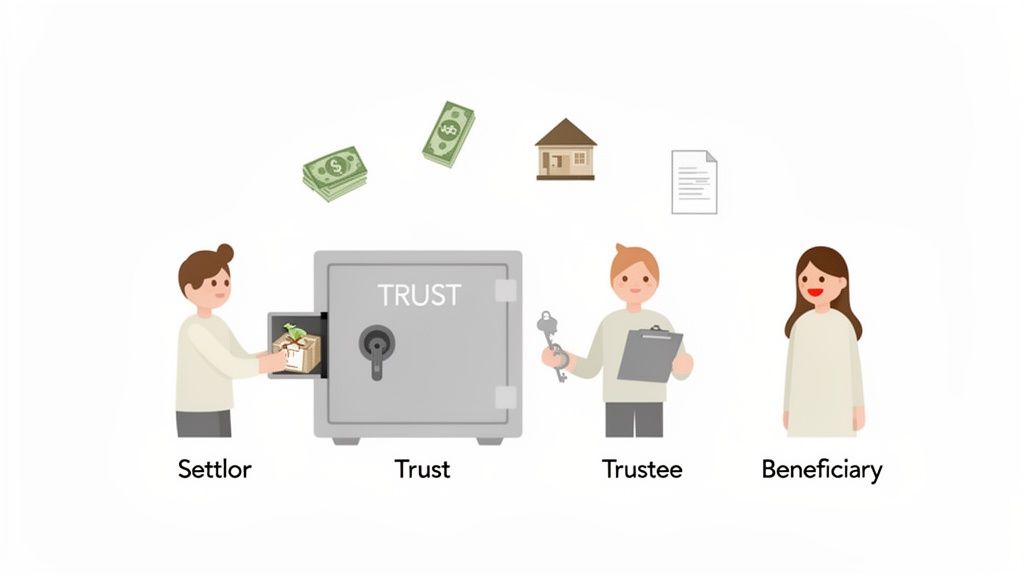
The Three Key Roles in a Trust
To understand how trusts work in Australia, it is helpful to first understand the three essential roles involved. Each has a distinct and legally defined function.
| Role | What They Do | Common Australian Example |
|---|---|---|
| Settlor | The person or company that formally creates the trust by contributing the first asset. | An independent party, like an accountant, who settles $10 to establish a new family trust for a client. |
| Trustee | Legally owns and manages the trust's assets, acting in the best interests of the beneficiaries. | A corporate trustee (a company) established to manage the assets of a family business. |
| Beneficiary | The people, companies, or other entities who may benefit from the trust's assets and income. | The children and grandchildren of the family who established a discretionary trust. |
Let's explore these roles further:
The Settlor: This person initiates the trust by providing the initial asset—often a nominal amount like $10—to formally create it. Under Australian law, the settlor’s role is then complete. It is important that the settlor is not a beneficiary to ensure the trust's validity and avoid potential tax complexities.
The Trustee: The trustee holds legal title to the trust's assets and has the significant responsibility of managing them. This role can be filled by one or more individuals or, commonly, a company (a corporate trustee). The trustee has a 'fiduciary duty'—a legal obligation of the highest order—to act with care and prudence, always prioritising the best interests of the beneficiaries.
The Beneficiaries: These are the individuals, companies, or even charities that the trust was established to support. Their entitlement to receive income or capital from the trust is determined by the rules set out in the trust deed.
This separation of roles is central to how a trust functions. For example, a professional operating a business may place significant assets into a trust. As a beneficiary, they may benefit from the trust's income, but the trustee's legal ownership may help shield those assets from personal business risks. The simplest form of this relationship can be seen in our guide explaining what a bare trust is.
Common Types of Trusts in Australia
In Australia, a 'trust' is not a single product. It is a family of legal structures, each designed to achieve specific financial objectives. The right structure for your circumstances will depend on what you are trying to accomplish. Are you seeking flexibility to manage wealth for your family, or do you need certainty for a joint business venture? The answer will often point toward a specific type of trust.
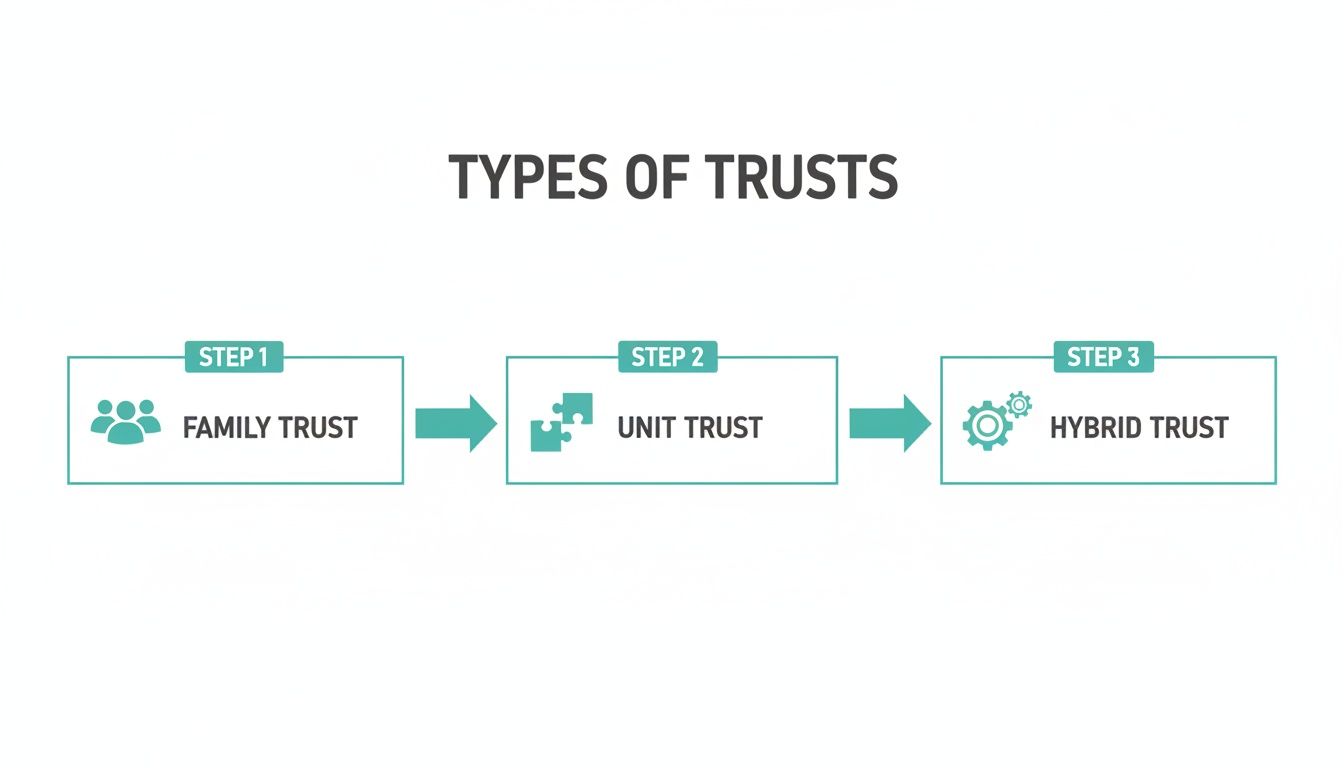
The Discretionary or Family Trust
The Discretionary Trust, often known as a Family Trust, is a common structure for Australian families and private business owners. Its key feature is flexibility. The trustee has the discretion to decide which beneficiaries receive income or capital from the trust—and how much—each financial year.
This discretion can be a powerful tool for managing family wealth. It allows the trustee to adapt to the changing circumstances of the beneficiaries. For example, a young adult pursuing higher education might require more support one year, while another family member might be starting a business. The trustee may adjust distributions accordingly, guided by the trust deed.
This structure is often used by families running a business or holding investments, as it may provide pathways for tax-effective income distribution among family members with lower marginal tax rates, always subject to ATO rules.
The Unit Trust
Where a discretionary trust offers flexibility, a Unit Trust provides certainty. The trust’s property is divided into a set number of ‘units’, similar to shares in a company. The beneficiaries, known as unitholders, own a specific number of these units.
Your entitlement to the trust's income and capital is directly proportional to the number of units you hold. If you own 25% of the units, you are entitled to 25% of the distributions.
This clear ownership structure makes unit trusts a suitable vehicle for unrelated parties entering a joint venture, such as a property development. Everyone’s stake is clearly defined from the outset.
- For business owners: A group of business owners, not related to each other, might use a unit trust to jointly purchase their commercial premises. Each owner would hold units reflecting their financial contribution.
- For new migrants: A group of investors pooling funds to acquire a business could use a unit trust to formalise each person's ownership share and entitlement to future profits.
How a Trust Manages Assets and Distributes Income
The practical function of a trust comes to life in how it handles assets and the income they generate. For tax purposes, an Australian trust is typically a ‘flow-through’ structure. It acts as a conduit, not a final destination for money. Unlike a company that pays tax on its profits, a trust usually passes its income through to the beneficiaries, who are then responsible for paying tax at their own marginal tax rates.
The Annual Distribution Process
Think of a trust as a temporary holding place for income earned during the financial year—such as rent, dividends, or business profits.
Before the end of the financial year on 30 June, the trustee has a critical duty: to formally resolve and document how to distribute this income among the eligible beneficiaries. This is a legally binding process, recorded in a written trustee resolution, which must be completed on time to be effective for tax purposes under ATO guidance.
Once the trustee resolves to make a beneficiary ‘presently entitled’ to a share of income, that income legally belongs to them for that financial year. The beneficiary then includes this amount in their personal tax return.
This mechanism is a cornerstone of wealth management and tax planning in Australia.
A Practical Australian Example
Consider a professional services provider earning Personal Services Income (PSI).
Sarah is a consultant operating her business through a trust. The trust earns $150,000 in net income for the year. Sarah’s husband, Tom, works part-time and earns a low income. Their adult son, Leo (20), is at university and has no income.
Before 30 June, the trustee (a company controlled by Sarah) could resolve to distribute the income in a way that aligns with the family’s circumstances and is compliant with PSI rules. For instance, a reasonable salary may be paid to Tom for administrative work he performs for the business. The remaining profit, being Sarah’s PSI, would be attributed to her.
This strategic distribution, when managed correctly and in accordance with tax law, may result in a better overall tax outcome for the family than if all income were taxed at Sarah's higher marginal rate. This illustrates how the choice of structure is a deliberate one, designed to suit specific family or business goals.
The Opportunities and Responsibilities of a Trust
Establishing a trust may present powerful ways to manage and protect wealth, but these opportunities are paired with significant legal and administrative responsibilities. A disciplined approach means understanding both sides—not just what a trust could do for you, but what it will require of you as its steward.
Sound financial decisions come from understanding risks as well as potential benefits. This balance ensures the structure can serve its purpose effectively over the long term.
Potential Benefits of a Trust Structure
When managed with care, a trust may offer several key benefits. These advantages are not automatic; they are the result of careful planning and consistent, compliant administration.
- Asset Protection: A trust may create a legal separation between personal and business assets. For a business owner or a professional in a field with high liability risk, placing assets like an investment portfolio into a trust could help shield them from commercial creditors or legal claims related to the business. The effectiveness of this depends on the specific circumstances and timing.
- Tax Planning Flexibility: In a discretionary trust, the ability to stream income to beneficiaries on lower marginal tax rates can be a valuable tool. This flexibility allows a trustee to adapt distributions to the changing financial circumstances of family members each year, which may improve the family's overall tax position in a compliant manner.
- Structured Succession Planning: A trust provides a private framework for passing wealth to the next generation. Unlike a will, a trust operates continuously and is not typically subject to the public probate process, which may allow for a smoother and more controlled transition of assets over time.
The Corresponding Responsibilities
For every potential benefit, there is a corresponding responsibility. The integrity of the trust depends on the trustee’s commitment to fulfilling their duties.
A trust is not a ‘set and forget’ vehicle. It is an active legal arrangement that requires ongoing attention, meticulous record-keeping, and unwavering adherence to the trust deed and Australian law.
- Diligent Administration: The potential asset protection of a trust is only as strong as its administration. This means maintaining separate bank accounts, never mixing trust and personal funds, and keeping detailed records of all transactions and decisions.
- Strict Compliance: The flexibility in tax planning comes with a firm duty to comply with all ATO requirements. This includes lodging annual trust tax returns, making and documenting trustee resolutions before 30 June each year, and navigating complex rules around unpaid present entitlements (UPEs) and personal services income (PSI).
- Fiduciary Duty: A trustee has a profound legal obligation to always act in the best interests of the beneficiaries. This means making prudent investment decisions, avoiding conflicts of interest, and treating all beneficiaries fairly according to the rules of the trust deed.
These responsibilities highlight the importance of obtaining professional advice. For complex structuring matters, our Business and Corporate Advisory services can provide clarity on establishing robust governance from the start.
Practical Steps to Establish a Trust
Setting up a trust is a significant legal and financial decision. It involves a series of deliberate steps, each requiring careful thought and, in most cases, professional guidance to ensure the structure is sound and serves your long-term goals.
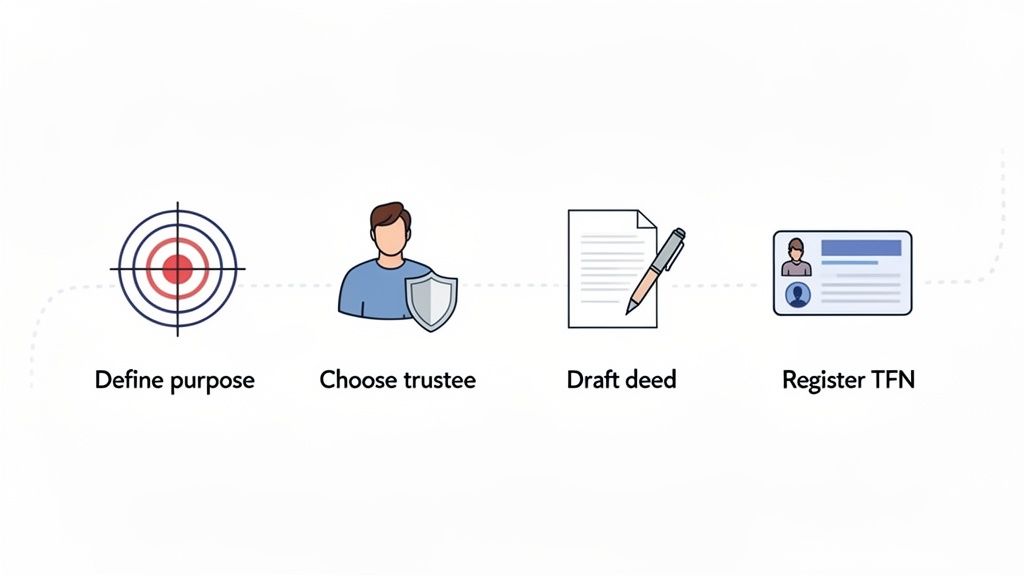
1. Define Your Purpose
First, clarify your objective. Are you primarily seeking asset protection, tax management flexibility for your family, or a clear succession plan for your business? Your purpose will guide the choice of trust structure.
2. Choose a Trustee and Draft the Deed
Appointing a trustee is a critical decision. You need a person or corporate entity that is responsible, diligent, and capable of fulfilling their duties with integrity. Following this, a solicitor will draft the trust deed, which is the trust's constitution. A well-drafted deed is vital for the trust to operate correctly.
3. Settle the Trust
An independent person (the settlor) gives an initial sum (often $10) to the trustee. This simple act formally creates the trust.
4. Complete Compliance Steps
The trustee must then:
- Have the trust deed stamped if required by your state or territory.
- Apply to the ATO for a Tax File Number (TFN) and an Australian Business Number (ABN) if the trust will be carrying on an enterprise.
- Open a dedicated bank account in the trust’s name to keep funds separate.
Following this structured process helps ensure your trust is built on a compliant and solid foundation. To explore foundational concepts further, you may find our educational resources helpful.
A Concise Takeaway
A trust is a powerful tool for managing and protecting wealth, founded on the principle of stewardship. Its effectiveness lies in the clear separation of roles between the settlor, trustee, and beneficiaries, all governed by the trust deed. While trusts may offer benefits in asset protection, tax planning, and succession, these are balanced by significant responsibilities of diligent administration and strict legal compliance. Thoughtful planning and patient management over time are key to ensuring a trust achieves its intended purpose.
If you would like clarity on how these principles may apply to your own circumstances, you may wish to speak with a qualified adviser. You can contact Everglow on 1300 913 929 or email contact@everglow.au to arrange a discussion.
General Advice Warning: The information provided in this article is general in nature and does not take into account your personal objectives, financial situation, or needs. Before acting on any information, you should consider the appropriateness of the information having regard to your own objectives, financial situation, and needs and seek personal advice from a qualified financial adviser.
Want help applying this to your situation?
Every situation is different. Book a time with our team to talk it through, or call us on 1300 913 929.