
In Australia, the approach to tax on dividends is unique, structured around a system designed to prevent the double taxation of investment returns. When you receive a dividend from an Australian company, it often arrives with a franking credit. This credit acts as a receipt for tax the company has already paid on its profits, and it could significantly reduce your personal tax liability. Understanding this system is a cornerstone of prudent financial stewardship.
Understanding Dividend Income in Australia
Receiving a dividend is a tangible result of successful investing; it represents your share of a company's profits. For many Australians—from professionals building a portfolio to business owners and families planning for their future—dividends can be a reliable component of an income stream.
However, like any form of income, dividends are of interest to the Australian Taxation Office (ATO). Dividends are considered assessable income and must be declared in your annual tax return, where they will be taxed at your personal marginal tax rate. A clear understanding of this process is the first step toward managing your investment returns effectively.
The Foundation of Australian Dividend Tax
At its core, Australia's dividend tax system is built on a single principle: a dollar of profit should not be taxed twice. When a company earns a profit, it pays company tax. It then distributes a portion of the after-tax profit to shareholders. If you were then taxed on the full dividend amount, that same profit would be taxed a second time.
To address this, Australia uses a dividend imputation system. This framework provides shareholders with a credit for the tax the company has already paid. This credit is passed to you as a franking credit.
The purpose of the imputation system is to ensure company profits are ultimately taxed at the shareholder's personal marginal tax rate, rather than once at the company level and again at the personal level. This is a key feature of Australian tax law, designed to encourage investment in domestic companies.
Your Role as an Investor
As an investor, your responsibility is to understand how dividend income and franking credits integrate into your overall tax position. Good stewardship of your finances begins with this clarity.
Here are the practical steps to follow:
- Report Everything Accurately: You must declare all dividend income received during a financial year. This includes both the cash payment and the value of any attached franking credits.
- Keep Your Statements: Companies issue dividend statements detailing the cash payment, the franking credit amount, and other essential information. Retain these records, as they are necessary for completing your tax return.
- Seek Personal Advice: Tax rules can be complex and their application depends on your specific circumstances. Consulting a qualified adviser can provide clarity and help ensure your investment strategy aligns with your financial goals.
With this foundational knowledge, you can approach your investments with quiet confidence and prepare to explore how Australia's dividend tax system works in practice.
How the Dividend Imputation System Works

At the heart of Australia’s dividend tax rules is the dividend imputation system. It is a framework designed to resolve the common issue of double taxation on company profits.
Consider this process: An Australian company generates a profit and pays the required tax to the ATO. When it later distributes a dividend from the remaining profit, it attaches a franking credit—a notification that tax has already been paid on that underlying profit.
The purpose of the franking credit is to ensure the final tax paid on the original company profit aligns with your personal tax rate. This creates a fair and integrated outcome for investors.
The Purpose of Franking Credits
The primary objective is to link the corporate and personal tax systems. Before this system was introduced, company profits were taxed at the corporate level and then again when received by shareholders as dividends.
A franking credit represents the company tax that has already been paid. When you receive a franked dividend, you are receiving both a cash payment and a tax credit. You are required to declare both to the ATO because the credit is designed to reduce your final tax bill.
A franking credit is a tax offset. It is evidence that a company has paid tax, which you, the shareholder, may then use to reduce your own income tax liability. It is the key mechanism for preventing double taxation.
Introduced in 1987, this system was further enhanced on 1 July 2000, when franking credits became fully refundable—a significant development for many investors.
This policy encouraged Australian companies to distribute profits. According to RBA data, between 2005 and 2015, listed companies paid out an average of 67% of their profits as dividends, a figure notably higher than in other developed economies.
Franked, Unfranked, and Partially Franked Dividends
When reviewing a dividend statement, you will encounter terms such as 'franked', 'unfranked', or 'partially franked'. Understanding these is essential for calculating your tax on dividends in Australia.
Here is a simple breakdown:
- Fully Franked Dividends: This indicates the dividend was paid from profits on which the company paid the full rate of Australian tax (currently 30% for large businesses or 25% for eligible smaller ones). You receive the maximum possible franking credit. Our guide on what is a fully franked dividend provides further detail.
- Unfranked Dividends: This is a dividend paid from profits on which the company has not paid Australian tax, perhaps due to carried-forward tax losses. An unfranked dividend has no franking credits attached.
- Partially Franked Dividends: This is a hybrid. The dividend is paid from profits where the company paid tax on only a portion of them. You receive a franking credit, but it will be less than the maximum amount.
Your dividend statement provides all necessary details: the cash received, the franking percentage, and the value of the credit. Careful review of this document is your first step. It informs you how much income to declare and the tax offset you can claim. The next step is to understand how these figures are applied in your tax calculation.
Calculating Your Tax on Franked Dividends
With a grasp of the dividend imputation system's theory, let's turn to the practical application.
Calculating the tax may initially seem unusual, but it is a logical, step-by-step process prescribed by the ATO. It involves three key stages: identifying the cash received, "grossing up" the dividend to determine your total assessable income, and then applying the franking credit to reduce your tax liability.
The objective is to ensure the profit generated by your shares is ultimately taxed at your personal rate—no more, no less.
The First Step: Grossing Up Your Dividend
When you receive a franked dividend, the cash payment is only part of the equation. To calculate your tax correctly, you must first determine the "grossed-up" dividend.
This simply means adding the value of the franking credit back to the cash dividend, effectively reconstituting the dividend to its original, pre-tax amount. This grossed-up figure is what you must declare as income on your tax return.
The ATO provides a standard formula. For a company paying tax at 30%, the franking credit is calculated as: Cash Dividend Amount / 0.7 x 0.3. This formula reverses the tax the company already paid.
For example, imagine a professional investor receives a $700 cash dividend. The company paid tax at 30%, so the dividend statement shows a franking credit of $300.
The total assessable income from that dividend is $1,000 ($700 cash + $300 credit). It is this $1,000 figure that must be added to your other earnings for the year.
Applying Your Marginal Tax Rate
Once the $1,000 grossed-up dividend is established, the next step is to calculate the tax on it. This is where your personal marginal tax rate is applied.
Your marginal rate is the rate of tax you pay on the last dollar you earn and generally includes the Medicare levy (currently 2% for most taxpayers).
Continuing our example, let's assume the investor's total income places them in the 34.5% tax bracket (including the Medicare levy).
- Grossed-up Dividend: $1,000
- Tax on Dividend (at 34.5%): $1,000 x 0.345 = $345
This $345 is the initial tax on the dividend income, before the franking credit is applied.
Using the Franking Credit as a Tax Offset
Here is the key step. The franking credit acts as a direct, dollar-for-dollar reduction against your tax payable. The system is crediting you for the tax the company has already paid on your behalf.
In our example, the franking credit was $300.
- Initial Tax Liability: $345
- Less Franking Credit Offset: -$300
- Final Tax Payable on Dividend: $45
After the calculation is complete, the investor owes an additional $45 on that dividend. This occurs because their personal tax rate (34.5%) was higher than the company's tax rate (30%). The system simply requires them to pay the difference.
How Franking Credits Affect Your Tax at Different Income Levels
The final outcome depends on a simple comparison: is your personal tax rate higher, lower, or the same as the company tax rate? The table below illustrates how different the result can be.
| Investor's Marginal Tax Rate (including Medicare Levy) | Franking Credit Value | Tax on Grossed-Up Dividend | Final Outcome for Investor |
|---|---|---|---|
| 0% (e.g., Retiree, low income) | $300 | $0 | $300 Cash Refund from ATO |
| 21% (up to $45,000) | $300 | $210 | $90 Cash Refund from ATO |
| 34.5% ($45,001 to $120,000) | $300 | $345 | $45 Extra Tax to Pay |
| 39% ($120,001 to $180,000) | $300 | $390 | $90 Extra Tax to Pay |
| 47% (over $180,000) | $300 | $470 | $170 Extra Tax to Pay |
This highlights why franking credits are particularly beneficial for some investors. The outcome is always tied to your individual financial circumstances.
Worked Examples Across Different Tax Brackets
Let's illustrate with three distinct scenarios using our $700 cash dividend with a $300 franking credit.
Example 1: The Low-Income Earner or Retiree
- Marginal Tax Rate: 0% (below the tax-free threshold).
- Tax on Grossed-Up Dividend ($1,000): $0
- Less Franking Credit Offset: -$300
- Final Outcome: The ATO owes the investor $300, which is issued as a cash refund.
Example 2: The Middle-Income Professional
- Marginal Tax Rate: 34.5% (including Medicare levy).
- Tax on Grossed-Up Dividend ($1,000): $345
- Less Franking Credit Offset: -$300
- Final Outcome: The investor has a $45 tax liability on this dividend.
Example 3: The High-Income Business Owner
- Marginal Tax Rate: 47% (top bracket, including Medicare levy).
- Tax on Grossed-Up Dividend ($1,000): $470
- Less Franking Credit Offset: -$300
- Final Outcome: The investor owes an additional $170 in tax.
These examples clarify that depending on your circumstances, franking credits may result in a tax refund or an additional tax liability. Understanding your position is essential for disciplined tax planning and is a fundamental part of a sound financial strategy.
How Dividend Tax Affects Different Investors
While the principles of dividend taxation are uniform, the practical impact depends on the structure used to hold your shares. The tax outcome for an individual investor often differs significantly from that of a family trust or a superannuation fund, even when each receives the same franked dividend.
Understanding these distinctions is a cornerstone of effective financial planning. The choice of structure directly influences your tax obligations and, consequently, your net investment returns. The right structure depends entirely on your personal circumstances and long-term goals.
This infographic illustrates the standard process for an individual investor receiving a franked dividend.
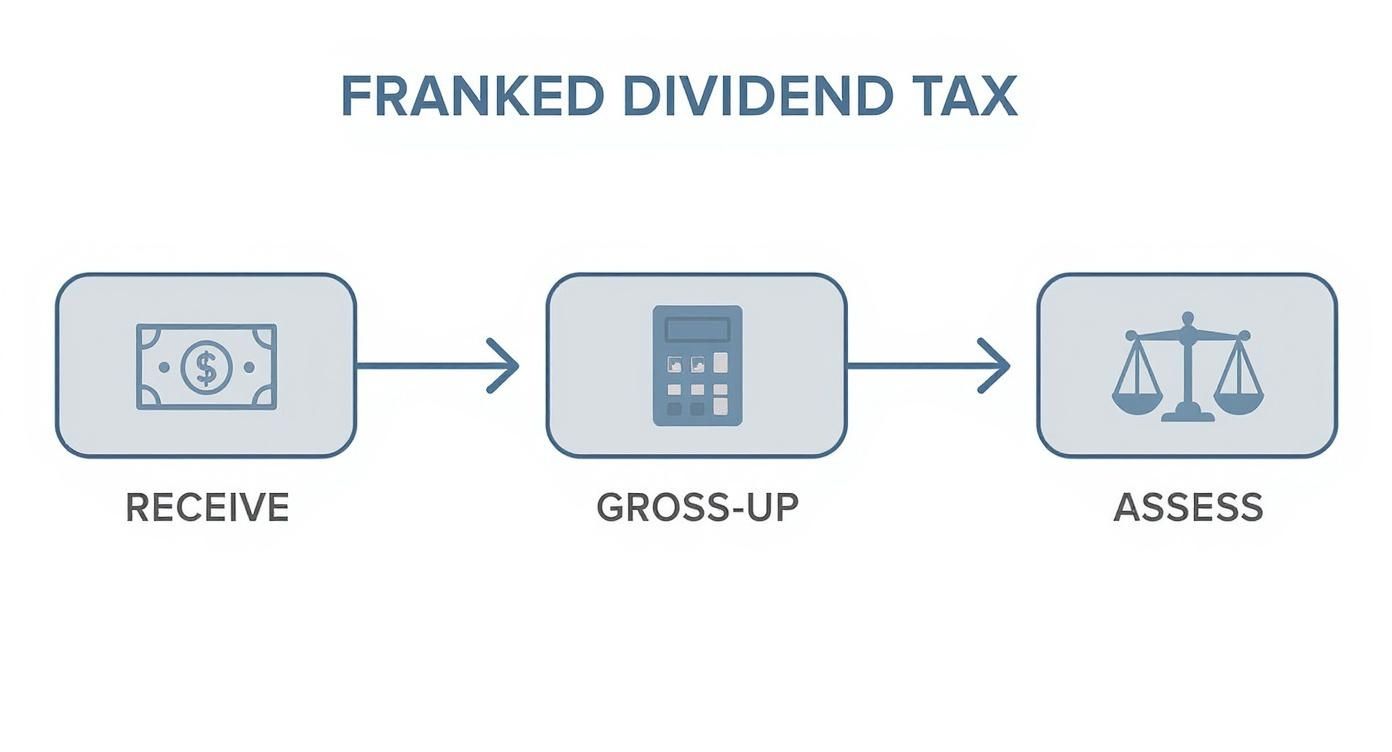
As shown, it is a three-step process: receive the cash dividend, "gross it up" with the franking credit, and then calculate the tax. This is the foundation. Now, let’s examine how this applies in other common investment structures.
Dividends Within a Self-Managed Super Fund (SMSF)
For many Australians, an SMSF is a key vehicle for building retirement savings. The taxation of dividends inside an SMSF depends on whether the fund is in the "accumulation" or "pension" phase.
- Accumulation Phase: While you are still working and contributing to your super, earnings within the fund, including grossed-up dividends, are taxed at a concessional rate of 15%. If your SMSF receives a fully franked dividend (with a 30% tax credit), this results in a 15% tax refund to the fund. This surplus can enhance the fund's growth over time.
- Pension Phase: Once you retire and begin drawing an income from your super, investment earnings become tax-free. This means the SMSF can claim the entire 30% franking credit back from the ATO as a cash refund, providing a significant boost to retirement income.
This dual-phase system highlights the importance of aligning your investment strategy with your life stage.
Dividends Held in a Discretionary Trust
A discretionary trust, often known as a family trust, offers considerable flexibility. The trust itself typically does not pay tax. Instead, it distributes income—and the associated tax liabilities—to its beneficiaries.
When a trust receives a franked dividend, it distributes the grossed-up amount to the beneficiaries. Each beneficiary then includes their share of this income in their personal tax return and claims the corresponding franking credits.
This allows for strategic planning, where income may be directed to a family member with a lower marginal tax rate, such as a university student or a non-working spouse. This could reduce the family's overall tax liability. It is crucial, however, that the trust is administered strictly in accordance with legal requirements to remain compliant. Depending on the goal, it may also be important to understand the differences between a discretionary trust and what is a bare trust, as their functions and obligations are distinct.
Dividends Received by a Private Company
The situation is different again when a private company holds the shares. A company includes the grossed-up dividend in its own taxable income. The franking credits it receives are then added to its franking account.
This allows the company to attach these credits to its own dividend payments to its shareholders in the future. This system ensures that tax credits are not lost and ultimately flow through to the individual investor, maintaining the integrity of the imputation system.
For companies, proper management of the franking account is a serious compliance obligation. The ATO has strict rules, and errors can lead to significant issues. Meticulous record-keeping is a legal requirement.
Guidance for Non-Resident Investors
The rules change for investors who are not Australian residents for tax purposes. In place of the imputation system, a withholding tax regime generally applies.
If an Australian company pays an unfranked dividend to a non-resident, it is required to withhold tax and remit it to the ATO. The rate is typically 30%, but may be lower if a double tax agreement exists between Australia and the investor’s country of residence.
Franked dividends are typically exempt from withholding tax, as Australian tax has already been paid on the underlying profit. However, it is important to note that non-residents cannot claim a refund for any franking credits. This is a critical detail for overseas investors and new migrants to consider in their Australian investment planning. Seeking personal advice is the most prudent way to navigate these international tax matters.
Reporting Dividend Income and Avoiding Common Mistakes
Understanding the imputation system is the first part; ensuring accurate reporting to the Australian Taxation Office (ATO) is the practical application. Diligent compliance is foundational to good financial management, and awareness of common errors can prevent future complications.
The process is generally straightforward. For each dividend payment, the company provides a dividend statement. This document is your primary record, detailing the cash paid, the franking credit, and the payment date. Your first responsibility is to maintain organised records of these statements.
The Role of ATO Pre-filling
To simplify tax reporting, the ATO uses data provided by companies to pre-fill dividend information in your myTax return. While helpful, it is important to remember that the legal responsibility for accuracy remains entirely with you.
You must cross-check every pre-filled figure against your dividend statements. Discrepancies can and do occur. Accepting the ATO’s figures without verification is a common and avoidable mistake. The pre-filling service should be treated as a guide, not a substitute for your own records.
Declaring Dividends on Your Tax Return
When lodging your tax return, you must declare the grossed-up dividend as income, not just the cash you received. This means adding the cash payment and the franking credit together. This total is entered in the dividends section of your return.
The franking credit amount is then declared separately as a tax offset. This two-step process ensures the ATO first calculates tax on your full, pre-tax income before applying the credit to reduce your final tax bill.
Good record-keeping is more than a compliance task; it is an act of financial stewardship. Clear, organised records enable informed decisions, effective planning, and the ability to address any ATO query with confidence.
This diligent approach is particularly important in the Australian market, where dividends form a significant part of total shareholder returns. Between 2012 and 2015, the total dividend pool grew steadily, as outlined in analysis available on the RBA's website.
Common Pitfalls to Avoid
Even seasoned investors can make mistakes. Awareness of these potential pitfalls is your best defence.
- Forgetting to Gross-Up: This is perhaps the most frequent error. Declaring only the cash dividend understates your assessable income and may lead to an amended assessment and penalties from the ATO.
- Misunderstanding Unfranked Dividends: An unfranked dividend has no franking credits. You must still declare the full cash amount as income, which will be taxed at your marginal rate without any offsetting credit.
- Ignoring Small Dividend Amounts: All dividend income must be declared, regardless of the amount. The ATO’s data-matching capabilities are highly advanced, and even small omissions can be identified.
- Incorrectly Claiming Credits: You cannot claim a franking credit as an offset unless you have also included that same amount in your grossed-up dividend income. The two components must be declared together.
Mastering these details is a fundamental part of a sound financial plan and helps you make smart investment tax strategies for Australian investors. Taking the time to report correctly is an investment in your financial peace of mind.
Your Dividend Tax Questions Answered
As you manage your portfolio, practical questions naturally arise. Here, we address some of the most common queries we encounter from investors to ensure these concepts are clear.
What Happens if My Marginal Tax Rate Is Lower Than the Company Rate?
This is an excellent question that goes to the heart of why the imputation system can be so effective, particularly for individuals on lower incomes or in retirement.
If your personal tax rate is less than the 30% company rate, the outcome is generally favourable. The franking credit you claim will be greater than the tax you owe on the dividend. The ATO refunds this excess amount to you in cash. This is a core feature of the system and a significant advantage for retirees and super funds in the pension phase.
Do I Need to Pay Tax on Unfranked Dividends?
Yes, you do. An unfranked dividend is a distribution from company profits on which no Australian company tax has been paid. Consequently, it carries no franking credits.
You must declare the full cash amount of the dividend as part of your assessable income. It will be added to your other income sources, such as salary or business income, and taxed at your marginal rate. Without a franking credit to offset the tax, the full tax liability on that income will apply.
How Does the ATO Know About My Dividend Income?
The ATO has comprehensive data. Australian companies are legally required to report all dividend payments they make to the ATO, linked to your Tax File Number (TFN). This information is used for the ATO's pre-filling service.
While pre-filling is a convenience, the final responsibility for a correct tax return rests with you. Always verify the pre-filled data against your own dividend statements before lodging. Consider it an essential part of your financial due diligence.
The ATO's data-matching systems are highly sophisticated. Treat the pre-filling service as a helpful prompt to review your records, not as a replacement for careful verification.
Can I Get Franking Credits From International Shares?
No, franking credits are a feature of the Australian tax system. They are only attached to dividends paid by Australian-resident companies that have paid Australian corporate tax.
Dividends from international shares are considered foreign-source income. You must still declare this income on your Australian tax return. To prevent double taxation, you may be able to claim a foreign income tax offset for any tax already paid in the foreign country. This is a separate mechanism from the dividend imputation system.
Navigating foreign investment income can be complex due to varying tax treaties. Seeking personal advice is a prudent course of action.
Takeaway: Australia's dividend imputation system is designed to tax company profits at your personal marginal rate. Understanding how to declare dividends and franking credits correctly is not just a compliance task, but a vital part of responsible financial management. Careful record-keeping and a clear grasp of the rules allow you to manage your obligations with confidence and clarity.
At Everglow Prosperity, we provide integrated guidance to help you navigate the complexities of investment taxation with clarity and confidence. Our team is here to ensure your financial structures align with your long-term goals. Contact us today to build your enduring prosperity.
Article created using Outrank
