

A bare trust is one of the simplest legal structures available, yet it serves a precise and valuable purpose. In essence, it is an arrangement where one person or entity (the trustee) holds the legal title to an asset, but does so entirely for the benefit of another (the beneficiary).
Think of the trustee as a custodian. They are a placeholder on official documents, with no independent power or active duties other than to act on the beneficiary's direct instructions. The beneficiary is, for all practical purposes, the true owner, controlling the asset and entitled to its benefits.
Understanding The Bare Trust in Simple Terms
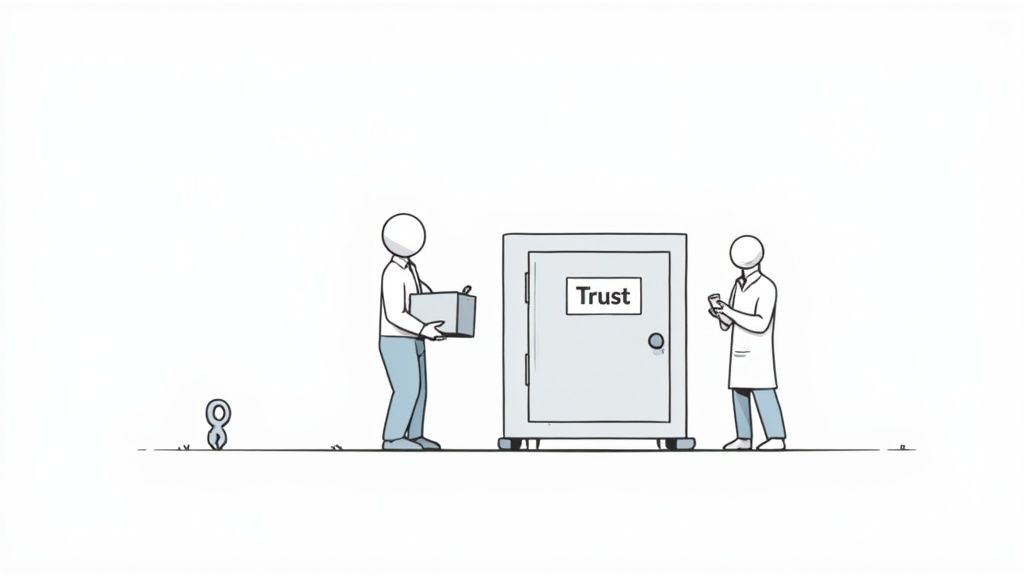
Trusts can often seem complex, wrapped in legal terminology. A bare trust, however, is refreshingly direct. It is a clean, straightforward way to manage ownership. Imagine you ask a trusted friend to hold a valuable item for you. They cannot use it, sell it, or do anything with it unless you explicitly tell them to. This is the fundamental principle of a bare trust.
The structure works by separating two forms of ownership: legal ownership and beneficial ownership.
The trustee holds the legal title. This means their name appears on official paperwork, such as a property deed or share certificate. However, their involvement typically ends there. They have no active duties to perform, no say in how the asset is managed, and no personal financial interest in it.
The beneficial owner, on the other hand, receives all the rights and responsibilities. They have an absolute right to any income the asset generates (like rent or dividends), they are responsible for paying tax on that income, and they can direct the trustee to transfer the asset into their own name at any time, provided they are of legal age and capacity.
The Trustee and The Beneficiary
The relationship between the trustee and beneficiary defines a bare trust. The critical difference compared to other trusts is the complete absence of discretion for the trustee. While a trustee in a family trust might actively manage investments or decide on distributions, a bare trustee is simply a nominee.
Here is a brief summary of their roles:
- The Trustee: Essentially a custodian. Their sole duty is to safeguard the asset and act precisely as the beneficiary instructs. Nothing more, nothing less.
- The Beneficiary: The true owner in practice. They direct all actions, from selling the asset to taking legal ownership themselves.
To understand this better, let's examine how these roles function in practice.
Key Roles In A Bare Trust Arrangement
The table below outlines the distinct responsibilities and powers of the trustee and the beneficiary. It is a simple relationship, but clarity is essential for it to operate correctly under Australian law.
| Role | Key Responsibilities | Decision-Making Power |
|---|---|---|
| Trustee | Holds legal title to the asset. Must protect the asset from loss or damage. Acts only on the direct instructions of the beneficiary. | None. The trustee has no independent power to sell, lease, or otherwise deal with the asset. They are a nominee. |
| Beneficiary | Entitled to all income and capital from the asset. Responsible for all tax liabilities arising from the asset. | Absolute. The beneficiary has complete control and can direct the trustee to take any action regarding the asset. |
Understanding this clear separation of duties is the first step toward using a bare trust effectively and compliantly. The trustee is passive; the beneficiary is active.
A bare trust is recognised in Australian law as the simplest form of trust, where the trustee holds legal title to property but has no active duties beyond transferring the property to the beneficiary on demand. This principle has been affirmed in Australian courts, confirming that trustees in these arrangements must act solely on the directions of the beneficiaries. For a deeper dive into the legal nuances, Dundas Lawyers offers a great explanation of what constitutes a bare trust.
This simple yet powerful setup is a foundational tool for certain financial and business strategies. Whether you are a business owner structuring an asset purchase, a professional managing investments, or a family planning for the future, understanding this structure is key. The most important step is ensuring the planning and documentation are correct from the outset.
When planning any financial structure, tax considerations are always a primary concern. The treatment of a bare trust in Australia is, fortunately, quite straightforward. The Australian Taxation Office (ATO) applies a 'look-through' approach, which is the key to understanding how these trusts operate practically.
The ATO essentially looks past the trustee—who is merely holding the legal title—and focuses directly on the beneficiary. Because the beneficiary has an absolute and immediate right to the asset and any income it produces, they are considered the true owner for tax purposes. This means the trust structure itself is effectively transparent to the ATO.
In practice, any income, such as rent from a property or dividends from shares, is reported on the beneficiary's personal tax return. If the asset is sold, any Capital Gains Tax (CGT) is also the beneficiary’s responsibility. The beneficiary is the one who may apply any CGT discounts or exemptions they are eligible for.
The Beneficiary's Tax Obligations
Under this look-through model, all tax reporting and payment obligations rest with the beneficiary. This is a critical point, whether you are a business owner using a bare trust to hold a commercial property or a grandparent holding shares for a child.
Here is a simple breakdown:
- Income Tax: All income generated by the asset must be declared on the beneficiary’s annual tax return.
- Capital Gains Tax (CGT): When the asset is eventually sold, the beneficiary calculates and pays the CGT. The cost base and the 12-month holding period for the CGT discount are also determined from their perspective.
- No Trust Tax Return: In most standard cases, a separate trust tax return is not required. This may reduce administrative complexity and accounting fees.
This approach is logical. The Australian Board of Taxation has confirmed this as the standard treatment for bare trusts, given the trustee's duties are so minimal. You can explore the details in the official government review of bare trusts for the full legislative background.
However, while this simplifies compliance, it is vital to maintain meticulous records proving the bare trust was established correctly from the beginning.
Stamp Duty Considerations
While the ATO's position on income tax is consistent nationally, stamp duty is governed by state and territory laws, and the rules can vary significantly. This is an area where seeking professional guidance is not just advisable—it is essential.
For instance, when a property held in a bare trust is eventually transferred from the trustee to the beneficiary, you may be able to claim a stamp duty exemption or concession.
However, this is almost always conditional. You will likely need to prove that the beneficiary provided all the funds for the original purchase and that your bare trust deed was properly documented from the outset. An error at this stage could lead to an unexpected and significant tax bill.
For anyone planning their financial future, understanding these details is crucial. It is wise to explore smart investment tax strategies for Australian investors to see how structures like bare trusts can fit into a broader, well-considered plan. Wise financial management involves understanding both the opportunities and the obligations.
Practical Ways Australians Use Bare Trusts

While the theory of a bare trust is simple, its value becomes apparent in real-world applications. Across Australia, families, investors, and business owners use this straightforward structure to address specific, practical challenges. It is not a universal solution, but in the right circumstances, it offers a clean and efficient path.
Most often, these arrangements are used to hold an asset for someone who cannot legally hold it themselves, to simplify future changes in ownership, or to manage assets with a degree of privacy. Let's explore a few common scenarios where a bare trust proves its worth.
Holding Assets for Minors
This is perhaps the most common—and relatable—use of a bare trust. Consider a grandparent who wishes to gift shares to a grandchild to help fund a future house deposit.
The challenge is that a minor cannot legally own assets like real estate or shares directly. This is where a trusted adult, usually a parent, can act as the trustee.
- How it Works: The parent holds the legal title to the shares as trustee, but the grandchild is absolutely entitled to them as the beneficiary.
- The Result: Once the grandchild turns 18, they can direct the trustee to transfer the legal ownership into their own name. Any dividends earned over the years are taxed in the child’s hands which, depending on their other income, could result in a better tax outcome.
It is a clean way to ensure the asset is securely managed for the child’s benefit, ready for when they are old enough to take control.
Streamlining Property Transactions for Privacy
In business and investing, there are times when privacy is preferred. A business owner or investor might not want their personal name on a public property title when purchasing a commercial building.
In this situation, a company can be established to act as a corporate trustee—a nominee owner—under a bare trust. The individual or their business entity remains the beneficiary, retaining all control and true ownership.
In effect, you separate the public-facing legal owner from the true beneficial owner. The company on the title is a placeholder; it has no independent power and must act on the directions of the beneficiary, who collects rent, manages the property, and is responsible for tax.
This strategy may also simplify bringing in new partners in the future. Instead of changing the property title (which can trigger stamp duty and other costs), it may be possible to adjust ownership at the beneficiary level. This requires careful structuring and expert advice, as it forms part of building robust asset protection strategies.
Assisting New Migrants or Overseas Investors
For people new to Australia or investing from overseas, navigating the property market can be daunting. A bare trust can act as a stable bridge, allowing a trusted local resident—such as a family member or adviser—to hold a property on their behalf while they finalise residency or organise their affairs.
Imagine a skilled professional migrating to Australia who wants to secure a family home before they arrive. A trusted relative already here could act as the trustee, using funds provided by the migrant to purchase the property.
The bare trust deed makes it unequivocally clear that the relative is merely a custodian. This ensures that once the migrant is settled in Australia, the legal title can be transferred to them—often with stamp duty concessions, depending on the state and the timing of the arrangement. This can provide significant peace of mind during a major life transition.
Using a Bare Trust for SMSF Property Investment

This is a specialised and highly regulated use of a bare trust. When a Self-Managed Super Fund (SMSF) borrows to buy an investment property, it must use a specific structure known as a Limited Recourse Borrowing Arrangement (LRBA). At the heart of this arrangement is a bare trust.
The bare trust acts as a legal safe-deposit box. It holds the legal title to the property on behalf of the SMSF while the loan is being repaid. This is not optional; it is a mandatory requirement from lenders and the ATO.
The purpose is to create a firewall. If the loan defaults, the lender's recourse is limited only to the property held within that bare trust. Your other superannuation assets remain protected. This design allows SMSFs to use leverage for property investment while strictly quarantining the associated risk.
The Single Acquirable Asset Rule
The ATO is exceptionally strict about what can be held in this structure. The foremost rule is the ‘single acquirable asset’ rule. This means the bare trust can hold one—and only one—distinct asset. For example, you cannot buy two separate apartments on different titles and hold them in the same LRBA.
There is some nuance. A factory building and the land it occupies, sold under a single contract, are generally considered a single asset. The key is that it must be one identifiable thing. If you wish to make improvements later, that funding must come from the SMSF's existing cash, not from the original loan.
This compliance point is absolute. A bare trust in an SMSF arrangement is created to hold a single acquirable asset on behalf of the fund until the related loan is paid off. This structure must also have a separate corporate trustee distinct from the SMSF trustee, and the trust deed must be in place before any property contracts are signed. These steps are crucial to meet both legal and lender requirements.
This disciplined approach is what keeps the arrangement compliant and protects the fund's integrity.
The Corporate Trustee Requirement
Another non-negotiable requirement is the separation of trustees. For an LRBA to be compliant, the bare trust must have its own trustee, which is almost always a new, special-purpose company, often called a 'custodian' or 'nominee'.
This separation of duties is vital for legal clarity and asset protection. It creates a clean structure:
- SMSF Trustee: Manages the entire super fund, makes investment decisions, and is the ultimate beneficiary of the bare trust.
- Bare Trust Corporate Trustee: Has one job only—to hold the legal title to the property. It has no other assets or duties and acts solely on the directions of the SMSF trustee.
This clean separation helps prevent legal complications and gives lenders the confidence required to approve the loan. Establishing these structures correctly from the start is a core part of managing your investment property effectively.
Why Specialist Advice Is Essential
Setting up an LRBA is not a DIY task. The rules set by the ATO and ASIC are complex. A single misstep—such as signing the property contract before the trust is formally established—can have serious consequences, potentially making your entire SMSF non-compliant.
Before borrowing within your superannuation, seeking advice from financial advisers and lawyers who specialise in SMSFs is critical. They will ensure the Bare Trust Deed is drafted correctly, the trustee structure is sound, and every step is executed in the proper sequence. In the world of superannuation, a careful, measured approach is the only way to operate.
Choosing the right structure for your assets is a foundational decision in good financial stewardship. While a bare trust offers elegant simplicity, its passive nature means it is not the right tool for every purpose.
To understand where a bare trust fits, it helps to compare it with two other common structures in Australia: the discretionary trust (often called a family trust) and the unit trust.
The key difference comes down to one word: discretion. A bare trust has none. A discretionary trust, by contrast, is built entirely around it. This single distinction affects everything from asset protection to tax planning.
Bare Trust Versus Discretionary (Family) Trust
A discretionary trust gives the trustee broad power to decide which beneficiaries receive income or capital from the trust—and in what proportion—each financial year. This flexibility is its greatest strength.
Consider a family-owned business. For tax planning, this structure can be highly effective. The trustee can assess the personal income levels of various family members (the beneficiaries) and distribute profits in a way that may minimise the overall tax paid by the family. This is an active management role that a bare trustee cannot perform.
A bare trustee’s only job is to follow the beneficiary's instructions. A discretionary trustee has a much bigger responsibility: to act in the best interests of all potential beneficiaries, using their discretion wisely and in line with the trust deed.
This active role also adds a valuable layer of asset protection. Because no single beneficiary has a fixed, guaranteed entitlement to the trust's assets, those assets may be shielded from creditors if one beneficiary encounters financial difficulty. In a bare trust, the asset belongs absolutely to the beneficiary, leaving it fully exposed.
Bare Trust Versus Unit Trust
A unit trust functions more like a company with shareholders. The trust's assets are divided into "units," and the beneficiaries (known as unitholders) own a fixed number of these units. Their entitlement to the trust’s income and capital is directly proportional to their unitholding.
This structure is often used when unrelated parties invest in an asset together, such as a commercial property. It makes each person's stake clear and fixed.
- Fixed Entitlement: If you own 25% of the units, you are entitled to 25% of the net income and capital.
- Commercial Clarity: It provides certainty for business partners or co-investors because entitlements are not subject to a trustee's discretion.
Unlike a bare trust with its single, absolute owner, a unit trust is designed to formally manage multiple owners with clearly defined shares. It is a commercial structure built for joint ventures, whereas a bare trust is a simple holding arrangement.
For families seeking more dynamic ways to manage wealth, it is worth learning how to set up a family trust in Australia.
To put it all into perspective, here is a high-level comparison.
Bare Trust vs Discretionary Trust vs Unit Trust
This table outlines the core differences, helping you see at a glance which structure might align with your goals.
| Feature | Bare Trust | Discretionary (Family) Trust | Unit Trust |
|---|---|---|---|
| Control | Beneficiary has absolute control. | Trustee has full discretion over distributions. | Unitholders have rights based on their unit holdings. |
| Beneficiary Rights | Fixed and absolute entitlement to the asset. | No fixed entitlement; rights depend on trustee’s decision. | Fixed entitlement proportional to units held. |
| Tax Treatment | Taxed in the hands of the beneficiary (look-through). | Taxed in the hands of beneficiaries who receive distributions. | Taxed in the hands of unitholders based on their entitlement. |
| Best For | Holding a single asset for a single, known beneficiary. | Family businesses, tax planning, and asset protection. | Joint ventures and investments with unrelated parties. |
Understanding these fundamental differences is the first step toward choosing a structure that not only meets your immediate needs but also supports your long-term vision. Each has its purpose, and the wisest choice comes from a clear understanding of the road ahead.
Establishing Your Bare Trust the Right Way
While the concept of a bare trust is simple, its establishment requires a disciplined and careful approach. An informal agreement or poorly documented arrangement can negate the benefits, creating legal and tax complications in the future.
Setting up your trust correctly is about building a legally sound structure that will withstand scrutiny from the ATO, state revenue offices, and lenders.
The cornerstone of any valid bare trust is the Bare Trust Deed. This is the definitive proof of the arrangement. It must be drafted with precision, clearly identifying the trustee, the beneficiary, and the specific asset being held.
Critically, the deed must be signed and dated before the asset is acquired. If you are buying property, this means the deed must be executed before you sign the contract of sale. This timing is non-negotiable, as it provides evidence that the trustee was acting in that capacity from the very beginning.
Key Steps for a Sound Foundation
Creating a bare trust is a methodical process. Each step must be completed correctly and in the right order to ensure the structure is legally robust.
- Seek Professional Guidance: Before taking any action, speak with your solicitor and tax adviser. They can confirm if a bare trust is the right fit for your circumstances and highlight potential issues.
- Draft the Bare Trust Deed: Have a solicitor prepare a clear, comprehensive deed. It must explicitly state that the trustee has no active duties and is required to act solely on the beneficiary's instructions.
- Execute the Deed: Both the trustee and the beneficiary must sign and date the deed. This must happen before any contract to acquire the asset is signed.
- Acquire the Asset: With the deed in place, the trustee can now acquire the asset, with their name on the legal title. It is vital that all funds for the purchase come from the beneficiary, and you must keep clear records to prove this.
Common Pitfalls to Avoid
Even with a straightforward structure, errors can occur. A little foresight can prevent future difficulties. Be mindful of these common mistakes:
- Poor or Delayed Documentation: A verbal agreement or a deed signed after the purchase is unlikely to be accepted by a state revenue office, which could trigger a full stamp duty assessment and other penalties.
- The Trustee Oversteps Their Role: If a trustee makes independent decisions about the asset—such as renovating it without instruction—the arrangement may no longer be considered a bare trust, which can have serious tax consequences.
- Mixing Funds: The beneficiary must provide all the funds for the purchase. If the trustee contributes their own money, it can compromise the ownership structure and potentially invalidate the trust.
A well-structured bare trust offers clarity and simplicity, which becomes apparent when compared to other trust types. The infographic below outlines the fundamental differences between bare, discretionary, and unit trusts.
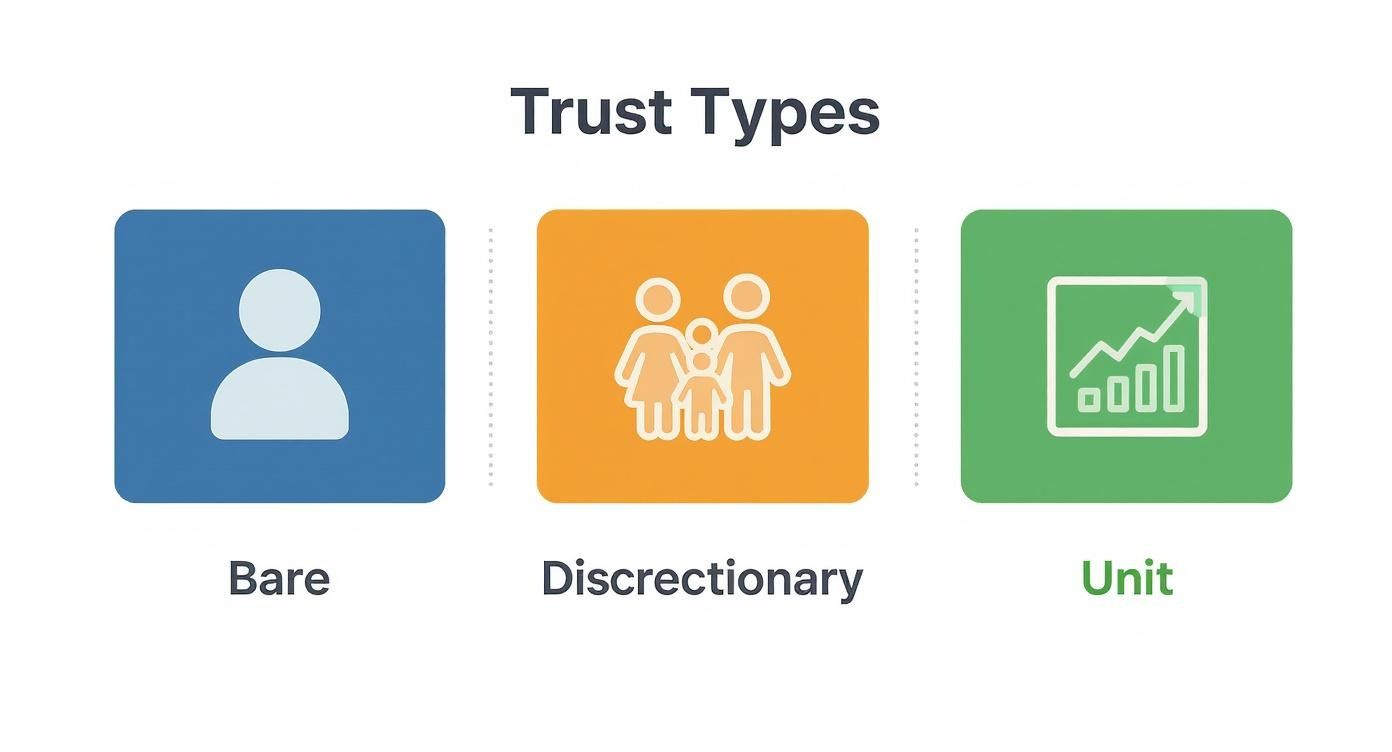
As you can see, the bare trust is defined by its direct, one-to-one relationship. It is quite different from the flexibility of a discretionary trust or the commercial focus of a unit trust. Whether you use this structure for property or other assets, ensuring your financing is appropriate is also key. A strategic loan review can help align your lending with your ownership structure.
Your Top Bare Trust Questions, Answered
Theory is one thing, but practical questions are what matter most when dealing with trusts. Let's address some of the most common queries about using bare trusts in Australia.
Does a Bare Trust Need to Lodge a Tax Return?
Generally, no. A bare trust is often described as 'transparent' for tax purposes because the ATO looks straight through the trust to the beneficiary.
This means all income and any capital gains are declared on the beneficiary's personal tax return. This simplifies compliance. However, simplicity should not be mistaken for a lack of diligence—you still need robust records to prove the trust's existence and track all transactions. Depending on your circumstances, you should seek personal tax advice to ensure you are meeting your obligations.
Can I Be Both the Trustee and the Beneficiary?
No. A core principle of trust law in Australia is the separation of legal ownership (the trustee) from beneficial ownership (the beneficiary). If you are the sole trustee and the sole beneficiary, a trust does not exist—you simply own the asset outright.
For a trust to be legally valid, these two roles must be held by different people or entities. While a trustee might also be one of several beneficiaries in more complex trust structures, a one-to-one relationship where the same person holds both titles is not a valid trust.
What Happens When the Beneficiary Wants the Asset?
This is where the simplicity of a bare trust is most evident. The trustee's primary duty is to follow the beneficiary's lawful instructions regarding the asset.
When the beneficiary (assuming they are an adult and legally capable) requests that the asset be transferred into their name, the trustee is legally obligated to do so. This action effectively concludes the trust for that particular asset. Be mindful of stamp duty; while concessions often apply in these situations, it is crucial that the trust was set up and documented correctly from the beginning to avoid any unexpected liabilities.
At Everglow Prosperity, we provide the steady guidance needed to build enduring financial structures. From initial setup to long-term strategy, we partner with you to ensure your decisions today support your prosperity for years to come. Connect with our team for integrated advice you can trust.
Article created using Outrank
General Advice Warning: The information in this article is general in nature and does not take into account your objectives, financial situation or needs. Before acting on it, consider whether it is appropriate for you and seek personal advice. Tax and superannuation rules can change. Financial advice is provided by Everglow Wealth Pty Ltd, a Corporate Authorised Representative (No. 1254987) of PGW Financial Services Pty Ltd (AFSL 384713). Tax advice is provided by Everglow Accounting Pty Ltd.
Want help applying this to your situation?
Every situation is different. Book a time with our team to talk it through, or call us on 1300 913 929.
Book a free first meetingOur audit and assurance services →Estimate your fees →
Keep exploring