
A cash flow forecast template is more than a spreadsheet; it is a tool for looking ahead, helping you anticipate the movement of money in and out of your finances over a specific period. It may be thought of as a financial roadmap, offering a structured, forward-looking view to plan for future commitments and opportunities with greater clarity.
Building the Foundation for Financial Clarity
A common point of confusion for many business owners is the difference between profit and cash flow. This is a critical distinction. While profit is an accounting measure of what remains after subtracting expenses from revenue, cash flow is the tangible money available to meet your obligations.
It is possible for a business to appear profitable on paper yet face a liquidity challenge if cash from sales has not yet been received into its bank account.
Understanding this difference is a foundational step toward sound financial stewardship. Before considering templates, it may be useful to solidify your understanding of the core concept of Cash Flow. This forward-looking perspective can be essential for navigating Australia’s financial environment.
The Purpose of a Forecast
A well-structured forecast may serve several practical purposes for Australian professionals and organisations. It is not intended as a static record-keeping exercise, but as a dynamic guide for making considered decisions.
Its value may be demonstrated in several areas:
- Meeting Compliance Obligations: A forecast can help ensure you have sufficient funds set aside for ATO obligations, such as Business Activity Statements (BAS) and employee superannuation contributions, which may help in avoiding penalties.
- Satisfying Lender Criteria: When applying for business or property finance, Australian lenders will often request detailed cash flow projections to assess your capacity to service the loan. A considered forecast demonstrates diligent preparation.
- Informing Strategic Planning: It may provide the foresight to decide on appropriate timing for significant decisions, such as hiring new staff, purchasing major equipment, or expanding operations.
A disciplined approach to forecasting may transform financial management from a reactive exercise into a proactive strategy. It can provide the quiet confidence needed to navigate both calm and turbulent economic seasons.
For a small business owner in Sydney, this might mean planning for seasonal dips in revenue. For a not-for-profit in Melbourne, it could involve aligning major expenditures with grant funding schedules.
A robust template can help you identify potential shortfalls in advance, providing time to make considered adjustments. When planning cash outflows, it may also be an opportunity to identify potential savings. We cover related concepts in our guide on small business tax deductions.
Ultimately, a cash flow forecast can be an indispensable tool for building financial resilience and making informed, patient decisions for the long term.
Key Components of a Cash Flow Forecast
To build an effective forecast, it is helpful to understand its core components. Each element contributes to your financial story, and their careful consideration is crucial for creating a reliable picture of what may lie ahead.
This table breaks down the essential elements that form a comprehensive cash flow forecast.
| Component | Description | Australian Example |
|---|---|---|
| Cash Inflows | All sources of cash anticipated to come into the business or personal accounts. | A Melbourne café’s daily sales, a quarterly BAS refund from the ATO, or rental income from an investment property. |
| Cash Outflows | All payments and expenses expected to be made. This includes both fixed and variable costs. | A tradesperson’s supplier invoices, monthly rent for a Sydney office, employee wages, and superannuation contributions. |
| Opening Balance | The amount of cash available at the beginning of the forecast period. | The balance of your primary business bank account on the 1st of July. |
| Net Cash Flow | The difference between total cash inflows and total cash outflows for a specific period (e.g., a month). | If inflows are $20,000 and outflows are $15,000, the net cash flow is +$5,000. |
| Closing Balance | The cash position at the end of the period, calculated by adding the net cash flow to the opening balance. | An opening balance of $10,000 plus a net cash flow of $5,000 results in a closing balance of $15,000. |
By methodically mapping out these components, you may move from estimation to a clearer, data-driven view of your financial trajectory. This clarity can allow you to make decisions with greater confidence.
Constructing Your Cash Flow Forecast
Building a cash flow forecast is a methodical process that does not need to be overly complicated. For many Australian business owners and professionals, a simple spreadsheet can be an effective starting point. It offers the flexibility to create something that reflects your unique circumstances without being constrained by unnecessary features.
The objective is to create a clear, logical map of how money may move through your accounts over a set period. This is less about high-level accounting and more about building a practical tool for looking ahead and making sounder decisions.
This simple flow illustrates how mapping what comes in and what goes out can bring genuine financial clarity.
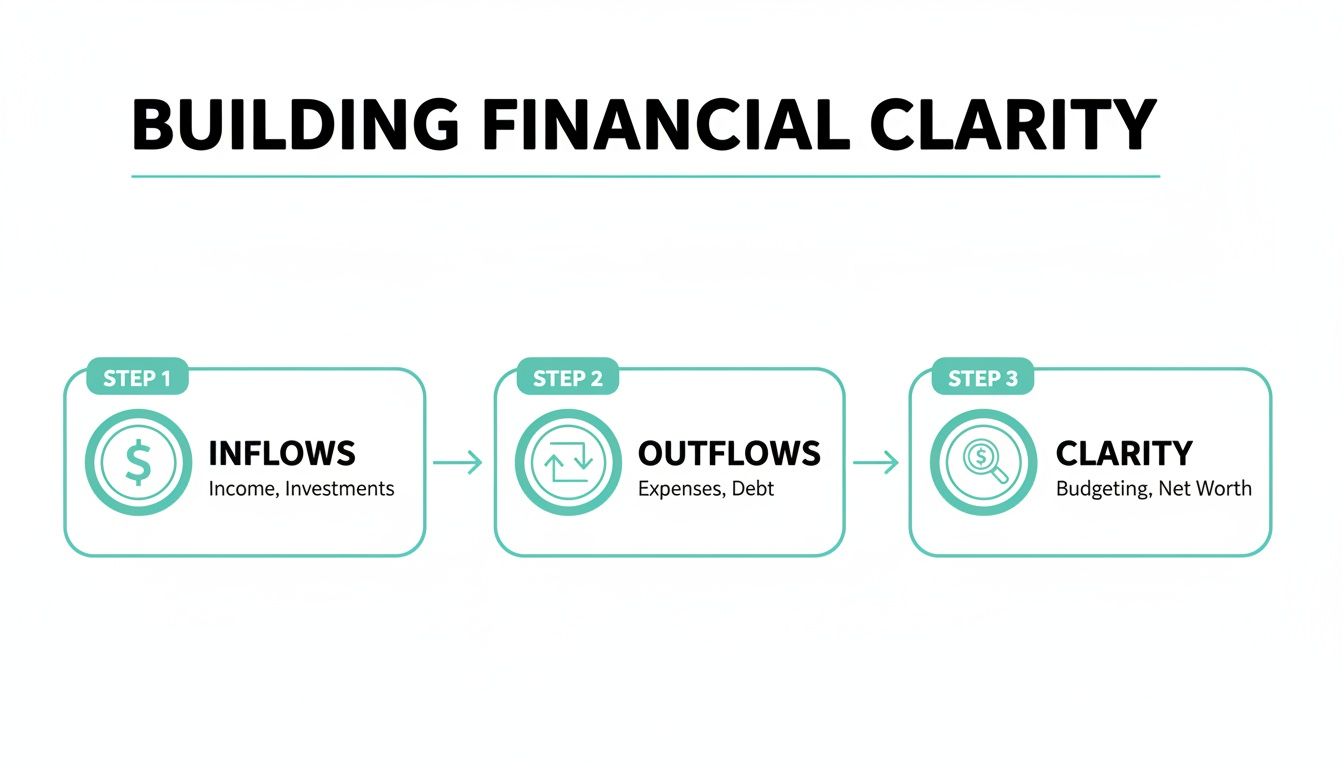
The visual reinforces a fundamental point: clarity is seldom achieved by looking at only one side of the ledger. A deeper understanding comes from seeing the relationship between the money arriving and the money leaving.
Setting Up Your Template Structure
First, it is helpful to define the structure of your forecast. This involves setting the timeframes you wish to measure and creating clear categories for every cash movement. A well-organised template may be easier to update and, more importantly, to understand at a glance.
Your structure could be built on three core elements:
- Time Periods: Decide on the frequency of your forecast. A 12-month forecast broken down month-by-month is a common and practical approach. However, if your cash flow is variable, a weekly forecast for the first 1-3 months could provide the granular detail needed for day-to-day management.
- Cash Inflows: This section would list every anticipated source of cash expected to reach your bank account.
- Cash Outflows: A parallel section would itemise all the cash payments you expect to make.
Separating inflows from outflows creates a clean visual of your financial rhythm, making it easier to spot trends, pressure points, and opportunities.
Detailing Your Cash Inflows
An accurate forecast depends on realistic cash inflow projections. This process benefits from an honest assessment of historical data and a solid grasp of your operating environment. It may be prudent to adopt a conservative approach rather than using overly optimistic sales figures, as this often results in a more useful tool.
Consider including these common sources of cash:
- Sales Revenue: Project your sales based on past performance, seasonal trends, and confirmed work. A medical professional, for example, might forecast patient fees based on their appointment book.
- Debtor Payments: Review your accounts receivable. It is important to forecast when you expect to receive the cash, not just when the invoice is due. If a key client consistently pays 30 days late, your forecast should reflect that reality.
- Government Grants or Rebates: If you are a not-for-profit expecting grant funding or a business awaiting an R&D tax incentive refund from the ATO, these amounts should be placed in the month you genuinely expect the funds to arrive.
- Asset Sales or Loans: Remember to include any one-off cash injections, such as proceeds from selling a company vehicle or funds from a new business loan.
Itemising Your Cash Outflows
Similar to your inflows, your cash outflows should be detailed and grounded in reality. This side of the ledger is often easier to forecast, as many expenses may be fixed or predictable. It can be helpful to review your bank statements from the last few months to ensure no small, recurring payments are missed.
Your outflow categories will likely include items such as:
- Supplier Payments: Map out what you owe suppliers based on their payment terms. If you have 30-day terms, the cash outflow occurs in the month after you receive the invoice.
- Operating Expenses: This category holds your fixed costs, such as rent, utilities, and insurance premiums.
- Salaries and Superannuation: These are regular, predictable payments. Remember to factor in the quarterly superannuation guarantee payment deadlines set by the ATO.
- BAS Payments: Your Business Activity Statement obligations are a critical outflow to plan for. A good forecast can help ensure you have the funds set aside in advance, avoiding surprises.
- Loan Repayments: Be sure to include both the principal and interest components for any business loans.
Developing a firm handle on these movements is a cornerstone of responsible financial management. Our discussion on small business cash flow management explores these ideas in more depth.
Calculating Your Cash Position
Once you have listed all your inflows and outflows, the final step is to calculate your net cash flow and closing balance for each period. This is where your financial trajectory begins to take shape.
The calculation is straightforward: Opening Balance + Total Inflows – Total Outflows = Closing Balance. The closing balance of one month becomes the opening balance for the next.
This simple formula is the engine of your forecast. It translates your detailed lists into a clear, forward-looking view of your bank balance. A consistently positive net cash flow may signal a healthy position. A negative figure, on the other hand, can provide an early warning, allowing you to make thoughtful adjustments instead of being forced into reactive decisions.
If you would like clarity on how these principles may apply to your own circumstances, you may wish to speak with a qualified adviser. You can contact Everglow on 1300 913 929 or email contact@everglow.au to arrange a discussion.
General Advice Warning: The information provided in this article is general in nature and does not take into account your personal objectives, financial situation, or needs. Before acting on any information, you should consider the appropriateness of the information having regard to your own objectives, financial situation, and needs and seek personal advice from a qualified financial adviser.
Customising Your Forecast for Real-World Scenarios
A generic cash flow forecast template is a useful starting point, but its real power may be unlocked when it is shaped to the unique rhythm of your operations. A standard spreadsheet cannot easily grasp the nuances of Medicare billing cycles or the seasonal peaks of a retail business. True financial foresight often comes from adapting the tool to your specific world, turning it from a simple document into a dynamic guide for decision-making.
This is where planning meets reality. By tailoring your forecast, you can create a more accurate and reliable picture of your financial future—one that speaks directly to the challenges and opportunities you face. It allows you to model real-world events and see their potential impact on your cash position before they happen.
For the Medical Professional
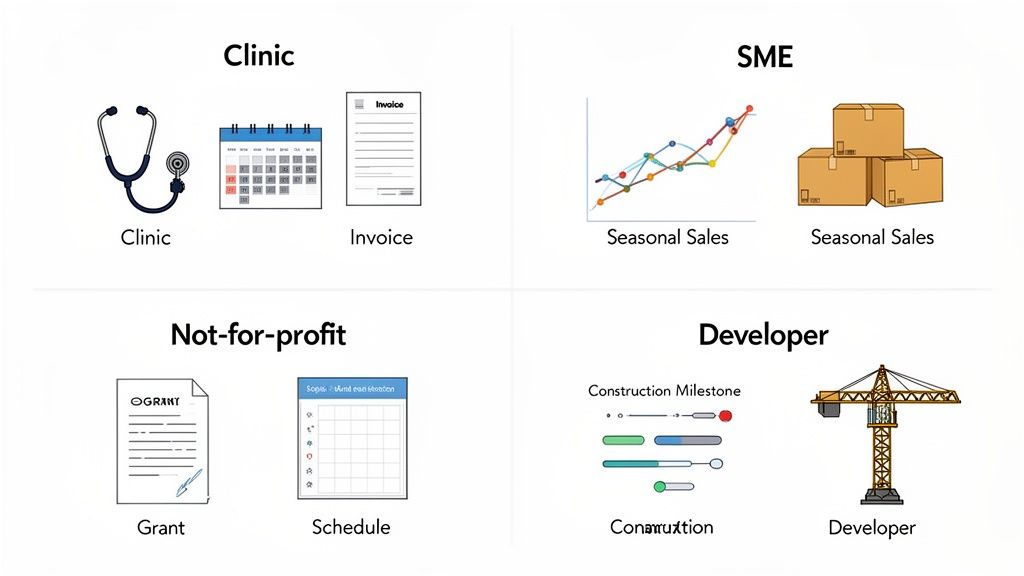
A medical practitioner's cash flow can be more complex than that of a standard business. Income is often a mix of direct patient payments, Medicare bulk-billing rebates, and payments from private health insurers. Each of these streams may operate on a different schedule, a complexity a generic forecast might miss.
To build a more useful forecast, a specialist or GP could consider these specifics:
- Separate Inflow Streams: Instead of a single line for "Revenue," create distinct lines for "Patient Gap Payments," "MBS Rebates," and "Private Health Fund Payments."
- Model Payment Lags: Patient payments may be immediate, but MBS rebates from Services Australia can take several days. Insurer payments might follow a 30-day cycle. Your forecast should reflect these real-world timings to be accurate.
- Account for PSI Rules: If you operate as a sole trader or through a company, understanding how Personal Services Income (PSI) rules may affect tax planning is important. A forecast can help you set aside an appropriate amount for PAYG instalments, ensuring no surprises from the ATO.
This level of detail can provide a clearer view of your liquidity, helping you manage practice expenses and plan for new equipment with greater confidence.
For the Small to Medium Enterprise (SME)
An SME owner, such as one running a Brisbane retail store or a Perth construction firm, may face a different set of variables. Their world is often shaped by seasonal demand, inventory management, and supplier credit terms. A customised cash flow forecast can become an essential tool for navigating these peaks and troughs.
Consider a retail business preparing for the Christmas period. Their forecast would benefit from specific adjustments:
- Model Seasonal Sales Spikes: Sales in November and December might be significantly higher than in February. The forecast should reflect this surge in cash inflows.
- Factor in Inventory Outlays: To meet that demand, significant cash may be spent on stock in September and October. This large outflow, occurring before the sales revenue arrives, is a classic cash flow pressure point a forecast helps you prepare for.
- Track GST Obligations: Higher sales mean a larger GST liability. A tailored forecast will map out the increased BAS payment due to the ATO in the following quarter. You can find more details in our guide explaining how GST works in Australia.
By modelling these realities, the business owner may spot a potential cash shortfall in October and arrange a short-term overdraft or negotiate different payment terms with suppliers in advance.
For the Not-for-Profit Organisation
Not-for-profit (NFP) entities operate in a unique financial environment, often relying on grant funding, donations, and membership fees. Their cash flow is frequently tied to funding cycles and acquittal reporting, which require meticulous planning.
A customised forecast for an NFP could include:
- Grant Funding Schedules: Instead of "Sales," the inflow section might have lines like "Grant A Payment 1" or "Grant B Final Payment," mapped to the exact month you expect the funds from government bodies or foundations.
- Project-Specific Outflows: Expenses could be tagged to specific funded projects. This helps ensure spending aligns with grant conditions and may simplify the acquittal reporting process required by funders.
- Compliance Costs: Outflows should also account for specific NFP compliance costs, such as annual audit fees required to meet ACNC (Australian Charities and Not-for-profits Commission) requirements.
For an NFP, a well-structured forecast is more than a financial tool; it can be an instrument of accountability, demonstrating responsible stewardship of funds to stakeholders and regulators.
For the Property Developer
Property development is a project-based world with a long and complex cash flow cycle. A generic monthly forecast may be of limited use. The financial model is often tailored to the specific milestones of a project, from land acquisition to final settlement.
Key customisations for a developer may include:
- Project-Based Timelines: The forecast might span 2-3 years, broken down by project phases rather than just months (e.g., Acquisition, DA Approval, Construction, Settlement).
- Milestone-Based Inflows: Cash often arrives in large lump sums, such as construction loan drawdowns tied to completion stages and, finally, the settlements from purchasers.
- Detailed Cost-to-Complete Outflows: Outflows would likely be detailed, covering everything from council fees and consultant invoices to construction progress payments and finance costs.
This tailored approach allows the developer—and their lenders—to track project viability and manage the large cash outlays required during the construction phase. It can be a critical tool for managing project risk.
If you would like clarity on how these principles may apply to your own circumstances, you may wish to speak with a qualified adviser. You can contact Everglow on 1300 913 929 or email contact@everglow.au to arrange a discussion.
General Advice Warning: The information provided in this article is general in nature and does not take into account your personal objectives, financial situation, or needs. Before acting on any information, you should consider the appropriateness of the information having regard to your own objectives, financial situation, and needs and seek personal advice from a qualified financial adviser.
Turning Your Forecast Into a Strategic Tool
Completing your cash flow forecast template is not the end point; it is the beginning. Its real power lies not just in seeing the numbers, but in using them to inform strategic conversations about your business's direction. This is where the forecast becomes a dynamic tool, helping you navigate challenges and pursue opportunities with confidence.
Once the data is compiled, the real work begins. The discipline is in using this foresight to ask "what if" questions. It represents a shift from reacting to past events to proactively shaping what may come next.
Run Scenarios: Prepare for Different Possibilities
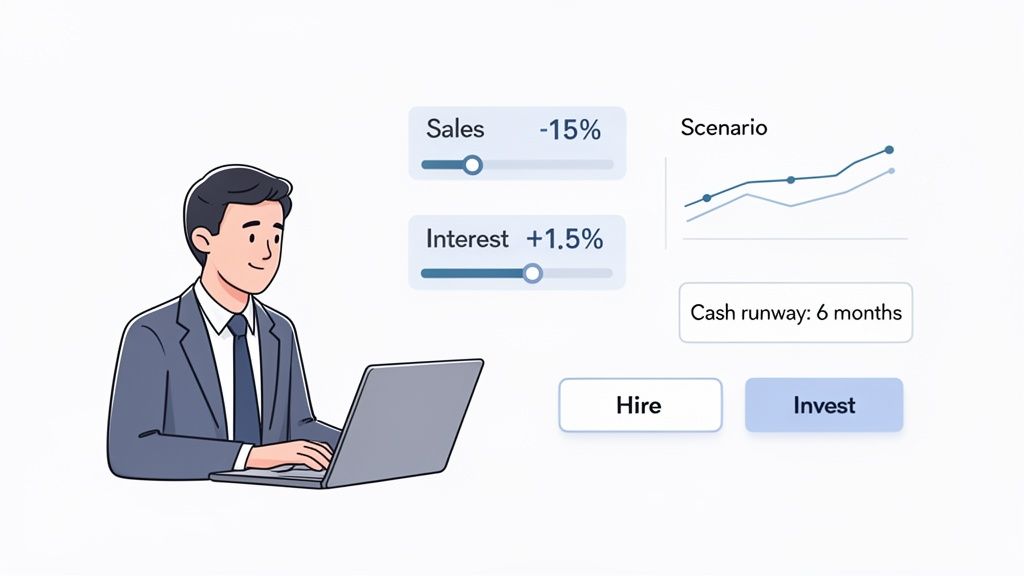
Strategic forecasting involves exploring different potential outcomes. Scenario planning allows you to create different versions of your forecast based on what the future might hold, both positive and negative. It can be thought of as a financial stress test for your plans.
Here are a few practical Australian examples:
- A dip in sales: What happens if a major client pays 60 days late, or your sales drop by 15% for a quarter? Modelling this scenario will show you when a cash shortfall might occur, giving you valuable time to consider your options.
- A rate hike: If you have a variable-rate business loan and the Reserve Bank of Australia lifts rates by 0.5%, what is the potential effect on your monthly repayments and overall cash position in six months?
- Supplier price changes: How would a sudden 10% increase in the cost of key materials impact your cash reserves over the next financial year?
By plugging these hypotheticals into your template, you can quantify the potential impact. This allows you to build a calm, measured response long before a situation may become a crisis.
Your forecast is a safe space to test the impact of big decisions and external shocks without risking real capital. This practice builds both financial discipline and foresight.
Inform Your Biggest Business Decisions
Your forecast can provide the data needed to make significant strategic moves. Instead of relying on intuition alone, you can model the potential cash flow impact of a major decision, which is essential for building a sustainable business.
A solid forecast can help you pinpoint an appropriate moment to:
- Bring on new staff: You can model the real cost of a new hire—not just the salary, but superannuation, payroll tax, and onboarding costs—to see how it affects your cash runway. It helps ensure you are hiring from a position of strength.
- Invest in new equipment: If you are considering a major capital purchase, your forecast can show you whether you can afford to pay for it outright or if financing is a more suitable move. It is also a key document lenders may want to see to assess your ability to make repayments. We cover this in more detail in our guide to business loan requirements in Australia.
- Expand your premises: Before signing a new lease, you can map out the increased rent, fit-out costs, and other expenses. This gives you a clearer picture of the long-term impact on your liquidity.
Set and Track Key Performance Indicators
Finally, your forecast is an excellent tool for setting and tracking financial Key Performance Indicators (KPIs) that reflect the health of your business. These metrics can serve as a quick, at-a-glance dashboard.
One of the most critical KPIs for any business is its cash runway. This indicates how many months your business could operate if revenue were to cease. It is a fundamental measure of financial resilience.
By tracking your cash runway and other key metrics within your forecast template, you can create a powerful feedback loop. You can see how your decisions may directly impact your financial stability over time, connecting smart planning to long-term success.
If you would like clarity on how these principles may apply to your own circumstances, you may wish to speak with a qualified adviser. You can contact Everglow on 1300 913 929 or email contact@everglow.au to arrange a discussion.
General Advice Warning: The information provided in this article is general in nature and does not take into account your personal objectives, financial situation, or needs. Before acting on any information, you should consider the appropriateness of the information having regard to your own objectives, financial situation, and needs and seek personal advice from a qualified financial adviser.
Risks and Responsibilities
A cash flow forecast can be a powerful tool for looking ahead, but its usefulness depends on the assumptions it is built upon. Its integrity relies on a degree of realism.
While it is an internal guide, its accuracy can have real-world consequences, particularly in Australia where company directors have specific legal duties. A forecast built with discipline and prudence is an asset; one based on wishful thinking could become a liability.
Navigating Common Pitfalls
Even with the best intentions, it is possible for inaccuracies to affect a forecast. One of the most common issues is overly optimistic sales projections. It is often more prudent to base revenue forecasts on historical data and confirmed work, rather than ambitious targets.
Another frequent oversight is forgetting large, one-off expenses that do not occur monthly. These can impact cash reserves if not planned for. Examples include:
- Annual insurance premium payments.
- Quarterly superannuation and BAS obligations to the ATO.
- Yearly professional registration or software subscription renewals.
- Setting aside funds for equipment replacement or repairs.
Forgetting these lump-sum outflows can create a misleading picture of your liquidity, potentially leading to an unexpected cash shortfall.
A forecast is only as reliable as its most conservative assumption. When you ground your projections in tangible evidence and account for known future obligations, you build a tool that fosters resilience.
Upholding Your Compliance Obligations
While you build your cash flow forecast for internal strategic planning, it has a direct link to your compliance responsibilities. Under Australian law, company directors have a duty to prevent insolvent trading. An accurate, regularly updated forecast is a key tool for monitoring your company’s solvency, as defined by ASIC. It can provide evidence that you are proactively managing your ability to pay your debts as and when they fall due.
Furthermore, the data in your forecast is linked to your reporting obligations to the Australian Taxation Office (ATO). Diligent forecasting helps ensure you have sufficient cash set aside for PAYG withholding, GST, and income tax. This demonstrates good governance and helps avoid ATO penalties. If you are seeking tailored support with these matters, our business and corporate advisory services may provide some clarity.
The Role of Your Forecast in Securing Finance
Should you need to seek external funding, your cash flow forecast transitions from an internal document to a critical part of your application. Lenders in Australia will almost always request detailed projections to assess your capacity to service a loan. They will scrutinise your assumptions, looking for evidence of a realistic and well-considered plan.
A credible forecast that shows a clear path to repayment—even under conservative scenarios—can significantly strengthen your position. Conversely, a forecast that appears unrealistic could undermine a lender's confidence. This underscores the importance of maintaining a disciplined, evidence-based approach. If you have questions about how these principles might apply to your circumstances, please feel free to contact us to arrange a discussion.
If you would like clarity on how these principles may apply to your own circumstances, you may wish to speak with a qualified adviser. You can contact Everglow on 1300 913 929 or email contact@everglow.au to arrange a discussion.
General Advice Warning: The information provided in this article is general in nature and does not take into account your personal objectives, financial situation, or needs. Before acting on any information, you should consider the appropriateness of the information having regard to your own objectives, financial situation, and needs and seek personal advice from a qualified financial adviser.
Practical Next Steps
A cash flow forecast is not just another spreadsheet. It can be thought of as an instrument panel for your financial life, providing the foresight needed to act with discipline and patience. When you translate future possibilities into figures, you may shift from reacting to financial events to shaping them. The benefit can be the quiet confidence that comes from understanding your financial direction.
With that foundation, it is time to put these ideas into action. This is not a one-off task, but a regular discipline that can build genuine financial resilience over time.
Finding Your Rhythm
To begin, here are some practical steps you could take:
- Review your history. Gather your bank statements and accounting records from the last 6 to 12 months. Your past performance is often the most reliable starting point for your first projections.
- Block out the time. Set aside a specific, uninterrupted period to build your first forecast. Protecting this time is an investment in your own financial clarity.
- Set a review date. A forecast is a living document. Commit to reviewing it—weekly or monthly—to compare your projections against reality and make considered adjustments.
You may wish to download a free cash flow forecasting template to start building your own forecast. It can be an excellent starting point for mapping out your financial future.
When to Seek a Clearer Picture
While a template provides a valuable structure, your circumstances are unique. Matters such as project financing, variable income streams, or significant capital investments may require a more nuanced approach. Your forecast might even uncover a potential cash shortfall that needs careful navigation, or an opportunity to make your financing work more effectively.
For instance, your forecast might reveal that current business loan repayments are placing pressure on your working capital during seasonal lulls. That is a powerful insight. It could prompt a strategic loan review to assess whether your debt structure aligns with the rhythm of your cash flow.
The purpose of a forecast is to empower you to ask better questions and make more informed decisions. It can illuminate the path ahead, showing both opportunities to pursue and risks to manage with prudence and foresight.
If you would like clarity on how these principles may apply to your own circumstances, you may wish to speak with a qualified adviser. You can contact Everglow on 1300 913 929 or email contact@everglow.au to arrange a discussion.
General Advice Warning: The information provided in this article is general in nature and does not take into account your personal objectives, financial situation, or needs. Before acting on any information, you should consider the appropriateness of the information having regard to your own objectives, financial situation, and needs and seek personal advice from a qualified financial adviser.
