
Starting a nonprofit organisation in Australia is a significant undertaking, driven by a vision to serve the community. The path from a heartfelt idea to a sustainable, compliant entity requires careful planning and a deep understanding of the legal and financial landscape. This journey is one of stewardship, where disciplined action and foresight lay the groundwork for lasting impact.
Building the Foundation for Your Nonprofit
A powerful vision is the starting point, but its endurance depends on a well-constructed framework. This initial stage is about establishing the fundamentals with clarity and patience: defining your purpose with precision and selecting a legal structure that will support your mission through various seasons.
First, your organisation’s purpose must be clearly articulated. What specific need will your organisation address? Who, precisely, are you setting out to assist? A sharply defined mission is not merely for promotional materials; it is the compass guiding every decision, from governance to funding applications. It must be specific enough to be meaningful, yet flexible enough to allow for future growth. Depending on your circumstances, this purpose will also determine your eligibility for charity status.
Choosing the Right Legal Structure
With your purpose clarified, the next critical decision is the legal structure. This is not a simple administrative choice; it defines your governance model, legal liability, and operational framework under Australian law. For most emerging nonprofits in Australia, the decision often lies between two principal paths:
- Incorporated Association: This structure is generally suited for smaller, community-focused groups operating within a single state or territory. Registered at the state level, it is typically simpler and less costly to establish and maintain. The governance requirements are managed under state legislation, which may be less demanding for a founding team.
- Company Limited by Guarantee: This is a national structure, registered with the Australian Securities and Investments Commission (ASIC) under the Corporations Act 2001. It is often the preferred choice for larger organisations that intend to operate across state borders, seek significant public funding, or apply for certain tax concessions. This structure carries more rigorous reporting obligations, but in return provides a robust governance framework recognised nationwide.
The choice of structure has significant implications. An incorporated association may be perfectly suited for a local environmental group or a regional arts society. Conversely, a national health research foundation would likely be better served as a company limited by guarantee. Getting this decision right from the outset is a crucial act of stewardship. It is also worth considering whether a for-profit structure may better suit a social enterprise, a concept explored in our guide on the advantages of being a sole trader.
Comparing Common Nonprofit Legal Structures in Australia
Selecting the appropriate legal structure is one of the most foundational decisions you will make. It dictates your compliance obligations, governance responsibilities, and operational capacity. To assist in this decision, here is a comparison of the most common structures in Australia.
| Structure Type | Governing Body | Best Suited For | Key Governance Consideration |
|---|---|---|---|
| Incorporated Association | State/Territory Fair Trading | Small, community-based groups operating within one state. | Simpler compliance obligations, but operational scope is limited to its state of incorporation. |
| Company Limited by Guarantee | ASIC (Australian Securities & Investments Commission) | Larger organisations, those operating nationally, or seeking DGR status. | More complex director duties and reporting requirements under the Corporations Act. |
| Indigenous Corporation | ORIC (Office of the Registrar of Indigenous Corporations) | Aboriginal and Torres Strait Islander groups. | Specifically designed to meet the governance needs of Indigenous communities under the CATSI Act. |
| Charitable Trust | Governed by trust law and the trustee | Philanthropic entities managing assets or distributing funds to other charities. | The trustee has a high fiduciary duty of care; this structure is less common for operational charities. |
Each structure serves a different purpose. The key is to align the framework with the scale and ambition of your mission, ensuring it can support your activities responsibly.
Understanding the Australian Nonprofit Landscape
When you establish a nonprofit, you are entering a vital and substantial sector of the Australian economy. The latest data from the Australian Charities and Not-for-profits Commission (ACNC) provides a grounded perspective. Over 60% of Australian charities operate with an annual revenue of less than $500,000.
This statistic shows that the majority of organisations are small to medium-sized, often driven by dedicated individuals addressing local needs. These entities are the backbone of our communities, contributing to a sector with a total revenue of $222 billion in 2023. This is both an encouragement and a sober reminder—it confirms there is a viable path for smaller-scale success, but also highlights the need for careful financial strategy to secure support. You can explore the full dataset by reviewing the 11th edition of the Australian Charities Report.
A well-considered structure and a clearly articulated purpose are not mere formalities. They are acts of stewardship that honour the community you intend to serve and build the trust required for sustainable impact.
Taking the time to make these foundational decisions correctly is an investment in your organisation's future, ensuring it is built not just on passion, but with the resilience to thrive.
Navigating the Official Registration Process
Once your mission and structure are determined, the next phase involves formalising your organisation's existence with various government bodies. This process demands patience and meticulous attention to detail. It is the formal introduction of your entity to the regulatory environment, ensuring it operates with the integrity your cause deserves from its inception.
The initial step is to legally establish your entity. If you have chosen to operate as a company limited by guarantee, you will register with the Australian Securities and Investments Commission (ASIC). For an incorporated association, registration is handled by the relevant Fair Trading or consumer affairs body in your state or territory. This step gives your nonprofit a distinct legal identity, separate from its founders.
Following this, you must obtain an Australian Business Number (ABN). This unique 11-digit identifier is essential for almost all official business, including registering for GST if your annual turnover meets the threshold. Applying for an ABN is typically a straightforward online process through the Australian Business Register.
This visual guide breaks down the first few moves every nonprofit founder makes, from the initial idea to a formally recognised structure.
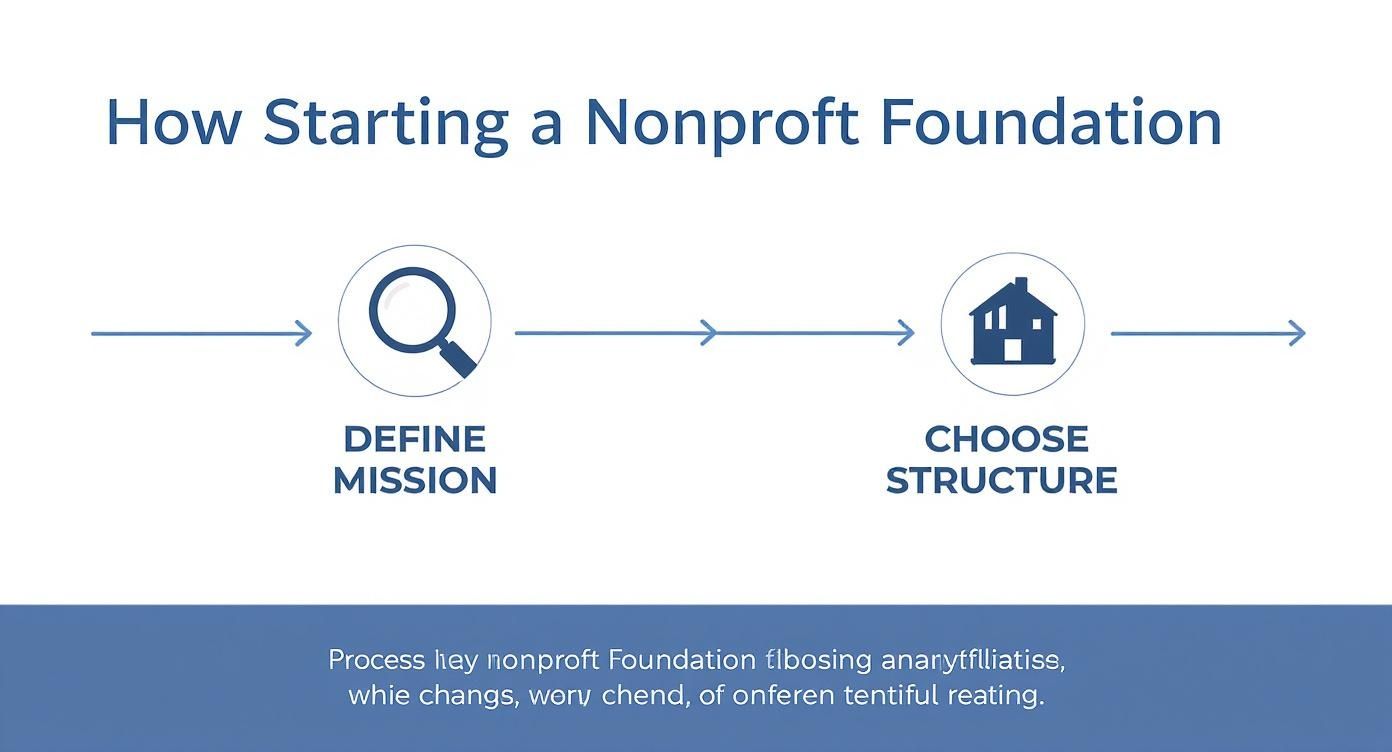
As the flowchart illustrates, clarifying your purpose and structure is the critical groundwork that must be laid before proceeding with official registrations.
Securing Charity Status with the ACNC
Registering as a charity with the Australian Charities and Not-for-profits Commission (ACNC) is a significant milestone. The ACNC is the national regulator for charities and the gateway to most Commonwealth tax concessions. Its role is to maintain public trust in the sector, so its application process is designed to verify that your organisation's purpose and activities are genuinely charitable.
To be successful with your ACNC application, you will need to prepare:
- Your governing document: This is your constitution or rulebook. It must clearly state your charitable purpose and include specific clauses required by the ACNC, such as how assets will be handled upon winding up.
- Details of your 'Responsible Persons': These are your board or committee members. They must meet certain eligibility criteria and understand the legal duties associated with their roles.
- A clear description of your activities: You need to explain how your day-to-day operations will directly work to achieve your charitable mission.
The ACNC website is an indispensable resource, offering guidance, checklists, and tools to help you prepare a comprehensive application.
Applying for Tax Concessions and DGR Status
Once the ACNC approves your charity registration, it will notify the Australian Taxation Office (ATO). The ATO will then assess your eligibility for Commonwealth tax concessions. These concessions are significant financial benefits and may include income tax exemption, GST concessions, and fringe benefits tax (FBT) rebates, depending on your circumstances.
True compliance is not a burden to be managed, but a discipline that builds trust. Each form filled, and each deadline met, is a quiet affirmation of your commitment to accountability and good stewardship.
A further valuable step is to apply for Deductible Gift Recipient (DGR) status. This allows your organisation to receive donations for which the donor can claim a tax deduction, a substantial advantage for fundraising efforts. DGR status is not automatic; the ATO assesses whether your organisation fits into one of the specific DGR categories outlined in the tax law.
This registration pathway is sequential. Each step builds on the last, and an error early in the process can cause significant delays. It is a process that rewards careful preparation. Understanding complex financial structures can be beneficial, and our discussion on what is a discretionary trust offers relevant insights into duties and responsibilities. Seeking personal advice is essential, and our expertise in tax and super compliance can provide further context for your obligations.
Establishing Good Governance and Operations
With your nonprofit officially registered, the focus shifts to building an organisation that is not only passionate but also professional, accountable, and structured for longevity. This phase is about establishing sound governance. It is not about creating bureaucracy, but about implementing a strong, reliable framework that safeguards your mission, your team, and the community you serve. This is how you earn and maintain the trust of donors, funding bodies, and the public.
Think of it as laying the foundations for a house. A solid foundation built now will ensure the structure can withstand future challenges.

Appointing Your First Board or Committee
Selecting the individuals who will guide the organisation is one of the most important decisions you will make. This is not just about finding enthusiastic supporters; it is about assembling a team of custodians for your vision. The ACNC refers to these individuals as your 'Responsible Persons', and they hold significant legal duties.
Resist the temptation to appoint only friends or the first volunteers. A strong board comprises a diversity of skills and perspectives. You should seek a blend of expertise, including:
- Financial acumen: An individual who can interpret financial statements and guide budgeting.
- Legal insight: A professional who can help navigate compliance and identify potential risks.
- Sector knowledge: Someone with direct experience in your field of operation.
- Community connections: People who can act as advocates and open doors for partnerships.
Under Australian law, these are not ceremonial roles. Board members have a legal duty to act with care and diligence, always in the best interests of the organisation. It is an active, engaged responsibility. For a deeper understanding of these kinds of duties, our guide on what is a discretionary trust provides useful context on fiduciary obligations.
Drafting Your Governing Document
Whether it is a constitution or a set of rules, this document is your organisation's operational manual. It is the rulebook that guides decision-making and helps prevent future disputes. It needs to be clear, practical, and tailored to your specific organisation.
A robust governing document should clearly define:
- Your purpose and objectives: A clear statement of your charitable mission.
- Membership details: Who can become a member and what their rights are.
- Board powers and duties: The scope of authority for the board and its members.
- Meeting and voting procedures: How formal decisions are made and recorded.
- Financial management protocols: Who has the authority to manage finances.
- Conflict of interest policy: A process for managing situations where personal interests may conflict with the organisation’s interests.
- A dissolution clause: A mandatory clause outlining that, upon winding up, any surplus assets must be transferred to another nonprofit with a similar purpose.
A well-drafted governing document will provide clarity and stability for years to come.
Good governance isn't a one-off task you tick and forget. It's the daily practice of careful planning and disciplined action that allows a noble mission to survive and thrive.
Establishing Core Operational Policies
Finally, a set of core policies will bring your governance framework to life. These documents translate principles into practical, everyday guidance for your board, staff, and volunteers.
It is not necessary to have a comprehensive policy library from day one. Begin with the essentials. A conflict of interest policy, a code of conduct, and basic financial handling procedures are fundamental. Documenting these early helps manage risk and demonstrates a commitment to professional operations. For a broader understanding of compliance issues, our article on promoter penalty laws and tax compliance is a valuable resource.
By methodically putting these foundations in place, you are building a resilient, trustworthy organisation capable of making a genuine difference.
Setting Up Financial Systems and Fundraising
With a solid governance framework established, the next step is to build the financial engine that will sustain your mission. This is about more than just accurate bookkeeping; it is the foundation of public trust and the key to your nonprofit's long-term viability. This phase requires creating clean, transparent systems for managing all financial resources.
The first essential step is to open a dedicated bank account in your nonprofit's legal name as soon as your ABN is issued. This simple action creates a critical separation between the organisation's funds and any personal finances, which is fundamental for accountability. All income and expenses must flow through this account to create a clear, auditable trail.

Choosing Your Accounting System
Once the bank account is active, you need a reliable method for tracking your finances. For many new organisations, a cloud-based accounting system is a practical choice. Platforms such as Xero or MYOB are widely used, often offering discounted pricing for nonprofits and providing the tools needed to manage income, expenses, and payroll.
A suitable accounting system will help you:
- Track all financial transactions correctly, distinguishing between different income sources like grants and donations.
- Monitor expenditure against your budget, which is essential for responsible financial management.
- Generate clear financial reports for your board and for your annual reporting obligations to the ACNC.
Whichever system you choose, ensure it is configured to provide your board with the timely and accurate information needed for sound decision-making.
Understanding the Australian Funding Landscape
Securing funding is one of the most significant challenges for any new nonprofit. It is important to approach this with a realistic perspective grounded in the current Australian context.
While the nonprofit sector’s total revenue reached $222 billion in 2023, this figure is heavily influenced by a small number of large, established organisations. For example, while donations and bequests rose to $18.9 billion, this was inflated by a single gift of $4.9 billion. Excluding this, donations grew by less than 0.4%, indicating that public giving has been relatively static. Furthermore, approximately 40% of all donations go to just 30 well-known charities, underscoring the importance of a diversified funding strategy. You can review these trends in this analysis of the Australian Charities Report.
A sustainable nonprofit never relies on a single source of income. It cultivates a diverse mix of support, from small community donations to government grants, patiently building relationships and proving its impact over time.
This reality means that relying solely on public donations may not be a viable strategy. Your financial plan should explore a mix of potential income streams, which could include:
- Government grants at local, state, and federal levels.
- Philanthropic grants from foundations and private ancillary funds.
- Corporate partnerships and sponsorships.
- Fundraising events and community appeals.
- Earned income from services, provided it aligns with your charitable purpose.
Navigating Fundraising Compliance
Before soliciting your first donation, you must understand your fundraising compliance obligations. In Australia, fundraising activities are regulated at the state and territory level. This means you will likely need to obtain a fundraising licence in each state and territory where you intend to seek donations. These laws are in place to protect the public and ensure transparency.
Failure to comply can result in significant penalties, so it is vital to check the specific requirements with the relevant authority in each jurisdiction. This may seem like an additional administrative burden, but it is a fundamental aspect of operating as a trustworthy and accountable organisation. The way you manage funds may also be influenced by your legal structure, a concept further explored in our article explaining what is a discretionary trust.
By setting up these financial systems with care and building a disciplined and informed fundraising strategy, you create the resilient foundation your nonprofit needs to serve its community for years to come.
Staying Compliant: The Ongoing Work of Good Governance
Achieving official registration is a significant accomplishment, but it marks the beginning of your journey, not the end. From this point forward, the focus is on maintaining your status and, equally important, the trust of your supporters and the public. This is achieved through the quiet, consistent work of ongoing compliance—a disciplined rhythm that keeps your organisation in good standing and allows you to concentrate on your mission.
One of the most effective first steps is to develop an annual compliance calendar. This simple tool transforms compliance from a reactive task into a predictable, manageable process. It helps you anticipate requirements, plan accordingly, and allows your board to focus on strategic direction, confident that foundational legal duties are being met.
The ACNC Annual Information Statement
The cornerstone of your annual obligations is the Annual Information Statement (AIS). This is a mandatory report that must be submitted to the Australian Charities and Not-for-profits Commission (ACNC). It is the primary way the ACNC ensures transparency and accountability across the sector.
The level of detail required in your AIS depends on the size of your organisation, which is determined by its annual revenue:
- Small charities (revenue under $500,000) submit a basic AIS covering their purpose, activities, and a simple financial summary.
- Medium charities (revenue from $500,000 up to $2,999,999) submit a more detailed AIS along with a financial report that has been either reviewed or audited.
- Large charities (revenue of $3 million or more) are subject to the highest level of scrutiny, requiring a fully audited annual financial report to be submitted with their AIS.
This tiered system is designed to be proportionate, but the core obligation applies to all registered charities. Failure to lodge your AIS is a serious matter and can lead to penalties or, ultimately, the revocation of your charity registration by the ACNC.
Beyond the ACNC: Broader Reporting and Tax Duties
Your reporting duties extend beyond the ACNC. Depending on your legal structure, other regulatory bodies will also require periodic reporting. For instance, a company limited by guarantee has ongoing obligations to the Australian Securities and Investments Commission (ASIC).
Your relationship with the Australian Taxation Office (ATO) is also continuous. If you employ staff, you will be responsible for managing Pay As You Go (PAYG) withholding and making superannuation contributions. If you are registered for GST, you must lodge your Business Activity Statements (BAS) on time. These are not optional administrative tasks; they are fundamental legal duties. To understand the gravity of these responsibilities, our overview of promoter penalty laws and tax compliance offers important context.
Good stewardship isn't about grand gestures. It's found in the consistent, disciplined execution of your duties. Annual reporting is a testament to your organisation’s integrity and its respect for the trust placed in it by donors and the community.
Good Record-Keeping Makes Everything Easier
Meeting these ongoing obligations is made significantly simpler with diligent record-keeping. Your financial accounts must be accurate and up-to-date. Your board meeting minutes, key decisions, and operational records should be meticulously maintained. This is not just about compliance; it is the bedrock of good governance.
Accurate records provide the evidence needed for your AIS, strengthen grant applications, and give your board the reliable information required for sound strategic decisions. Think of it as building your organisation's institutional memory—a clear account of your journey, your finances, and your impact.
Ultimately, ongoing compliance is the practical expression of your commitment to your cause. It is the steady, patient work that builds the foundation for making a real, lasting difference.
A Few Common Questions We Hear
When you are driven by a clear mission, practical questions about the path ahead are natural. Having guided many founders through this process, we have identified several queries that arise consistently. Here are some of the most common ones, addressed with a focus on Australian regulations.
How Long Does It Really Take to Register a Charity in Australia?
This is a marathon, not a sprint. While establishing your legal structure—such as an incorporated association or a company limited by guarantee—may take only a few weeks, the charity registration process requires patience.
A straightforward application to the Australian Charities and Not-for-profits Commission (ACNC) may be processed in as little as 15 business days. However, if your purpose or structure is more complex, the assessment could take several months. If you are also seeking Deductible Gift Recipient (DGR) status from the ATO, you should allow for at least another 28 days after your ACNC registration is approved. It is prudent to anticipate a three to six-month journey from inception to full registration, though this can vary depending on your circumstances.
Can Founders or Directors Draw a Salary?
Yes, this is possible, but it is an area that requires careful management and full transparency. The fundamental principle is that any payment must be for genuine work performed for the nonprofit.
Any salary or fee must be reasonable and reflect fair market value for the skills and time contributed. Your organisation's governing document must permit such payments, and a robust conflict of interest policy must be in place and actively used. The ACNC closely scrutinises payments to related parties to ensure that the organisation’s funds are being used to advance its charitable mission, not to provide a private benefit to individuals. For a business owner, understanding your obligations around tax and super compliance is a vital part of good stewardship.
What’s the Difference Between a Nonprofit and a Registered Charity?
These terms are often used interchangeably, but in Australian law, they have distinct meanings.
A nonprofit organisation (NPO) is a broad term for any group that operates for a community purpose rather than for the profit of its owners or members. A local sports club for new migrants or a social group for professionals are examples.
A registered charity, however, is a specific type of NPO that has been formally registered with the ACNC. To achieve this status, an organisation must have a charitable purpose for the public benefit and meet strict governance and reporting standards. Becoming a registered charity is the pathway to accessing Commonwealth tax concessions and building significant public trust, but it also entails ongoing compliance obligations.
Wise decisions come from understanding responsibilities as well as potential benefits. Investing in professional advice at the outset is an act of good stewardship that protects your mission for the long term.
Do I Actually Need a Lawyer to Start a Nonprofit?
While it is not legally mandatory to engage a lawyer, it is a highly advisable step. You are creating legally binding documents and navigating a complex regulatory environment that will shape your organisation's future.
A lawyer specialising in charity law can help ensure your governing document is not only compliant but also fit for your specific purpose. Similarly, a qualified accountant is invaluable for establishing your financial systems and tax planning from the outset. This initial investment in professional advice can prevent significant and costly problems in the future. Seeking advice tailored to your unique situation is crucial, a principle that applies to all complex structures, including a discretionary trust.
At Everglow Prosperity, we understand the unique financial landscape that nonprofits must navigate. From entity setup to audit and advisory, our integrated team provides the clear, reliable guidance your organisation needs to build a foundation for enduring impact. Partner with us to turn your vision into a sustainable reality. Find out how we can help at https://everglow.au.
General Advice Warning
The information provided in this article is general in nature and has been prepared without taking into account your personal objectives, financial situation or needs. Before acting on any information in this article, you should consider the appropriateness of the information to your own circumstances and, where appropriate, seek professional advice from a financial adviser, accountant, or lawyer.
