

Understanding what a discretionary trust is can be a quiet turning point in your financial journey. Let's explore this structure with steady clarity.
At its core, a discretionary trust is a legal arrangement where a person or a company (the trustee) holds assets for the benefit of a group of people (the beneficiaries). It creates a formal separation between the legal ownership of assets—such as investments, business interests, or family property—and your personal name.
Think of it as a carefully managed family chest. The trustee acts as the guardian, holding the keys and looking after the contents with a high degree of care. They decide who among the family members might benefit from the chest, and when. The beneficiaries, while having a potential interest, cannot simply demand access. This separation is the foundational principle of the structure.
The true strength of this arrangement lies in the word discretion. Each financial year, the trustee has the discretion to decide which beneficiaries may receive income or capital from the trust, and in what amounts. This inherent flexibility makes it a considered tool for long-term financial planning and adapting to a family’s evolving circumstances over many financial seasons.
The Key Players in a Trust
To appreciate how a discretionary trust operates, it's important to understand the roles involved. Every trust is built around four key positions:
- The Settlor: This is the individual who initiates the trust. They do so by "settling" a nominal sum of money (often just $10) and signing the formal trust deed. Once this is done, their role is complete.
- The Trustee: This is the legal owner and manager of the trust's assets. The trustee can be one or more individuals, though a company is often used for this role. The trustee has a strict legal obligation—a fiduciary duty—to manage the assets solely for the benefit of the beneficiaries.
- The Assets: These are the items of value held within the trust, which could include cash, shares, investment properties, or business interests. While the trustee legally owns these assets, they cannot use them for their own personal gain.
- The Beneficiaries: This is the group of people or entities who may receive distributions from the trust. A trust deed typically defines this group broadly to include immediate family, extended relatives, and sometimes associated companies or charities, depending on your circumstances.
This is not a fringe strategy; it is a well-established component of wealth management in Australia. For many years, families and business owners have used discretionary trusts to protect what they have built and to steward their financial futures with care.
According to ATO data for the 2022-23 financial year, over 1.02 million trusts were operating in Australia. This figure indicates how commonly these structures are used. You can find more perspectives on the role of family trusts in Australia on investsmart.com.au.
Ultimately, establishing a discretionary trust is an act of careful, forward-looking financial stewardship. It is about building a foundation that is resilient enough to withstand challenges yet flexible enough to adapt over the long term. Understanding these fundamentals is the first step in assessing whether it is an appropriate path for your family.
Understanding the Key Roles in Your Trust
A discretionary trust is more than a legal document; it is a relationship founded on specific roles and responsibilities. Understanding these roles is the first step toward appreciating how a trust functions and why its structure is so deliberate.
Consider it like a well-captained ship. There is the individual who commissions its construction, the captain responsible for navigation, the ultimate owner with the power to appoint the captain, and the passengers who may benefit from the journey. In the context of a trust, these roles are the Settlor, the Trustee, the Appointor, and the Beneficiaries.
The Settlor: The Person Who Creates the Trust
Every discretionary trust begins with the Settlor. This person or company formally establishes the trust by signing the trust deed and "settling" a small sum—often $10—to create the initial trust property.
With that, the Settlor's involvement concludes. It is a critical requirement of Australian law that the Settlor steps away permanently and cannot be a beneficiary. This ensures the trust is genuinely established for the benefit of others and not as a vehicle for the creator's own benefit. They initiate the process but do not direct its course.
The Trustee: The Daily Manager
The Trustee is the legal owner and day-to-day manager of the trust's assets. While individuals can serve in this role, it is common to use a company (a ‘corporate trustee’) to enhance asset protection and simplify succession planning.
A Trustee holds a significant legal responsibility known as a fiduciary duty. This is not merely an informal agreement; it is a legally enforceable obligation to act solely in the best interests of the beneficiaries. These duties include:
- Making investment decisions for the trust's assets.
- Maintaining detailed and accurate financial records.
- Lodging the annual trust tax return with the ATO.
- Resolving each year how to distribute the trust's income and capital.
The Trustee must act with diligence and care, always adhering to the rules set out in the trust deed.
The diagram below provides a clear visual representation of how the trustee manages the assets for the group of beneficiaries.
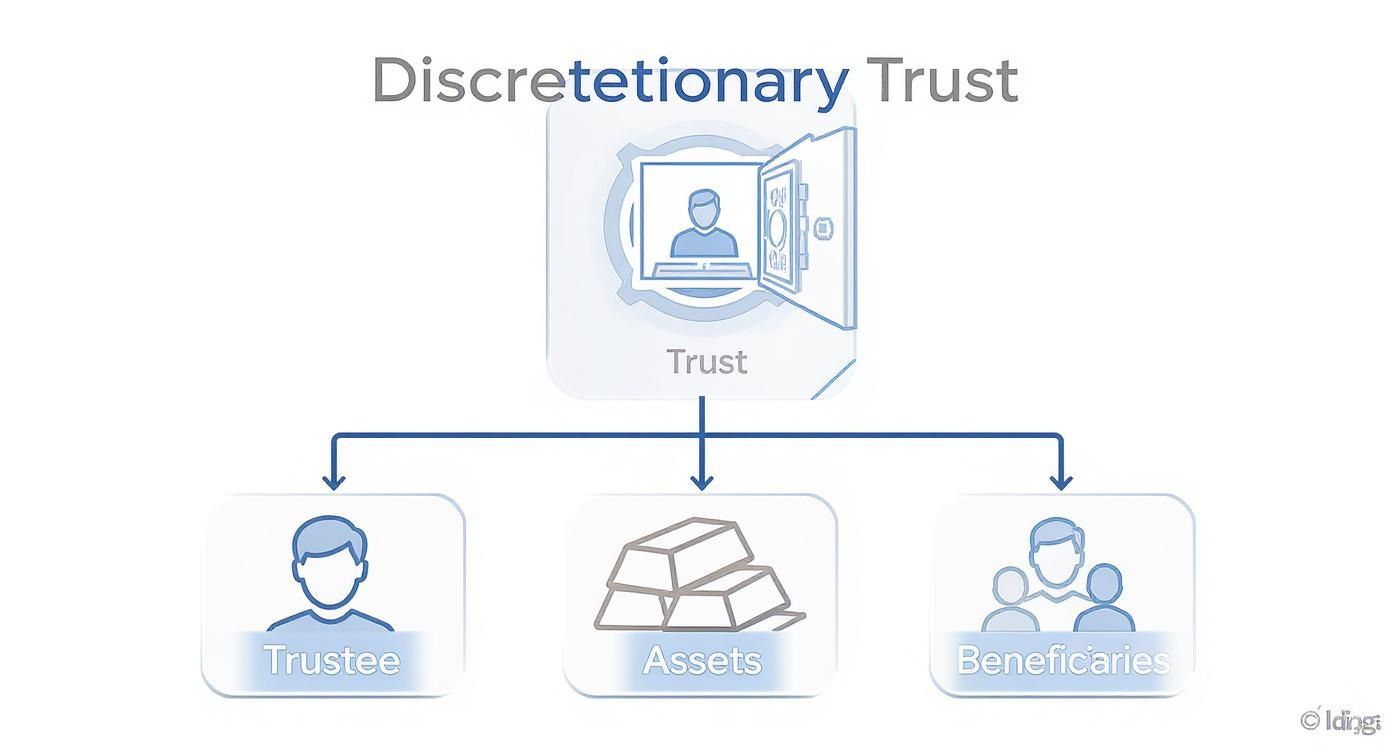
This structure creates a clear separation between the legal management of assets and those who may benefit from them, which is fundamental to how a discretionary trust operates in Australia.
The Appointor: The Ultimate Controller
While the Trustee manages the daily operations, the Appointor holds the ultimate authority. This is the person who has the power to appoint and, crucially, remove the Trustee. This simple power gives the Appointor ultimate control without being involved in day-to-day administration.
The Appointor's role is often described as the 'guardian' of the trust. It is the most powerful position, and planning for the succession of this role is critical to ensuring the trust serves its intended purpose for generations.
Selecting the Appointor is one of the most significant decisions you will make. This role should be filled by someone you trust implicitly to guide the trust in the right direction. For many families, the individuals who establish the trust initially assume this role. You can see how this compares with other structures in our guide on what is a bare trust.
The Beneficiaries: The Potential Recipients
Finally, we have the Beneficiaries. These are the individuals, companies, or other trusts eligible to receive income or capital distributions. The nature of a discretionary trust means that beneficiaries have no fixed entitlement or legal right to the trust’s assets.
Instead, they hold what is legally termed a 'mere expectancy'—a hope that the Trustee will exercise discretion in their favour. The trust deed typically defines the beneficiaries as a broad 'class,' which could include:
- Spouses and children
- Grandchildren and other relatives
- Family companies or other trusts
- Designated charities
This flexibility is a key feature of the trust. It allows the Trustee to adapt distributions as the family's needs evolve—whether that involves supporting a child through education, assisting a family member starting a business, or distributing income in a tax-effective manner each year. To learn more about how trusts interact with tax incentives, you may find our article on ATO's early-stage investment tax benefits helpful.
To help clarify these roles, here is a summary table.
Key Roles and Responsibilities in a Discretionary Trust
This table outlines the primary roles within a discretionary trust, their functions, and key considerations under Australian law.
| Role | Primary Function | Key Considerations |
|---|---|---|
| Settlor | Formally establishes the trust by signing the deed and providing the initial settlement sum (e.g., $10). | Must be independent and cannot be a beneficiary. Their role is purely administrative and ends once the trust is created. |
| Trustee | Legally owns and manages the trust assets day-to-day. Makes investment and distribution decisions. | Has a fiduciary duty to act in the best interests of all beneficiaries. Can be an individual or a company (corporate trustee). |
| Appointor | Holds the power to appoint and remove the trustee. The ultimate controller of the trust. | The most powerful role. Careful succession planning for the Appointor is critical for the trust's long-term control and stability. |
| Beneficiary | A person or entity eligible to receive distributions of income or capital from the trust. | Has no fixed entitlement to assets, only a 'mere expectancy'. The class of beneficiaries is defined broadly in the trust deed. |
Understanding these distinct functions demonstrates how a well-structured trust can be a powerful vehicle for asset protection and flexible wealth distribution when managed with foresight and care.
How Trusts Protect Your Family Assets

One of the most compelling reasons families and business owners establish a discretionary trust is for the quiet strength it offers in asset protection. It can be thought of as a financial buffer in an uncertain world, creating a deliberate, legal separation between the assets you have worked to build and the personal or professional risks you may face.
This is not about avoiding responsibilities; it is about prudent financial stewardship.
When you place assets within a trust, they are legally owned by the trustee—not by you or any of the beneficiaries personally. This simple distinction is remarkably powerful. It means that if a beneficiary were to encounter personal financial difficulty, bankruptcy, or legal claims, the assets held within the trust are generally shielded from those creditors.
The reason for this is that beneficiaries do not own the trust assets. As mentioned, they only have a 'mere expectancy' or a hope of receiving a distribution. They cannot demand payment, and if they cannot, their creditors generally cannot either. This protective barrier is a cornerstone of why so many Australians use a discretionary trust to safeguard their legacy.
Asset Protection in Practice
Let’s move from theory to see how this may work for Australian professionals and families. These examples illustrate how the trust structure can create a protective buffer, though it is vital to remember that outcomes always depend on specific circumstances and a correct legal setup.
Scenario 1: A Business Owner in a High-Risk Industry
Consider a professional engineer who runs a consulting practice. While rewarding, her profession carries a risk of litigation. To manage this, she holds her significant investment portfolio—shares and a commercial property—within a family discretionary trust. Her personal assets are modest, limited to her everyday bank account and vehicle.
If a professional indemnity claim were to succeed against her personally for an amount beyond her insurance coverage, the assets inside the trust would generally be beyond the reach of that claim. The trust owns the portfolio, not her. This allows her to pursue her professional work with greater peace of mind, knowing her family’s financial future has an additional layer of protection.
Scenario 2: A New Migrant Family Building Wealth
Imagine a family who has recently migrated to Australia and is building a new life. They establish a business and, over time, acquire investment properties. They place these properties into a discretionary trust to separate their growing family wealth from their business operations.
Years later, their business faces an unexpected downturn and is forced to cease trading with outstanding debts. Because the property portfolio is held in the trust, it is separate from both the business and their personal names. This means business creditors generally cannot make a claim against those properties to settle the company’s debts. The family’s foundational wealth is preserved.
A discretionary trust is a tool for building a financial legacy that may endure beyond a personal or business lifetime. It is about separating business risk from family security.
It is critical to understand that this protection is not absolute. Courts can look past a trust structure if it was established specifically to defeat creditors or if assets were transferred into it when financial trouble was already apparent. This is precisely why obtaining timely, expert advice from the outset is so important.
Ultimately, a well-structured trust is an exercise in foresight. It acknowledges that life is unpredictable and provides a disciplined framework to protect what matters most. By separating ownership from benefit, you are not just managing wealth; you are building a resilient financial foundation for generations to come.
Using Your Trust for Smarter Tax Planning
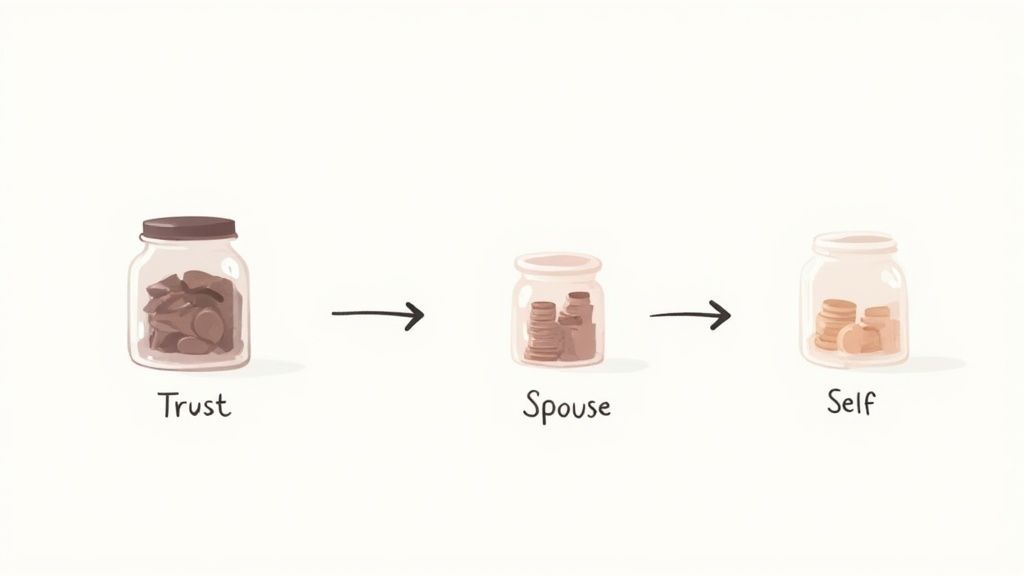
Beyond asset protection, a powerful feature of a discretionary trust is its potential to help families strategically manage their tax obligations. This is not about finding loopholes; it is about a core, legally sound function known as income streaming.
In simple terms, income streaming gives the trustee the discretion to decide who receives what, and when. Each financial year, they can determine which beneficiaries receive the trust's taxable income and how much each person is allocated.
This flexibility can be a significant advantage. It allows the trustee to direct income toward family members on lower marginal tax rates, which may reduce the family's overall tax liability. The trustee can assess each beneficiary's financial situation annually and make prudent decisions that align with the family’s current needs and tax circumstances.
How Income Streaming Works in Practice
Let's walk through a practical example.
Imagine a family trust generates $100,000 in net income for the financial year. The family includes a parent earning a high income (in the top tax bracket), a spouse who works part-time, and two adult children at university with minimal personal income.
If the high-income parent earned that $100,000 directly, it would be taxed at their personal marginal rate, which could be up to 47% (including the Medicare levy).
With a trust, the trustee has other options. Before 30 June, they can resolve to distribute that income more effectively. A common strategy might look like this, depending on personal advice:
- Spouse (Part-time worker): Receives $40,000 of trust income.
- Adult Child 1 (University student): Receives $30,000 of trust income.
- Adult Child 2 (University student): Receives $30,000 of trust income.
By distributing the income in this manner, each individual is taxed at their own, lower marginal rate. The result could be a much smaller overall tax bill for the family compared to one person receiving the entire amount. It is a tailored approach that can adapt as your family’s situation changes year after year.
The annual distribution resolution is one of the most important duties of a trustee. Documenting these decisions clearly before the end of the financial year is a non-negotiable compliance requirement under ATO guidelines.
Streaming Different Types of Income
The flexibility may not stop at just splitting income. A well-drafted, modern trust deed often allows the trustee to "stream" specific types of income to different beneficiaries. This is particularly relevant for managing capital gains and franked dividends.
For instance, if the trust sells an asset and realises a capital gain, the trustee could potentially direct that gain to a beneficiary who has capital losses from other investments to absorb it.
Similarly, franked dividends, which carry valuable tax credits, could be streamed to a beneficiary who can make the most of those franking credits. This kind of strategic allocation adds another layer of tax efficiency.
It's crucial to remember that these strategies demand careful planning and professional advice. The rules can be complex, and what works for one family might not work for another. Prudent tax planning is about patient, disciplined action, not about taking aggressive risks.
Meeting Your Trust Compliance Obligations
Establishing a discretionary trust is a significant first step, but its true value is realised through diligent management year after year. The flexibility and protection it offers are accompanied by serious legal and financial duties. Meeting these obligations is not just about paperwork—it is about upholding the integrity of the trust and ensuring it continues to work for your family.
Think of yourself as the steward of a financial legacy. A garden requires constant attention to thrive, and a trust is no different. It needs methodical, consistent care to remain compliant and effective under Australian law. These are not mere suggestions; they are the non-negotiable responsibilities that keep your asset protection structure sound. For an overview of these duties, see our guide on meeting your trust compliance obligations.
From the very beginning, this means maintaining complete separation of the trust's finances. Your trust must have its own dedicated bank account. Commingling trust funds with your personal or business money is a critical error that could undermine the entire structure, exposing assets to the very risks you sought to mitigate.
Key Annual Responsibilities for Trustees
Good governance is built on rhythm and routine. By completing a set of annual tasks, you create a clear, auditable trail that demonstrates you are fulfilling your duties as a trustee. Here is what must be done each year:
- Meticulous Record-Keeping: Every transaction must be tracked. This involves keeping all invoices, receipts, and bank statements that form the backbone of your trust's financial records for the year.
- Annual Financial Statements: Before lodging a tax return, you must prepare a balance sheet and a profit and loss statement. These documents provide a clear financial snapshot of the trust's performance.
- Lodge a Trust Tax Return: The trust must file its own tax return with the ATO. This return details all the income it earned and, crucially, declares how that income was distributed to the beneficiaries. Timeliness is key—failing to lodge on time can result in penalties, so it pays to understand the implications of a late tax return fine.
- Document Your Distribution Decisions: This is a critical step. Each year, before 30 June, you must formally decide and document how the trust's income will be distributed among the beneficiaries. This is done via a ‘trustee resolution,’ a legally binding document that must be clear and unambiguous.
Navigating Increased ATO Scrutiny
Trusts are powerful structures, and the ATO is well aware of this. With substantial sums distributed annually, it's no surprise that trusts are under careful observation. The ATO is watching these arrangements closely to ensure they are being used appropriately. You can discover more insights about family trusts and ATO scrutiny on firstlinks.com.au.
A key area of ATO focus is Section 100A of the tax act. This provision targets arrangements where income is distributed to one person on paper, but the financial benefit ultimately flows to someone else. Non-compliant arrangements can have serious consequences, so ensuring your distributions are managed correctly is essential.
Meeting your obligations is about more than ticking boxes. It is about honouring the reason you established the trust. Diligent compliance protects the structure, safeguards the assets within, and ensures your trust can continue to benefit your family for generations to come.
Is a Discretionary Trust Right for You?
Deciding to establish a discretionary trust is a significant financial step. It is a powerful tool, but whether it is the right one depends on your personal circumstances and long-term objectives. It is not a universal solution, but for certain goals, it can be an incredibly effective framework.
A discretionary trust is particularly well-suited to specific situations. Are you a professional in a high-risk industry? A family business owner planning for succession? Or an investor holding assets like property or shares that you anticipate will grow over time? In these cases, a trust offers a structured way to manage both asset protection and tax planning.
Comparing Structures: A Simple Overview
It is helpful to see where a discretionary trust fits alongside other common structures. Each has a specific purpose, and understanding the key differences is crucial.
- Sole Trader or Partnership: These are simple to establish, but they leave your personal assets completely exposed to business risks. There is no separation.
- Company: A company provides a separate legal entity, which is excellent for protecting the personal assets of its owners (shareholders). However, profits are taxed at a flat company rate, and distributing those profits can be less flexible than with a trust.
- Discretionary Trust: This structure combines strong asset protection with significant tax flexibility. Unlike a company, income can be distributed to different beneficiaries each year to potentially minimise the family’s overall tax liability. It is designed for holding assets and distributing income prudently.
For simpler scenarios, such as holding a single asset for one person, another structure might be more appropriate. We explore this further in our guide explaining what is a bare trust. Every choice comes with its own set of responsibilities and outcomes.
A Deliberate Act of Financial Governance
Ultimately, creating a discretionary trust is not just a tax strategy; it is a fundamental act of financial governance. It is a decision that demonstrates a commitment to careful planning and the preservation of what you have built for the next generation. This structure is designed to endure, quietly adapting to your family's changing needs and financial seasons.
Its true strength, however, comes from being established correctly and managed with diligence. This is not about finding a loophole. It is about building a resilient and lasting foundation for your family’s financial future.
A well-considered trust is a powerful legacy tool, but it requires careful planning and personalised, professional advice. Its value is realised not just in its creation, but in the disciplined stewardship that follows.
This is not a path to walk alone. The landscape of trust law, ATO rules, and long-term strategy requires an experienced guide. Seeking professional advice is not just the final step—it is a core part of the entire process, ensuring your trust is sound, compliant, and perfectly aligned with your goals.
When you're considering a discretionary trust, the high-level benefits are one thing, but it's the practical, day-to-day questions that often arise. Let's walk through some of the most common queries we hear from clients, so you have a clearer picture of how these trusts operate.
Can a Trust Get a Loan to Buy Property?
Yes, a discretionary trust can borrow money to acquire assets like property. However, the process is not as straightforward as a personal loan.
Lenders in Australia are cautious because the trust itself is not a legal entity they can sue. To manage their risk, banks will almost always require the trustee—or if it is a corporate trustee, its directors—to provide a personal guarantee.
This means that while the trust owns the property, your personal assets could be at risk if the loan defaults. It is a serious commitment, and lenders will carefully assess the trust's financial position and the trustee’s capacity to service the debt.
What Happens if the Trust Has a Financial Loss?
This is a very important point to understand. If your trust incurs a net financial loss for the year—for example, if the expenses on an investment property exceed the rental income—that loss is "trapped" within the trust.
You cannot distribute the loss to a beneficiary to offset their personal taxable income. Instead, under ATO rules, the trust must carry that loss forward. It can then be used to reduce taxable income the trust earns in future years, provided certain continuity tests are met. This is a key difference compared to other structures and highlights the need for sound financial planning within the trust.
Good financial governance means planning for all seasons, not just prosperous ones. Understanding how losses are treated is as important as planning for profits, ensuring the trust remains resilient over the long term.
How Much Does It Cost to Manage a Trust?
The costs generally fall into two categories.
First, there are the setup costs. This covers the professional fees for a lawyer to draft a robust trust deed and for an accountant to establish a corporate trustee. Depending on the complexity, this can range from a few hundred to several thousand dollars.
Then, you have the ongoing annual costs. These are the recurring expenses for accounting fees to prepare the trust’s financial statements and lodge its tax return, plus the annual ASIC fee to maintain the corporate trustee's registration. It is important to budget for these compliance costs each year to ensure everything operates smoothly and correctly.
Can You Add or Remove Beneficiaries?
The answer to this question is found entirely within the terms of your trust deed.
Most well-drafted, modern deeds define the 'class of beneficiaries' very broadly. They will typically include a wide circle of family members and related entities, so new additions like grandchildren are automatically included as they are born, without requiring amendments.
Attempting to remove a beneficiary, however, is a much more complex matter. It is often not possible unless the trust deed specifically grants that power. Making any changes to the class of beneficiaries is a significant legal step and should never be undertaken without seeking expert legal advice first, as it could have unintended tax or legal consequences. This is a powerful reminder that the trust deed is your foundation—it needs to be built with foresight.
A Clear Path Forward
Navigating the decision to establish a discretionary trust requires calm consideration and a clear understanding of both the opportunities and the responsibilities involved. It is a long-term strategy, best built on a foundation of sound advice and diligent management. By taking a measured and informed approach, a discretionary trust can become a cornerstone of your family's financial security for many years to come.
At Everglow Prosperity, we provide the clear, seasoned guidance you need to navigate the complexities of trust establishment and management. Our integrated team is here to help you build a resilient financial structure aligned with your long-term goals.
Contact us today to discuss your financial strategy.
General Advice Warning: The information in this article is general in nature and does not take into account your objectives, financial situation or needs. Before acting on it, consider whether it is appropriate for you and seek personal advice. Tax and superannuation rules can change. Financial advice is provided by Everglow Wealth Pty Ltd, a Corporate Authorised Representative (No. 1254987) of PGW Financial Services Pty Ltd (AFSL 384713). Tax advice is provided by Everglow Accounting Pty Ltd.
Want help applying this to your situation?
Every situation is different. Book a time with our team to talk it through, or call us on 1300 913 929.
Book a free meetingAustralian tax guide →Estimate your fees →
Keep exploring