
The journey of a sole trader often begins with individual effort, but a time may come when growth requires more than one pair of hands. This is a significant milestone, a sign that your hard work is creating real momentum. The direct answer to the question, "can a sole trader have employees?" is yes, it is entirely possible in Australia.
However, the moment you decide to hire, your role undergoes a fundamental change. You transition from being a solo operator to an employer. This shift is not merely a change in title; it introduces a new set of legal, financial, and ethical responsibilities that require careful and considered management.

Your Core Responsibilities as a Sole Trader Employer
When you engage your first staff member, you are accepting important duties established under Australian law. This is a considerable shift, and understanding these obligations is fundamental to building a sound, sustainable enterprise. Thinking through these responsibilities before your first employee begins is an act of good stewardship, ensuring this new chapter starts with clarity and protects both your team member and the business you have built.
Paying Your People Correctly and Lawfully
Your most immediate duties revolve around remuneration. This begins with registering with the Australian Taxation Office (ATO) and implementing compliant systems from the outset.
Two key obligations are:
- Pay As You Go (PAYG) Withholding: Before processing your first payroll, you will likely need to register for PAYG withholding. This system requires you to deduct income tax from your employee's wages and remit it to the ATO on their behalf. The amount withheld depends on their earnings and the details provided in their Tax File Number (TFN) declaration.
- Superannuation Guarantee: Under the Superannuation Guarantee scheme, you are legally required to pay super contributions for all eligible employees. This payment, currently set by the government, is a percentage of an employee’s ordinary time earnings and must be paid at least quarterly into their nominated superannuation fund. Failure to meet these obligations on time may result in significant penalties from the ATO.
For instance, a new migrant who has established a small graphic design studio in Melbourne as a sole trader and hires a junior designer will need to calculate and withhold tax from the designer's pay. They must also make regular super contributions to the designer's chosen fund to remain compliant.
Protecting Your Team and Your Business
Beyond correct payment, your responsibilities extend to providing a safe workplace and adhering to national employment laws. These systems create a safety net and establish clear, fair working conditions.
- Workers' Compensation Insurance: This is mandatory for all employers in Australia and is regulated at a state and territory level. You must have a current workers' compensation insurance policy to cover your employees in the event of a work-related injury or illness. The specific rules and providers vary by jurisdiction, so it is important to check the requirements in your state.
- National Employment Standards (NES): The Fair Work Act 2009 outlines ten minimum entitlements for all employees, known as the National Employment Standards. These cover matters such as maximum weekly hours, requests for flexible working arrangements, and various types of leave (including annual, personal/carer's, and compassionate leave). You must provide these entitlements to all eligible staff.
Diligent record-keeping and a reliable payroll system, almost always one that is Single Touch Payroll (STP) enabled to report to the ATO, are essential. It is a journey that requires patience and a commitment to doing things correctly from the beginning. For those new to this business structure, reviewing an educational resource on what is a sole trader may provide helpful context.
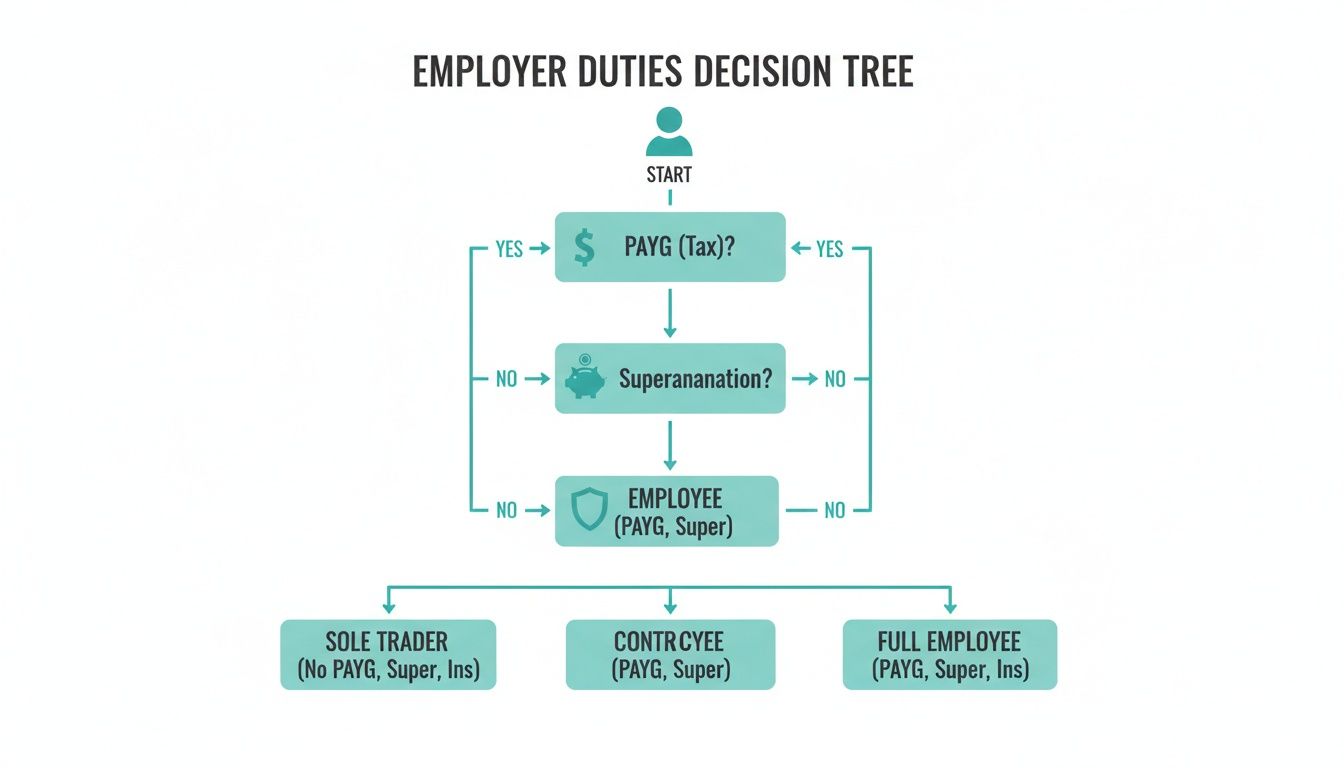
Risks and Responsibilities: Employee vs. Contractor
When bringing someone into your business, one of the most critical steps is to correctly classify the working relationship. Distinguishing between an employee and an independent contractor is not a matter of preference; the ATO and Fair Work Ombudsman have clear guidelines. Misclassification may lead to future claims for unpaid entitlements and penalties.
An employee generally works in your business as an integral part of it. A contractor, however, is running their own business and provides services to yours. This distinction frames your obligations.
The ATO looks at the totality of the relationship to determine its nature. Key indicators include:
| Factor | Employee | Independent Contractor |
|---|---|---|
| Control | Works under your direction regarding how, when, and where the work is done. | Has a high degree of control over how and when they perform the work to achieve an agreed outcome. |
| Financial Risk | Bears no financial risk. You are responsible for business costs. | Bears the financial risk of making a profit or loss and is responsible for rectifying their own errors. |
| Tools | You typically provide the tools and equipment needed to do the job. | Usually provides their own significant tools and equipment required for the service. |
| Delegation | Is expected to perform the work personally. | Is generally free to delegate or subcontract the work to others. |
A common mistake is assuming that a worker with an Australian Business Number (ABN) is automatically a contractor. This is not the case. The entire relationship must be assessed. If you are a professional earning Personal Services Income (PSI), this distinction is especially important.
For example, a physiotherapist operating as a sole trader who hires a receptionist for set hours to manage appointments is engaging an employee. If that same physio engages an accountant to prepare their annual tax return, that accountant is a contractor.
Getting this classification wrong could expose your business to claims for back-pay, unpaid superannuation, and penalties. If there is any doubt, seeking professional advice before engaging someone may be a prudent step. Our business and corporate advisory services are designed to provide clarity on such matters.
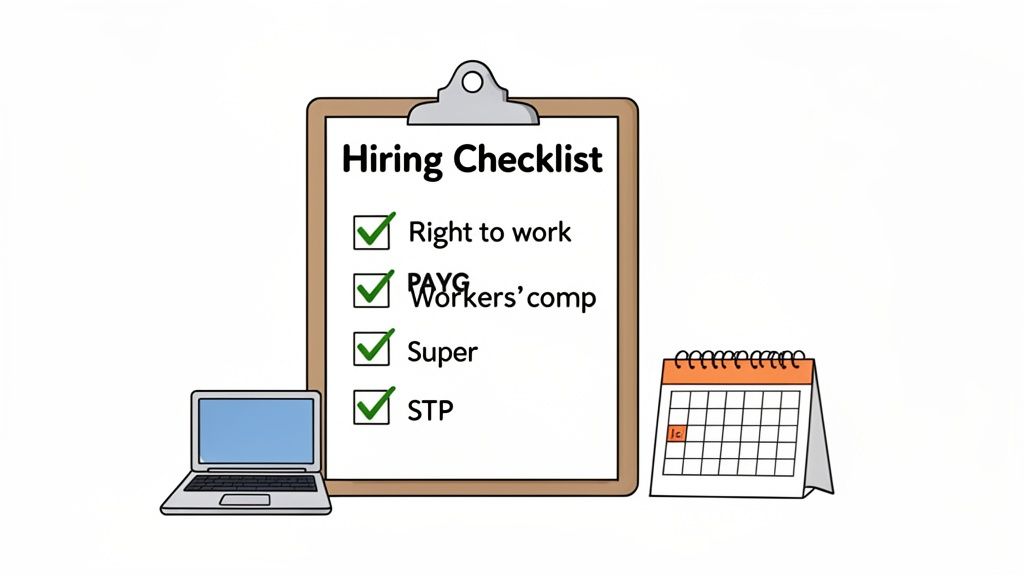
Practical Next Steps for Hiring
Hiring your first employee marks a fundamental shift. The process begins with a methodical approach to your legal duties. This is about building a compliant foundation to support growth and mitigate risk.
Before You Hire:
- Verify Right to Work: Confirm your potential employee has the legal right to work in Australia via the government’s Visa Entitlement Verification Online (VEVO) service.
- Register for PAYG Withholding: Register with the ATO to legally withhold tax from your employee's wages.
- Secure Workers' Compensation Insurance: Obtain a valid policy before your employee commences work, in line with your state or territory’s requirements.
- Choose a Default Super Fund: Nominate a compliant MySuper product for employees who do not choose their own fund.
Onboarding Your New Employee:
- Employment Agreement: A written agreement outlining the terms of employment, compliant with the Fair Work Act and any relevant modern award, is highly recommended.
- TFN Declaration Form: Your employee must complete this form so you can calculate the correct tax to withhold.
- Superannuation Standard Choice Form: Provide this form to your employee to allow them to nominate their chosen super fund.
A well-organised payroll system is more than an administrative tool; it is a demonstration of your commitment to running a compliant, transparent business.
A Concise Takeaway
A sole trader can indeed have employees in Australia. This step signifies business growth but also introduces significant responsibilities. Good stewardship of your finances and your people requires a disciplined approach to tax, superannuation, and employment law.
The journey to becoming a successful employer is not a sprint. It is a steady process built on careful planning, consistent action, and a commitment to doing things correctly. By approaching this new chapter with foresight and a genuine commitment to your responsibilities, you position your business for sustainable success.
If you would like clarity on how these principles may apply to your own circumstances, you may wish to speak with a qualified adviser. You can contact Everglow on 1300 913 929 or email contact@everglow.au to arrange a discussion.
General Advice Warning: The information provided is general in nature and does not take into account your personal objectives, financial situation, or needs. You should seek personal advice from a qualified professional before making any financial decisions.
