

A Working Away From Home Allowance (WAWHA) is a payment an employer may provide to cover an employee's additional living costs when their role requires them to live and work away from their usual home for a temporary period. It is intended to address expenses such as accommodation, meals, and other day-to-day costs.
This allowance is distinct from payments for brief overnight trips or permanent relocations. It is specifically designed for extended, temporary assignments, ensuring an employee is not financially disadvantaged by undertaking their duties in a different location.
Understanding the Working Away From Home Allowance
The working away from home allowance serves a specific purpose within Australia’s tax framework. It is structured for circumstances where an employee is required to temporarily reside in a different location for work, while continuing to maintain their permanent home elsewhere.
It may be considered a financial bridge, intended to ensure fairness when a project necessitates a temporary change in living arrangements. This is not a bonus or a perquisite; it is a practical payment designed to cover genuine, additional expenses. The Australian Taxation Office (ATO) provides clear guidance to distinguish this allowance from other types of payments, and careful adherence to these rules is important for both employers and employees.
The Core Purpose of the Allowance
At its heart, the allowance is about compensating an employee for costs they would likely not have incurred if they were living at their normal home. The entire arrangement is predicated on the expectation that the employee will eventually return to their primary residence once the temporary assignment concludes.
Key considerations may include:
- It’s Temporary: The work assignment should have a reasonably clear end date. It is generally not intended for indefinite roles or permanent relocations.
- A Maintained Home: The employee must be maintaining their permanent home elsewhere, with the intention of returning to it.
- It Covers Additional Costs: The allowance is specifically for accommodation, food, and incidental expenses that arise from living away from home for work.
This structure allows businesses to support staff on projects in different cities or regional areas—from a consultant on a three-month secondment in Melbourne to a construction crew on a remote project in the Pilbara.
At its heart, the allowance acknowledges the financial reality of temporary work placements. It is a mechanism for good stewardship, allowing employers to meet project needs while ensuring their team members are appropriately supported, all within a compliant framework.
For individuals whose work is primarily based from their own home, the rules and financial considerations are entirely different. You can learn more by exploring our guide on claiming working from home expenses, which is an educational resource covering a separate set of opportunities and responsibilities.
When managed correctly and in line with ATO guidance, the working away from home allowance can be an effective tool. It may provide clarity to businesses planning their projects and financial stability to the professionals undertaking them.
If you would like clarity on how these principles may apply to your own circumstances, you may wish to speak with a qualified adviser. You can contact Everglow on 1300 913 929 or email contact@everglow.au to arrange a discussion.
General Advice Warning: The information provided is general in nature and does not take into account your personal objectives, financial situation, or needs. Before acting on any information, you should seek personal advice from a qualified professional.
How to Determine Employee Eligibility
Determining who may qualify for a working away from home allowance comes down to understanding its core purpose. The Australian Taxation Office (ATO) has established clear guidelines to distinguish this allowance from other payments. It is designed for genuinely temporary situations, not for permanent moves or a standard daily commute.
The central principle is that the employee’s work in the new location must be temporary, and they must be maintaining their usual home elsewhere. It can be viewed as a temporary secondment, not a permanent relocation. The allowance is intended to help cover the additional, duplicated living costs that arise from this arrangement.
The Core Conditions For Eligibility
To assess whether an employee may be eligible, there are a few fundamental conditions that typically need to be met. These criteria help demonstrate that the employee’s personal life and home base remain anchored to their permanent residence, and the new work location is a temporary arrangement.
The key qualifying factors usually include:
- It Must Be Temporary: The role at the new location should have a defined end point, which could be tied to a specific project deadline or a fixed-term contract.
- A Permanent Home Must Be Maintained: The employee must continue to have their permanent home available for their use for the duration of the temporary assignment.
- The Intention Is to Return: It should be clear that the employee is expected to return to their permanent home once the temporary assignment is complete.
- Distance and Practicality: The new workplace should be far enough from their permanent home that a daily commute would not be reasonable.
Working through this process helps clarify if the allowance fits the situation. This decision guide provides a high-level visual of these key considerations.
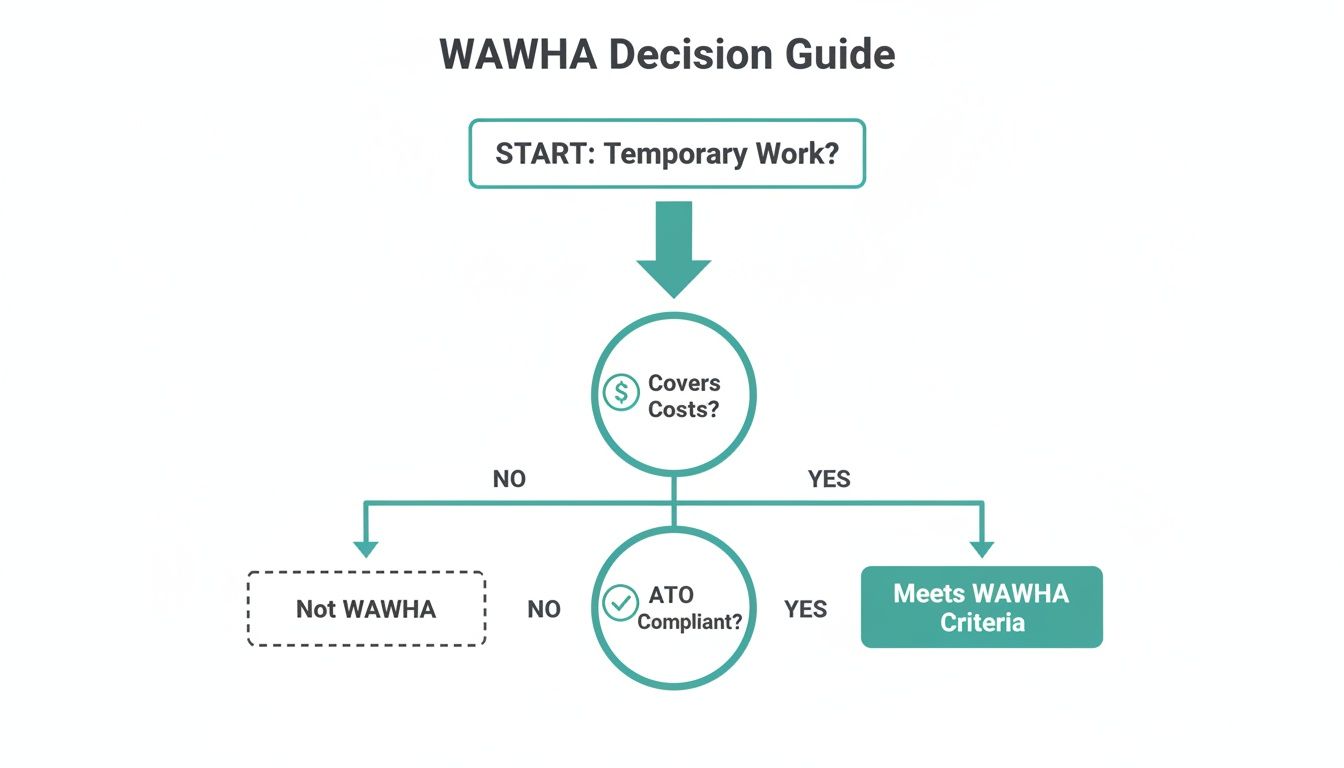
As the flowchart illustrates, eligibility often begins with a temporary work requirement. From there, it involves covering additional living costs, all while operating within the ATO’s compliance guidelines.
The Significance Of The 21-Day Rule
A guideline the ATO often refers to is the '21-day rule'. While not a strict law, it serves as a strong indicator of what is considered temporary. If an employee is away from their usual home for a continuous period of less than 21 days, any payment they receive is generally treated as a travel allowance, not a working away from home allowance.
However, if they are away continuously for 21 days or more, it is more likely to be considered a working away from home allowance, provided all other conditions are met. This distinction is important because the tax treatment for each allowance can differ significantly. For some international professionals, understanding this is particularly crucial as it may intersect with their residency status. You can find more on this in our guide to being a non-resident for tax purposes in Australia.
Practical Scenarios In Australia
To see how these rules might apply in practice, let's consider a couple of examples relevant to Australian professionals.
- A Specialist Doctor: A surgeon from Sydney accepts a three-month locum role at a regional hospital in Dubbo. She continues to maintain her Sydney home where her family lives and intends to return once the contract is finished. Her circumstances appear to align with the eligibility criteria for a working away from home allowance.
- A Construction Team: A Brisbane-based construction firm sends a team of five people to a remote site in Central Queensland for an eight-week project. The workers are provided with temporary accommodation near the site, but they all maintain their family homes and private lives in Brisbane. This arrangement also points towards eligibility for the allowance.
In both these scenarios, the work is temporary, permanent homes are being maintained, and the intention to return is clear. These examples reflect the substance of the arrangement, which is a key focus for the ATO. Clarifying these facts from the outset is a matter of good financial governance.
Calculating Rates and Understanding FBT
Once it has been established that an employee is genuinely eligible for a working away from home allowance, the focus shifts to the financial details. It is important to consider how much should be paid and how to remain aligned with Australian Taxation Office (ATO) guidance.
The ATO provides a clear framework to work within. Each financial year, it releases Taxation Determinations that specify what it considers to be ‘reasonable amounts’ for accommodation, food, and incidental costs. These figures form the basis of a compliant allowance.
The ATO's Safe Harbour Rates
The ATO’s reasonable amounts can be thought of as a ‘safe harbour’. If the allowance paid remains within these published limits, the process may be simplified from a tax perspective.
When an allowance that does not exceed these rates is paid for a genuine working away from home arrangement, the payment is generally exempt from Fringe Benefits Tax (FBT). This can remove a significant administrative burden and provide businesses with greater certainty in their financial planning.
These reasonable amounts are not universal. They vary based on several key factors:
- Location: Rates are higher for capital cities and other designated high-cost areas to reflect local living costs.
- Employee’s Salary: The ATO sets different rate tiers based on an employee's annual salary band.
- Accompanying Family: The reasonable amounts may be adjusted if the employee’s spouse or children are living with them.
It is sound practice to consult the correct Taxation Determination for the relevant financial year. This ensures calculations are always based on the most current and accurate figures.
Here is a simple, illustrative breakdown of what these rates might look like for one person.
Example ATO Reasonable Daily Allowance Amounts for 2026
This table shows a hypothetical breakdown of reasonable daily allowance amounts for an employee on a salary of $135,000 working in a high-cost area. Note: These figures are illustrative; always consult the current official ATO Taxation Determination for accurate rates.
| Expense Category | Daily Reasonable Amount (Example) |
|---|---|
| Accommodation | $295.00 |
| Food and Drink | $125.50 |
| Incidental Expenses | $22.75 |
| Total Daily Allowance | $443.25 |
As shown, the rates provide a clear benchmark for structuring allowance payments in a way that aligns with ATO expectations.
Understanding Fringe Benefits Tax Implications
Fringe Benefits Tax is an area where details matter. A key advantage of structuring a payment as a compliant working away from home allowance is the potential to be exempt from FBT.
If an allowance exceeds the ATO's reasonable amounts, the entire allowance—not just the excess portion—could become subject to FBT. The primary exception is if the employer can demonstrate that the employee’s actual expenses were higher and has the records to substantiate this. This is why careful calculation from the beginning is so important.
This is a critical distinction. A standard travel allowance for a short trip is typically treated as assessable income for the employee. A compliant WAWHA, however, is a fringe benefit. If it stays within the safe harbour limits, it is generally an exempt benefit. This may be simpler for the employer and provide a clearer financial outcome for the employee. To optimise costs and maintain compliance, many businesses integrate these payments into their broader corporate travel expense management strategy.
Reporting Through Single Touch Payroll
With Single Touch Payroll (STP) now standard practice, correct reporting is essential. A working away from home allowance has specific reporting rules that distinguish it from a normal salary.
Under STP Phase 2, this allowance should generally be reported as 'Allowance Type RD'. This code covers various allowances, including travel, and signals the nature of the payment clearly to the ATO. Correctly categorising these payments is a core payroll responsibility and helps prevent future queries or audits. It is a small but vital step in the process. When considering the bigger picture, understanding which payments are deductible is also crucial; our guide to small business tax deductions can be a helpful starting point. Deliberate, thoughtful planning is a key tenet of good financial stewardship.
If you would like clarity on how these principles may apply to your own circumstances, you may wish to speak with a qualified adviser. You can contact Everglow on 1300 913 929 or email contact@everglow.au to arrange a discussion.
General Advice Warning: The information provided is general in nature and does not take into account your personal objectives, financial situation, or needs. Before acting on any information, you should seek personal advice from a qualified professional.
Keeping Your Records Straight for Compliance

Sound financial management often relies on quiet, consistent discipline. In the context of a working away from home allowance, this discipline is most evident in record-keeping. The ability to substantiate the arrangement, should the Australian Taxation Office (ATO) make enquiries, is the foundation of compliance for both employers and employees.
This is not about creating unnecessary paperwork, but about building a clear, factual record that supports the allowance. Each document serves as a piece of evidence, demonstrating that the arrangement was temporary, necessary, and managed in line with ATO guidelines. Good records provide clarity and confidence for all parties involved.
Key Documents for Employers
As a business, your responsibility is to demonstrate that the work arrangement meets the criteria for the allowance. Your documentation should present a clear picture of a temporary assignment, not a disguised relocation.
The records you maintain need to validate the decisions made. It may be wise to have the following on file:
- Employment Contracts or Agreements: These should clearly state the temporary nature of the work, including expected start and end dates.
- Signed Employee Declarations: A formal declaration where the employee confirms they are maintaining their permanent home elsewhere and intend to return to it.
- Project Timelines or Scopes of Work: Documents that outline the specific, finite project the employee was assigned to complete.
This paper trail is your primary substantiation. It shows that you have planned thoughtfully and followed the spirit of the rules, not just the letter.
Responsibilities for Employees
While the employer establishes the allowance, the employee also has a role in maintaining good records. This becomes especially important if actual costs are higher than the allowance received, as the employee may be able to claim a deduction for the difference, depending on their circumstances.
If you are an employee receiving this allowance, keeping your own clear records is a matter of prudent financial management. Proper documentation is crucial for tax time, so it's essential to know how to organize receipts for taxes effectively.
A well-organised file of receipts and a simple travel diary are not just for tax purposes. They are tools of financial awareness, helping you understand the true cost of working away and ensuring you are being appropriately compensated for it.
A Practical Record-Keeping Checklist
A systematic approach to your documents can prevent future complications. Whether using a digital system or a physical folder, consistency is key.
Essential Records to Maintain:
- Accommodation Receipts: Invoices or receipts from hotels, serviced apartments, or rental properties that clearly show dates and costs.
- Meal and Incidental Records: While not always required if your allowance is within ATO reasonable rates, it may be wise to keep a diary or log of meal expenses, especially for larger amounts.
- Travel Diary: A straightforward log detailing the dates, locations, and purpose of your time working away from home. This is particularly useful for longer or more complex assignments.
- Proof of Ongoing Home Expenses: For employees, showing evidence of continued mortgage or rent payments for your permanent home can be a crucial piece of substantiation.
Sometimes circumstances are not straightforward, such as when you lack receipts for every small expense. For guidance in those situations, our article on managing work-related travel expenses without receipts may be useful. Taking the time to keep these documents organised from the start is a simple act that can provide peace of mind.
If you would like clarity on how these principles may apply to your own circumstances, you may wish to speak with a qualified adviser. You can contact Everglow on 1300 913 929 or email contact@everglow.au to arrange a discussion.
General Advice Warning: The information provided is general in nature and does not take into account your personal objectives, financial situation, or needs. Before acting on any information, you should seek personal advice from a qualified professional.
Sidestepping the Common Pitfalls
Navigating the rules for a working from home allowance requires careful attention to detail. It is possible to make a mistake, often from a simple misunderstanding of the arrangement's intended purpose. Anticipating these potential pitfalls is key to sound financial management and maintaining compliance with the ATO.
A disciplined approach from the outset helps protect both the business and the employee. It is a matter of foresight and diligent review.
Misclassifying the Work Arrangement
A significant risk is mistaking a permanent relocation for a temporary one. If an employee moves to a new city indefinitely and relinquishes their original home, any payment they receive is not a working away from home allowance. Treating it as such could be a red flag for the ATO and may trigger a substantial Fringe Benefits Tax (FBT) liability.
Another common error is paying the allowance for travel that is a normal part of the job.
- A sales representative who travels to different cities to meet clients is typically undertaking standard business travel, not working away from home.
- A FIFO (fly-in-fly-out) worker, whose travel is a fundamental part of their ongoing role, usually falls under different rules entirely.
The allowance is specifically for temporary secondments that sit outside an employee's usual work routine. For anyone seeking guidance on structuring business activities correctly, our business and corporate advisory services can help chart a clearer course.
Overlooking a Change in Circumstances
What begins as a temporary arrangement can sometimes evolve into something more permanent. A three-month project might be extended, and then extended again, until it quietly becomes an indefinite role. When that occurs, the nature of the work has changed, and eligibility for the allowance may cease.
It is the employer's responsibility to periodically review these arrangements. Continuing to pay the allowance after an assignment has effectively become permanent is a compliance risk that can be sidestepped with regular checks.
This is where good stewardship comes in—it involves patient and disciplined action over time, not just a 'set and forget' approach.
Having Inadequate or Incomplete Paperwork
A lack of clear, supporting documents is another classic vulnerability. Without a signed employee declaration, a contract that specifies the temporary nature of the work, or records to substantiate the arrangement, justifying an FBT exemption can become difficult if the ATO raises questions.
This is not merely a box-ticking exercise; it is about building a robust, factual record that supports your position. For a deeper look into managing tax-related paperwork, our guide on claiming work-related travel expenses offers some useful insights. Taking the time to establish these foundational elements correctly can provide lasting peace of mind.
If you are looking for clarity on your specific situation, a conversation with a professional can provide valuable perspective. Feel free to contact our team to explore the next steps.
General Advice Warning: The information provided is general in nature and does not take into account your personal objectives, financial situation, or needs. Before acting on any information, you should seek personal advice from a qualified professional.
Want help applying this to your situation?
Every situation is different. Book a time with our team to talk it through, or call us on 1300 913 929.
Book a free meetingAustralian tax guide →Estimate your fees →
Keep exploring