
Receiving a tax refund that is smaller than anticipated can be unsettling. For many Australians, the annual tax refund feels like a bonus, but it is fundamentally a reconciliation of payments between you and the Australian Taxation Office (ATO).
A lower refund often indicates that you have paid a more accurate amount of tax throughout the financial year. While this may feel disappointing, it is often a sign of efficient cash flow management, meaning you have retained more of your earnings with each pay cycle rather than providing an interest-free loan to the ATO.
Understanding Your Australian Tax Refund

A tax refund is the return of income tax that has been overpaid. Consider it in the same way you would an overpayment on a utility bill; at the end of the period, the provider would return the exact amount you overpaid. The principle is identical for your income tax.
Therefore, a smaller refund may positively affect your regular cash flow. It suggests that your employer has withheld an amount of tax that more closely aligns with your actual tax liability, leaving more funds in your possession throughout the year.
An Overview of Factors Leading to a Lower Tax Refund
Several key factors may contribute to smaller tax refunds for many Australians. It can be helpful to understand these common reasons.
| Reason | How It May Affect Your Refund | What This Could Mean For You |
|---|---|---|
| Cessation of LMITO | The Low and Middle Income Tax Offset of up to $1,500 is no longer available. | Your total tax liability for the year may be higher than in previous years, which could directly reduce your potential refund. |
| Stage 3 Tax Cuts | These adjustments are delivered through reduced tax withheld from your regular pay. | You may have already received the benefit in your ongoing pay, so there could be less overpaid tax to be refunded at the end of the financial year. |
| Increased Income | Earning more can move you into a higher marginal tax bracket, increasing your overall tax liability. | A greater portion of your income may be taxed at a higher rate, which could absorb any overpayments made during the year. |
| Changes in Deductions | Evolving ATO rules for work-from-home claims may result in fewer eligible expenses. | Your taxable income might be higher than anticipated, potentially leading to a smaller refund or a tax payable notice. |
Understanding these elements is a foundational step toward managing your tax position with greater clarity.
Key Legislative Changes Influencing Refunds
For many Australians, the reasons for a smaller refund can be traced to two significant, nationwide changes in the tax system. Appreciating these shifts provides important context for your financial position.
The two primary drivers are:
- The end of the Low and Middle Income Tax Offset (LMITO): This was a temporary offset designed to reduce the tax liability for eligible earners. Its removal means many individuals' tax obligations have increased, even if their income has remained stable.
- The implementation of Stage 3 tax cuts: These tax cuts function by reducing the amount of tax withheld from your regular pay. While you may be better off in each pay cycle, there may not be a large sum of overpaid tax to be refunded at year-end.
Navigating these changes and ensuring you meet the tax return deadline in Australia may be more straightforward when you understand the fundamentals. This grounding can help you approach your tax obligations with more confidence.
The Cessation of the LMITO and Its Impact
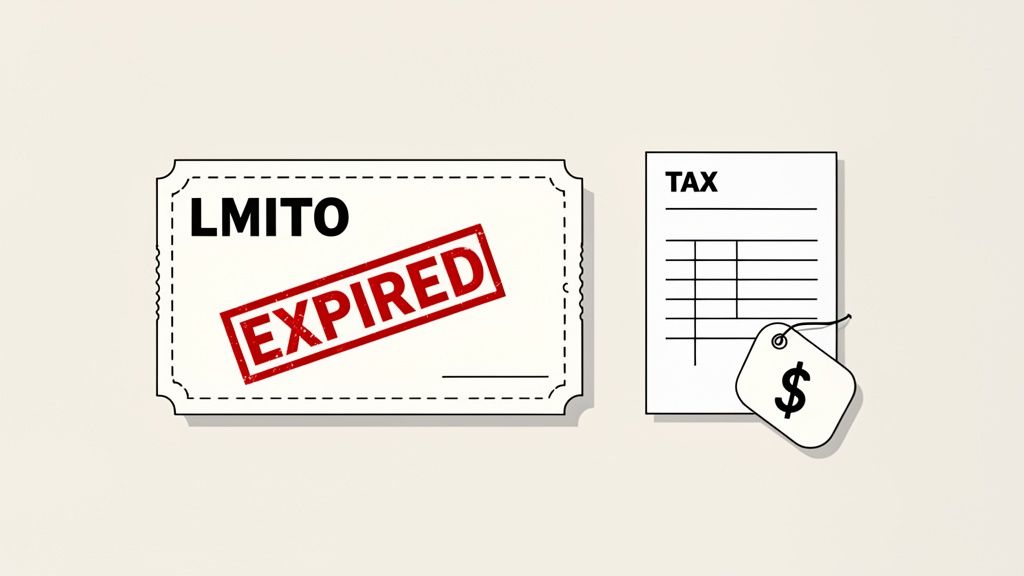
For many taxpayers, the most direct reason for a lower refund is the end of the Low and Middle Income Tax Offset (LMITO). This was a temporary measure providing tax relief to individuals earning up to $126,000 per year. It is important to note that it was last applied to tax returns for the 2021-22 financial year.
The LMITO functioned as a direct reduction in your final tax bill. With this offset no longer in effect, your final tax liability is likely to be higher than in recent years, even if your income and deductions have not changed.
This is not an error in your calculations but a systemic legislative change affecting millions of taxpayers across Australia. The absence of this offset means the baseline amount of tax you are liable for has increased.
Quantifying the LMITO Effect
The removal of the LMITO has had a measurable financial impact. The offset once provided up to $1,080 to eligible taxpayers, a significant amount that often contributed to a larger refund. Its cessation has led to a noticeable reduction in the average refund amount.
Indeed, early data from the ATO for the 2024-25 financial year indicated the average tax refund fell to approximately $2,331 per person. This represents a decrease of more than $430 from the previous year's average of $2,761, as detailed in this analysis of Australian tax refund statistics.
This data reinforces that a smaller refund is a widespread experience, with this specific policy change being a primary contributing factor.
Adjusting to the New Tax Environment
Understanding why the LMITO ended is the first step. It helps reframe the question from "why is my refund so low?" to a more forward-looking "what is my current tax position?". This shift in perspective is a cornerstone of sound financial management.
A smaller refund is not necessarily negative; it often signifies that your tax withholding throughout the year was more accurate. The key may be to adapt your financial strategy to this new reality rather than relying on a large lump sum that is no longer available.
For professionals, business owners, and families, this change underscores the importance of proactive tax planning. When you have a clearer understanding of your likely tax obligations in advance, you can budget with more confidence and make informed financial decisions. It may also be a suitable trigger to review your financial strategy and explore legitimate ways to manage your tax liability, such as those outlined in our guide on how to reduce taxable income in Australia.
Accepting this change is the first step. The next is to plan for the years ahead, ensuring your financial plans are based on the current tax system, not on past expectations.
How the Stage 3 Tax Cuts Affect Your Refund
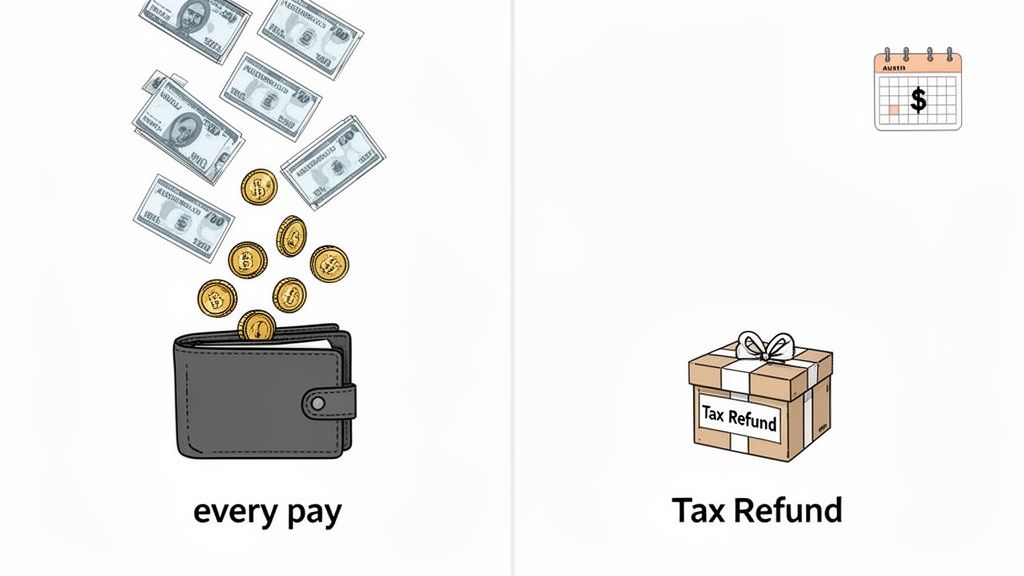
It is a common point of confusion. Many Australians anticipated that the Stage 3 tax cuts would result in a larger refund, so a smaller outcome can feel counterintuitive. The reality is somewhat different and depends on the method of delivery for these cuts.
Since July 2024, employers have been required to withhold less tax from each paycheque in accordance with updated tax tables. You have likely already been receiving the benefit of the tax cuts incrementally in your take-home pay.
Your refund is the mechanism by which the ATO returns tax you have overpaid during the year. As your employer has been withholding a more accurate (and lower) amount of tax, there is simply less to refund. The system has become more efficient, which naturally leads to a smaller lump sum at tax time.
From Annual Lump Sum to Ongoing Benefit
This was a deliberate policy shift designed to improve your regular cash flow rather than provide a single windfall once a year. The benefit has moved from a delayed payment to a consistent increase in your weekly or fortnightly salary.
The new tax brackets facilitate this change. The rate for income between $18,201 and $45,000 was reduced from 19% to 16%, and for income between $45,001 and $135,000, it moved from 32.5% to 30%. Because you may have already received this benefit throughout the year, a mental shift away from expecting a large refund may be necessary.
The focus now turns to how you might steward the extra cash flow in your bank account with each pay cycle.
Putting Your Improved Cash Flow to Work
This steady increase in take-home pay presents an opportunity for proactive financial management. While the extra amount may seem modest each week, it can accumulate into a significant sum over the course of a year.
The current system places you in greater control. Instead of the ATO holding your overpaid tax for a year, you now have access to that capital as you earn it.
This may open up several possibilities, depending on your circumstances. You could consider:
- Making additional contributions to your superannuation.
- Directing the funds into a high-interest savings account.
- Reducing your mortgage or other debts with extra repayments.
Each of these actions puts your money to work for you immediately. For those focused on long-term wealth, this improved cash flow can make advanced strategies, such as understanding how to potentially cut your tax to 15% using super, feel more attainable. Grasping this new dynamic is key to making the most of the tax adjustments.
How Personal Circumstances Can Reduce Your Refund
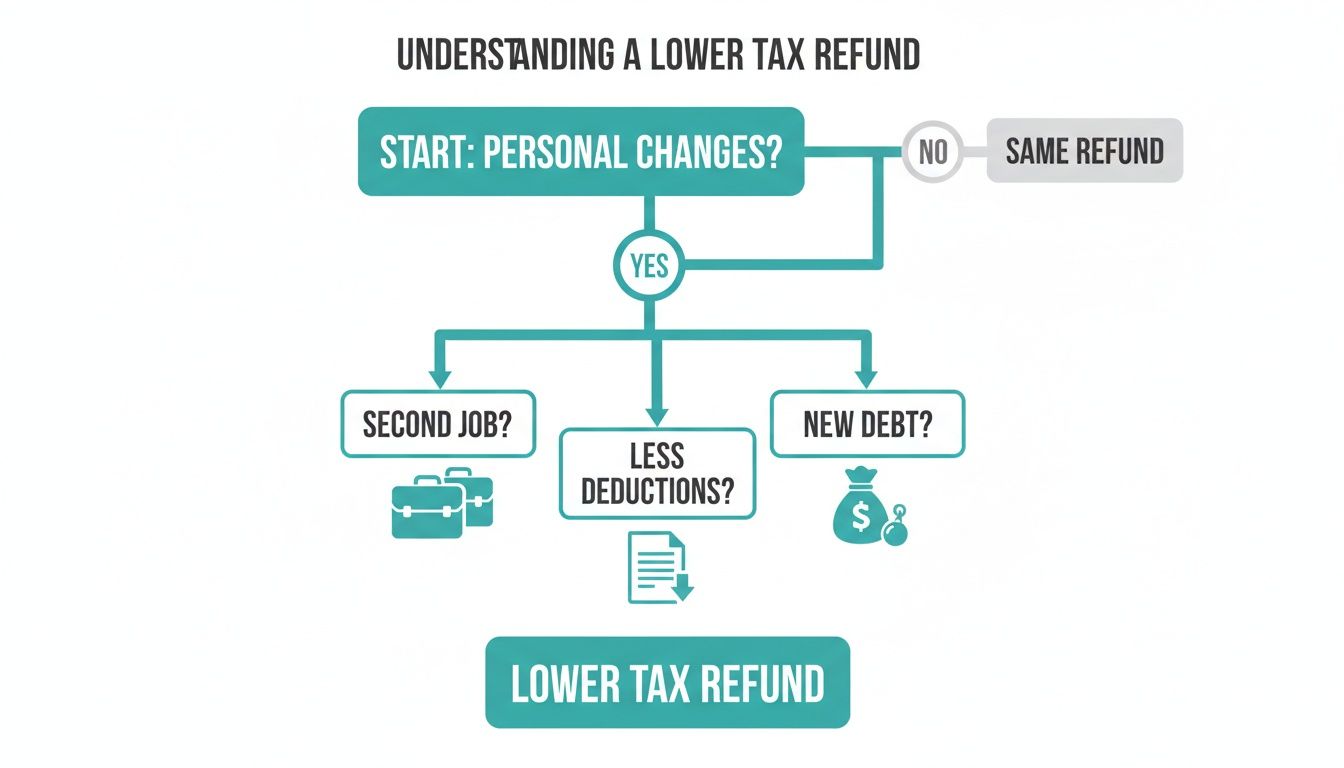
While legislative changes have a broad impact, it is often the shifts in our personal lives—our employment, investments, and family situations—that directly influence our final tax position. These are not necessarily signs of an error, but rather the natural financial outcomes of life's progression.
For example, a professional who takes on a second job or consulting work must navigate their tax obligations carefully. Most people claim the tax-free threshold for their primary source of income, meaning no tax is paid on the first $18,200. If this threshold is claimed for a second job, insufficient tax will likely be withheld, potentially resulting in a tax liability instead of a refund.
Similarly, it is wise to remain aware of how evolving government policies may intersect with your personal situation. Monitoring developments, such as potential changes to income tax exemptions for specific groups, can help build a clearer picture of your obligations.
Changes to Income and Deductions
The way Australians work has changed, and our tax deductions have evolved accordingly. For instance, a professional who has transitioned from working fully from home to a hybrid or full-time office arrangement may see a significant reduction in their work-related expense claims.
Fewer days at home may mean fewer home office running costs to claim, resulting in a smaller deduction. The ATO rules in this area have been updated, so accuracy is essential. Our guide on claiming working from home expenses provides an overview of the current requirements.
New sources of investment income can also affect a tax outcome. If you have started earning dividends from shares, distributions from a managed fund, or interest from a savings account, this income is assessable. Unless tax was withheld at the source, this additional income will increase what you owe to the ATO.
The Impact of HELP Debt
For many Australians, a Higher Education Loan Program (HELP) debt plays a significant role in their final tax assessment. Compulsory repayments are calculated as a percentage of your income, and the ATO collects this amount through the tax return process.
When the ATO calculates your final tax position, your HELP repayment is treated as a liability. This amount is subtracted directly from any refund you might have been due or added to any tax you owe.
This means that even if you have paid the correct amount of tax on your salary, a portion of your potential refund may be automatically directed to repay your HELP debt. The result is often a much smaller net refund. As your income increases, so does the repayment percentage, which will trigger a larger HELP repayment and further reduce your tax refund. Understanding this relationship is key to setting realistic expectations.
Risks, Responsibilities, and Practical Next Steps
A smaller tax refund is not merely a financial outcome; it is a valuable signal to review your financial structure and strategy with care. It underscores the responsibility each of us has to understand our obligations and plan accordingly.
- For Business Owners and PSI Earners: Your primary responsibility is to correctly assess your income and structure your tax affairs in compliance with ATO guidelines. For those earning Personal Services Income (PSI), misinterpreting the rules can lead to incorrect tax assessments. Similarly, for small business owners, ensuring your Pay-As-You-Go (PAYG) instalments align with your actual income is crucial to avoid a large tax bill at year-end. Reviewing your entitlements in our guide to small business tax deductions may be a helpful exercise.
- For New Migrants: A key responsibility is to correctly determine your tax residency status. This factor dictates whether you must declare worldwide income in Australia and has a profound impact on your final tax outcome. Seeking professional advice may be appropriate if you are uncertain.
- For Families: Life changes, such as a partner returning to work or children leaving home, can alter eligibility for certain family tax benefits. It is important to update your circumstances with Services Australia and the ATO to ensure the correct amounts are paid and to avoid potential debts.
Rather than viewing a low refund as a setback, it could be considered an opportunity to refine your financial approach. Good stewardship involves looking ahead, understanding obligations, and planning with quiet confidence. Depending on the complexity of your situation, seeking professional guidance from a financial planning expert may be a prudent step toward achieving that certainty.
A Concise Takeaway
A lower tax refund is often not a sign of a problem, but rather an indication that your tax withholding has become more accurate throughout the year. Legislative changes like the end of the LMITO and the implementation of Stage 3 tax cuts, combined with personal circumstances such as a change in income or deductions, are the most common reasons. This shift presents an opportunity for more disciplined, proactive financial management, allowing you to steward your improved cash flow with intention throughout the year.
If you would like clarity on how these principles may apply to your own circumstances, you may wish to speak with a qualified adviser. You can contact Everglow on 1300 913 929 or email contact@everglow.au to arrange a discussion.
General Advice Warning: The information provided in this article is general in nature and does not take into account your personal objectives, financial situation, or needs. Before acting on any information, you should consider the appropriateness of the information having regard to your own objectives, financial situation, and needs, and seek personal advice from a licensed professional.
