

In Australia's taxation system, a foundational principle allows a portion of your annual income to remain untaxed. This is known as the tax-free threshold, which is currently $18,200 for Australian residents for tax purposes.
This threshold serves as the starting point for income tax. Earnings up to this amount are taxed at zero, a feature designed to support all individuals, particularly those with lower incomes. Understanding its application is a key step in prudent financial management.
Your Starting Point for Australian Income Tax
The tax-free threshold is a core component of the Australian tax framework. It directly influences how much tax an employer withholds from your remuneration, a system known as Pay-As-You-Go (PAYG) withholding. Correctly applying this threshold may assist with managing your cash flow throughout the year and can affect your net take-home pay.
To provide context, here is a summary of how the threshold generally operates.
Australia's Tax-Free Threshold at a Glance
| Attribute | Details |
|---|---|
| Current Threshold | $18,200 per financial year |
| Who may be Eligible? | Australian residents for tax purposes |
| How It Works | The first $18,200 of annual income is not typically subject to income tax |
| How to Claim It | Generally claimed via a TFN Declaration when commencing new employment |
| Multiple Employers | It is generally advisable to claim it from one employer only |
| Non-Residents | Generally not eligible; tax may be payable from the first dollar earned |
This table summarises the key points, but the practical value lies in understanding how these details may apply to your personal circumstances.
Key Aspects of the Threshold
For most professionals, families, and business owners in Australia, the threshold is a straightforward concept. However, individual circumstances can alter its application.
- Residency is Crucial: The full $18,200 threshold is generally available only to Australian residents for tax purposes. This status is determined by a specific set of factors defined by the Australian Taxation Office (ATO), distinct from citizenship or visa status.
- The One-Payer Guideline: If you have more than one source of income, it is often appropriate to claim the tax-free threshold from only one of them. A common approach is to claim it from the highest-paying source of income to help ensure your tax withholding is as accurate as possible.
- Impact on Your Pay: When you claim the threshold correctly, your employer generally withholds less tax from each pay cycle. If you do not claim it, more tax is typically withheld, which may be returned as a refund upon lodging your tax return. For more on this, you may find our guide to the Australian tax return deadline useful.
The tax-free threshold provides a buffer, ensuring that a foundational level of income remains untaxed. It is a consistent feature of our system, designed to promote fairness and simplicity at the entry level of earnings.
The $18,200 figure has been in place since the 2012–13 financial year. It is important to note that if you are a new migrant or became an Australian resident part-way through a financial year, the threshold may be adjusted on a pro-rata basis. The ATO provides specific guidance on this calculation, which typically starts with a base amount of $13,464, plus a portion of the remaining $4,736 based on the number of months you were a resident. You can discover more insights about personal tax thresholds for a deeper dive into these calculations.
Determining Your Eligibility to Claim the Threshold
Eligibility to claim the $18,200 tax-free threshold depends almost entirely on one factor: your residency status for tax purposes.
It is a common point of confusion, but your tax residency is a concept separate from your citizenship or immigration status. The Australian Taxation Office (ATO) applies its own set of tests to determine this, and establishing your status correctly is the first step toward ensuring your tax obligations are managed appropriately.
Your visa may permit you to live and work in Australia, but the ATO’s rules determine how you are taxed here. These rules consider factors such as the ‘resides test’—which assesses your physical presence and intention to make Australia your home—and the ‘183-day rule’, which is a more direct measure of your time in the country during the financial year.
This simple decision tree provides a high-level overview of the residency determination process.
The key takeaway is clear: being an Australian resident for tax purposes is the gateway to accessing the tax-free threshold. Understanding which side of that line you fall on is essential.
Rules for Non-Residents and Temporary Visitors
If you are not an Australian resident for tax purposes, the rules are quite different. Generally, you cannot claim the tax-free threshold. This means you may be required to pay tax from the very first dollar you earn from an Australian source.
The specific treatment can vary depending on your situation.
- Working Holiday Makers: Individuals on a 417 or 462 visa are subject to a different set of tax rates. They are typically taxed at 15% on income up to $45,000, but do not access the standard tax-free threshold in the same way as a resident.
- Foreign Residents: An individual classified as a foreign resident for tax purposes generally pays tax at a rate of 30% on their Australian-sourced income up to $135,000, with no access to the $18,200 threshold.
These different treatments underscore the importance of correctly identifying your tax residency status from the outset. To understand this topic in more detail, you can learn about the implications of being a non-resident for tax purposes in Australia.
New Migrants and Part-Year Residency
It is common for new migrants or Australians returning from overseas to become an Australian resident part-way through a financial year. In these cases, the full $18,200 threshold is generally not available. Instead, a pro-rata, or adjusted, amount is applied.
The ATO has a specific calculation for individuals who become residents during the year. It typically involves a base tax-free amount plus a proportionate amount for the number of months you were a resident.
This approach is designed to be equitable, ensuring the threshold you receive reflects the period you were part of the Australian tax system.
For example, consider a professional who migrates from Singapore and becomes an Australian tax resident on 1 January. As a resident for six months of the financial year (January to June), their tax-free threshold would be adjusted to reflect this half-year period.
Determining tax residency can be complex, particularly if you have ties to multiple countries or your circumstances change frequently. If your situation is not straightforward, obtaining professional advice may be a prudent step to ensure you are meeting your obligations.
How to Claim the Tax-Free Threshold Correctly
The process for claiming the tax-free threshold is generally straightforward and is integrated into the employment commencement process. The Australian Taxation Office (ATO) has designed it to be a simple part of your onboarding paperwork, helping to ensure your tax is managed correctly from your first payment.
When you start a new role, your employer will provide a Tax File Number (TFN) Declaration form. This is the key document where you inform your employer of your tax circumstances, including whether you wish to claim the tax-free threshold.
For most Australians with one job, the choice is simple. You may tick 'yes' to the question, "Do you want to claim the tax-free threshold from this payer?". This instructs your employer to apply the $18,200 threshold to your pay, which typically means less tax is withheld from each pay cycle.
Managing Multiple Income Sources
It is common to have more than one source of income, such as a second job, freelance work, or a government pension. When managing multiple payers, careful consideration is required.
As a general rule, you should only claim the tax-free threshold from one employer or payer at a time. It often makes sense to claim it from your highest-paying source of income.
Each employer's payroll system operates independently. If you were to claim the threshold at two different jobs, both might apply the $18,200 allowance as if that were your only income. The result could be that neither job withholds enough tax to cover your total annual earnings, potentially leading to a tax liability when you lodge your return.
By claiming the threshold from only your main employer, you help ensure that the tax withheld across all your sources of income is more likely to align with your end-of-year tax obligation. This simple step promotes financial stability and helps avoid unexpected liabilities.
A Practical Example of Claiming the Threshold
Let's consider a practical scenario to illustrate this principle.
Scenario: Sarah is a full-time professional earning $80,000 a year. She also has a weekend job at a local café, earning an additional $15,000 a year.
- The Recommended Approach: Sarah claims the tax-free threshold from her main professional role. For her café job, she does not claim it. This instructs her café employer to withhold tax from the first dollar she earns there. This way, sufficient tax may be withheld throughout the year to cover her combined $95,000 income.
- An Alternative Approach: If Sarah claimed the threshold from both jobs, each employer would calculate tax based on a lower effective income. This could create a significant shortfall in the tax withheld, potentially leaving her with a debt to the ATO at tax time.
This example highlights the importance of making a deliberate choice. Taking a moment to complete this form correctly may save you from financial stress later. If you are unsure which approach is appropriate for your circumstances, our team can provide guidance through our specialised tax and accounting services.
Reviewing Your Declaration
Life events can change your financial situation. A new job, a change in income, or a shift in working hours could mean it is appropriate to update your TFN Declaration with your employer.
Lodging a new form may be advisable if you:
- Start or stop a second job.
- Change your work arrangements, for example from part-time to full-time.
- Begin receiving a taxable pension or other government allowance.
Staying current with this information helps keep your tax withholding accurate. It is a small administrative task that can contribute to sound financial management.
Practical Australian Examples
Understanding the theory is one thing, but seeing how the tax-free threshold applies in different scenarios can provide greater clarity. While the rule itself is simple, its effect on your take-home pay can vary depending on your personal circumstances.
Let's explore a few common examples relevant to Australian professionals, business owners, and new migrants. These illustrations show how a thoughtful approach to this detail can support your cash flow management and help you meet your obligations to the Australian Taxation Office (ATO).
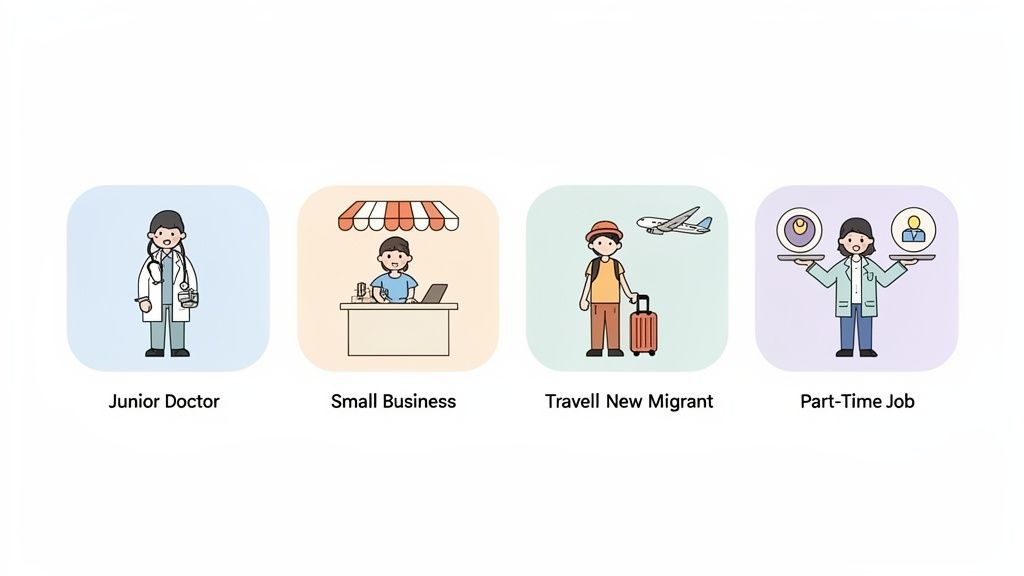
The First-Year Medical Resident
Dr. Anya has just commenced her residency at a public hospital, earning $75,000 a year. This is her only source of employment income.
- Action: When completing her TFN Declaration form, Dr. Anya correctly claims the tax-free threshold.
- Application: Her hospital's payroll system will not withhold income tax from the first $18,200 she earns. Tax will only be calculated on the remaining $56,800.
- Outcome: This ensures the tax taken from her fortnightly pay is calculated appropriately from the start, supporting stable cash flow.
The Small Business Owner
Ben operates a small marketing agency structured as a company. He draws a director's salary of $90,000 per year, processed through payroll.
- Action: As the company is his only source of employment income, Ben claims the tax-free threshold for his director's salary.
- Application: His company withholds tax on the basis that the first $18,200 of his $90,000 salary is tax-free.
- Outcome: This is a disciplined approach for a business owner. By treating his salary correctly for PAYG withholding, Ben helps ensure his personal tax obligations are met progressively, keeping them distinct from the company's tax affairs.
Understanding how to correctly apply the tax-free threshold is a foundational element of sound financial stewardship. It demonstrates foresight and an appreciation for the steady, patient management of one's tax obligations.
The New Migrant Professional
Li Wei, an IT professional, moves from China and becomes an Australian resident for tax purposes on 1 January. He secures a role with a $120,000 annual salary. As he was a resident for only half the financial year, he is not entitled to the full $18,200 threshold.
- Action: Li Wei's tax-free threshold needs to be calculated on a pro-rata basis.
- Application: The ATO has a specific rule for part-year residents. He is entitled to a base tax-free amount of $13,464, plus a portion of the remainder. For his six months of residency, his adjusted threshold is approximately $15,832.
- Outcome: It is possible his employer's standard payroll software may not automatically adjust for part-year residency, even if he claims the threshold. This could result in less tax being withheld than required. This is a classic situation where it may be prudent to set aside funds for a potential tax liability. We explore similar topics in our educational resource on why your tax refund might be lower than expected.
The Individual with Two Part-Time Jobs
Chloe is a part-time graphic designer earning $40,000. She also works evenings at a restaurant, earning another $20,000. Her total income is $60,000.
- Action: Chloe claims the tax-free threshold from her higher-paying design job only. For the restaurant job, she ticks 'no' on her TFN Declaration.
- Application: Her design employer applies the $18,200 threshold. Her restaurant employer withholds tax from the first dollar she earns, and at the appropriate marginal rate.
- Outcome: This disciplined approach helps prevent a tax bill at the end of the year. By not claiming the threshold twice, she ensures the total tax withheld across both jobs is more likely to be aligned with her actual tax liability on her combined $60,000 income.
These examples show that while the rule is simple, its correct application requires careful consideration of one's own circumstances. A thoughtful declaration is a small act that can contribute significantly to good financial discipline.
If you would like clarity on how these principles may apply to your own circumstances, you may wish to speak with a qualified adviser. You can contact Everglow on 1300 913 929 or email contact@everglow.au to arrange a discussion.
General Advice Warning: The information provided in this article is general in nature and does not take into account your personal objectives, financial situation, or needs. Before acting on any information, you should consider the appropriateness of the information having regard to your own objectives, financial situation, and needs and seek personal advice from a qualified financial adviser.
Want help applying this to your situation?
Every situation is different. Book a time with our team to talk it through, or call us on 1300 913 929.
Book a free meetingAustralian tax guide →Estimate your fees →
Keep exploring