

In Australia, the term negative gearing is frequently discussed, particularly in property investment circles. In essence, a property is negatively geared when the annual costs of holding it—such as loan interest, council rates, and maintenance—are greater than the rental income it generates. This resulting net rental loss may, depending on your circumstances, be used to reduce your other taxable income, which could lead to a lower tax liability for the financial year.
This guide breaks down the concept into clear, practical terms, grounded in Australian tax rules and financial principles.
Understanding the Core Concept of Negative Gearing
Negative gearing is a financial strategy that many Australian property investors, business owners, and families planning for their future may encounter. At its heart, it is an approach that calls for patience—a strategy focused on long-term capital growth rather than immediate rental profit. The central premise is that an investor is prepared to accept a short-term cash flow shortfall with the expectation that the property's value will appreciate significantly over time.
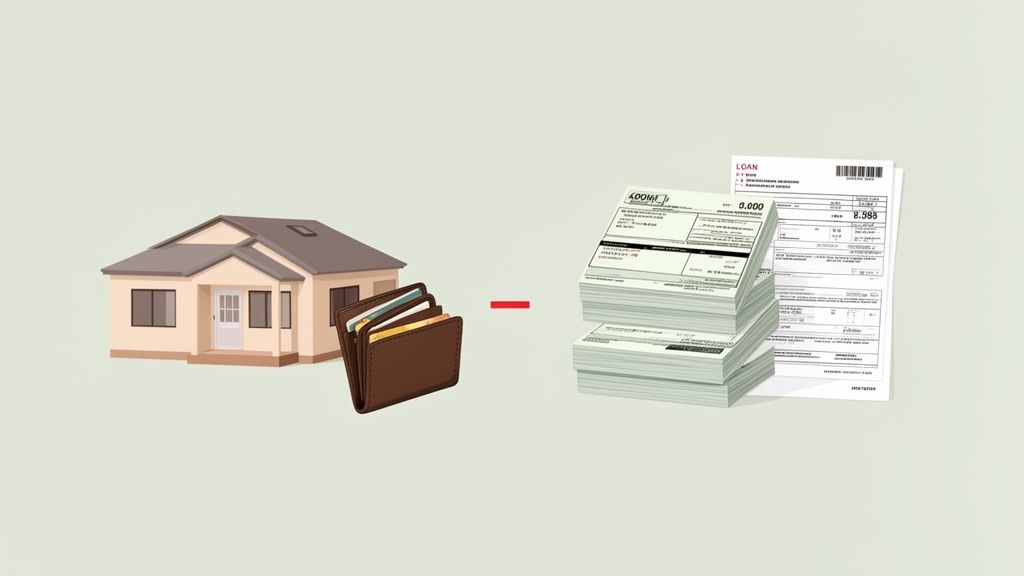
This approach is recognised within the Australian taxation system. The Australian Taxation Office (ATO) generally allows taxpayers to claim deductions for expenses related to an income-producing asset. When these allowable deductions exceed the rental income, a net rental loss is created. This loss can then be offset against other assessable income, such as a salary or business profits.
The Key Components
To understand how this functions, it is helpful to consider its main components:
- Rental Income: This is the total rent received from tenants over the financial year.
- Deductible Expenses: These include the costs incurred in managing the property. Common examples are loan interest, strata fees, repairs, insurance, and property management fees.
- Net Rental Loss: This is the shortfall that occurs when your total deductible expenses are greater than your rental income. It is the "negative" aspect of negative gearing.
- Taxable Income Reduction: This is where the strategy may offer a benefit. The net rental loss can be subtracted from your other income, which could result in a lower tax liability or a larger tax refund.
A foundational understanding of cash flow in real estate is essential, as this determines whether a property is generating or consuming cash on an ongoing basis. To see how this fits into a broader wealth-building plan, you may find our overview of Australian property investment strategies a useful educational resource.
The strategy effectively turns a cash flow loss into a potential tax benefit, making it more affordable to hold a growth-focused asset while you wait for its value to go up. But it’s no sure thing—its success depends entirely on the property appreciating in value down the track.
This is a disciplined approach that requires careful financial management. It is not about quick wins. It is about patient, thoughtful planning, where potential tax benefits may help you adhere to a long-term vision for building wealth through property. The decision to pursue this path should always be made with a clear view of both the opportunities and the responsibilities involved, and professional advice may be appropriate.
A Practical Example of Negative Gearing in Australia
To grasp how negative gearing works in practice, it helps to view it from two perspectives: its effect on your day-to-day cash flow and its impact on your annual tax return.
First, there is the cash flow reality. A negatively geared property requires an ongoing financial contribution from you. Because the rent received is insufficient to cover all expenses—such as mortgage repayments, strata fees, and council rates—you must cover the difference from your other income or savings.
Then, at the end of the financial year, the focus shifts to tax. Your accountant or tax agent will tally all the deductible expenses and subtract them from the rental income to determine the net rental loss. Under current Australian tax law, this loss can then be used to reduce your other taxable income, which is the mechanism for the potential tax benefit.
Hypothetical Scenario: An Australian Professional
Consider a professional in Melbourne earning $190,000 per annum. They purchase an investment property for $800,000, motivated by its long-term capital growth potential rather than immediate rental profit.
They secure an interest-only loan to finance the purchase. A simplified breakdown of the property's finances for one year might look like this:
- Annual Rental Income: A tenant pays $650 per week, resulting in $33,800 for the year.
- Annual Deductible Expenses: The total costs—including loan interest, council rates, insurance, and property management—come to $48,000.
It is clear the expenses exceed the income, creating a net rental loss.
The Calculation:
$33,800 (Rental Income) – $48,000 (Deductible Expenses) = -$14,200 Net Rental Loss
This $14,200 shortfall is the cash the investor has had to cover from their own funds over the year, equating to approximately $1,183 per month.
The Tax Outcome
At tax time, this $14,200 net rental loss becomes significant.
- Without the investment property, their taxable income would be their full $190,000 salary.
- With the property, they can deduct the loss: $190,000 (Salary) – $14,200 (Net Rental Loss) = $175,800 New Taxable Income.
By lowering their taxable income, they reduce the amount of tax owed for the year. The exact tax saving depends on their marginal tax rate, but for an individual in this income bracket, the reduction can be substantial. This tax benefit helps to offset the cash shortfall they covered each month, making it more manageable to hold a growth-oriented asset. For more on this, our guide on mortgage interest and tax deductions may be helpful.
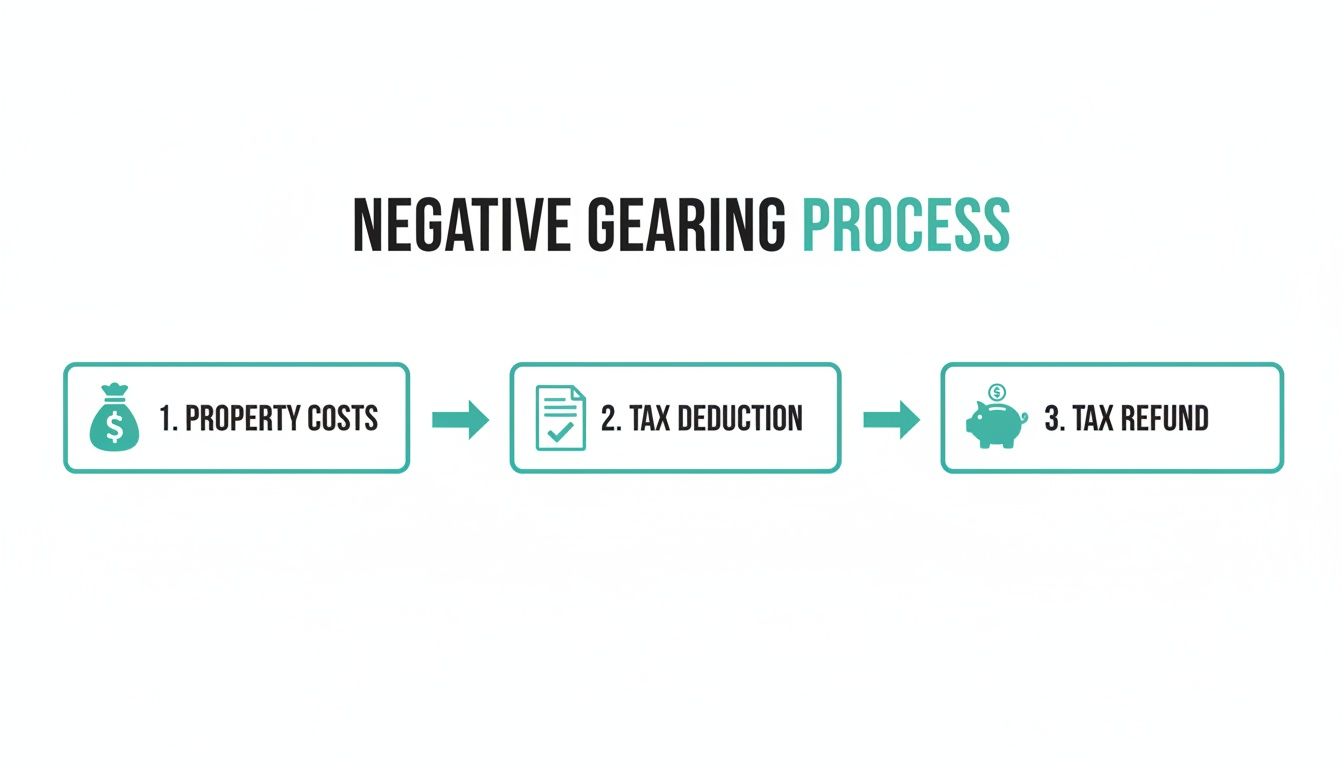
This diagram illustrates how the process works in a typical negative gearing scenario, from covering property costs to claiming them via the tax system.
Key Responsibilities for Investors
This process is contingent on one critical responsibility: meticulous record-keeping. This is a non-negotiable requirement from the Australian Taxation Office (ATO). Every dollar claimed as an expense must be substantiated by a receipt, invoice, or bank statement.
It is also important to understand that not all expenses are treated equally under tax law:
- Immediate Deductions: Regularly incurred costs, like loan interest, rates, and repairs, can generally be claimed in the same financial year they are paid.
- Capital Works and Depreciation: Larger costs related to the building's structure or for assets like a new oven are different. These are typically claimed over several years.
Getting this right is fundamental. The potential tax benefit from negative gearing is a direct consequence of a genuine financial loss and depends entirely on adhering to ATO regulations. A disciplined and organised approach is essential for this to be a sustainable, long-term investment strategy.
Risks, Responsibilities, and Long-Term Strategy
A prudent financial path is one walked with a clear understanding of both potential benefits and risks. While negative gearing can be part of a long-term wealth strategy, its success is never guaranteed. It depends on factors that are often outside an investor's direct control.

The entire strategy hinges on one crucial assumption: capital growth. Australian property markets, however, can move in cycles. They may experience long periods of stagnation or even decline. Should the market soften, an investor could be left covering ongoing cash flow losses without the prospect of a future capital gain to justify them. The ultimate goal is that any profit realised on sale, known as a capital gain, will be significantly greater than the accumulated holding costs.
The Role of Capital Gains Tax
This strategy works in conjunction with another feature of Australia's tax system: the Capital Gains Tax (CGT) discount. As per ATO guidelines, if you hold an investment property for more than 12 months before selling, you may be eligible for a 50% discount on the capital gain. This means only half of the profit might be added to your taxable income for that year.
Consider a small business owner who holds a negatively geared property for ten years. Over that decade, their total net rental losses amount to $90,000. However, the property's value increases, and they sell it for a capital gain of $350,000.
- Because they held it for over a year, the 50% CGT discount may apply.
- The assessable capital gain could be reduced to $175,000 ($350,000 / 2).
- In this scenario, the final assessable gain of $175,000 significantly outweighs the $90,000 it cost to hold the property.
This interplay between managing short-term losses and aiming for a long-term, tax-effective gain is the strategic core of negative gearing.
Market Sensitivities and Personal Obligations
An investor's financial position can be sensitive to broader economic shifts. Rising interest rates, for example, will increase mortgage repayments and deepen the cash flow shortfall. This is why having a robust financial buffer is a non-negotiable element of sound planning.
Rental income can also be affected by various factors:
- Extended Vacancy Periods: A property sitting empty for weeks or months can place a significant strain on finances.
- Unexpected Maintenance: Major repairs can arise without warning and require immediate, unbudgeted expenditure.
- Regulatory Changes: Tax laws around negative gearing and capital gains are subject to change, which could alter the financial viability of the strategy over time.
The responsibility of a property investor is to have the financial resilience to manage these possibilities. Sound stewardship means preparing for the lean seasons, not just hoping for periods of growth.
The decision to pursue negative gearing should be based on a comprehensive assessment of your personal financial situation, risk tolerance, and long-term goals. It requires the capacity to absorb short-term losses and a patient, disciplined approach to wealth creation over many years. This is a journey of careful planning, not speculation.
Practical Next Steps for Aspiring Investors
Understanding the theory of negative gearing is the first step; applying it wisely requires careful consideration. It is a significant financial commitment that comes with real responsibilities and demands deliberate planning grounded in your complete financial picture.
A Thorough Personal Assessment
Before proceeding, an honest assessment of your personal circumstances is essential. You should consider your income stability, your current savings, and your ability to comfortably cover a potential cash flow shortfall for an extended period. Financial resilience is the bedrock of any sound property investment.
It is a valuable exercise to model different scenarios:
- Interest Rate Changes: How would a 1% or 2% rise in your mortgage rate affect your monthly budget?
- Rental Vacancies: What impact would an unexpected eight-week vacancy have on your finances?
- Market Stagnation: How does the long-term outcome look if capital growth is slower than anticipated?
Thinking through these "what-ifs" helps build a more robust financial plan.
Seeking Professional Guidance
Given the complexities of Australian tax law, lending criteria, and property market dynamics, seeking professional guidance is often a prudent step. A qualified adviser can help ensure your decisions align with your long-term goals and responsibilities. They can bring clarity to how these financial principles apply specifically to your situation, whether you are a professional, a business owner, a new migrant, or a local family.
If you are considering how such strategies fit within your broader financial life, our financial planning services are designed to provide that clarity and structure.
Ultimately, the path forward should be paved with diligence and foresight.
Key Takeaway
Negative gearing is a long-term property investment strategy available in Australia where the goal of future capital growth outweighs the reality of a short-term cash flow loss. Its potential success depends on property value appreciation, and the strategy is supported by the tax system, which may allow rental losses to reduce an investor's other taxable income. This approach requires financial stability, a high tolerance for risk, and meticulous record-keeping. It is not suitable for everyone, and professional advice is recommended to determine if it aligns with your personal financial circumstances and goals.
If you would like clarity on how these principles may apply to your own circumstances, you may wish to speak with a qualified adviser. You can contact us on 1300 913 929 or email contact@everglow.au to arrange a discussion.
General Advice Warning
The information provided in this article is general in nature and does not take into account your personal objectives, financial situation, or needs. Before acting on any information, you should consider the appropriateness of the information having regard to your own objectives, financial situation, and needs and seek personal advice from a qualified financial adviser.
Want help applying this to your situation?
Every situation is different. Book a time with our team to talk it through, or call us on 1300 913 929.