

At its heart, a unit trust is a way of holding assets—like a commercial property or a portfolio of shares—on behalf of a group of people. Instead of owning the asset directly, each person holds ‘units’ that represent their fixed share of the investment.
Think of it like a group of professionals buying their business premises together. Instead of putting every individual's name on the title deed, which can become complicated, they establish a trust. The trust legally owns the property, and each professional receives a number of units proportional to their capital contribution. It’s a clear, structured way to define precisely who owns what.
Understanding the Key Players
To grasp what is a unit trust, it is essential to understand the three main parties involved. Each has a specific, legally defined role, all set out in the trust's founding document, the trust deed. This framework provides a steady foundation for co-investment, whether for a family business or a joint venture between unrelated parties.
This structure is a well-established feature of Australia's financial landscape. The first unit trusts emerged in 1936, created by Australian Fixed Trusts. The goal was to provide everyday investors with access to a diversified portfolio of securities, a concept that had proven successful in British markets.
The Trustee
The Trustee is the legal owner of the assets held in the trust. This can be an individual but is more commonly a company, appointed for liability protection. The trustee holds the title to the property or shares, but—and this is a critical distinction—they do not hold it for their own benefit. Their duty is to manage the assets solely for the unitholders.
A trustee's duties are serious and legally binding under Australian law. They are responsible for administering the trust according to the rules in the trust deed and must always act in the best interests of all unitholders. This is a fiduciary duty, a cornerstone of trust law, which demands a high standard of care and loyalty.
The Unitholders
The Unitholders are the 'beneficial' owners of the trust's assets. They are the individuals or entities who contribute the capital to acquire the asset. In return for their capital, they receive units that represent their precise share of the trust’s income and capital.
For instance, if two business partners contribute equally to buy a commercial building through a unit trust, they would each hold 50% of the units. This entitles each of them to half the net rental income and half of any capital gain if the building is sold. While it shares features with other trusts, this fixed ownership stake is what sets it apart from more flexible arrangements. For contrast, you may wish to understand what a bare trust is.
The Trust Deed
The Trust Deed is the rulebook. It is the foundational legal document that establishes the trust and dictates how it will be administered. A well-drafted trust deed is essential and should clearly set out:
The rights and responsibilities of the trustee and the unitholders.
The rules for how units may be issued, transferred, or redeemed.
The process for distributing income and capital gains.
The mechanisms for resolving disputes or winding up the trust.
Having this document drafted by an experienced legal professional is critical for preventing future disagreements and ensuring the trust operates as intended under Australian law.
Here’s a summary of the roles:
Key Parties in a Unit Trust at a Glance
| Role | Who They Are | Primary Responsibility |
|---|---|---|
| Trustee | An individual or a company | The legal owner and manager of the trust's assets, acting in the best interests of the unitholders in accordance with the trust deed. |
| Unitholders | Individuals, companies, or other trusts | The beneficial owners who provide the capital and are entitled to income and capital in proportion to their units. |
| Trust Deed | The foundational legal document | The 'rulebook' that governs the trust's operations, and the rights and obligations of all parties. |
Understanding these roles is the first step in seeing how a unit trust can provide a clear and effective structure for joint investments.
How a Unit Trust Actually Works in Australia
A unit trust is a clear, rule-based structure designed to allow a group of people to invest together, with a dedicated manager ensuring the arrangement is managed with prudence. The entire operation is governed by one critical document: the Trust Deed.
Think of the trust deed as the trust's constitution. This legally binding agreement specifies every operational detail—from the trustee's powers to the unitholders' rights. A carefully drafted deed anticipates future scenarios and potential disagreements, laying out clear procedures for matters like issuing new units, valuing assets, or settling disputes.
The Trustee: A Duty of Care
While the Trust Deed is the blueprint, the Trustee brings it to life. The trustee is the manager responsible for executing the plan laid out in the deed.
Under Australian law, a trustee has a strict fiduciary duty. This is a legal obligation to act solely in the best financial interests of the unitholders. It is one of the highest standards of care recognised by law.
This duty means the trustee must:
Manage the trust’s assets with care and diligence.
Avoid any conflicts between their personal interests and their duties to the trust.
Keep meticulous and accurate financial records, which should be available for unitholders to inspect.
Act impartially, ensuring no single unitholder or group is unfairly favoured over others.
These duties are enforced by the Australian Securities and Investments Commission (ASIC) and common law. Any breach can result in serious legal and financial consequences for the trustee, providing a powerful safeguard for investors' capital.
Following the Money: How Income and Capital Flow
One of the most appealing features of a unit trust is its straightforward handling of returns. Any income the trust’s assets generate—such as rent from a commercial property or dividends from shares—flows through to the unitholders. Similarly, if an asset is sold for a profit, that capital gain is also passed on.
This distribution is not arbitrary. It is calculated in direct proportion to the number of units each person holds. For example, if you hold 40% of the units in a trust that owns an office building, you are entitled to 40% of the net rental income each year. This transparent, pro-rata system provides certainty and fairness.
Unit trusts are a significant part of Australia's financial system. They are a cornerstone of retail investment, with total assets under management reaching around AUD 480 billion in the second quarter of 2023. This figure highlights their role as a popular vehicle for pooling capital into major assets. You can explore more Australian investment fund statistics here.
The mechanics of a unit trust are built on a solid legal foundation. The Trust Deed sets the rules, the Trustee carries them out with a high degree of care, and the unitholders benefit in precise proportion to their investment. This structured approach is what makes it a reliable way to invest and own assets with others—provided it is managed with foresight and discipline. Understanding these operational pillars is the first step to seeing how a unit trust could fit into your financial strategy.
Navigating Tax and Compliance Obligations
Understanding the relationship between a unit trust and the Australian Taxation Office (ATO) is crucial. When structured and managed correctly, a unit trust may be a tax-effective way to hold investments. However, this outcome depends entirely on diligent and ongoing compliance.
A key feature of a unit trust is that it is typically treated as a ‘flow-through’ entity for tax purposes. This means the trust itself generally does not pay income tax. Instead, the income it generates—such as rent or dividends—flows directly through to the unitholders.
The Flow of Income and Tax
Each unitholder is responsible for their share of the trust's taxable income, determined by their unit holding. They declare this income in their personal tax return and pay tax at their own marginal rate. The tax outcome is personal; a professional in a high tax bracket and a new migrant starting a business could be unitholders in the same trust, but they may pay different amounts of tax on the same distribution, depending on their circumstances.
This flow-through approach can be particularly beneficial when dealing with capital gains.
When a unit trust sells an asset for a profit, it triggers a Capital Gains Tax (CGT) event. If that asset was held for over 12 months, the trust may be eligible for the 50% CGT discount. This discount can then flow through to individual unitholders, potentially reducing their taxable capital gain.
This is a significant advantage compared to a company structure, which cannot pass the CGT discount on to its shareholders. Accessing this benefit requires that your record-keeping and compliance are meticulously maintained. To explore these concepts further, you may wish to read our guide on smart investment tax strategies for Australian investors.
This flowchart breaks down the basic journey, from the trust's legal foundation to the unitholder benefits.
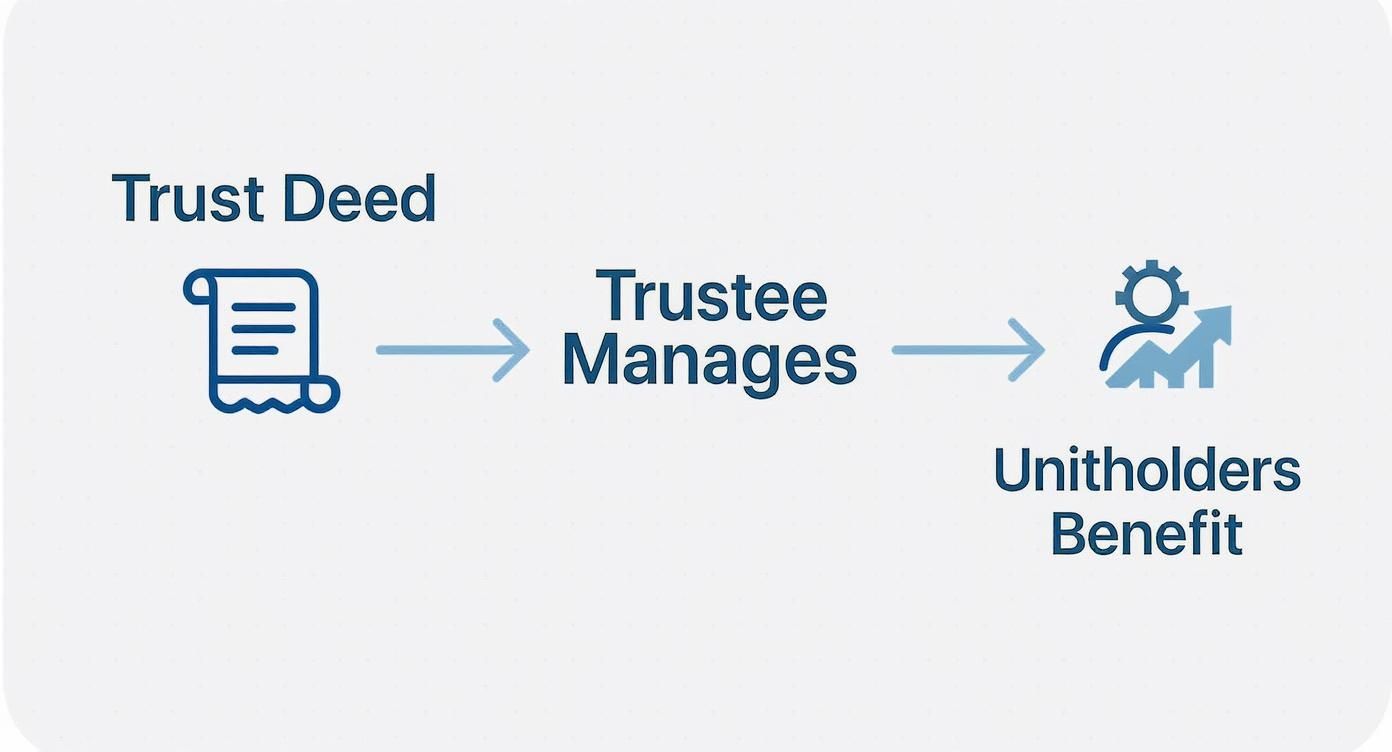
As shown, the Trust Deed governs the trustee's actions, which in turn delivers financial outcomes to the unitholders—all within a strict legal and tax framework.
Your Core Compliance Duties
To maintain the trust’s tax-effective status, the trustee has a list of non-negotiable responsibilities each financial year. Failure to meet these obligations can lead to significant financial penalties.
One of the most critical annual tasks is the trustee's distribution resolution. This is a formal, written decision made before 30 June each year, which records how the trust's income and capital gains will be distributed among the unitholders.
This step should not be underestimated. If a valid resolution is not made on time, the trustee could be assessed for tax on any undistributed income, potentially at the highest marginal rate. This can be avoided with disciplined administration.
Beyond this key resolution, the trustee is also responsible for:
Lodging an annual trust tax return: Even if the trust pays no tax itself, it must report its income, deductions, and distributions to the ATO.
Maintaining accurate records: This includes keeping meticulous financial statements, minutes from trustee meetings, and an up-to-date register of all unitholders.
Obtaining an ABN and TFN: The trust requires its own Australian Business Number (ABN) and Tax File Number (TFN) to operate.
Staying on top of these duties requires a steady hand. While the potential tax treatment of a unit trust is favourable, those benefits are entirely dependent on compliant administration. Seeking personal tax advice is always a prudent step to ensure your structure is working effectively for you.
Unit Trusts Versus Companies: A Structural Comparison
For anyone starting a business or making a joint investment in Australia, choosing the right structure is a foundational decision. It is the blueprint for your financial future, shaping everything from tax obligations to the protection of your personal assets.
Two common vehicles are the unit trust and the proprietary limited (Pty Ltd) company. While they may appear to serve similar purposes, they are fundamentally different in their operation and legal standing.
Understanding these differences is about ensuring your structure aligns with your objectives. A family investing in property has different needs from a group of unrelated partners launching a new technology venture. Let's compare them side-by-side.

How Profits and Income are Handled
The most immediate difference is how money moves from the entity to the owners.
A unit trust is designed for clarity. The trust's net income for the year is distributed to unitholders based on their fixed unit holdings. It is a "flow-through" system where income passes directly to the individuals, who then pay tax on it at their personal marginal rates.
Companies are more rigid. The company first earns the profit and pays tax at the corporate rate (currently 25% for many small businesses). Only then can the directors decide to pay out the remaining profits to shareholders as dividends. While franking credits are designed to prevent double taxation, the process is less direct and gives directors more control over when profits are distributed.
The distinction here is about timing and control. With a unit trust, income generally must be distributed each year. In a company, directors can choose to retain profits for reinvestment, deferring the tax event for shareholders until a dividend is paid.
Capital Gains and Tax-Effective Investing
This is where the unit trust can be particularly advantageous, especially for long-term investments like property or shares.
When a unit trust sells an asset held for more than 12 months, it may be able to access the 50% Capital Gains Tax (CGT) discount. This discount can be passed directly to eligible individual unitholders, meaning they may only have to pay tax on half of their share of the capital gain.
A company cannot do this. If a company realises a capital gain, it pays tax on the full amount at its corporate tax rate. It cannot pass the 50% CGT discount through to its shareholders. For a successful long-term investment, this difference could have a significant impact on the final after-tax return.
Asset Protection and Personal Liability
Protecting personal assets is a primary concern for any investor, and a company structure is often seen as the standard for liability protection.
A company is a separate legal entity. This means if the company incurs debt or is sued, liability generally stops with the company itself. Shareholders' personal assets—like the family home—are typically shielded, with their risk limited to the value of their shares.
A unit trust, on its own, does not offer this inherent protection. The trustee is legally responsible for the trust’s debts. If an individual is appointed as trustee, their personal assets could be at risk. This is why it is standard practice to use a corporate trustee for a unit trust. This common strategy creates a strong layer of liability protection, combining the benefits of the trust structure with the asset protection of a company.
While a unit trust's fixed entitlements are clear, it is helpful to see how it compares to other trust types. You can learn more by reading our guide on what a discretionary trust is to understand the full range of options.
To make the differences clearer, here is a simple table.
Unit Trust vs Company: A Structural Comparison
This table summarises the practical distinctions between unit trusts and companies under Australian law.
| Feature | Unit Trust | Company (Pty Ltd) |
|---|---|---|
| Income Flow | Income 'flows through' annually to unitholders to be taxed at their marginal rates. | Profits are taxed at the corporate rate, then may be distributed as dividends. |
| CGT Discount | May pass the 50% CGT discount through to eligible individual unitholders. | Cannot pass the CGT discount through to shareholders. |
| Asset Protection | Limited liability is achieved by appointing a corporate trustee. | Provides limited liability to shareholders as a separate legal entity. |
| Ownership | Ownership is held via units, which can be transferred or redeemed according to the trust deed. | Ownership is held via shares, governed by the Corporations Act. |
The "best" choice depends on your specific activities, your partners, and your long-term goals. Taking the time to weigh these factors with a professional adviser is the first step toward building a robust structure that will support your financial objectives for years to come.
Real-World Scenarios: Where Unit Trusts Are Used
Theory is one thing, but seeing how a unit trust functions in practice helps clarify its purpose. In these real-world examples, a well-structured unit trust provides the clear, steady framework needed for different parties to pursue a shared goal.
Let's look at a few common Australian scenarios where the disciplined nature of a unit trust helps align the interests of different people.

Investing in Commercial Property
Imagine a group of medical specialists—a surgeon, an anaesthetist, and a GP—teaming up to purchase the medical suites they currently rent. They are colleagues, not family, and they require absolute certainty about their ownership stakes from the beginning.
A unit trust is a suitable fit here.
Clear Ownership: If each contributes equally, they each receive an equal number of units. This gives them a clearly defined one-third stake in the property, formally recorded in the unit register.
Orderly Entry and Exit: If one specialist decides to retire or relocate, the trust deed can outline a clear process for selling their units to the remaining partners or a new investor, without the complexity of changing the property's legal title.
Direct Income Flow: The rent paid by their respective practices flows through the trust and is distributed to them personally, in direct proportion to their unit holdings.
This structure allows unrelated parties to invest together with confidence, knowing their rights and responsibilities are clearly defined from the outset.
Managing a Family Business
Consider a family-owned business where the founding parents are still involved, but their two adult children now hold key roles. The parents want to distribute profits in a fixed manner to reward everyone's contribution and also need a structured way to plan for eventual succession.
A unit trust can provide that fixed framework. The parents might hold 60% of the units, with each child holding 20%. This locks in how profits are distributed, ensuring everyone receives a share that reflects their stake in the business. It is a straightforward approach that provides certainty and can be a sound alternative to a more flexible discretionary family trust when fixed entitlements are the priority.
A Property Development Joint Venture
Imagine a small-scale property developer partnering with a landowner to build a block of townhouses. The developer brings the expertise, and the landowner contributes the land. They need a structure that precisely defines how profits will be split when the townhouses are sold.
A unit trust offers that precision. Units can be issued based on the agreed value of each party’s contribution. When the properties sell, the profits are divided strictly according to those unit holdings. The trust deed serves as the rulebook for the joint venture, keeping all parties aligned.
These examples occur against a backdrop of a growing Australian economy. Household financial assets recently grew, partly due to strong market performance. Unit trusts are a key part of this ecosystem, providing a vehicle for everyday investors to participate in this growth. You can discover more insights about Australian household wealth directly from the ABS.
In each case, the unit trust acts as a predictable and transparent tool. It requires careful planning and diligent management, but for the right situation, it provides a powerful foundation for building shared prosperity.
Common Pitfalls and How to Avoid Them
A unit trust can be a powerful tool, but its strength depends on how well it is managed. Wise financial stewardship involves understanding the risks as clearly as the potential benefits. Foresight and careful planning are the best defences against common mistakes that can lead to costly disputes or unwelcome attention from the ATO.
Many of the most serious problems trace back to a single source: a poorly drafted Trust Deed. This document is the constitution for your trust. Any ambiguity left at the start can grow into a significant problem later.
The Danger of a Vague Trust Deed
Imagine two business partners who start a venture full of optimism. A few years later, they have a major falling out. If their Trust Deed lacks clear, mechanical rules for how to value units or manage a forced exit, they are left trying to negotiate during a conflict. This often spirals into costly legal battles that could have been avoided.
A robust deed is essential. It must clearly specify:
The exact method for valuing units if a unitholder wishes to exit.
Clear pre-emptive rights, giving remaining unitholders the first option to buy those units.
A defined process for resolving disagreements, such as mediation or arbitration clauses.
Without these specifics, you are building your investment on an unstable foundation.
A classic oversight is failing to plan for unexpected life events—such as the death, disability, or bankruptcy of a unitholder. A well-written deed provides a clear roadmap for these scenarios, protecting everyone's interests and ensuring the trust can continue to operate smoothly.
Critical Compliance Missteps
Once the trust is established, the work continues. Ongoing administration demands discipline. One of the most frequent—and damaging—errors is failing to correctly make and document the annual distribution resolutions before the 30 June deadline.
This is not optional paperwork. If a trustee fails to make a valid resolution to distribute all of the trust's income, the ATO can assess the trustee on that income at the highest marginal tax rate. A simple administrative slip can turn a tax-effective structure into a significant financial liability.
Another major pitfall is co-mingling funds. Trust assets must always be kept completely separate from the personal or business assets of the trustee and unitholders. Using the trust's bank account for personal expenses may seem harmless, but it erodes the legal separation of the trust. This can expose trust assets to creditors and create a compliance nightmare. Prudent financial management means keeping things strictly separate.
Diligence in these areas is fundamental to protecting your structure and your wealth. For those managing more complex family assets, understanding the nuances between different trust types is also crucial; our guide on what a discretionary trust is provides helpful context.
A Grounded Takeaway
We have explored how a unit trust can be a flexible and effective way to co-own assets, particularly when seeking a certain tax outcome. Its true strength, however, lies not just in the initial setup but in disciplined, ongoing administration. It requires careful planning and a steady hand to ensure it remains compliant and continues to serve your long-term goals.
Wise financial decisions come from understanding responsibilities as well as opportunities. The structure of a unit trust offers clarity and fixed entitlements, which can be invaluable in business and investment partnerships. The key is ensuring this structure aligns with your specific goals and is managed with diligence. Careful planning, patience, and disciplined action are the cornerstones of good financial stewardship.
For those considering this path, the next practical steps involve ensuring your foundational documents are sound.
For existing trusts: A professional review of your trust deed can identify any ambiguities before they become problems.
For new ventures: Seeking detailed Business Structuring Advice is a critical investment to ensure the chosen structure—whether a trust, a company, or another entity—is fit for your purpose.
Ultimately, understanding what is a unit trust means seeing it as a tool that, when used correctly, can provide a powerful foundation for building a secure and prosperous future.
General Advice Warning: The information provided in this article is general in nature and has not taken into account your personal situation, financial needs or objectives. You should seek professional advice tailored to your specific circumstances before making any financial decisions.
Your Questions About Unit Trusts, Answered
Let's address some of the common questions we hear about unit trusts in Australia. These details often arise when people are considering this structure for their investments.
Can My SMSF Invest in a Unit Trust?
Yes, a Self-Managed Super Fund (SMSF) can invest in a unit trust, but this must be approached with extreme caution. The ATO has strict 'in-house asset' rules to prevent individuals from using their superannuation to improperly benefit themselves or related parties.
If the unit trust is controlled by you, your family, or other associates of your SMSF, it is likely to be considered a 'related trust'. In this case, your SMSF's investment in that trust is generally capped at 5% of your super fund’s total assets. Breaching these rules can result in severe penalties. This is an area where seeking specialist SMSF advice is essential for compliance.
What is the Difference Between a Fixed and a Non-Fixed Unit Trust?
The key difference is certainty.
A fixed unit trust is the most common type, particularly for joint ventures or property investments. Here, each unitholder has a fixed, unchangeable entitlement to the trust's income and capital. Your ownership stake is clearly defined.
A non-fixed unit trust, on the other hand, gives the trustee some discretion in how they distribute income or capital. This adds complexity and can lead to different tax outcomes, particularly regarding tax losses or Capital Gains Tax (CGT) events. Due to this complexity, professional advice is vital.
How Do You Wind Up a Unit Trust?
Closing down a unit trust is a formal legal process that must follow the steps outlined in the Trust Deed.
Generally, the process involves these key stages:
Liquidate the assets. All assets owned by the trust are sold and converted to cash.
Settle all debts. Before any distributions are made to unitholders, all of the trust’s liabilities must be paid in full.
Distribute the remainder. Any remaining funds are distributed to the unitholders, strictly in proportion to their unit holdings.
This final distribution is a CGT event for the unitholders, and the tax implications need to be managed correctly. Due to the legal and tax complexities, seeking professional guidance to wind up a trust is the prudent way to ensure all obligations are met.
Navigating the world of trusts requires a steady hand and an expert eye. At Everglow Prosperity, we specialise in building financial structures that are robust, compliant, and perfectly aligned with your long-term goals. Explore our services to see how we can support your journey.
https://everglow.au
General Advice Warning: The information provided in this article is general in nature and we have not taken your personal situation, financial needs or objectives into consideration. You should seek professional advice tailored to your specific circumstances before making any financial decisions.
Want help applying this to your situation?
Every situation is different. Book a time with our team to talk it through, or call us on 1300 913 929.
Book a free meetingAustralian tax guide →Estimate your fees →
Keep exploring