

A hybrid trust is a sophisticated financial structure, though the concept behind it is quite straightforward. It is created by blending the key features of a discretionary trust with the certainty of a unit trust. This unique combination creates a flexible tool that, with careful planning, may be shaped to meet specific family or business objectives.
In the landscape of Australian financial planning, there is rarely a one-size-fits-all solution. A hybrid trust exemplifies this. It is a specialised vehicle, designed for situations where a standard family trust or a simple unit trust may not fully align with a family's or business's long-term strategy.
Think of it as a custom-built arrangement. One part of its structure operates with the predictable certainty of fixed entitlements, while the other part remains adaptable, ready to respond to changing circumstances.
A hybrid trust allows some beneficiaries to hold 'units' with fixed entitlements to capital or income, much like shareholders in a company. At the same time, other beneficiaries can be 'discretionary', which allows the trustee to distribute income with flexibility, depending on shifting needs or tax planning considerations.
This dual-natured approach can be useful. For instance, it may allow business founders to define their capital stake with fixed units while using the discretionary component to stream profits tax-effectively among family members who might have different income levels from year to year. To better understand the foundations, it may be helpful to explore our guide on how trusts work in Australia.
This diagram illustrates how a hybrid trust draws its core features from both the unit and discretionary trust frameworks.

As you can see, it is not a radical new invention but a thoughtful integration of two well-established structures.
Key Characteristics
A well-drafted hybrid trust is often defined by a few core attributes:
- Blended Beneficiary Classes: It is built to accommodate two distinct groups—unit holders with fixed, defined rights, and discretionary beneficiaries whose entitlements may change each year at the trustee's discretion.
- Defined Capital vs. Flexible Income: A common setup is for the units to relate to the capital of the trust, giving a degree of certainty to the initial investors, while the income distribution remains flexible. However, the exact mechanics are dictated by the trust deed.
- Governed by the Trust Deed: This is the foundational legal document. It sets out the governing rules, defining the rights of each type of beneficiary and the specific powers of the trustee.
Due to this complexity, these trusts require careful planning and professional drafting to ensure they meet Australian Tax Office (ATO) guidelines and function as intended. Before considering a specific structure like this, it may be prudent to understand the general pros and cons of a trust to appreciate where the hybrid model might be suitable.
The Architecture of a Hybrid Trust
To understand a hybrid trust, it helps to look at its core components. Think of it like a blueprint for a custom-built home. The design defines who is involved, their role, and the rules of the house. It is a deliberate structure, bringing together different elements to achieve a specific financial objective.
At its core, you'll typically find three key players, common to most Australian trusts:
- The Settlor: This is the person or entity that formally establishes the trust by settling the first asset, which is often a nominal sum like $10. Once the trust is created, the settlor's role is usually complete.
- The Trustee: The trustee is the legal owner and day-to-day manager of the trust's assets. The trustee has a significant legal duty—a fiduciary duty—to administer the trust according to the rules in the trust deed and for the benefit of all beneficiaries.
- The Beneficiaries: These are the people or entities who may benefit from the trust's income and capital. It is here, in how the beneficiaries are structured, that the hybrid trust shows its unique character.
The Two Classes of Beneficiaries
The defining feature of a hybrid trust is how it can separate its beneficiaries into two distinct groups, each with different rights. This dual structure is what gives it a powerful blend of certainty and flexibility.
1. Unit Holders (Fixed Beneficiaries)
Unit holders have a fixed, defined entitlement to a portion of the trust's income or capital. This is similar to being a shareholder in a company. Their ownership is clear, measurable, and defined by the number of units they hold, providing the kind of stability that investors or business partners often seek.
2. Discretionary Beneficiaries
This group is different; they do not have a fixed entitlement. Instead, the trustee has the discretion to decide who in this group receives a distribution, how much they receive, and when they receive it. This class is often a wider family group, and this flexibility may be advantageous for tax planning and adapting to the changing needs of family members over time. We explore this flexibility further in our article on what is a discretionary trust.
The potential strength of a hybrid trust is its ability to separate the certainty of who owns the capital from the flexibility of who receives the income. Founders might secure their investment with units, while still being able to thoughtfully distribute profits to family members based on their individual circumstances each year.
The Role of The Trust Deed
The entire operation is governed by one critical legal document: the trust deed. This is the constitution, the rulebook for the trust. It meticulously spells out the trustee's powers and duties, the specific rights of both unit holders and discretionary beneficiaries, and the rules for distributing income and capital.
Given its complexity, obtaining a professionally drafted and customised trust deed is essential. A poorly written deed could lead to confusion, disputes between beneficiaries, or unintended consequences with the ATO. The deed must be clear and robust to ensure the trust operates exactly as intended.
Practical Applications for Australians
Theory is one thing, but understanding how a hybrid trust might work for Australian families and businesses is where its potential becomes clearer. Let’s walk through a few practical scenarios to see what this structure might look like.
These examples are illustrative only. Every situation has its own unique financial and legal texture, so this is not a substitute for personal advice. The potential strength of a hybrid trust is its ability to be shaped to fit specific, often multi-layered, goals.
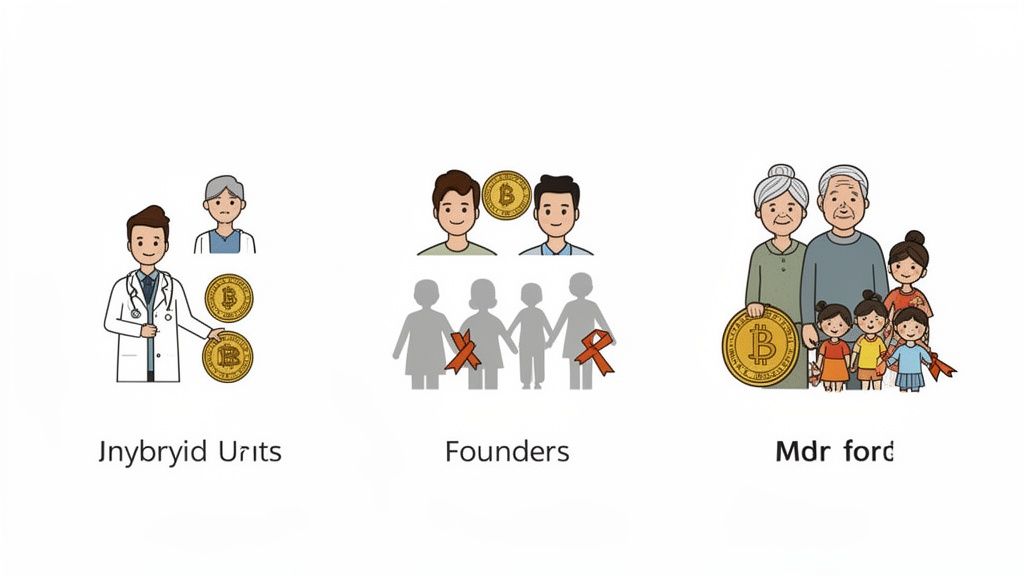
For Medical Professionals and PSI Earners
Imagine a specialist surgeon who has built a successful private practice. Her primary goals are to protect the wealth she has generated and provide for her family in a structured, tax-aware manner.
A hybrid trust could be a considered option here. She and her partner might be the primary unit holders, reflecting the capital they’ve invested in the practice and its assets. This gives them a clear, defined ownership stake and a fixed entitlement to the trust's capital value, which can deliver long-term security.
At the same time, their two adult children at university could be named as discretionary beneficiaries. This allows the trustee (perhaps a corporate trustee controlled by the surgeon and her partner) to stream income to the children to assist with their living and education expenses. Because the children may be in a lower marginal tax bracket, this approach could result in a more effective tax outcome for the family group. It is a way of providing support that can be both flexible and well-structured.
For Business Partnerships and SMEs
Now, let's picture two entrepreneurs who have started a technology business. One founder contributed 70% of the initial capital, while the other provided 30%. They need a structure that formally recognises their different investment levels but also allows for flexible profit sharing.
A hybrid trust may be able to solve this. The founders could be issued units in proportion to their capital contribution—70 units for one, 30 for the other. This formalises their ownership and ensures their share of the business's capital value is defined, which can be reassuring for all parties.
The discretionary beneficiaries could then be the respective family trusts of each founder. This allows business profits to be distributed each year in a way that is responsive to their individual family circumstances and tax positions, subject to the trust deed and any partnership agreements. You can find more on this in our guide to what is a family trust in Australia.
This structure may provide the certainty needed for a business partnership while retaining the agility required to manage profits wisely.
For New Migrants and Multigenerational Families
Finally, consider a family that has recently migrated to Australia. They arrive with capital and have clear commitments to support elderly parents in their home country, as well as goals to establish themselves and their children here.
A hybrid trust can offer a robust framework for managing these complex responsibilities. The family could establish a trust where a specific class of units is created to provide a fixed, reliable income stream for their parents overseas. This provides certainty and helps them meet their commitments with discipline.
The rest of the trust's assets and income could then be managed on a discretionary basis for the benefit of themselves and their children in Australia. As their needs change—buying a home, funding education, starting a business—the trustee has the flexibility to distribute funds accordingly. A considered approach like this allows the family to balance fixed obligations with the evolving needs of building a new life.
Risks, Responsibilities, and Next Steps
While the flexibility of a hybrid trust is a powerful feature, it is a significant commitment. This is not a ‘set and forget’ arrangement; it is an active responsibility that demands diligence and careful management.
The professional costs to establish a hybrid trust properly can be significant, reflecting the complexity of drafting a trust deed that is both legally sound and aligned with your objectives. That initial investment is then followed by ongoing administrative duties.
Ongoing Governance and Compliance
A hybrid trust demands a disciplined approach to its management. These are legal and financial obligations that help ensure the trust remains compliant and continues to function as intended.
Key ongoing responsibilities typically include:
- Annual Financial Statements: Preparing detailed accounts that provide a clear and accurate picture of the trust's financial position.
- Tax Filings: Completing and lodging the trust’s annual tax return with the ATO, ensuring all income is correctly reported and distributed.
- ASIC and ATO Adherence: Keeping up to date with relevant regulations, especially from ASIC if using a corporate trustee, and following ATO guidance.
Neglecting these duties can lead to serious consequences, including financial penalties and potentially compromising the tax benefits the structure was designed to provide.
Practical Next Steps
The journey to sound financial stewardship is one of patient, disciplined action. Before proceeding with any structure, it is wise to seek professional guidance. An experienced adviser can help you weigh whether a hybrid trust genuinely aligns with your circumstances or if a simpler structure might serve you better.
To build on what we’ve discussed, our resource on Understanding Your Trustee Duties provides valuable context on the obligations involved in managing any trust. For those with commercial interests, our work in Business and Corporate Advisory can help clarify how different structures might support your business objectives.
Ultimately, the goal is to build a financial framework that provides security and serves your objectives for years to come. When used for the right reasons, and with a full understanding of the responsibilities involved, a hybrid trust can be a cornerstone of that plan.
A thoughtful decision is an empowered one. The purpose of seeking advice is not simply to get an answer, but to gain the clarity needed to act with confidence and foresight.
To begin that conversation and determine the most appropriate path for your situation, you are welcome to Contact Us to arrange a discussion with our team.
General Advice Warning: The information provided is general in nature and does not take into account your personal objectives, financial situation, or needs. Before acting on any information, you should consider the appropriateness of the information having regard to your own objectives, financial situation, and needs and seek personal advice from a suitably qualified adviser.
Want help applying this to your situation?
Every situation is different. Book a time with our team to talk it through, or call us on 1300 913 929.
Book a free meetingAustralian tax guide →Estimate your fees →
Keep exploring