

A family trust is a legal arrangement designed to hold and manage assets on behalf of a group of family members. It functions less like a personal bank account and more like a protected vessel for your family’s wealth. The core principle is the separation of the legal ownership of assets from the people who benefit from them. Understanding this distinction is fundamental to grasping its purpose and potential.
Understanding the Foundations of a Family Trust

At its heart, a family trust is an agreement where a person or a company—the trustee—is given the legal responsibility to manage assets for the benefit of family members, known as the beneficiaries. This entire arrangement is governed by a foundational legal document, the trust deed, which sets out the rules of operation.
In Australia, the most common form is the discretionary trust, a term often used interchangeably with "family trust". As explored in our guide on what is a discretionary trust, the word 'discretionary' is key. It grants the trustee the discretion—or choice—to decide which beneficiaries receive income or capital from the trust each financial year, and in what amounts.
Why Are Family Trusts So Common?
This structure has become a well-established vehicle for Australian families and business owners. Data from the Australian Taxation Office (ATO) shows over 1.02 million trusts lodged returns in the 2022-23 financial year, collectively generating almost $489.5 billion in total business income, illustrating their significant role in the economy.
The reasons for this widespread adoption are grounded in two primary objectives that a trust structure may help achieve:
- Asset Protection: By placing assets into a trust, they are legally owned by the trustee, not by any individual beneficiary. Depending on your circumstances, this may create a protective barrier between your family’s wealth and personal or business liabilities.
- Tax Planning Flexibility: The discretionary nature of the trust allows the trustee to distribute income in a tax-effective manner. Income may be streamed to family members on lower marginal tax rates, which could reduce the family’s overall tax liability for the year. For instance, a professional earning Personal Services Income (PSI) may find a trust helps separate business assets from personal risks.
A family trust is a tool for long-term stewardship. It encourages careful planning and disciplined action, allowing you to manage assets with foresight for the benefit of your family across different financial seasons.
Understanding these core concepts is the first step. The true value emerges when you see how these principles are applied through the specific roles and responsibilities that govern the trust.
Understanding the Key Roles Within the Trust
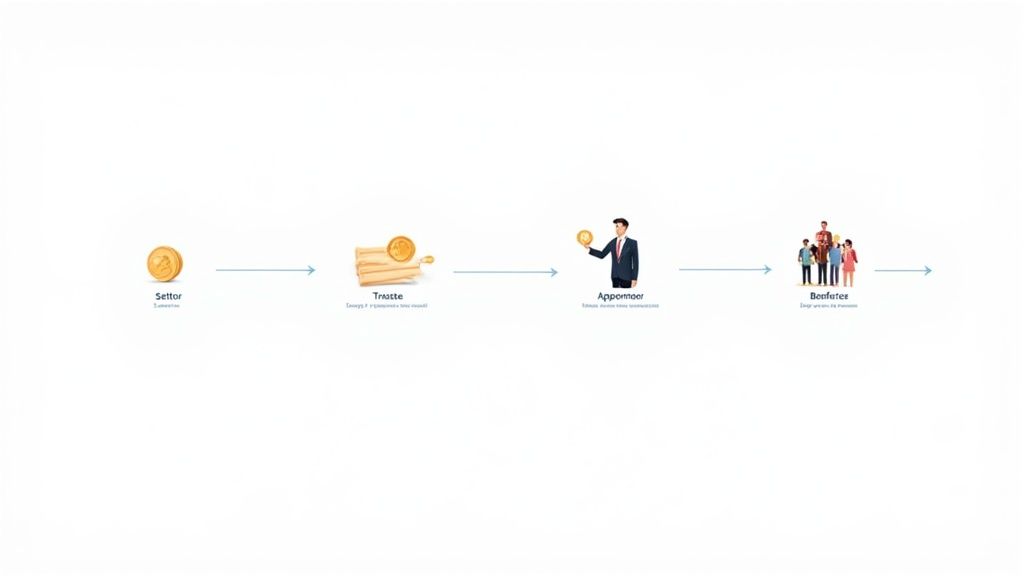
To properly understand what a family trust is in Australia, one must appreciate the distinct roles within it. Each role carries specific legal duties, creating a system of checks and balances that ensures the trust operates as intended. This structure is not a mere formality; it is the engine that drives the trust, guided by the rules of the trust deed.
For families, including new migrants establishing their financial footprint in Australia, clarity on these roles is the first step toward responsible management of family assets.
The Settlor: The Person Who Begins It All
The journey of every family trust begins with the Settlor. This person, who must not be a beneficiary, formally establishes the trust by signing the trust deed and providing a small, initial amount—often just $10—known as the "settled sum".
Once this is done, the Settlor's role is complete. They must step away and have no further involvement in the trust's management or its assets. This clean separation is critical for the trust's legal validity from its inception.
The Trustee: The Manager and Legal Owner
The Trustee holds the legal title to all the trust’s assets and is responsible for its day-to-day management. This includes making investment decisions, maintaining meticulous records, and ensuring all tax and legal obligations are met in line with ATO and ASIC requirements.
A trustee has a fiduciary duty, a significant legal responsibility to always act in the best interests of the beneficiaries. A common and often prudent strategy is to appoint a company as the trustee. This corporate trustee creates a clear separation between personal and trust assets and provides continuity, as a company's existence is not tied to an individual's lifespan.
The Appointor: The Ultimate Controller
While the Trustee manages the assets, the Appointor holds the ultimate power. This role has one critical function: to appoint and remove the Trustee. This authority acts as the final safeguard, ensuring the Trustee remains accountable to the trust's purpose.
Due to this influence, the Appointer is often considered the true controller of the trust. Careful consideration must be given to who holds this position and, equally important, who will succeed them. This is a crucial element of any sound succession and estate planning strategy.
The relationship between the Trustee and the Appointer is one of action and oversight. The Trustee steers the ship day-to-day, but the Appointer holds the map and can change the captain if they stray off course.
The Beneficiaries: The Reason for the Trust
Finally, the Beneficiaries are the family members and related entities for whose benefit the trust was established. In a discretionary family trust, beneficiaries do not have a fixed entitlement to the trust’s assets or income.
Instead, they have a right to be considered by the Trustee each year when income and capital are distributed. This flexibility allows the trustee to allocate funds in a manner that adapts to the family's changing circumstances and may be more tax-effective.
To clarify these roles, here is a simple breakdown.
Key Roles and Responsibilities in a Family Trust
| Role | Who It Is | Primary Responsibility |
|---|---|---|
| Settlor | An independent person (not a beneficiary) | Formally creates the trust by signing the deed and providing the initial settled sum. Their role is then finished. |
| Trustee | A person or, more commonly, a company | Holds legal ownership of the assets and manages the trust day-to-day. They have a legal duty to act in the best interests of all beneficiaries. |
| Appointor | A trusted individual or individuals | Holds the ultimate power to appoint and remove the Trustee. They are the true controller of the trust. |
| Beneficiaries | Family members and related entities | The people for whom the trust exists. In a discretionary trust, they have the right to be considered for distributions of income and capital. |
Each of these roles functions in harmony to create a robust structure for managing wealth. They provide clarity, control, and a clear framework for decision-making—all essential for any family seeking to build and protect its prosperity. As you weigh your options, our guide on Unit Trusts can help you compare how different structures define ownership and control.
The Core Functions: Asset Protection and Tax Planning

For Australian families and business owners, a family trust is a financial tool designed for two powerful purposes: protecting hard-earned wealth and managing the family’s overall tax position. These outcomes are not automatic; they arise from the trust's unique structure, which separates legal ownership of assets from those who benefit from them.
When managed with discipline and professional advice, a trust can become a central pillar of a family's financial strategy, offering a framework that can adapt as circumstances change over time.
Building a Wall Around Your Wealth
One of the most compelling reasons to establish a family trust is for asset protection. When you transfer assets—such as an investment property, a share portfolio, or a business—into a trust, you no longer own them in your personal name. Legal ownership shifts to the trustee.
This transfer may create a protective shield. If you, as an individual, face financial difficulties, litigation, or bankruptcy, assets held within the trust are generally not available to your creditors, because you do not legally own them. This is particularly relevant for business owners and professionals in high-risk fields who wish to separate their commercial risks from their family’s financial security.
It is important to be realistic. This protection is not absolute. Courts have the power to unwind arrangements that appear designed solely to defeat creditors. The timing and intent behind the trust's establishment are therefore critical. The process must be undertaken correctly from the outset, with proper legal and financial guidance.
Think of a family trust as a lockbox for your most important assets. You hand the key (control) to a manager you trust (the trustee), who is tasked with protecting what's inside for your family's benefit, keeping it safe and separate from your personal financial storms.
The Power of Flexible Income Distribution
The second primary benefit is tax planning. A discretionary family trust gives the trustee considerable flexibility in how the income earned by its assets is distributed each year. The trustee can choose which beneficiaries receive income and how much they get.
This enables a strategy often called 'income streaming'. Annually, before 30 June, the trustee can assess the financial situation of each family member and distribute the trust's income in a tax-sensible way for the family unit.
Consider this simple example. A trust generates $100,000 of income. The beneficiaries include:
- A parent who is a high-income earner, on the top marginal tax rate (47%, including the Medicare levy).
- An adult child at university with no other income.
- A spouse working part-time, well below the highest tax bracket.
Rather than the high-income parent receiving the full $100,000 and paying nearly half in tax, the trustee could distribute a portion to the university student (who may use their tax-free threshold) and another to the spouse. Depending on their circumstances, this strategy could result in a lower overall tax bill for the family.
Navigating Capital Gains Tax
This same flexibility can apply to capital gains. When a trust holds an asset for more than 12 months before selling it for a profit, it may be eligible for the 50% Capital Gains Tax (CGT) discount.
The trustee can then 'stream' that discounted capital gain to a specific beneficiary. That individual includes the gain in their personal tax return and pays tax at their marginal rate. This can be a significant advantage compared to a company structure, which is not eligible for the 50% CGT discount. For families building wealth through long-term investments, this can make a material difference over time. If you're comparing structures, our guide on Unit Trusts offers a useful perspective on managing ownership and distributions.
Ultimately, using a trust is an exercise in careful stewardship. It demands good administration and a clear understanding of both the opportunities and the responsibilities. While the potential benefits are significant, they depend entirely on your family's situation and strict compliance with Australian tax law. It is always wise to seek personal advice to ensure the structure is appropriate for you and managed correctly.
Meeting Your Compliance and Trustee Obligations
Establishing a family trust opens doors to significant opportunities, but it also carries serious legal and financial responsibilities. This is where diligence and good stewardship become non-negotiable. Operating a trust is not a ‘set and forget’ activity; it demands a disciplined approach to administration to ensure it remains compliant and effective.
Your trust deed is the constitution for your trust. It is the single source of truth that dictates how the trust must be managed, who can benefit, and what powers the trustee holds. Adhering to its terms is a legal requirement.
The Annual Rhythm of Compliance
Each financial year, the trustee must complete a cycle of duties governed by the Australian Taxation Office (ATO) and, with a corporate trustee, the Australian Securities and Investments Commission (ASIC). These are foundational obligations.
Key annual responsibilities include:
- Maintaining Financial Records: The trustee must keep accurate and complete financial records for all trust activities, including income, expenses, assets, and liabilities.
- Lodging a Trust Tax Return: An annual tax return must be prepared and lodged with the ATO, reporting all income earned by the trust.
- Making a Distribution Resolution: This is arguably the most critical annual task. Before 30 June each year, the trustee must formally decide and document how the trust's income will be distributed among the beneficiaries.
A late or invalid distribution resolution can have severe tax consequences. If the deadline is missed, the trustee may be assessed for tax on the trust's entire income at the highest marginal rate, currently 47%. This would negate any potential tax planning benefits.
The Importance of a Family Trust Election
To access certain tax concessions, such as carrying forward tax losses or receiving franking credits, many trustees make a Family Trust Election (FTE). This is a formal declaration to the ATO that nominates an individual as the central point of the ‘family group’.
Once an FTE is in place, distributions are strictly limited to this defined family group. This includes the nominated individual, their spouse, parents, grandparents, siblings, children, and other related entities. This election simplifies some tax rules but creates a firm boundary that cannot be crossed.
The Cost of Getting Distributions Wrong
The rules surrounding an FTE are strict. If a distribution is made to a person or entity outside the nominated family group, it can trigger a penalty known as the Family Trust Distribution Tax (FTDT), levied at the highest marginal rate of 47%.
The consequences can be financially severe. For further context, you can review this ATO update and its implications for trustees. Meeting your obligations is about more than just paperwork; it’s about acting in the best interests of the beneficiaries and preserving the integrity of the structure. It requires foresight, careful planning, and a commitment to getting the details right, year after year.
Passing Wealth to the Next Generation

A family trust is more than a tool for today; it is a vehicle for long-term stewardship, designed to carry a family’s prosperity across decades. When thoughtfully integrated into an estate plan, it can offer a controlled and private method for transferring wealth, often operating more efficiently than a will alone.
A key advantage is that assets held within the trust do not form part of your personal estate. This means they generally bypass the public and often lengthy probate process associated with a will, potentially allowing for a smoother transition of control to the next generation. This continuity is a cornerstone of prudent legacy planning.
Understanding the Trust Lifespan
It is crucial to understand that a trust is not a permanent entity. Its lifespan is finite, governed by a legal principle known as the rule against perpetuities, which prevents assets from being locked away in trusts indefinitely.
In most Australian states, this rule limits the life of a trust to 80 years from its establishment date. This built-in end date is a fundamental aspect of knowing what is a family trust in Australia and how to manage it for the long term.
The specific date a trust must end is its vesting date. On this day, the trust legally terminates, and the trustee is required to distribute all remaining assets—property, shares, cash—to the beneficiaries according to the terms of the trust deed.
The vesting date is a critical, unmovable horizon in the life of your trust. Planning for it isn’t a task for the final years but a consideration that should inform your strategy from the very beginning.
The Importance of Planning for Vesting
The scale of wealth held in these structures is immense. With an estimated $3 trillion in assets held across Australia, the eventual vesting of these trusts requires careful foresight.
Failing to plan for the vesting date can trigger significant and unwelcome tax consequences. The transfer of assets from the trustee to the beneficiaries upon vesting is a Capital Gains Tax (CGT) event. If those assets have grown substantially in value, this could result in a large tax liability that might have been managed more effectively with advance planning.
Thinking about the vesting date well in advance allows you to:
- Strategically distribute assets over time in a more tax-effective way.
- Review and update the trust deed to ensure its provisions still align with your family's circumstances.
- Consider restructuring options if appropriate, well before the deadline forces a decision.
This long-term perspective is the essence of good stewardship. It ensures the wealth you have carefully built continues to support your family as intended. For those considering simpler asset transfer mechanisms, our guide on what is a bare trust provides a useful comparison.
Common Questions About Family Trusts in Australia
As you explore family trusts, practical questions naturally arise. Here are clear, grounded answers to some of the queries we frequently hear from families and business owners.
Can I Set Up a Family Trust Myself?
While DIY trust kits are available, establishing a trust without professional advice carries significant risk. The trust deed is a complex legal document, not a simple form. A minor error or omission in its drafting could lead to serious and often irreversible tax and legal issues in the future.
Engaging a solicitor ensures the trust is structured correctly from the outset, tailored to your family’s unique circumstances. An accountant can then confirm it is the right financial vehicle for you and that you understand your ongoing duties as trustee. This initial investment is about securing the foundations.
What Is the Difference Between a Corporate and an Individual Trustee?
This is a key early decision with lasting consequences. An individual trustee is a person who holds the trust’s assets in their own name. While it may seem simpler, it can lead to complications if that person passes away, becomes incapacitated, or faces personal litigation.
A corporate trustee, a company established solely to act as trustee, is often the recommended path as it typically offers better protection and stability. Key advantages may include:
- Superior asset protection, creating a clear legal separation between personal wealth and trust assets.
- Administrative continuity, as a company’s existence is perpetual, simplifying succession planning.
- Clearer governance, which lenders and auditors generally prefer.
How Much Does a Family Trust Cost to Set Up and Run?
It is helpful to view the costs as an investment in protecting and managing your family’s wealth. Initial professional legal and accounting fees to establish a trust typically start from a few thousand dollars, depending on the complexity of your affairs.
Ongoing annual costs to maintain the trust in compliance with ATO and ASIC regulations must also be factored in. These will include:
- Accounting fees for preparing annual financial statements and the trust tax return.
- ASIC company fees if you have a corporate trustee, payable annually.
- Potential land tax, depending on the state where the trust holds property and its value.
Can a Family Trust Borrow Money for Investments?
Yes, a family trust can borrow funds to invest in assets like property or shares, provided the trust deed grants the trustee the power to do so. This is a common strategy for building wealth within a trust.
However, lending criteria for trusts are often stricter than for individuals. Lenders will almost always require personal guarantees from the directors of the corporate trustee or other key individuals. It is vital to seek professional financial advice to ensure any loans are structured correctly, align with the trust's objectives, and comply with current lending standards without creating unintended risks. You can gain further insight from our overview of tax and accounting services.
Is a Family Trust Right for You?
A family trust can be a highly effective structure for asset protection, tax planning, and intergenerational wealth management. However, it is not a universal solution. The complexity and ongoing administrative duties mean the decision requires careful consideration and professional guidance. For some, a different structure like a unit trust might be more suitable.
This guide provides a foundational understanding of family trusts in Australia. Your next practical step should be a conversation with qualified legal and financial advisers who can consider your personal circumstances. They can help you determine if this structure truly aligns with your family’s long-term financial vision, ensuring any decision is made with foresight and clarity. The right structure is one that serves your specific purpose with diligence and care.
At Everglow Prosperity, we partner with you to build enduring wealth with clarity and confidence. Contact us today to discuss your financial goals.
General Advice Warning: The information provided in this article is general in nature and has not been prepared with your personal objectives, financial situation, or needs in mind. Before making any decision, you should consider the appropriateness of this information to your own circumstances and seek professional advice.
Want help applying this to your situation?
Every situation is different. Book a time with our team to talk it through, or call us on 1300 913 929.