

In the landscape of Australian financial strategy, you may hear the term bucket company. What is it, and what role might it play?
A bucket company is a private company established to receive distributions from a family trust. It is a well-understood and legitimate structure within Australian tax law, often considered by families and business owners looking to manage their financial affairs over the long term. Its purpose is to ‘catch’ or hold profits distributed from a trust that, if paid to individual beneficiaries, could place them in higher personal tax brackets.
How a Bucket Company May Function
A bucket company, also known as a corporate beneficiary, generally has one primary function: to receive income distributed from a discretionary or family trust. The potential benefit of this structure lies in its tax treatment. When a trust validly distributes income to a company, that income is typically taxed at the flat corporate tax rate, which may be lower than the top marginal tax rates for individuals.
This allows profits to be retained within a controlled corporate structure. Instead of distributing all income to family members who might be subject to higher personal tax rates, a portion may be channelled into the company. This approach can be a patient, disciplined way to accumulate capital for future investment or business needs.
Understanding the Term 'Bucket Company'
The name itself offers a useful visual. Imagine your family trust’s annual profit as a stream of water. The trustee can direct this stream into different ‘buckets’—the beneficiaries. If too much is directed into an individual’s bucket, it can result in a higher personal tax liability.
A bucket company acts as a separate, larger bucket. It can be positioned to catch surplus income from the trust, holding that capital in an entity where it may be taxed at a predictable, flat corporate rate. This may provide greater control over the stewardship of a family's wealth and its overall tax position.
What Is Its Purpose?
At its core, a bucket company strategy is often centred on tax effectiveness and capital preservation. It is not about avoiding tax; rather, it is a recognised method for managing when and how tax is paid, in accordance with the law. Its key functions may include:
- Managing the Applicable Tax Rate: It allows profits distributed from a trust to be taxed at the corporate tax rate. This is currently 30%, or 25% for companies that qualify as a base rate entity under ATO rules.
- Asset Protection: Funds held within a company are legally separate from the personal assets of the family members. This may add a valuable layer of protection against certain personal financial risks, depending on the circumstances.
- Accumulating Capital: It creates a dedicated vehicle for retaining profits. This capital can then be used for future investments, such as acquiring shares, purchasing property, or providing funding back to a business under compliant loan terms.
To understand how this fits into a broader financial picture, you may find it helpful to explore resources on tax and accounting strategies.
A comparison of the numbers illustrates why this structure may be considered by families and businesses with higher incomes.
Individual vs. Bucket Company Tax Rates
This simplified table illustrates the potential tax difference on a $100,000 trust distribution directed to a bucket company instead of an individual already in the top tax bracket.
| Distribution Recipient | Applicable Tax Rate (Illustrative) | Tax on $100,000 Distribution |
|---|---|---|
| Individual (Top Rate) | 47% (including Medicare Levy) | $47,000 |
| Bucket Company (Base Rate) | 25% | $25,000 |
In this scenario, the initial tax difference is $22,000. This is a significant amount of capital that remains preserved within the family group, available for investment rather than being paid out in tax.
How a Bucket Company Works With a Family Trust
To appreciate how a bucket company may be useful, it is important to understand its relationship with a family trust. This is a deliberate structure, guided by Australian tax law, designed for thoughtful financial management and the preservation of capital within a family group.
The process begins when a family trust generates income, perhaps from a business or an investment portfolio. Before the end of the financial year on 30 June, the trustee must make a critical decision, which is formalised in a document known as a trust resolution.
This resolution is a legally binding instruction. In it, the trustee documents precisely how that year's income will be distributed among the eligible beneficiaries. It is at this point that a bucket company can play its role.
The Distribution Process Explained
In the trust resolution, the trustee might decide to distribute some income to individual family members to cover their living expenses, but only up to a point that is tax-effective for them. Any remaining profit—the portion that could push those individuals into higher tax brackets—may be distributed to the corporate beneficiary, which is the bucket company.
This formal act of distribution creates what is known in law as a 'present entitlement'. This means the bucket company is now legally entitled to that share of the trust’s income, even if the cash has not yet been physically transferred. This is a core concept in Australian trust law.
Once the resolution is signed and dated, the company includes this income in its own tax return and pays tax on that amount at the relevant corporate tax rate. This simple, deliberate redirection of income is the foundation of the strategy.
The diagram below illustrates this process.
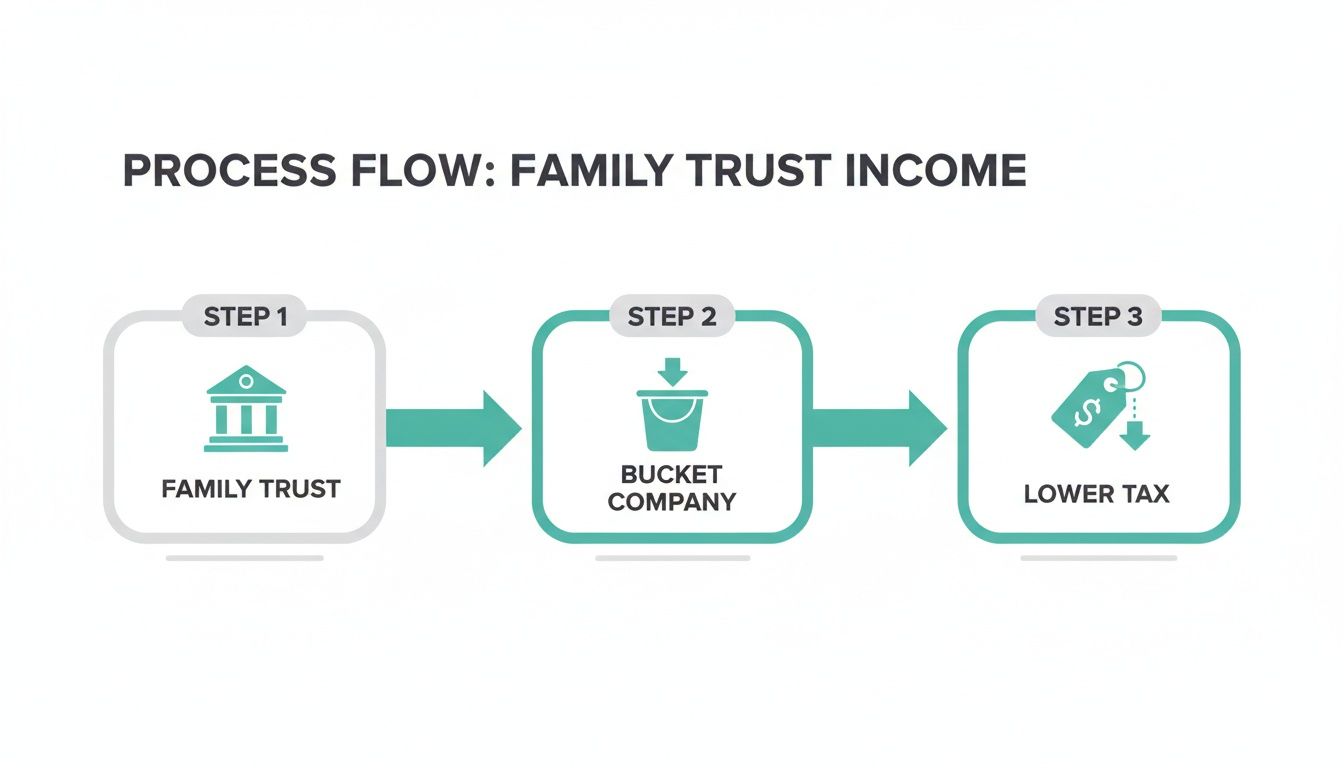
As shown, the process allows trust income to be retained within a controlled entity at what may be a lower tax rate, preserving capital for future use.
A Practical Example
The potential financial benefit of this structure becomes clearer when comparing tax rates. For the 2026–27 financial year, the top marginal tax rate for an individual earning over $190,000 is 45%, plus the 2% Medicare levy, totalling 47%.
In contrast, a bucket company pays tax at a flat 30%, or potentially 25% if it qualifies as a 'base rate entity'. The difference can be substantial.
Let's consider a practical example for an Australian professional.
A medical specialist’s family trust generates a net income of $300,000 for the year. The specialist has already earned sufficient income to be in the top tax bracket. If the trust were to distribute the full $300,000 to them personally, it would be taxed at the highest individual rate.
Instead, the trustee might make a different decision in the resolution:
- Distribute $180,000 to the specialist, bringing their taxable income to the threshold of the top tax bracket.
- Distribute the remaining $120,000 to the family’s bucket company.
The $120,000 is now taxed at the company rate (e.g., 25%) instead of the specialist's personal rate of 47%. Through this deliberate action, a significant amount of capital may be preserved. That money can now be used for future investments, to pay down debt, or to acquire other assets—all hallmarks of patient and thoughtful financial stewardship.
Potential Benefits of Using a Corporate Beneficiary
Including a corporate beneficiary in your trust structure is a strategic consideration for those focused on long-term wealth management and protection. The potential benefits extend beyond the immediate tax outcome and may form a cornerstone of a patient, multi-generational financial strategy.
One of the primary benefits is potential tax efficiency. When you direct trust profits to a bucket company, the tax on that income is capped at the corporate tax rate. For many business owners and professionals, this rate is substantially different from the top personal marginal tax rates, meaning more capital may remain within the family group.
This disciplined approach allows for the retention and accumulation of funds that might otherwise have been paid in tax. The company can effectively become a private treasury, a pool of capital that may be grown over time.
A Layer of Asset Protection
A significant—and often understated—advantage of this structure is the legal separation it creates. A company is a distinct legal entity, separate from its shareholders and directors.
When your trust distributes income to the bucket company, that money becomes an asset of the company. It is no longer your personal money. This means the capital is generally shielded from the personal liabilities of individual family members, which may create a valuable layer of protection against unforeseen personal or business risks. It can be a considered way to safeguard family wealth for future generations or planned investments.
A Strategic Investment Vehicle
The profits held inside a bucket company are typically not intended to sit idle. They can represent a ready-made pool of capital for future growth, funded with lower-taxed dollars. The company can then deploy this capital in several ways, depending on long-term goals:
- Purchase business assets: The company could acquire new equipment or machinery for a related family business.
- Build a share portfolio: It can be used to construct a diversified investment portfolio, with any subsequent investment income also taxed at the corporate rate.
- Fund property purchases: The accumulated capital can serve as a deposit for a commercial or residential investment property.
This ability to build and deploy capital methodically is what makes the structure potentially powerful. It may allow you to pursue planned financial growth without drawing on personal, after-tax savings.
The Franked Dividend System
In the future, shareholders may wish to access the profits held in the bucket company. When this occurs, the distributions are typically paid as dividends. Because the company has already paid tax on its profits, these dividends can be distributed with franking credits attached.
Franking credits represent the tax the company has already paid. For a shareholder, these credits can reduce the amount of personal tax payable on the dividend income. In some circumstances, if the credits exceed the tax owed, a refund from the ATO may be available.
This mechanism in Australia’s tax system is designed to prevent company profits from being taxed twice—once at the company level and again in the hands of the shareholder. It is an example of how a disciplined, multi-stage approach may lead to more effective outcomes over the long run.
Understanding Risks and Compliance Obligations
While a bucket company structure may offer a pathway for managing wealth, it is one that requires careful navigation and a clear understanding of your responsibilities. The potential tax benefits are directly linked to meticulous compliance with Australian law. This is not a 'set and forget' arrangement; it requires ongoing, diligent administration.
The cornerstone of compliance in this area is Division 7A of the Income Tax Assessment Act 1936. This is a critical piece of legislation that the Australian Taxation Office (ATO) uses to ensure profits held in a private company are not withdrawn tax-free by shareholders or their associates.
In simple terms, Division 7A prevents shareholders from treating the bucket company's funds as an informal, interest-free loan. Any payment, loan, or forgiven debt from the company to a shareholder or their associate can be treated by the ATO as an unfranked dividend. This means it could be added to the shareholder's personal taxable income for that year, often with significant tax consequences.
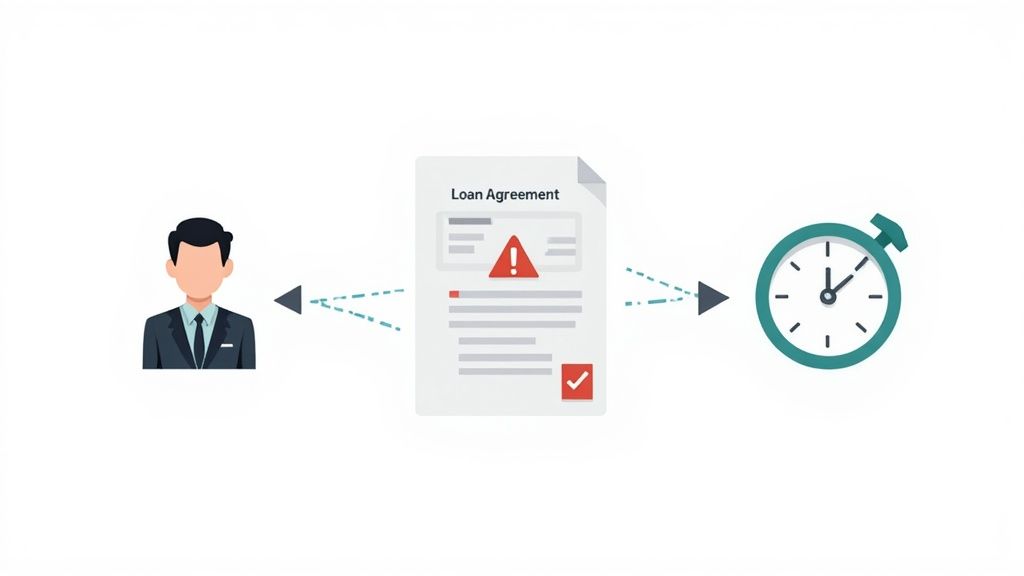
Navigating Division 7A Loans
What if you need to access the funds held in the bucket company? Division 7A provides a clear, compliant pathway to do so. The funds can be loaned to a shareholder, but only if the loan is structured correctly from the outset.
To comply with ATO requirements, a loan from the company must generally:
- Be documented in a formal, written loan agreement before the company’s tax return for that year is lodged.
- Charge a minimum interest rate, known as the 'benchmark interest rate', which is set by the ATO and updated annually.
- Adhere to a maximum loan term, typically seven years for an unsecured loan or up to 25 years if it is secured by a registered mortgage over real property.
- Require minimum annual repayments of both principal and interest.
Failing to meet these strict requirements can trigger an adverse tax outcome. This highlights the importance of seeking professional guidance to ensure every transaction is managed correctly.
Unpaid Present Entitlements (UPEs)
Another critical area of compliance arises when a trust makes a distribution to the bucket company. If the trust resolves to distribute income but does not physically pay the cash over, it creates an Unpaid Present Entitlement (UPE). This UPE is effectively treated as a loan from the bucket company back to the trust.
The ATO has specific and complex rules on how these UPEs must be managed. If left unaddressed, a UPE can also be caught by Division 7A, potentially triggering an unplanned tax liability. The rules surrounding UPEs can be technical, often requiring formal sub-trust arrangements or Division 7A compliant loan agreements to manage them properly.
A bucket company can be a powerful tool for disciplined financial stewardship. However, its effectiveness is entirely dependent on respecting the rules that govern it. Sound governance turns potential risk into enduring stability.
Ongoing Administrative Duties
Beyond the complexities of Division 7A and UPEs, operating a bucket company comes with the standard obligations of any Australian private company. These are not optional; they demand consistent attention.
Key ongoing duties include:
- Annual Company Tax Returns: The company must lodge a tax return with the ATO each year, declaring its income (including trust distributions) and paying the correct amount of tax.
- ASIC Compliance: The company's details must be kept up to date with the Australian Securities and Investments Commission (ASIC). This includes notifying them of changes to directors or shareholders and paying an annual review fee.
- Diligent Record-Keeping: Precise financial records for the company must be maintained, including bank statements, investment details, and clear documentation of all loans and dividend payments.
These compliance tasks are fundamental to the integrity of the structure. They reinforce a simple principle: with the opportunity for tax efficiency comes the responsibility of transparent and diligent administration. This careful stewardship is what ensures the structure can remain a source of strength for your family's financial future.
Is a Bucket Company an Appropriate Choice for You?
Deciding whether to establish a bucket company is a significant step that requires careful thought. It is not a universal solution but rather a specific tool designed for a particular set of financial circumstances and long-term goals. The process should always begin with a calm, considered review of your current position and future aspirations.
Whether this structure is suitable depends entirely on your individual circumstances. We find this structure is most often considered when a family trust is generating significant income, there are clear long-term plans for that capital, and there is a commitment to managing the associated administrative duties. It is a structure that rewards foresight and discipline.
Key Questions to Consider
Before proceeding, it may be helpful to reflect on a few key questions. Your answers will provide clarity and help facilitate a more productive discussion with a professional adviser.
- Your Income Level: Is your trust consistently generating profit that, if distributed to individuals, would push them into the highest tax brackets?
- Your Long-Term Goals: Do you have a clear plan for reinvesting the retained profits? This could include acquiring new assets, expanding a business, or building an investment portfolio.
- Your Administrative Capacity: Are you prepared for the ongoing compliance requirements? This involves annual tax returns, ASIC obligations, and maintaining meticulous records.
- Your Asset Protection Needs: Is the protection of your family's assets from business or personal risks a high priority for you?
If your answers to most of these questions are affirmative, then a bucket company may be a structure worth exploring with a qualified professional. It is often a logical consideration for those who have moved beyond meeting immediate needs and are now focused on building a solid financial foundation for the future. For more on this, our guide to tax and accounting strategies may be a useful starting point.
A bucket company is best viewed not as a short-term solution, but as a potential component of a multi-decade financial strategy. Its true value is typically realised over time, through disciplined action and unwavering compliance.
Ultimately, this is a significant decision. It has the potential to alter the way your family’s wealth is managed, taxed, and protected for the long term. It may present considerable opportunities, but it also brings distinct responsibilities that should not be underestimated. The key is to gain a clear understanding of how these elements align with your personal and financial objectives.
A Concise Takeaway
At its heart, a bucket company is a deliberate, structured tool within Australian tax law. When used appropriately and with diligent oversight, it may be an effective way to manage income from a trust, add a layer of asset protection, and build a disciplined investment vehicle for the long term.
However, it is a tool that requires careful handling. The opportunities it presents are matched by serious compliance duties, particularly the rules under Division 7A, which demand close attention. Mismanagement can undermine the structure, so careful and consistent administration is essential. This strategy is most suited to individuals and families with a clear, long-term vision for the capital they wish to preserve and grow.
If you are considering how to best structure your financial affairs and wish to understand your options, professional advice may be appropriate. To explore these concepts further, you may wish to contact our advisers to arrange a meeting.
If you would like clarity on how these principles may apply to your own circumstances, you may wish to speak with a qualified adviser. You can contact Everglow on 1300 913 929 or email contact@everglow.au to arrange a discussion.
General Advice Warning: The information provided in this article is general in nature only and does not take into account your personal objectives, financial situation, or needs. You should seek personal advice before acting.
Want help applying this to your situation?
Every situation is different. Book a time with our team to talk it through, or call us on 1300 913 929.
Book a free meetingAustralian tax guide →Estimate your fees →
Keep exploring