

Navigating taxes in Australia for expats can feel like charting a course through unfamiliar waters. The core principle, however, is straightforward: your tax obligations are tied to your residency status as defined by the Australian Taxation Office (ATO), not your citizenship or visa. Understanding this distinction is the essential first step for every expatriate, whether you are arriving, have been here for years, or are planning your departure.
Your Guide to Navigating Australian Expat Taxes
Moving to a new country is an exciting chapter, yet it introduces a new set of financial responsibilities. For expats with ties to Australia, managing your tax obligations requires a clear, methodical approach. This is not about finding clever loopholes; it is about understanding your duties and making sound decisions grounded in Australian law. Wise financial stewardship, based on a firm grasp of the rules, is the foundation of a stable future.
Think of this guide as a seasoned counsellor, here to break down complex matters into understandable, practical parts. We will walk through the key pillars of the Australian tax system that may affect you, based on current ATO guidance and established financial principles.
Key Areas We Will Cover
To provide a clear roadmap, this guide will focus on several critical areas. Each section builds on the last, creating a progressive understanding of your financial landscape as an expat. You will learn about:
- Determining Your Tax Residency: This is the absolute foundation of your Australian tax obligations. We will explore the ATO’s tests to help you understand how your status is determined in practice.
- Impact on Your Income: Discover how being a resident versus a foreign resident changes how your worldwide and Australian-sourced income is taxed.
- Managing Major Assets: We will cover the specific rules for Capital Gains Tax (CGT) and superannuation—two areas of great importance for most professionals and their families.
- Practical Compliance Steps: Learn about the fundamentals of lodging your tax return and the importance of good record-keeping to meet your responsibilities. For more on this, our article on what happens with a late tax return fine offers more detail.
By the end of this guide, you should be better equipped to manage your tax affairs with quiet confidence, making informed choices for your financial wellbeing.
Defining Your Australian Tax Residency Status
Determining your Australian tax residency status is the single most important first step for any expat. This status, decided by the Australian Taxation Office (ATO), determines whether you pay tax on your worldwide income or only on income earned from Australian sources.
It is a common misunderstanding to assume your residency for tax purposes is the same as your visa or citizenship status. The ATO examines the reality of your situation—a ‘question of fact’—based on a series of tests grounded in Australian law. These tests are designed to build a complete picture of your life and determine where your genuine connections lie.
This flowchart provides a high-level view of how these elements connect, starting with the foundational question of tax residency.
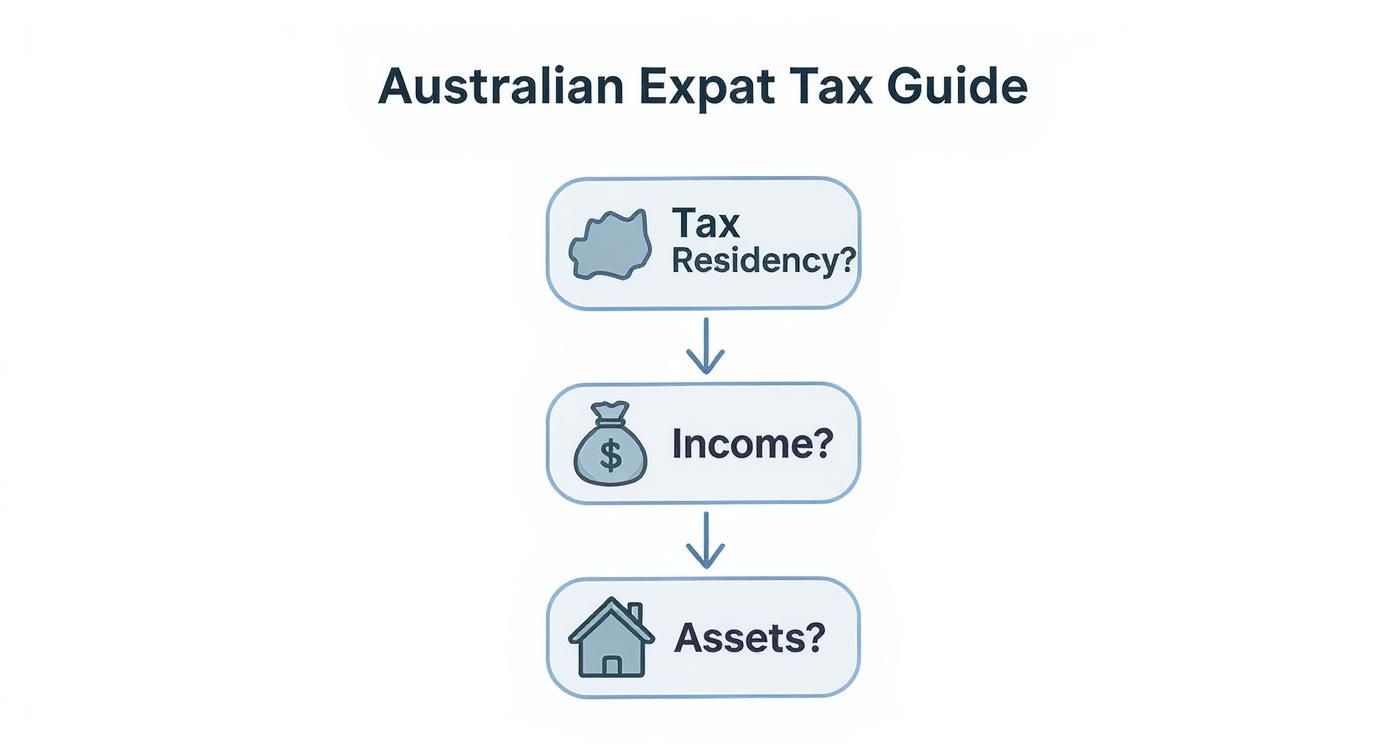
As you can see, your residency status is the gateway. Once that is clear, everything else about how your income and assets are handled under Australian tax law begins to make sense.
The Four Key Residency Tests
The ATO uses four tests to determine your residency status. You only need to meet one of them to be considered an Australian resident for tax purposes. These are not simple tick-boxes; they require an objective look at your life and where you are truly settled.
- The Resides Test: This is the primary test. It asks if you ‘reside’ in Australia in the ordinary sense of the word. The ATO will look at factors such as your physical presence, your intentions, where your family and business ties are, and whether you have established a home.
- The Domicile Test: This test applies if your permanent home—your legal 'domicile'—is in Australia. You will be a resident under this test unless you can prove to the ATO that you have established a permanent place to live elsewhere.
- The 183-Day Test: If you are physically in Australia for more than half the financial year (183 days), you may be deemed a resident. This does not have to be a continuous period. The main exception is if your usual home is genuinely outside Australia and you do not intend to take up residence here.
- The Commonwealth Superannuation Test: This is a specific test for Australian government employees working overseas who are part of certain public sector superannuation schemes.
Applying the Tests in Practice
Consider these tests as a way of painting a picture of your life. An IT contractor from overseas who moves to Sydney for a two-year project, rents an apartment, and brings their family along will almost certainly pass the resides test. Their actions demonstrate an intention to live in Australia for a settled period.
In contrast, consider a business owner who flies to Australia for frequent but short business trips. Their family, home, and main business operations remain in their home country. Even if their total time in Australia exceeds 183 days, they may not be considered a resident, as the centre of their life is clearly elsewhere.
At its heart, the ATO is trying to answer one question: where is your true home? When it comes to determining taxes in Australia for expats, your actions, family connections, and financial ties speak louder than your passport.
Establishing your residency is the cornerstone of sound financial planning. It allows you to anticipate your tax obligations and structure your affairs with foresight. For a deeper understanding of how this impacts your assets, our guide on the foreign resident capital gains withholding framework is a practical next step. Taking the time to get this right provides the clarity needed for every financial decision that follows.
How Residency Shapes Your Taxable Income
Once you have clarity on your residency status, you can begin to see its direct impact on your finances. Your residency status acts as the lens through which the Australian Taxation Office (ATO) views your income, defining what you owe and why.
For an Australian resident for tax purposes, the scope is broad. You are generally taxed on your worldwide income. This means your salary, business profits, and investment returns may all be assessable in Australia, regardless of where on the globe they were earned.
For a foreign resident for tax purposes, the focus narrows. You will typically only pay Australian tax on income that comes from an Australian source. This is the cornerstone of managing taxes in Australia for expats, as it dictates what you need to declare and, ultimately, what tax you will pay.
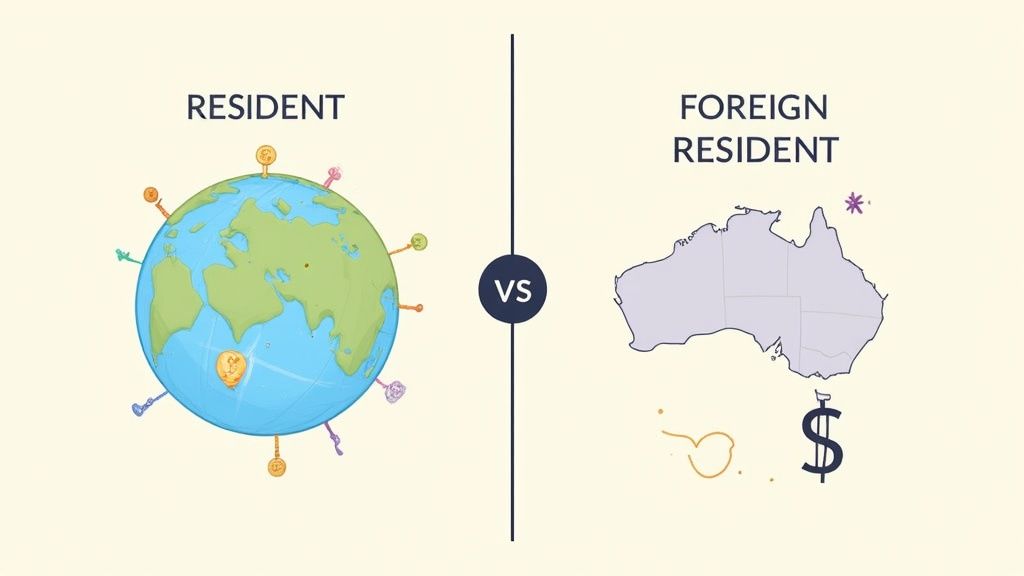
Resident vs. Foreign Resident: A Comparison
The differences extend beyond the source of your income. Your residency status also changes the tax rates you pay, the thresholds you can access, and your liability for certain levies. Understanding these differences is vital for sensible financial planning.
The tax rates for residents and foreign residents differ significantly. For the 2025–26 and 2026–27 income years, residents benefit from a progressive system, where the first $18,200 of income is tax-free. From there, rates climb up to 45% for income over $190,000.
Foreign residents, on the other hand, face different rates. There is generally no tax-free threshold, so income up to $135,000 is taxed at 30%, rising to 45% for amounts over $190,000. In addition, residents are liable for the Medicare levy, typically 2%, while foreign residents are generally exempt.
To make this clear, here is a simple side-by-side comparison.
Tax Rates Comparison for Residents vs. Foreign Residents
This table breaks down the key financial differences between being an Australian resident and a foreign resident for tax purposes.
| Tax Component | Australian Resident | Foreign Resident |
|---|---|---|
| Taxable Income Scope | Worldwide income (from all sources, globally) | Australian-sourced income only |
| Tax-Free Threshold | Yes, the first $18,200 of income is tax-free. | No tax-free threshold is generally available. |
| Medicare Levy | Yes, typically 2% of taxable income. | No, foreign residents are not liable. |
| Tax Rates | Progressive rates starting from 0%. | Different rates apply, often starting at a higher 30%. |
The main takeaway is that if you are a foreign resident, you may pay tax from the very first dollar of Australian-sourced income you earn. The lack of a tax-free threshold can come as a surprise if you are not prepared for it.
What Is Australian-Sourced Income?
For foreign residents, understanding what the ATO considers 'Australian-sourced' is critical. While the specifics can be complex depending on your circumstances, some common examples help paint the picture.
- Employment Income: If you physically perform work in Australia, the salary and wages you earn are generally Australian-sourced, regardless of where your employer is based.
- Business Income: Profit from a business that has a permanent establishment or carries out its main operations in Australia.
- Rental Income: Any income you generate from an investment property located in Australia.
- Capital Gains: The profit from selling 'Taxable Australian Property,' which most commonly includes real estate located in Australia.
- Investment Returns: This includes interest from Australian bank accounts or dividends from Australian companies. For a closer look, our guide on the tax on dividends in Australia has more detail.
For example, a software consultant who is a foreign resident and is brought in for a three-month project in Sydney would find the income she earns during that time is Australian-sourced and taxable here, no matter where her client is based.
Getting these distinctions right allows for confident planning. It helps you anticipate your tax bill and structure your affairs appropriately, so you can meet your obligations without unforeseen issues.
Managing Your Capital Gains and Superannuation as an Expat
For most professionals, your largest assets are often property and superannuation. As an expat, understanding how a change in residency status impacts these requires a steady hand. The rules are designed to ensure the wealth you have built is managed correctly under Australian law.
Addressing these matters is a core part of the financial journey for anyone dealing with taxes in Australia for expats. Let's walk through the key principles for both Capital Gains Tax (CGT) and superannuation, breaking them down into clear concepts.

Capital Gains Tax When You Cease Australian Residency
The moment you cease being an Australian resident for tax purposes, the Australian Taxation Office (ATO) may trigger a CGT event. This is often called a "deemed disposal." The law treats you as if you sold certain assets for their market value on the day you became a non-resident. This typically applies to assets that are not 'Taxable Australian Property' (TAP), such as shares in international companies.
When this occurs, you generally have two choices:
- Pay the CGT now: You can finalise the tax on any capital gains in the financial year you cease being a resident.
- Defer the CGT: You may elect to defer paying the tax until you actually sell the asset. If you choose this path, the asset is treated as TAP until it is sold, which means any future capital gain will be subject to Australian tax.
Seeking personal advice here is critical, as the appropriate path forward depends entirely on your specific circumstances.
The Main Residence Exemption for Foreign Residents
The rules around the main residence exemption have changed significantly. In the past, you could generally claim an exemption from CGT when you sold your family home. For foreign residents, however, those rules have been tightened.
If you are a foreign resident for tax purposes when you sign the contract to sell your Australian home, you generally cannot claim the main residence exemption. This may be the case even if it was your primary home for many years while you were an Australian resident.
There are very limited exceptions, such as certain life events occurring within six years of you becoming a foreign resident. Because these rules are strict, the timing of selling a former family home can have significant tax consequences.
A Practical Scenario
Imagine Sarah, a professional who worked in Melbourne for ten years before taking a long-term role in Singapore. She kept her Melbourne house, rented it out, and became a foreign resident for tax purposes.
Five years later, she decides to sell the property. Because she is a foreign resident at the time she signs the sale contract, she will likely be unable to claim any part of the main residence exemption. The entire capital gain, from the day she first bought the house until the day she sells it, could be subject to CGT. For a deeper look at the sale process itself, it is wise to review the rules around foreign resident capital gains withholding, as this may also apply.
Accessing Your Super After Leaving Australia
Your superannuation is for your retirement, and the rules around accessing it are strict. If you leave Australia permanently, you may be able to access your super through a Departing Australia Superannuation Payment (DASP).
To be eligible for a DASP, you generally need to meet these conditions:
- You were in Australia on a temporary visa that has now expired or been cancelled.
- You have left Australia and you are not an Australian or New Zealand citizen, or a permanent resident of Australia.
Be aware that the tax on a DASP can be high, so it is essential to understand the net amount you would receive before you apply. This decision balances getting access to your funds now against your long-term retirement plans.
In addition, Australian expats should stay informed of evolving rules. Once you become a tax non-resident, you are no longer liable for Australian CGT on most overseas assets you sell. However, you remain liable for CGT on your Australian property and other TAP assets, often at higher non-resident tax rates and without the benefit of the 50% CGT discount.
From 1 July 2026, Division 296 applies an extra tax to realised earnings on the part of a superannuation balance above $3 million (about 30% in total) and above $10 million (about 40% in total), a change that could impact expats with larger retirement savings.
Your Practical Steps for Tax Lodgement and Compliance
Understanding the theory of expat tax is one thing; turning that knowledge into confident, practical action is what matters. Managing your tax obligations does not have to be a source of stress. With a disciplined approach, it becomes a series of clear, manageable steps to ensure you meet your obligations on time.
Think of this as your roadmap for lodging an Australian tax return, regardless of where you are in the world. The key is good stewardship—careful planning, patient record-keeping, and acting well before deadlines approach.
Navigating Double Taxation Agreements
One of the foremost concerns for an expat is being taxed twice on the same income—once where you live, and again in Australia. This is precisely what Double Taxation Agreements (DTAs) are designed to prevent. Australia has these agreements with over 40 countries to clarify the taxing rights between the two jurisdictions.
These agreements typically ensure income is taxed primarily where it is earned and provide relief if both countries have a claim. This relief usually comes in the form of a foreign income tax offset, which allows you to reduce your Australian tax liability by the amount of foreign tax you have already paid on that income.
Your Lodgement Checklist
Lodging your tax return from overseas is about organisation. Remember, the Australian financial year runs from 1 July to 30 June. If you are lodging yourself, the deadline is generally 31 October. Missing it can lead to penalties, so it pays to be prepared. For more information, you can read our guide on the consequences of a late tax return fine.
Here is a practical checklist to help you prepare:
- Gather All Income Statements: This includes income from any Australian employment, investments, rental properties, or capital gains on Australian assets.
- Collect Evidence of Deductions: Keep records for work-related expenses, costs related to your Australian investment properties, or any other claims you may be entitled to.
- Document Foreign Tax Paid: To claim a foreign income tax offset, you need clear evidence of the tax you paid in another country.
- Record Your Travel Dates: Keep a precise log of your days in and out of Australia. This is fundamental to evidencing your residency status for the financial year.
- Update Your Details: Ensure your contact information and bank details with the Australian Taxation Office (ATO) are current.
The foundation of smooth tax compliance is disciplined record-keeping. Your records are not just for the ATO; they provide you with a clear, factual picture of your financial life, empowering you to make informed decisions.
Understanding the Financial Context
It can be helpful to remember your personal tax obligations are part of a much larger economic picture. In 2024-25, Australia’s total tax revenue saw a notable increase, with Commonwealth tax comprising 80.6% of the total. Personal income tax—which includes tax paid by residents and expats with Australian income—grew by 1.3%, or AUD 4.1 billion. This demonstrates how changes in Australian tax policy and the economy affect everyone connected to the system. You can find more insights into government finance statistics on the Australian Bureau of Statistics website.
By following these practical steps and keeping diligent records, you can turn tax compliance from a complex burden into a routine part of managing your finances well. This disciplined action ensures you meet your obligations and can move forward with clarity.
A Grounded Takeaway for Your Expat Journey
This guide was designed to provide a clear map for navigating taxes in Australia for expats. The core principles are to seek clarity on your residency status, be disciplined with your records, and plan ahead with patience.
We have walked through the key areas to help you feel more prepared, from the foundational step of determining your tax residency to the practical details of Capital Gains Tax and superannuation. Following a structured process can turn what feels overwhelming into a series of manageable steps.
The crucial takeaway is that your financial stewardship is your own. Understanding the rules and your responsibilities empowers you to make wise decisions, but every situation is unique. The information here provides a strong foundation, but it is not a substitute for professional guidance tailored to you. Seeking personal advice from a qualified adviser is a prudent step toward managing your financial future with quiet confidence.
General Advice Warning
The information provided in this article is general in nature and does not constitute personal financial or tax advice. It has been prepared without taking into account your personal objectives, financial situation, or needs. Before acting on any information, you should consider the appropriateness of the information, having regard to your own objectives, financial situation, and needs, and seek professional advice from a qualified financial adviser or registered tax agent.
Common Questions on Australian Expat Taxes
When you are dealing with tax across two countries, many questions can arise. To help provide clarity, here are some grounded answers to common queries we hear from expats navigating their Australian tax obligations.
"How long do I have to be in Australia to become a tax resident?"
There is a common myth that spending less than 183 days in Australia during a financial year automatically makes you a foreign resident for tax purposes. While the 183-day test is one of the tools the Australian Taxation Office (ATO) uses, it is not the only one.
The primary test is the 'resides test', which considers your connection to Australia. The ATO looks at the broader picture: Where is your family? Where are your assets? What are your intentions? You could be in the country for a relatively short period but still be considered a tax resident if your actions show you are treating Australia as your home. It depends on your overall situation, not just a calendar count.
"I live overseas now. Do I still need to lodge an Australian tax return?"
Moving abroad does not automatically sever your ties with the Australian tax system. Your obligation to lodge a tax return depends on whether you have earned any Australian-sourced income.
If you are a foreign resident for tax purposes but still receive income from Australia—such as rent from an investment property, dividends from Australian shares, or a salary for work performed while physically in Australia—then you will most likely need to lodge a return. Living overseas does not remove your Australian financial responsibilities.
"What happens if I sell my old family home in Australia while living abroad?"
This is a critical area, and a misstep can be costly. Selling your former main residence after you have become a foreign resident for tax purposes has major Capital Gains Tax (CGT) implications.
The main residence exemption, which usually shields your family home from CGT, is generally not available if you are a foreign resident when you sign the sale contract. This could mean the entire capital gain—from the day you first bought the property—becomes taxable. The timing of such a sale requires careful, professional planning. We explore this in more detail in our guide to foreign resident capital gains withholding.
"Can I get my superannuation out when I leave Australia?"
If you were in Australia on a temporary visa and have now left permanently, you may be able to access your super through a Departing Australia Superannuation Payment (DASP). Your eligibility depends on the type of visa you held.
However, a DASP is taxed, often at a high rate. You need to weigh the benefit of accessing the cash now against what you might be giving up in your long-term retirement savings. It is a decision that requires personal advice to ensure it aligns with your overall financial goals.
At Everglow Prosperity, we provide integrated financial solutions to help professionals and businesses manage their obligations with confidence. If you need clarity on your expat tax situation, we invite you to connect with our team.
Contact Us
General Advice Warning
The information provided in this article is general in nature and does not constitute personal financial or tax advice. We have not taken your personal situation, objectives, or financial needs into consideration. Before acting on any information, you should consider its appropriateness to your own circumstances and seek professional advice from a qualified adviser.
Want help applying this to your situation?
Every situation is different. Book a time with our team to talk it through, or call us on 1300 913 929.
Book a free meetingAustralian tax guide →Estimate your fees →
Keep exploring