
Navigating Australian tax obligations as an expatriate may seem complex. The process often begins with a critical question: are you considered an Australian resident for tax purposes?
This status is the foundation of your financial responsibilities in Australia. It determines whether tax is payable on your worldwide income or only on income sourced in Australia. Clarifying this from the outset is a prudent first step in managing your financial affairs with confidence.
Establishing Your Financial Foundation in Australia
For professionals, business owners, and new migrants arriving in Australia, understanding expat taxation is a matter of both compliance and sound financial management. The framework provided by the Australian Taxation Office (ATO) is clear, but its application often depends on an individual's unique circumstances.
Your tax residency status may be thought of as a starting point on a financial map. An incorrect assessment could lead to paying more tax than necessary or, conversely, failing to meet your obligations, which may result in penalties. It is a foundational element that can shape subsequent financial decisions.
Why Your Residency Status Matters
Your classification as a resident or non-resident for tax purposes has significant implications. For instance, it may dictate:
- Your assessable income: Residents are generally taxed on their income from worldwide sources. Non-residents, on the other hand, are typically taxed only on their Australian-sourced income.
- Tax rates: The marginal tax rates that apply to your income may differ depending on your residency.
- The tax-free threshold: Australian residents may be eligible for the tax-free threshold, which could reduce the overall tax payable.
- Medicare levy: Residents are generally required to pay the Medicare levy, whereas non-residents might be exempt depending on their situation.
Understanding these distinctions allows for proactive planning rather than reactive decision-making, which is a key principle of building financial stability over time. Sound financial decisions come from understanding risks as well as potential benefits.
Clarifying these complexities often requires patience and careful consideration. This primer on Australian tax residency provides an educational resource to explore this topic in more detail. In the sections that follow, we will look at the specific tests the ATO uses to determine residency and how foreign-sourced income may be treated.
If you would like clarity on how these principles may apply to your own circumstances, you may wish to speak with a qualified adviser. You can contact Everglow to arrange a discussion.
General Advice Warning
The information provided in this article is general in nature and does not take into account your personal objectives, financial situation, or needs. Before acting on any information, you should consider the appropriateness of the information provided and seek personal advice from a qualified professional.
Determining Your Australian Tax Residency Status
Before considering tax returns or investment structures, it is important to address a primary question: are you an Australian resident for tax purposes?
This is a significant factor in how Australia’s tax laws may apply to you. The Australian Taxation Office (ATO) determines this based on your specific circumstances, and it may not be directly related to your visa or citizenship status. It is possible to be a tax resident without being a permanent resident or an Australian citizen. Establishing this correctly is a foundational step toward managing your financial affairs appropriately as an expat.
This decision tree offers a simplified view of how residency status can influence tax obligations.
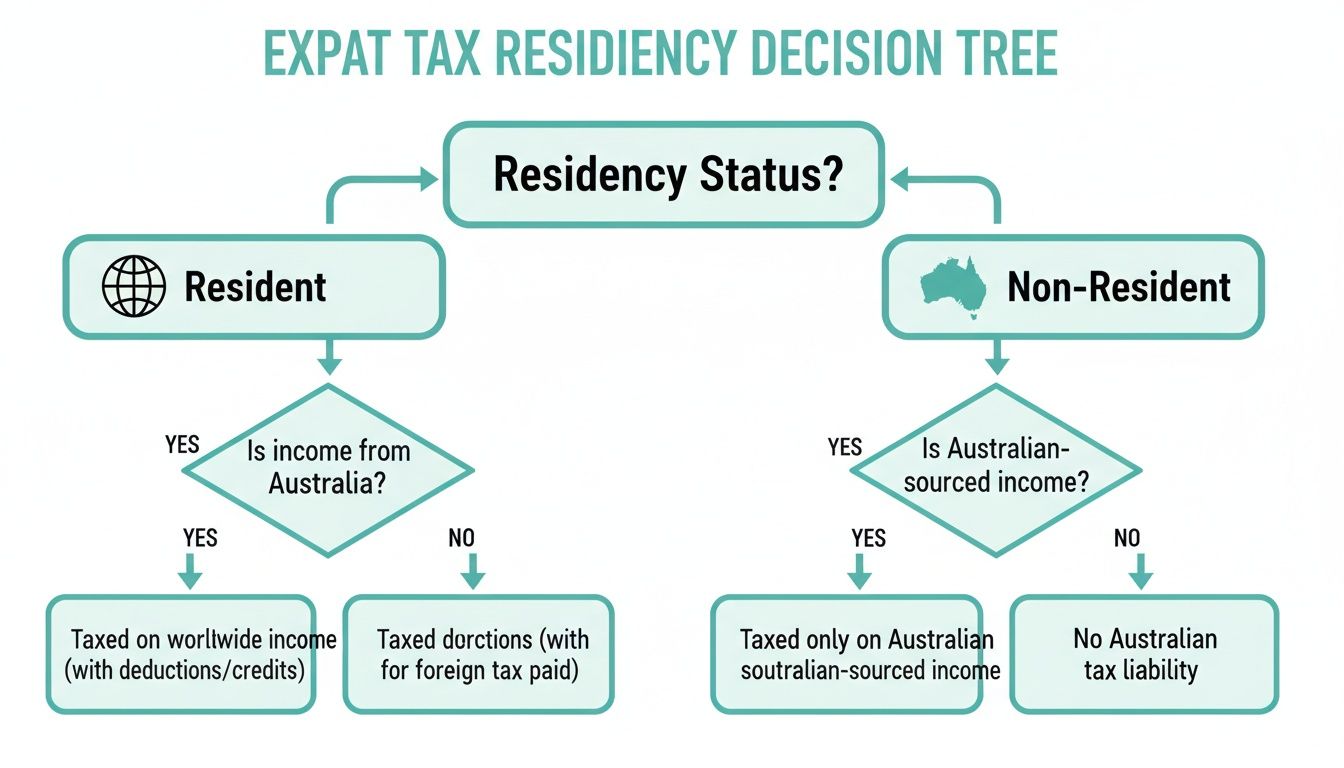
As the flowchart indicates, the path can diverge significantly. Residents may be taxed on their worldwide income, while non-residents are generally taxed only on income earned in Australia.
The Four Key Residency Tests
The ATO uses four tests to determine residency status. An individual only needs to meet one of these tests to be considered an Australian resident for tax purposes. These are not a simple checklist; they require a genuine assessment of your life, your ties to Australia, and your intentions.
Let's break them down into clear, practical steps.
Here is an overview of what the ATO generally considers with each test.
Australian Tax Residency Tests at a Glance
| Residency Test | Primary Consideration | Common Scenario for Australian Professionals or Migrants |
|---|---|---|
| The Resides Test | Where do you live and have your primary base? This is the main test. | A professional moves to Australia for an extended period, establishes a home, and develops social and economic ties, even on a temporary visa. |
| The Domicile Test | What country is your permanent legal home? | An individual born in Australia who has decided to make it their permanent home is temporarily living overseas. |
| The 183-Day Test | Have you been physically present in Australia for more than half the financial year? | A business owner has been in Australia for over 183 days (continuously or in separate trips) and has not established a permanent home elsewhere. |
| The Superannuation Test | Are you a member of a specific Commonwealth government super scheme? | An Australian government employee (or their spouse/child under 16) is working overseas and contributing to the PSS or CSS. |
These tests examine the substance of your situation, not just isolated facts like the number of days you have been in the country.
How This May Apply in Practice
These tests can seem abstract, so let's consider two practical examples relevant to Australian families and professionals.
Consider a medical professional from the UK who relocates to Sydney on a two-year working visa. She signs a lease on an apartment, enrols her children in a local school, and joins a professional medical association. Despite her visa being temporary, her actions suggest she is building a life in Australia. In these circumstances, the ATO would likely consider her a tax resident under the resides test.
Now, think of an Australian business owner who spends ten months of the year travelling for international business. Her family remains in their Melbourne home, she maintains her Australian bank accounts, and she consistently returns to that home between trips. She would likely remain an Australian tax resident under both the resides and domicile tests.
Why Your Residency Status is Financially Significant
The outcome of these tests can have a direct and immediate impact on your financial position. If you are classified as an Australian tax resident, you generally fall into our progressive tax system and may also be liable for the Medicare levy. Critically, you may also have access to the tax-free threshold.
Non-residents may face a different tax treatment. They are typically taxed from the first dollar of Australian-sourced income, with no tax-free threshold, making the residency distinction very important for financial planning.
Grasping these foundational principles is an important part of good stewardship. Your residency status may directly impact your applicable tax rates, your access to the tax-free threshold, and the scope of the income you are required to report to the ATO.
How to Manage Foreign Income and Double Taxation
For many expats, financial interests may extend beyond Australia's borders. You might hold overseas investments, earn rental income from a property in another country, or have international business interests. If you are an Australian resident for tax purposes, the ATO generally requires this worldwide income to be included in your assessable income.
This may raise a reasonable question: "Will I be taxed twice on the same income?" This is a significant concern, and the system is designed to address it through specific mechanisms. Australia has provisions in place to provide tax relief and prevent double taxation. These rules acknowledge that modern work and investment are often global.
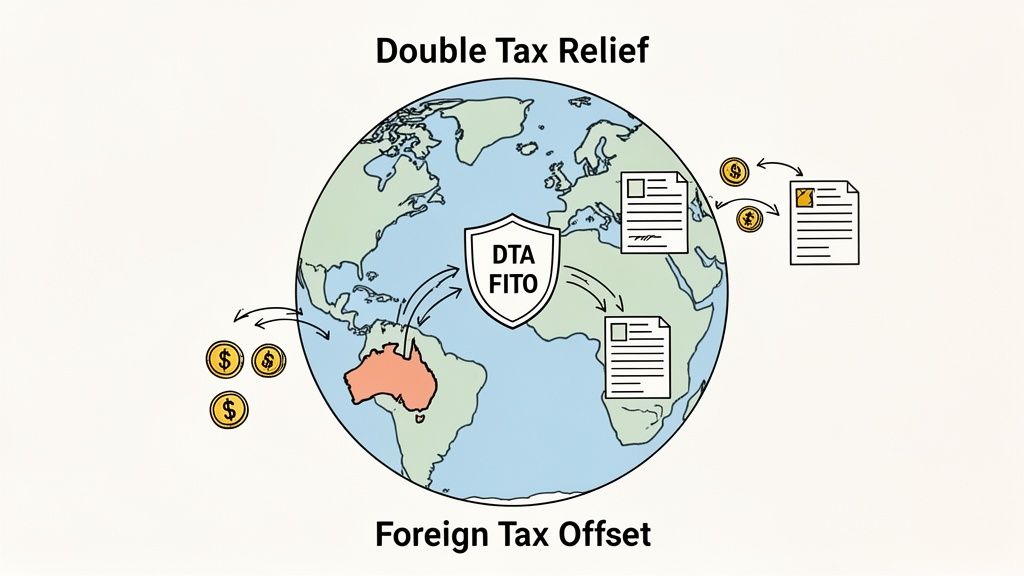
Understanding Double Tax Agreements
Australia has formal Double Tax Agreements (DTAs) with many countries. These may be viewed as official treaties between two nations designed to prevent double taxation and facilitate the exchange of information.
A DTA can be thought of as a set of rules that allocates taxing rights. Depending on the type of income—such as dividends, interest, or royalties—the agreement might give one country the sole right to tax it. Alternatively, it might allow both to tax it, with one country then required to provide relief.
The purpose of a DTA is to create clarity and certainty for individuals and businesses operating across borders. It provides a consistent framework to determine how income is treated, which can reduce the risk of being taxed twice on the same income.
Each agreement is unique. Its specific rules will depend on your circumstances and the type of income you are earning. For this reason, professional advice may be appropriate to interpret a DTA.
The Role of the Foreign Income Tax Offset
When a DTA allows both countries to tax the same income, Australia's primary mechanism for providing relief is the Foreign Income Tax Offset (FITO). This is a key tool for managing the tax on your international earnings.
The FITO may allow you to claim a credit against your Australian income tax for the foreign tax you have already paid. It can directly reduce your Australian tax liability, ensuring you do not pay tax twice on that portion of your income.
There are rules to claiming the FITO. You must generally meet two key conditions:
- You must have paid the foreign income tax.
- The income on which you paid that foreign tax must be included in your Australian assessable income.
The offset is capped at the amount of Australian tax that would otherwise be payable on that same foreign income. It cannot be used to reduce the tax on your Australian-sourced income.
A Practical Example of Tax Relief
Let’s see how this may work with a practical example. Imagine an Australian tax resident who owns a consulting business operating under a Personal Services Income (PSI) structure. This year, the business earns a profit in New Zealand and pays $15,000 in New Zealand income tax.
- Declaring Worldwide Income: As an Australian tax resident, she must declare this New Zealand profit in her Australian tax return.
- Calculating Australian Tax: The ATO calculates the Australian tax due on her total income, which now includes the NZ profit. Let's say the Australian tax on just the NZ portion of her income comes to $20,000.
- Claiming the FITO: Because she already paid $15,000 in tax to New Zealand, she may be able to claim a Foreign Income Tax Offset.
- The Final Outcome: The $15,000 FITO would directly reduce her Australian tax bill. In this scenario, she would owe the ATO the remaining $5,000 on that foreign income, thus avoiding double taxation.
This illustrates how the system is designed to provide a fair outcome. Understanding how your foreign income affects your overall position is a vital part of good financial management. Helping clients navigate these exact situations is a core part of our tax advisory services.
If you would like clarity on how these principles may apply to your own circumstances, you may wish to speak with a qualified adviser. You can contact Everglow on 1300 913 929 or email contact@everglow.au to arrange a discussion.
General Advice Warning
The information provided in this article is general in nature and does not take into account your personal objectives, financial situation, or needs. Before acting on any information, you should consider the appropriateness of the information provided and seek personal advice from a qualified professional.
Key Compliance Obligations for Expats in Australia
Good financial stewardship is built on diligent compliance. For expats navigating the Australian system, this means understanding and consistently meeting your obligations to the Australian Taxation Office (ATO). While these responsibilities should be taken seriously, they can be managed effectively with clear organisation and a patient approach.
This often comes down to lodging an annual Australian tax return if your income is above the relevant threshold. This is the primary way you report what you have earned, claim any eligible deductions, and reconcile your tax position for the financial year, which runs from 1 July to 30 June.
Annual Tax Lodgement
For individuals lodging their own return, the deadline is typically 31 October. However, if you engage a registered tax agent, you may be granted an extended deadline, sometimes well into the following year. This additional time can be valuable for gathering all your information, especially when coordinating details from overseas.
There are a few ways to lodge your return, each suited to different situations:
- myTax Portal: The ATO’s online platform is a direct and secure way for individuals to lodge. It often comes pre-filled with information from employers and banks, which can save time.
- Registered Tax Agent: Engaging a professional can provide peace of mind that your return is accurate, particularly when dealing with complex issues like foreign income or capital gains.
- Paper Lodgement: While less common, this option is still available for those who prefer or require it.
Timely reporting is central to the nation's financial framework.
The Pay As You Go System
Beyond the annual return, the Pay As You Go (PAYG) system is a core part of Australia's tax landscape. It is a way to pay tax in smaller, regular instalments throughout the year, rather than facing a single, large liability after you lodge.
PAYG Withholding is the system most people are familiar with. If you are an employee, your employer withholds a portion of tax from each payment and sends it directly to the ATO. The amount is an estimate, and it is all reconciled when you lodge your annual return.
PAYG Instalments might apply if you earn business or investment income—such as from shares or a rental property—that does not have tax withheld at the source. If this income is above a certain threshold, the ATO may require you to pay regular instalments towards your expected annual tax liability. This system can assist with cash flow management and help avoid a large tax bill at year-end.
The Cornerstone of Good Record-Keeping
Underpinning all of this is the discipline of keeping clear and accurate records. This is a fundamental part of responsible financial management. The ATO generally requires you to hold records for five years to substantiate the claims made in your tax return.
Sound financial decisions are built on a bedrock of reliable information. Keeping meticulous records of your income, expenses, and asset transactions provides the clarity needed for both accurate compliance and effective long-term planning.
This may include documents such as:
- Payslips and income statements from all sources, both in Australia and overseas.
- Records of tax paid in other countries if you plan to claim a foreign income tax offset.
- Receipts for any work-related expenses you intend to claim as deductions.
- Statements for your investments, detailing purchases and sales for capital gains tax purposes.
This disciplined habit not only helps ensure you can meet your obligations with confidence but also provides a clear picture of your financial position.
If you would like clarity on how these principles may apply to your own circumstances, you may wish to speak with a qualified adviser. You can contact Everglow on 1300 913 929 or email contact@everglow.au to arrange a discussion.
General Advice Warning
The information provided in this article is general in nature and does not take into account your personal objectives, financial situation, or needs. Before acting on any information, you should consider the appropriateness of the information provided and seek personal advice from a qualified professional.
Tax Planning Strategies for Your Financial Future
Effective tax management is about forward-looking planning that considers the seasons ahead, not just the one you are in. For expats, a patient and disciplined approach is key to building a resilient financial future, but any strategy must be appropriate for your personal circumstances. This involves understanding both opportunities and responsibilities.

Let's walk through some of the core principles you might discuss with an adviser, grounded in Australian law and ATO guidance.
The Importance of Timing
The specific dates you arrive in or depart from Australia can have significant tax implications. Becoming an Australian tax resident part-way through a financial year means your tax obligations may change from that day forward.
Where you have some control, careful timing could influence which financial year certain income is assessed in, or whether you may be eligible for the full tax-free threshold. Planning around these key dates can be a foundational part of sound taxation for expats.
Thoughtful planning is not about seeking shortcuts but about understanding how the deliberate timing of key financial events may align with established tax principles to produce a more favourable and sustainable outcome over the long term.
Choosing the Right Structure for Your Endeavours
For professionals, consultants, and business owners, the structure you operate through can profoundly shape your tax outcomes and compliance burden. The choice between operating as a sole trader, a partnership, a company, or a trust is a significant decision with long-term consequences.
Each structure has different rules when it comes to:
- Tax Rates: A company, for instance, pays tax at a flat corporate rate, which is different from the marginal personal income tax rates that apply to a sole trader.
- Asset Protection: Some structures, like companies, may create a legal separation between your personal and business assets. This separation could be a crucial factor.
- Compliance Obligations: The administrative and reporting requirements for a company or a trust are generally more involved than those for a sole trader.
The appropriate structure is entirely dependent on your activities, income levels, and long-term goals. What works for one person may be unsuitable for another, which is why tailored professional advice may be appropriate.
Superannuation and Other Considerations
Beyond business structuring, other avenues may present opportunities for tax management. Contributing to your superannuation fund, for example, is a common way to build retirement savings while potentially lowering your taxable income.
Similarly, how you hold your investments can influence your tax position, particularly concerning capital gains. The suitability of any strategy is deeply personal and depends on your risk appetite, investment horizon, and overall financial plan. The core message is simple: patience and foresight, guided by professional insight, are the cornerstones of responsible financial stewardship.
If you would like clarity on how these principles may apply to your own circumstances, you may wish to speak with a qualified adviser. You can contact Everglow on 1300 913 929 or email contact@everglow.au to arrange a discussion.
General Advice Warning
The information provided in this article is general in nature and does not take into account your personal objectives, financial situation, or needs. Before acting on any information, you should consider the appropriateness of the information provided and seek personal advice from a qualified professional.
