

In Australia, the rhythm of your financial life is often set by the tax year. It is a consistent 12-month cycle that commences on 1 July and concludes on 30 June the following year. This is the timeline the Australian Taxation Office (ATO) uses, and it provides the framework for most individuals and businesses to report their income and meet their obligations.
Understanding The Australian Financial Year Calendar
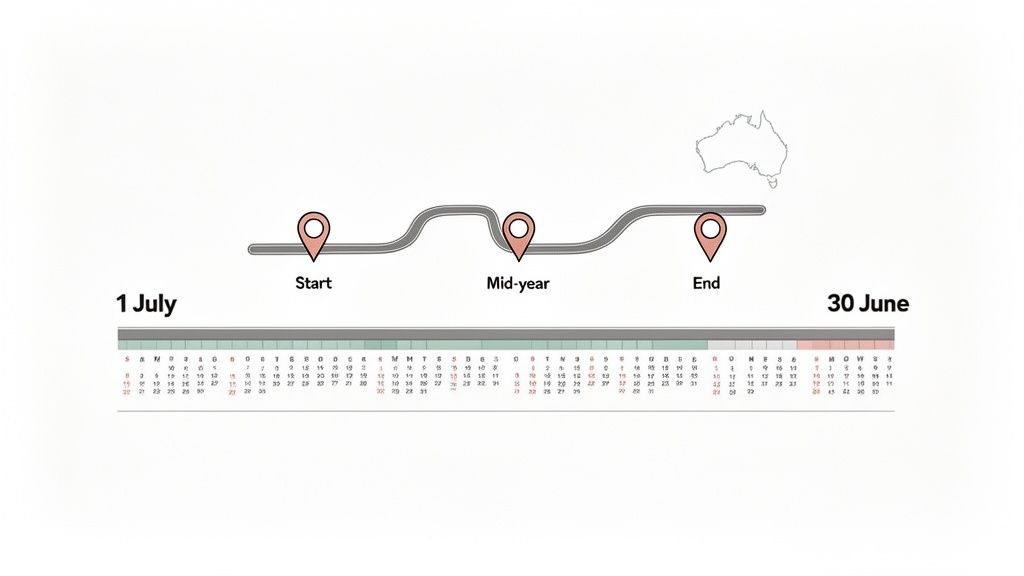
For professionals, business owners, and families, this calendar dictates the flow of financial responsibilities, providing a predictable structure for planning, reporting, and compliance. This standardised period is the bedrock of our tax system. It governs how and when you report your earnings, claim deductions, and ultimately, meet your responsibilities to the ATO.
Why a Standardised Calendar Matters
The consistency of the 1 July to 30 June cycle brings a measure of clarity to the process. It removes guesswork and allows you to prepare methodically, which is a cornerstone of sound financial management. By understanding these key dates, you may build a solid foundation for managing your tax obligations with confidence. It could be considered the first step in moving from a reactive scramble to a proactive, well-thought-out approach to your finances.
Grasping this financial calendar is less about memorising dates and more about understanding the seasonal rhythm of your financial life. It allows for thoughtful planning rather than last-minute reactions.
The timing has historical roots in Australia’s colonial past, originally aligned with agricultural cycles and government budgeting. After federation in 1901, it was adopted as the national standard. This long-standing structure continues to form the backbone of tax planning for professionals, businesses, and new migrants today. As you become familiar with this annual timeline, you can begin to consider the specific deadlines that fall within it. For further detail, you may wish to review information on the Australian tax due date system.
Key Tax Deadlines For Individuals And Sole Traders
If you are an individual or sole trader managing your own tax affairs, one key date is 31 October. This is the standard deadline the Australian Taxation Office (ATO) sets for lodging your income tax return for the financial year that concluded on 30 June. Meeting this deadline requires a degree of discipline and preparation.
The Role of a Registered Tax Agent
Engaging a professional can change the approach. When you work with a registered tax agent, you may gain access to their special lodgement program. Depending on your circumstances and lodgement history, this could extend your deadline later into the following year—often as late as May.
This extension is part of a structured system the ATO uses to manage the flow of tax returns. It can provide a more manageable timeline, taking the pressure off the single 31 October deadline and allowing for a calmer, more thorough preparation process. For a deeper insight into these timelines, you can learn more about the specifics of the tax return deadline in Australia.
Distinctions Between Salary Earners and Sole Traders
While the lodgement dates can be similar, the preparation required may differ. If you are a salaried employee, your primary task is often to gather your income statement, collate receipts for work-related deductions, and account for any other sources of income.
For a sole trader, the responsibilities can be more involved. In addition to the annual tax return, you may be managing quarterly Business Activity Statement (BAS) lodgements for Goods and Services Tax (GST) and Pay As You Go (PAYG) instalments. These quarterly touchpoints create a steady rhythm of compliance throughout the year. For a professional earning Personal Services Income (PSI), understanding these obligations is particularly important.
The decision to self-lodge or use an agent is a foundational choice in how you manage your financial timeline. One path requires readiness by spring, while the other may offer a longer, more structured runway guided by professional support.
For those running their own business as a sole trader, staying on top of these specific deadlines is an important part of maintaining good financial health. Depending on your circumstances, you may find that targeted support and information for sole traders helps to clarify these distinct responsibilities.
Deadlines for Companies, Trusts and SMSFs
For business owners and trustees, the financial year can have a different rhythm. While the standard 1 July to 30 June calendar remains the foundation, the tax deadlines for companies, trusts, and Self-Managed Super Funds (SMSFs) are often more nuanced than for individuals. These structures come with significant responsibilities, and their lodgement schedules reflect this complexity.
The Australian Taxation Office (ATO) has a structured program, particularly for those using a tax agent, which considers an entity's size, turnover, and compliance history. The following flowchart outlines the two main paths many taxpayers face.
It is a crucial choice: lodge by the standard deadline, or engage a professional who may be able to access an extended schedule.
Navigating Different Lodgement Schedules
Unlike the firm 31 October deadline for self-lodging individuals, the dates for business entities can vary. A company with a sound lodgement history, for instance, might not need to lodge until 15 May of the following year when working with its tax agent.
Conversely, a larger business with a tax liability over $20,000 in the prior year could face an earlier deadline of 15 January. Brand new SMSFs also have specific first-year lodgement dates that require careful management. For a deeper insight into these duties, it may be useful to understand the Self-Managed Super Fund rules that every trustee must follow.
Knowing which schedule applies to your specific structure is a core part of good financial stewardship. It is not a 'one-size-fits-all' system, and misinterpreting a due date can cause unnecessary complications.
For trustees and directors, these deadlines are more than just dates on a calendar; they are key milestones in fulfilling legal duties. A well-managed compliance schedule is often the hallmark of a well-managed entity.
Indicative ATO Lodgement Dates by Entity Type (Tax Agent Lodgement Program)
This table provides a general guide to lodgement due dates for different entities when using a registered tax agent. These dates are indicative and may vary based on individual circumstances and ATO discretion. Professional advice may be appropriate to confirm your specific dates.
| Entity Type / Circumstance | Typical Lodgement Due Date | Notes |
|---|---|---|
| Large/Medium Taxpayers (prior year tax > $20,000) | 15 January | May apply to companies, trusts, and SMSFs meeting this threshold. |
| SMSFs (New Registrants) | 28 February | For newly registered SMSFs lodging their first return. |
| Individuals & Trusts (prior year tax < $20,000) | 31 March | May apply where the latest due date is not 15 May. |
| Companies & SMSFs (good compliance history) | 15 May | A common deadline for many entities under the agent program. |
| Consolidated Groups | Varies | The head company's lodgement date usually applies to the group. |
This structured approach from the ATO is designed to manage the flow of tax returns, but it places the onus on business owners and trustees to understand their specific obligations. Proactive planning based on the correct deadlines is key to meeting responsibilities smoothly.
The Risks and Responsibilities of Meeting Tax Deadlines
Meeting tax obligations on time is a fundamental part of managing personal or business finances in Australia. The Australian Taxation Office (ATO) regards lodgement deadlines as firm responsibilities for every taxpayer. Overlooking these dates could lead to financial penalties that may be avoided with discipline and forward planning.
The ATO has a clear process for handling late submissions. While designed to encourage timely compliance, the costs of falling behind can accumulate.
Understanding Penalties and Interest
If you lodge a return or statement after the due date, you may face a Failure to Lodge (FTL) penalty. The amount can vary; it often depends on the size of the entity and the length of the delay. A medium-sized company, for example, could face a higher penalty than an individual taxpayer for the same delay.
In addition, any tax you owe will typically start attracting a General Interest Charge (GIC), which compounds daily. This is intended to compensate the government for the delayed receipt of funds. Australia’s tax revenue is essential for public services, so the ATO is focused on timely collection, as can be seen in Australia's tax revenue trends on CEICdata.com.
The consequences are not just financial. A history of late lodgements could attract further ATO attention, potentially complicating future interactions. A clean compliance record is a valuable asset.
A Proactive Approach to Potential Delays
Circumstances can arise where meeting a deadline is not possible. If you anticipate a delay, a proactive approach is often beneficial. It may be prudent not to wait for the due date to pass.
Reaching out to a qualified adviser or the ATO before a deadline is missed may open up options, such as lodging a deferral request or arranging a payment plan. The ATO is often more receptive to those who communicate early and demonstrate a commitment to resolving their obligations. A measured, early action is a hallmark of good financial management and may save considerable stress and expense. For more context, it may be useful to understand the ATO's approach to an overdue tax return penalty.
Strategic Tax Planning As 30 June Approaches
The 30 June deadline is not just the end of the financial year; it presents a crucial window for thoughtful financial management. It offers a chance to proactively shape your tax position for the closing year, rather than simply reacting when lodging a return months later. This period is an opportune time to pause, review the year's financial activity, and consider what actions may be appropriate for your specific situation.

Practical Considerations Before Year End
Depending on your structure and circumstances, several established strategies might be worth exploring with a professional. These actions are grounded in established tax principles and often revolve around the timing of income and expenses.
For example, a family-owned business might consider prepaying certain expenses, like rent or insurance premiums for the upcoming year. This action could bring forward a tax deduction into the current financial year. Similarly, a business owner may wish to review their asset register. The instant asset write-off rules change over time, but there can be opportunities to purchase and install essential equipment before 30 June to claim a deduction. This requires careful planning to ensure it aligns with genuine business needs and current ATO guidance.
The final weeks of June are not for hasty decisions, but for the deliberate execution of a well-considered plan. Sound strategy is about optimising within the rules, not chasing last-minute loopholes.
Superannuation and Family Planning
The end of the financial year is also a critical time for superannuation planning. It is a moment when families might look at making additional concessional or non-concessional contributions to enhance their retirement savings, while remaining mindful of the annual caps. For those who are eligible, strategies like contribution splitting with a spouse could also be considered. These are not decisions to be made lightly; they require foresight and a clear understanding of how they align with long-term wealth objectives.
The structure of your financial affairs dictates what may be possible. Taking the time to explore approaches to Business Structuring can lay a solid foundation for effective planning for years to come. Ultimately, navigating these opportunities requires a clear view of your financial position. A conversation with a professional offering Tax and Accounting Services can help clarify which actions are suitable for you.
Your Next Steps Toward Financial Clarity
Understanding Australia’s tax year can be the first step in shifting from a reactive to a proactive approach with your finances. This calendar is not merely a list of dates; it provides a rhythm for disciplined planning, enabling you to meet your obligations with foresight rather than last-minute pressure. When these deadlines are treated not as finish lines but as guideposts, you create the space for thoughtful, strategic action.
The journey towards sound financial management is built on clarity and consistency. To support this, it can be valuable to understand the fundamentals of good record-keeping. This includes the principles of a robust double-entry bookkeeping system, which can form the bedrock of sound financial decisions.
Charting Your Path Forward
With this knowledge, you can begin to map out your own financial calendar. We encourage you to review your position well ahead of key dates, considering both your responsibilities and where opportunities might lie.
- Review Your Structure: Does your current business or investment structure still serve your long-term goals? A qualified adviser can help you weigh the options.
- Plan Ahead for Lodgements: Whether you are an individual or a company director, knowing your specific lodgement date well in advance can remove stress and allow for proper preparation.
- Seek Clarity on Complex Matters: If you are managing an SMSF, a trust, or international business affairs, seeking professional guidance may be the most prudent way to ensure all your compliance needs are met.
Thinking strategically about your tax and accounting obligations is an important part of good stewardship. A well-considered plan, executed with patience, is a reliable path toward financial confidence and stability.
If you would like clarity on how these principles may apply to your own circumstances, you may wish to speak with a qualified adviser. You can contact Everglow on 1300 913 929 or email contact@everglow.au to arrange a discussion.
General Advice Warning: The information provided in this article is general in nature only and does not take into account your personal objectives, financial situation, or needs. You should consider seeking personal financial, legal, and taxation advice before acting on any information in this article.
Want help applying this to your situation?
Every situation is different. Book a time with our team to talk it through, or call us on 1300 913 929.