

Navigating the Australian tax year is a predictable cycle. Understanding its rhythm is the foundation of sound financial management, turning compliance from an annual obligation into a structured part of your financial strategy.
At its core, a tax due date is the final day the Australian Taxation Office (ATO) expects you to either lodge a return or pay a tax bill. A clear understanding of these dates is the first step toward thoughtful financial stewardship. This guide breaks down the key timelines in a practical way for Australian professionals, business owners, and families.
Understanding the Rhythm of the Australian Tax Year
The Australian financial year concludes on 30 June, which sets in motion a series of important obligations. Viewing these deadlines as planning milestones rather than pressure points may foster a sense of control and foresight.
It is important to understand the distinction between two fundamental concepts:
- Lodgement Due Date: This is the deadline to file your tax return or activity statement with the ATO. It concerns the submission of information.
- Payment Due Date: This is the separate deadline for paying any tax you owe. Depending on your circumstances, these two dates may not be the same.
Different Structures, Different Timetables
A common area of uncertainty is that different individuals and business structures may operate on different timetables. An individual lodging their own tax return has a very different deadline from a large company or a family trust managed by a tax agent.
For this reason, a clear, organised approach tailored to your specific situation is often beneficial. Whether you are a medical professional managing Personal Services Income (PSI), a new migrant navigating Australian tax law, or a family managing investments, your compliance calendar will have its own cadence. We explore this in our guide on the tax return deadline in Australia.
Grasping this annual rhythm is a foundation of good financial stewardship. It allows for thoughtful planning, helps maintain healthy cash flow, and may contribute to long-term financial stability.
Risks and Responsibilities
Meeting tax obligations is a key responsibility. Missing a tax due date can lead to penalties and interest charges from the ATO. It is also an opportunity for thoughtful planning. By understanding your deadlines, you can better manage cash flow, particularly if a tax payment is anticipated. This foresight helps ensure funds are available when needed, avoiding unnecessary financial strain.
Practical Next Steps
A simple yet effective first step is to identify which tax obligations apply to you and mark the relevant dates in your calendar. This disciplined action creates a clear roadmap for the year ahead, removing potential guesswork.
For those managing more complex affairs, such as a business or a diverse investment portfolio, obtaining tailored guidance may be appropriate. Our tax and accounting services are designed to bring clarity to these matters.
If you would like clarity on how these principles may apply to your own circumstances, you may wish to speak with a qualified adviser. You can contact Everglow to arrange a discussion.
General Advice Warning: The information provided in this article is general in nature and does not take into account your personal objectives, financial situation, or needs. Before acting on any information, you should consider the appropriateness of the information having regard to your own objectives, financial situation, and needs and seek personal advice from a qualified professional.
Key Tax Due Dates for Individuals and Sole Traders
For an individual or sole trader managing their own tax affairs, one date in particular anchors the financial year. The timeline for finalising tax obligations can, however, shift depending on the approach you take.
Understanding the flexibility within the system is where sound financial management often begins.
The Self-Lodger Deadline
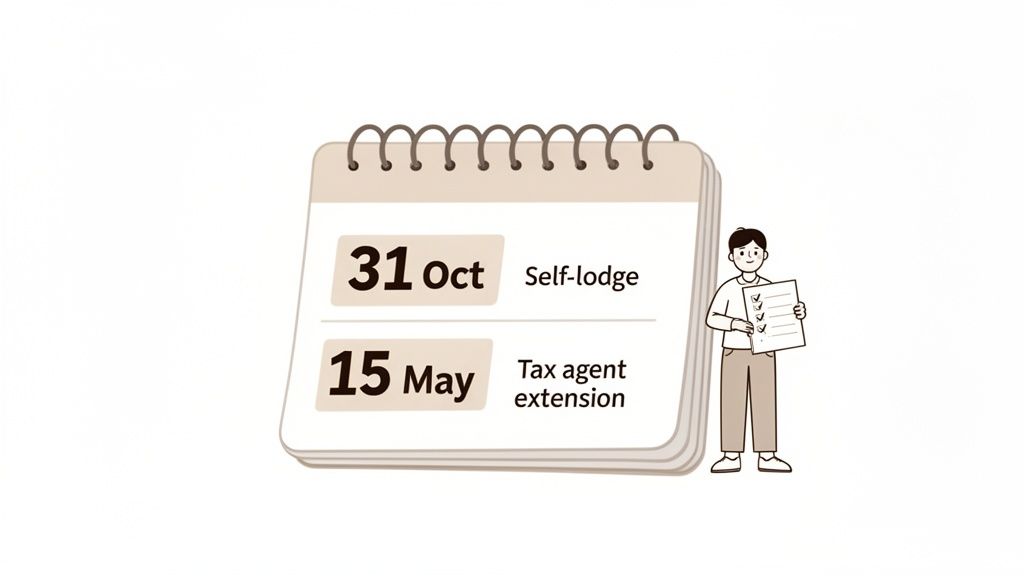
If you prepare and lodge your own income tax return, the deadline is generally 31 October each year. This provides a four-month window after the financial year ends on 30 June to collate records, determine your position, and submit your return to the Australian Taxation Office (ATO).
Missing this date may have consequences. A failure to lodge on time can attract penalties, which may increase the longer a return remains outstanding.
The Strategic Advantage of a Tax Agent
For those who engage a registered tax agent, the lodgement timeline may be different. This decision does more than delegate the preparation work; it can fundamentally alter your compliance calendar.
The ATO provides special lodgement programs for tax agent clients, which can extend the deadline as far as 15 May of the following year. This extension can be valuable for professionals with complex income streams, such as medical practitioners managing Personal Services Income (PSI), or sole traders with significant business expenses.
This additional time is an opportunity. It allows for more thorough record-gathering, careful consideration of all potential deductions, and a less hurried, potentially more accurate lodgement.
An extended deadline can also provide breathing room for cash flow planning, particularly if you anticipate a tax liability. Knowing your final tax position months before payment is due may allow for more measured financial decisions.
Summary of Key Lodgement Dates for Individuals
To provide a clear picture, here is a simple breakdown of the main lodgement dates for individuals and sole traders.
| Lodgement Method | Lodgement Due Date | Typical Circumstances |
|---|---|---|
| Self-Lodgement | 31 October | For individuals preparing and filing their own tax return directly with the ATO. |
| Using a Registered Tax Agent | Up to 15 May (next year) | For individuals who have appointed a tax agent to manage their lodgement. Circumstances vary. |
Regardless of the path chosen, the foundation of a smooth tax season is disciplined record-keeping throughout the year. This patient, methodical approach is a hallmark of good financial stewardship.
Navigating Deadlines for Companies, Trusts, and Super Funds
While individuals have a relatively predictable tax calendar, compliance for companies, trusts, and Self-Managed Super Funds (SMSFs) can be more nuanced. For directors and trustees, understanding these timelines is a cornerstone of good governance and responsible financial management.
The exact tax due date for these entities is not uniform. It may shift depending on specific circumstances, such as lodgement history or prior-year tax liabilities. This variability suggests that a proactive, forward-looking approach may be beneficial.

The Tax Cycle for Companies and Trusts
For most Australian companies with a standard 30 June year-end, the lodgement deadline for the annual income tax return may be 28 February of the following year. However, this date can change.
For instance, companies classified as large or medium taxpayers with a tax liability over a certain threshold in the prior year may face an earlier deadline of 15 January. This is why it is important to confirm your entity's specific classification and due date with the ATO or your adviser. Trusts also have their own compliance rhythm, with lodgement dates that can vary significantly, especially when managed through a tax agent's lodgement program.
A common pitfall is assuming all business structures operate on the same schedule. Proactively confirming your entity's specific tax due date is a simple discipline that can mitigate unnecessary compliance risk.
Compliance for Self-Managed Super Funds (SMSFs)
The compliance calendar for an SMSF is particularly strict. The lodgement due date for the annual return for a newly registered SMSF is typically 28 February. For established funds, the date may be extended to 15 May if lodging through a tax agent.
However, the fund’s annual audit must be completed before the return can be lodged. This is a critical responsibility for trustees, reinforcing the need for diligent record-keeping and early engagement with an approved SMSF auditor. The rules governing SMSFs are detailed and require careful navigation. You can learn more about a Self-Managed Super Fund and its specific rules.
Practical Next Steps
A practical approach is to build tax planning into the organisation's regular financial rhythm. This involves moving beyond seeing the tax due date as a single event and instead viewing it as the culmination of a year's worth of careful record-keeping and financial management. This discipline makes cash flow planning more manageable and is a hallmark of a well-run, resilient organisation.
A Concise Takeaway
Understanding your specific tax due date is a foundational element of sound financial management in Australia.
- Individuals: If lodging yourself, the deadline is generally 31 October. Using a tax agent may extend this to 15 May of the following year.
- Businesses, Trusts & SMSFs: Deadlines vary based on structure, history, and whether an agent is used. Proactive confirmation is key.
- Quarterly Obligations: For many businesses, BAS, PAYG, and superannuation create a steady rhythm of compliance throughout the year.
Meeting these obligations is both a responsibility and an opportunity for strategic financial planning. A disciplined, forward-looking approach helps manage cash flow, mitigate risk, and supports long-term financial wellbeing.
If you would like clarity on how these principles may apply to your own circumstances, you may wish to speak with a qualified adviser. You can contact Everglow on 1300 913 929 or email contact@everglow.au to arrange a discussion.
General Advice Warning: The information provided in this article is general in nature and does not take into account your personal objectives, financial situation, or needs. Before acting on any information, you should consider the appropriateness of the information having regard to your own objectives, financial situation, and needs and seek personal advice from a qualified professional.
Want help applying this to your situation?
Every situation is different. Book a time with our team to talk it through, or call us on 1300 913 929.