

Handing over a family business is more than a transaction; it is the continuation of a legacy. The journey of succession planning for a family business does not begin with legal documents. It starts with honest conversations and a clear-eyed assessment of where the business and family stand today. This first step is about moving from vague hopes to a structured, open dialogue.
Building the Foundation for a Smooth Handover
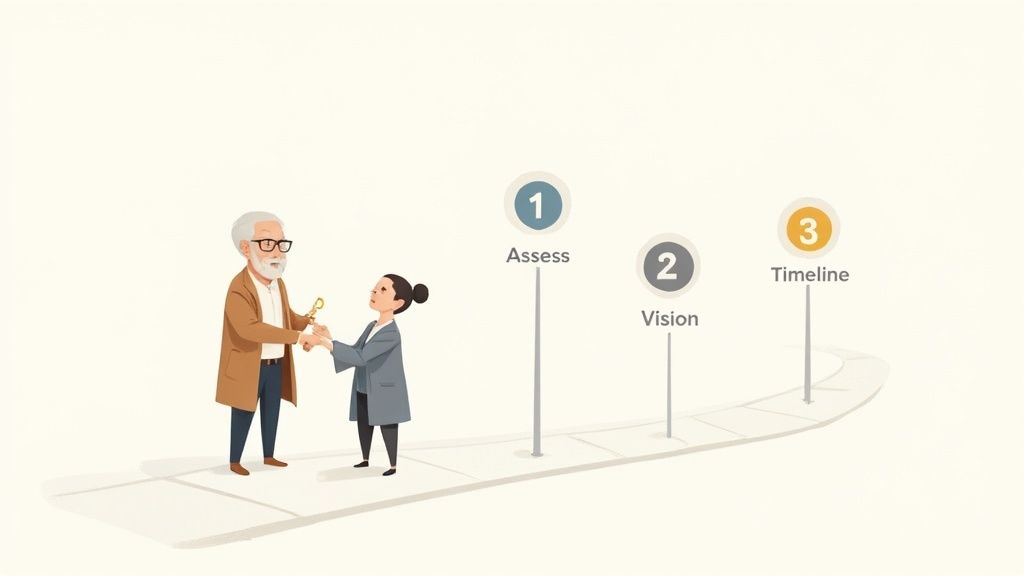
The handover of a family enterprise is a significant event for the family members involved and for the business itself. In Australia, many well-intentioned transitions encounter difficulties, not from a lack of desire, but because planning began too late. The process can feel overwhelming, entangled in family dynamics and the daily pressures of running the business.
Good stewardship, however, demands a start.
The first move is to calmly and objectively assess the current state of affairs. This is not about assigning blame but about creating a clear, shared picture of the starting point. This careful evaluation forms the bedrock upon which all future decisions will be built.
Assessing Business and Family Readiness
Before mapping a path forward, you must know your exact location. This requires a dual assessment: one of the business's health and one of the family's preparedness for what lies ahead. It is a quiet, reflective process that demands looking at facts without letting emotion cloud judgement.
From a business perspective, an honest appraisal of these areas is necessary:
- Financial Health: Is the business consistently profitable? What do the balance sheet and cash flow statements truly say about its stability? Depending on your circumstances, a potential lender may scrutinise at least three years of financial records, making a firm grip on the numbers essential.
- Operational Stability: How much does the business rely on the current owner? Are there documented systems that would allow it to run smoothly under new leadership? A business that depends entirely on one person’s knowledge carries significant transition risk.
- Legal & Compliance Standing: Are all ASIC and ATO obligations up to date? Are employment agreements, key supplier contracts, and property leases in good order? Any compliance gaps should be addressed long before a handover is considered.
At the same time, the family’s readiness is just as crucial. Many plans are derailed by unspoken assumptions. Consider a migrant family who built a successful construction firm in Western Sydney. They might assume their eldest child will take over. But if that child, now a skilled doctor, has different aspirations, the assumption could lead to conflict.
A successful succession plan is built on open communication, not on assumptions. The hardest conversations are often the most necessary ones to have at the very beginning.
Establishing a Shared Vision
Once you have a clear picture of the present, it is time to look toward the future. This is not about one person imposing a vision on everyone else. It is about forging a collective agreement on what the business should become. This dialogue is vital for preventing future conflicts by aligning everyone's expectations early on.
This means asking direct, sometimes uncomfortable, questions:
- What is the long-term goal? Is it to keep the business in the family? Is it to prepare it for a sale to an external party or a management buyout?
- What role, if any, will family members who are not active in the business play? Their financial interests and expectations must be considered.
- How will the retiring generation be supported financially? Their future security is a cornerstone of any workable plan.
For instance, a family running a winery in the Barossa Valley may have one child passionate about winemaking and another with a flair for marketing. A shared vision could involve structuring the business so both can contribute their unique skills and have a clear path forward.
A well-defined vision gives the process direction and purpose, turning an emotional journey into a shared project. This foresight is the essence of good stewardship—protecting what has been built while preparing it for the seasons ahead.
Choosing the Right Business Structure for the Future
Once you have a shared vision for the future, the next step is a quiet but critical one: ensuring the legal and governance framework of your business can support that vision.
The structure you operate under is the bedrock of a successful succession. It dictates how control is exercised, how assets are protected, and the tax outcomes for everyone involved under Australian law. A structure chosen with foresight can withstand the tests of time and change.
Common Structures for Australian Family Businesses
In Australia, family businesses usually operate under a few core structures, each with distinct implications for a future handover. The best choice depends entirely on your family's specific circumstances and long-term goals.
- Sole Trader/Partnership: While simple to set up, these structures offer little separation between personal and business assets. This lack of asset protection can create significant risk during a transition and may complicate the transfer of ownership.
- Company (Pty Ltd): A proprietary limited company is a separate legal entity. This creates a clear line between business and personal liabilities, providing a vital layer of protection. Ownership is held via shares, which can be transferred, sold, or passed on in a will, making it a flexible and common choice.
- Trusts (Family or Discretionary): A family trust holds assets on behalf of beneficiaries—the family members. A trustee, often a company, manages those assets according to a formal trust deed. Trusts can be effective for asset protection and may offer flexibility in distributing income to family members in a tax-effective way.
The structure you choose has direct consequences. For example, transitioning a business held in a company might involve a share sale, which could trigger Capital Gains Tax (CGT) obligations. If the business assets are held within a trust, transferring control of the trustee can be a different process.
Dissecting Trusts and Their Role
Trusts are a popular vehicle for family businesses, but they demand careful management. A discretionary trust, often called a family trust, gives the trustee the power to decide which beneficiaries receive income or capital each year. This makes it a highly flexible tool for tax planning.
Another form, the unit trust, operates differently. Here, beneficiaries hold 'units', much like shareholders in a company. These units entitle them to a fixed proportion of the trust's income and capital. This can provide more certainty for beneficiaries but offers less flexibility for the trustee.
The legal structure of your business isn't just an administrative detail. It’s a strategic tool that directly influences control, risk, and the financial well-being of your family for generations.
The Importance of a Family Charter
Beyond the legal structure registered with ASIC, a family charter or constitution is a vital governance tool. This is not a legally binding document like a shareholder agreement. Instead, it is a moral compass—a document that sets out the family's values, vision, and rules of engagement.
A well-drafted charter calmly addresses sensitive issues before they can become points of conflict.
- Rules for family employment: What qualifications are needed for a family member to join the business?
- Leadership selection: How will the next CEO or managing director be chosen?
- Communication protocols: How will decisions be shared with family members, both inside and outside the business?
- Conflict resolution: What is the agreed-upon process for handling disagreements?
Imagine a family running a chain of cafes in Brisbane. Their charter could specify that any child wanting a management role must first work for two years in an external hospitality business. This ensures they bring valuable experience and are not seen to be getting special treatment, preserving both family harmony and business integrity. That simple rule, agreed upon in advance, can prevent immense difficulty down the track.
Navigating Australian Tax and Estate Planning Rules
When tax enters the succession conversation, the process can feel overwhelming. The rules set by the Australian Taxation Office (ATO) and state revenue offices are exacting, and how you structure the transfer of your business will have significant financial consequences. This is a landscape that demands careful navigation with professional guidance.
The scale of this challenge is immense. Across Australia, an estimated $3.5 trillion in wealth is set to pass to the next generation over the coming 20 years. That figure highlights just how much is at stake. You can read more about these findings on the future of family enterprises to grasp the national context.
A considered approach is about understanding both your obligations and your opportunities, ensuring you act in full compliance while making prudent decisions for your family's future.
Capital Gains Tax and the Small Business Concessions
One of the biggest financial hurdles in any business transfer is Capital Gains Tax (CGT). When you dispose of an asset—like shares in a family company—the ATO will generally tax the capital gain, which is the difference between what the asset cost you and what you received for it.
However, the Australian government provides a valuable set of concessions designed to reduce or even eliminate the CGT bill, known as the Small Business CGT Concessions.
To be eligible, you first need to meet several basic conditions. This includes being a small business entity (with an aggregated turnover of less than $2 million) or satisfying the maximum net asset value test (where the net value of your CGT assets is no more than $6 million).
If you meet these initial tests, four powerful concessions may come into play:
- 15-Year Exemption: If you have owned the asset for 15 years and you're over 55 and retiring, you may pay no CGT at all.
- 50% Active Asset Reduction: Allows you to reduce the capital gain on a business asset by 50%.
- Retirement Exemption: You may be able to disregard capital gains up to a lifetime limit (currently indexed at $500,000).
- Rollover: Lets you defer a capital gain if you use the proceeds to acquire a replacement business asset.
These concessions can completely change the financial outcome of your succession plan, but their application is highly technical. Eligibility depends entirely on your specific circumstances.
The Small Business CGT Concessions are powerful tools, but they are not automatic. Eligibility must be carefully assessed against strict ATO criteria with the help of your accountant.
Transfer Methods and Their Tax Implications
The way you structure the handover directly impacts your tax obligations. A simple gift of shares to your children is treated very differently by the ATO than a structured sale at market value.
Let's look at a few common scenarios:
- Sale at Market Value: This is a straightforward transaction where the retiring owner sells their shares or business assets to the successor for an agreed price, triggering a CGT event. The concessions mentioned above could then be applied if eligible.
- Gift or Transfer Below Market Value: Even if no money changes hands, the ATO’s market value substitution rules generally apply. This means CGT could be calculated as if you sold the asset for its full market price.
- Inheritance via an Estate: If the business passes on through a will, different CGT rules apply. In many cases, the CGT liability may be "rolled over" to the beneficiary, who then becomes liable for the tax only when they eventually dispose of the asset.
Structuring the business within a trust can add another layer of options. For many families, understanding what a family trust is in Australia is a crucial first step, as it can provide a flexible way to distribute ownership and income over time.
This table provides a high-level summary of the key tax issues to work through with your professional advisers.
Key Australian Tax Considerations in Business Succession
A summary of major tax issues and potential relief options available under Australian law. This is for general guidance only; seek personal advice.
| Tax Consideration | Brief Explanation | Potential Strategy or Relief (Subject to Eligibility) |
|---|---|---|
| Capital Gains Tax (CGT) | A federal tax on the capital gain made from the disposal of an asset, including business shares or the business itself. | Small Business CGT Concessions (15-year exemption, 50% active asset reduction, retirement exemption, rollover). |
| Stamp Duty | A state/territory-based tax on the transfer of certain assets, such as land, real estate, or business property. Rates vary between jurisdictions. | Some states offer exemptions or concessions for transfers between family members or as part of a business restructure. |
| Goods and Services Tax (GST) | A 10% tax on most goods and services. A business sale can be a taxable supply, potentially triggering a large GST liability. | The ‘going concern’ exemption, which allows the sale of a business to be GST-free if specific conditions are met by both the seller and buyer. |
| Division 7A | Anti-avoidance rules that can treat payments, loans, or forgiven debts from a private company to a shareholder as an unfranked dividend. | Ensuring all transactions between the company and family members are on commercial terms, with compliant loan agreements in place. |
| Inheritance Tax | Australia does not have a specific inheritance or death tax, but CGT can still apply to assets passed through an estate. | A CGT rollover may be available for assets passing to a beneficiary, deferring the tax liability until they sell the asset. |
Navigating these rules is complex, but getting the structure right from the beginning is paramount. This groundwork empowers you to have more informed conversations with your financial adviser and accountant, ensuring your succession plan is built on a compliant and tax-effective foundation.
Preparing the Next Generation of Leaders
A solid business structure and a smart tax plan are the skeleton of your succession plan. But the heart of any successful handover—the part that truly determines if the legacy thrives—is the people.
It is about the careful, deliberate preparation of the next generation to take the reins. A successful transition rests on their shoulders, and good stewardship means ensuring they are genuinely equipped for that responsibility. This is where the process shifts from financial mechanics to mentorship. It demands objectivity, foresight, and a commitment to developing capability, not just passing down a title.
Objectively Assessing Skills and Commitment
The first step is to look at potential successors with a clear, unbiased eye. This is often the hardest part for a family business, where personal history is deeply woven into professional life. But making this decision based on merit, not emotion, is essential for the business's long-term health.
A proper framework is needed, something that goes beyond observation. Start by asking tough questions:
- Demonstrated Competence: Do they have the technical skills for the role? Have they shown good judgement in smaller leadership opportunities?
- Commitment to the Business: Is their interest in leading genuine, or a sense of obligation? A successor who isn’t passionate about the business will struggle to inspire the team.
- Emotional Intelligence: How do they handle pressure and conflict? Do they command respect from employees, suppliers, and customers through their actions?
This is not a one-time test. It is an ongoing dialogue, a process of understanding their strengths to build on them, and identifying weaknesses to address with a structured development plan.
Creating a Development Roadmap
Once a potential successor is identified, their preparation must be intentional. Simply working in the business is not enough. They need a roadmap that systematically builds their skills, experience, and credibility.
An effective development plan often includes:
- External Experience: Encourage them to work outside the family business. It provides invaluable perspective, builds confidence, and ensures they earn respect on their own merits. For example, a new migrant family running an import business might insist their child work for a logistics multinational to understand global supply chains.
- Phased-In Responsibilities: Gradually increase their duties. Let them start by managing a small team or project, then a department, and eventually a division. This allows them to learn—and make mistakes—in a controlled environment.
- Formal Mentorship: Establish a formal mentoring relationship, either with the current owner or a trusted external adviser. This creates a safe space for them to ask questions and get honest feedback.
This phased approach helps de-risk the final handover, turning it into a gradual transition rather than a sudden event.
Treating family members fairly does not always mean treating them equally. Fairness in a business context means providing opportunities based on merit, skill, and contribution—not just family connection.
Establishing Objective Governance
To protect both the business and family relationships, the leadership transition needs to be governed by clear, objective standards. This helps take emotion out of the decision-making process and keeps the focus on what is best for the company.
One of the most powerful tools for this is establishing an advisory board with independent, non-family members. These advisers can provide impartial feedback on a successor’s performance and help hold them accountable to agreed-upon milestones.
It is also crucial to set clear Key Performance Indicators (KPIs) for the potential successor. This provides a transparent way to measure their progress, whether it's hitting revenue targets, improving operational efficiency, or successfully leading a new product launch.
Recent Australian studies show a worrying trend: succession is being delayed. Grant Thornton’s 2025 Family Business Report found that over 30% of the rising generation are already aged between 44 and 64, suggesting many transitions are being pushed back. You can explore the full findings of the Family Business Report 2025 to better understand this dynamic.
This extended window is an opportunity. It gives you time to implement a robust development and assessment process, ensuring the leader you eventually choose is selected for their proven readiness, not just their last name. By doing this, you fulfil your duty as a steward—preparing a leader capable of carrying the legacy forward.
Bringing Your Succession Plan to Life
A succession plan is just an idea on paper until you put it into action. This is the stage where conversations become contracts, intentions become legal certainties, and clear communication preserves stability and trust.
Executing your plan is a deliberate process. It is about moving the discussion from the family living room to the boardroom, formalising agreements, and setting a practical timeline. This disciplined action turns years of careful thought into a tangible, secure future.
Formalising the Plan with Essential Legal Documents
To give your plan legal standing, it needs to be backed by properly drafted documents. These are not just formalities; they are the instruments that ensure your wishes are carried out, especially if the unexpected happens. Working with your solicitor is non-negotiable.
Key documents almost always include:
- Updated Wills: The personal wills of the exiting owners must align with the business succession plan to ensure business assets are distributed as intended and to help prevent challenges to the estate.
- Shareholder or Partnership Agreements: This agreement needs to be reviewed and amended to reflect the new ownership structure. It sets the rules of engagement for all owners.
- Buy-Sell Agreements: This document outlines what happens if an owner wants to exit, becomes disabled, or passes away. It will often specify a valuation method and a funding mechanism, such as insurance, to make the process seamless.
This legal framework provides clarity and protects both the business and the family from costly disputes.
Creating a Clear Timeline with Measurable Milestones
A gradual, planned transition is almost always smoother than an abrupt handover. The key is to map out a clear timeline with measurable milestones that mark the transfer of responsibilities and ownership over a defined period.
A family in the professional services industry, for instance, might structure a three-year timeline:
- Year 1: The successor takes over day-to-day operational management, with the founder stepping back into a strategic advisory role.
- Year 2: The successor assumes full financial authority, while the founder transitions to a non-executive director position on the board.
- Year 3: The final transfer of shares is completed, and the founder fully exits the business as planned.
The following infographic illustrates the fundamental process of preparing the next generation for this journey.
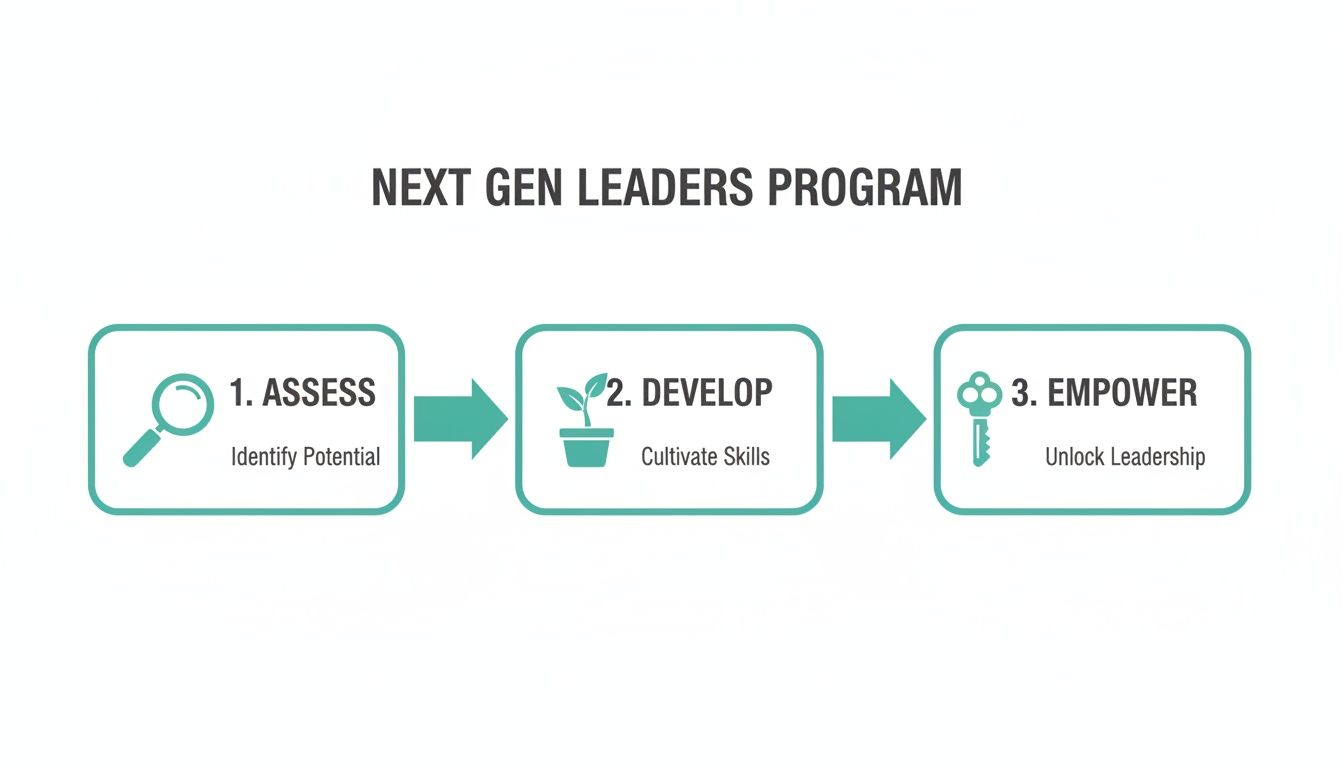
This visual underscores that empowering future leaders isn't a sudden event. It's a structured process requiring careful assessment, skill development, and a clear path to authority.
Communicating with Key Stakeholders
How you communicate the plan is as important as the plan itself. Transparency with key stakeholders is essential to maintaining confidence during a period of change.
You may need to tailor your message for each audience:
- Family Members: Be open and honest, especially with those not directly involved. They need to understand how the transition affects their financial interests.
- Employees: Your team will naturally have questions about the future. Reassure them of the business's stability and their place in it.
- Suppliers and Customers: Key business partners need to know it's business as usual. A calm, confident message about continuity will preserve these relationships.
- Lenders and Financiers: Your bank needs to be confident in the new leadership’s ability to manage the business. A professional presentation of the plan is essential.
Despite the obvious need for this planning, there is a significant gap between intention and action in Australia. Research from PwC's Family Business Survey revealed that while about a third of family businesses expect a transition within five years, only 25% have a robust, documented, and communicated plan in place. You can discover more insights on family business preparedness to understand the risks of inaction.
The quiet work of documentation and communication is what transforms a succession plan from a fragile idea into a resilient reality. It provides certainty in a time of change.
Finally, every sound plan includes a contingency. What happens if an owner passes away unexpectedly? Your buy-sell agreement, properly funded by insurance, is your primary defence. By formalising your plan, setting a clear timeline, and communicating thoughtfully, you are engaging in the highest form of stewardship.
Common Questions About Family Business Succession
As families move from broad ideas to real-world decisions, specific questions arise. Getting clear, practical answers is crucial to keeping the process moving forward.
Here are some common questions we hear, with answers grounded in the realities of Australian business and law.
What Is a Fair Way to Treat Children Not Joining the Business?
This is often the most emotionally charged question. The key is to understand that treating children fairly does not necessarily mean treating them equally. The goal is to separate business ownership from family inheritance.
A common approach is to have the business professionally valued. You can then allocate non-business assets of equivalent value—like property, investment portfolios, or proceeds from a life insurance policy—to children not involved in the company. This strategy allows the successor to take control of the business without being burdened by buyout debts, and it ensures other children receive their fair share of the family’s overall wealth.
When Is the Right Time to Start Planning?
Ideally, you should start the succession planning conversation five to ten years before you think about stepping back. A longer runway allows for smart tax planning, properly mentoring the next generation, and structuring the business for a seamless handover. Starting early transforms a potentially rushed event into a gradual and controlled process, allowing for calm, deliberate decisions.
A well-timed plan is a gift to the next generation. It provides them with a clear runway for leadership and protects the business from the instability that comes with sudden change.
How Do We Value the Family Business Accurately?
An accurate valuation is non-negotiable and must be done by an independent, qualified valuer. Relying on an informal guess can create family disputes and potential issues with the ATO.
A professional valuer will typically consider:
- Earnings and Cash Flow: Analysing historical profits and future projections.
- Assets: Looking at tangible (property, equipment) and intangible (goodwill, brand) assets.
- Industry Benchmarks: Comparing your business to similar companies in your sector.
An objective valuation provides a defensible number for legal and financial purposes, ensuring the transfer happens on fair, commercial terms. This is particularly vital for managing potential Capital Gains Tax. Once you have a firm valuation, you and your adviser can explore effective capital gains tax strategies in Australia.
Can We Sell to a Non-Family Member?
Absolutely. Sometimes, the best person to take over is a long-serving key employee (a management buyout) or an external buyer. If no one in the family has the skills or desire to lead, selling externally is a valid strategy. The core principles of good planning remain the same: prepare the business for sale, get an independent valuation, and manage the tax implications with care. Good stewardship means putting the business first.
A carefully constructed succession plan is an act of stewardship. It provides clarity and security for the business you have built and for the family you have nurtured. The thoughtful, patient work you do today lays the foundation for a stable and prosperous future.
If you are ready to begin building a secure future for your family business, we invite you to connect with our team.
General Advice Warning: The information provided in this article is general in nature and has been prepared without taking into account your personal objectives, financial situation, or needs. Before acting on any information, you should consider the appropriateness of the information in regard to your own situation and seek personal advice from a qualified professional.
Want help applying this to your situation?
Every situation is different. Book a time with our team to talk it through, or call us on 1300 913 929.