

Navigating financial reporting in Australia can sometimes feel complex. However, clarity often begins with understanding a key distinction: the difference between a General Purpose Financial Report (GPFR) and a Special Purpose Financial Report (SPFR).
A GPFR could be thought of as a comprehensive public guide, designed for a broad audience—investors, regulators, and the public—who need a complete, standardised picture to make informed decisions. As these users typically cannot request specific details directly, the report must adhere to the full suite of Australian Accounting Standards.
An SPFR, in contrast, is a more focused document. It may be compared to a tailored brief prepared for a specific group of people who already have access to the entity, such as business owners, a particular lender, or the Australian Taxation Office (ATO). These users can often request information directly, so the report is prepared specifically for their needs.
This distinction is fundamental to understanding why and how these reports are prepared.

Understanding Your Reporting Obligations
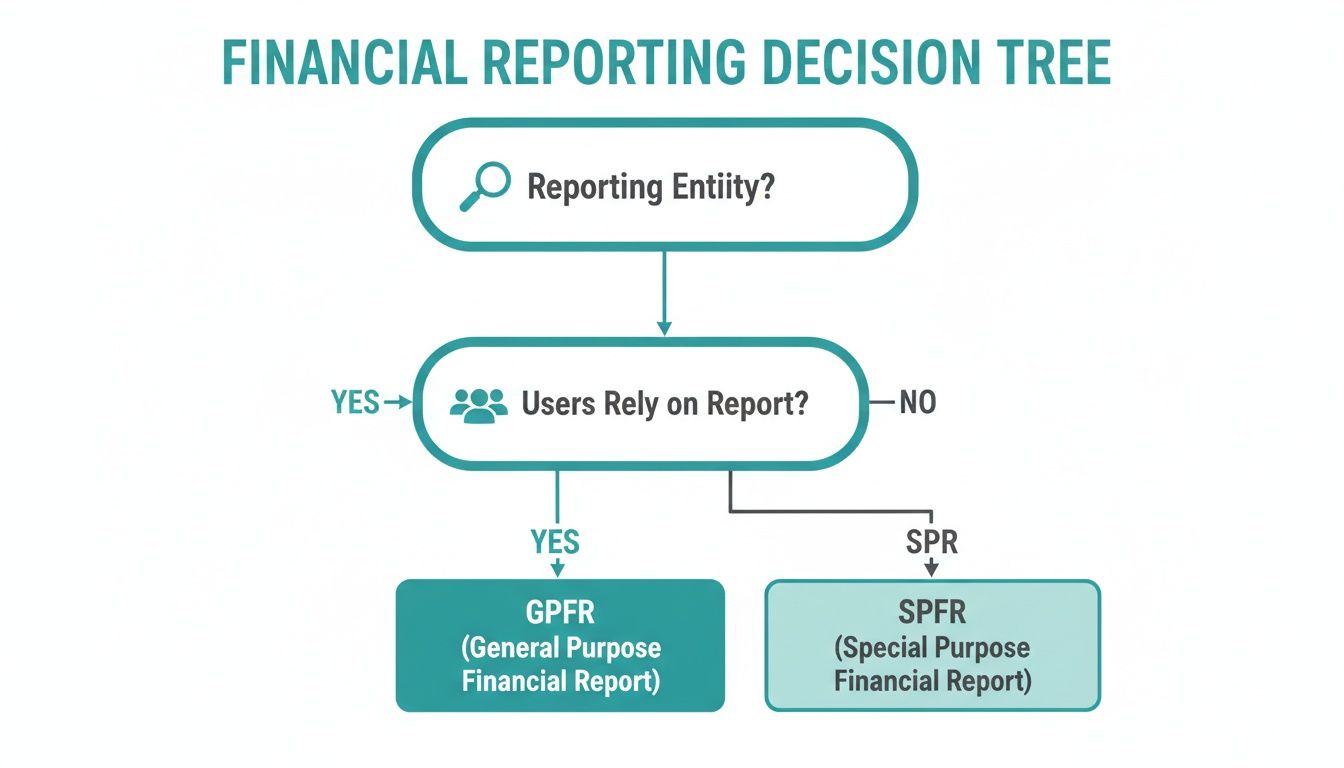
The decision to prepare a GPFR or an SPFR generally depends on one question: is your organisation a ‘reporting entity’?
Under Australian accounting rules, a reporting entity is an organisation where it is reasonable to expect the existence of users who rely on general-purpose financial reports for their economic decisions. These users typically lack the ability to command information directly from the entity.
Several factors may indicate an entity is a reporting entity, including:
- Separation of ownership and management: For example, a large public company with numerous shareholders not involved in daily operations.
- Economic or political significance: An entity might be a major regional employer or hold significant influence.
- Substantial external funding: Heavy reliance on banks or other financiers may create a dependency on general-purpose reports.
If an organisation does not meet these criteria, it may be able to prepare an SPFR. For many Australian family-owned companies, small businesses, and certain not-for-profits, this can be a practical and more cost-effective pathway. This approach may reduce complexity as it does not require compliance with every Australian Accounting Standard. For those just starting, our guide on understanding your financial reporting obligations provides further context.
However, this flexibility is not without responsibility. An SPFR must still be fit for its purpose, provide a true and fair view for its intended audience, and meet requirements set by bodies like the Australian Securities and Investments Commission (ASIC) or the Australian Charities and Not-for-profits Commission (ACNC). A sound understanding of this concept is a foundational step in good financial governance.
Practical Examples in an Australian Context
The decision to prepare special purpose financial reports has practical implications for various types of Australian entities.
For a family-owned construction business in regional Victoria: The directors are the sole shareholders and work in the business daily. Their primary lender has a long-standing relationship and direct access to the financial controller. For their annual reporting, an SPFR prepared for the owners, the bank, and the ATO could be appropriate, as the users can command information as needed.
For a new migrant starting a tech consulting firm: As a sole director operating under a proprietary limited company, the main users of the financial reports are the director, the ATO for tax purposes, and potentially a lender for a small business loan. An SPFR may be sufficient, providing the necessary information without the extensive disclosures of a GPFR.
For a professional services provider (e.g., a medical practice): The partners are the primary users of the financial statements, alongside the ATO. They have complete access to the practice’s financial data. In this scenario, an SPFR is often suitable for meeting their specific information needs and compliance obligations.
In each case, the entity is not considered a 'reporting entity' because the users of the financial statements have the capacity to obtain the information they require directly. This allows them to tailor their reporting accordingly.
Risks, Responsibilities, and Diligent Stewardship
Opting to prepare an SPFR carries with it significant responsibilities. This pathway is not a shortcut but a considered judgment that requires a clear understanding of both opportunities and risks.
Key Responsibilities:
- True and Fair View: Under the Corporations Act 2001, directors have an overriding duty to ensure the financial statements provide a ‘true and fair view’, regardless of the reporting framework used. This responsibility is non-negotiable.
- Clear Documentation: It is a hallmark of good governance to document the reasoning for concluding that the entity is not a reporting entity. This record demonstrates due diligence should regulators like ASIC or the ATO ever query the decision.
- Compliance with Standards: While an SPFR does not require adherence to all Australian Accounting Standards, it must still comply with those mandated by law or a governing body. For instance, the ACNC requires registered charities to apply a specific set of accounting standards even when preparing an SPFR.
Potential Risks:
- Incorrect Assessment: The primary risk is incorrectly classifying an entity as a non-reporting entity. If it is later determined that a GPFR was required, the entity may be compelled to restate its financial statements, a process that can be costly and damage stakeholder confidence.
- Failing User Needs: An SPFR must meet the needs of its specific users. If a report for a lender omits information critical to their credit assessment, it could breach loan covenants or harm the lending relationship.
- Regulatory Scrutiny: ASIC actively monitors financial reports and has highlighted that all entities, regardless of their reporting framework, must apply sound judgment to complex areas like asset valuation and revenue recognition.
Thoughtful financial stewardship involves patiently weighing these responsibilities and risks. It is a discipline built on making informed, defensible choices that ensure the organisation stands on a firm and compliant foundation.
Practical Next Steps
For directors and business owners, navigating these obligations requires a deliberate approach.
- Identify Your Report Users: Begin by clearly identifying who relies on your financial reports. Are they internal managers with direct access, or are there external parties who depend solely on the formal statements?
- Review Governing Rules: Examine your company’s constitution, trust deed, and relevant legislation. Requirements within the Corporations Act 2001 or from bodies like the ACNC often guide the decision. Our audit and assurance services can provide clarity on these requirements.
- Seek Professional Advice: Given the complexities of Australian Accounting Standards and regulatory oversight, discussing your specific situation with a qualified professional is a prudent step toward ensuring compliance.
Concise Takeaway
The choice between preparing a General Purpose or Special Purpose Financial Report is a significant governance decision based on whether an entity is a ‘reporting entity’. An SPFR can offer a more practical reporting solution for many Australian businesses, but it demands a thorough understanding of legal duties, user needs, and the responsibility to present a true and fair view.
If you would like clarity on how these principles may apply to your own circumstances, you may wish to speak with a qualified adviser. You can contact our advisory team to arrange a discussion.
General Advice Warning: The information provided in this article is general in nature and does not take into account your personal objectives, financial situation, or needs. Before acting on any information, you should consider the appropriateness of the information provided and seek personal advice from a qualified professional.
Want help applying this to your situation?
Every situation is different. Book a time with our team to talk it through, or call us on 1300 913 929.
Book a meetingProperty finance and tax guide →See our fees →