

For a sole trader in Australia, understanding the Goods and Services Tax (GST) is a fundamental part of responsible business stewardship. The key figure to be mindful of is $75,000. Should your business’s annual GST turnover reach this amount, or be projected to, you may be required to register for GST with the Australian Taxation Office (ATO).
Considering this threshold is often the first significant step in a sole trader's tax journey. A clear understanding of this obligation can help you manage your financial responsibilities with foresight and confidence.
Understanding Your GST Obligations as a Sole Trader
When you are focused on building a business—whether as a freelance creative, a skilled tradesperson, or an independent consultant—navigating tax obligations like GST can feel like a considerable responsibility. The framework, however, is designed to be consistent. Once understood, managing GST can become a standard part of your financial rhythm, rather than a source of concern.
This guide will outline the essentials of GST for a sole trader. We will start with the fundamentals as set out by the ATO and build from there. While the $75,000 threshold may seem straightforward, knowing what constitutes 'GST turnover' is where the detail becomes important.
Throughout this guide, we will touch on the core areas a sole trader may need to consider:
- Registration Thresholds: Understanding when you may be required to register, and the circumstances under which you might choose to do so voluntarily.
- Practical Management: How to issue compliant tax invoices and manage your reporting obligations.
- Record-Keeping: The importance of maintaining accurate records for compliance and to support any claims for GST credits you may be entitled to.
For those just starting, it may also be helpful to understand the business structure you are operating under. We provide a broader context in our guide on what it means to operate as a sole trader.
Ultimately, a sound grasp of GST is a cornerstone of good financial management. It may allow you to operate with greater confidence, meet your obligations, and build a resilient financial foundation for your business over the long term.
When Do I Need to Register for GST?
For many sole traders in Australia, the question is not if but when GST registration becomes a consideration. Addressing the timing of your GST registration is a key financial milestone. It is an important part of managing your business finances with foresight, rather than reacting to circumstances as they arise.
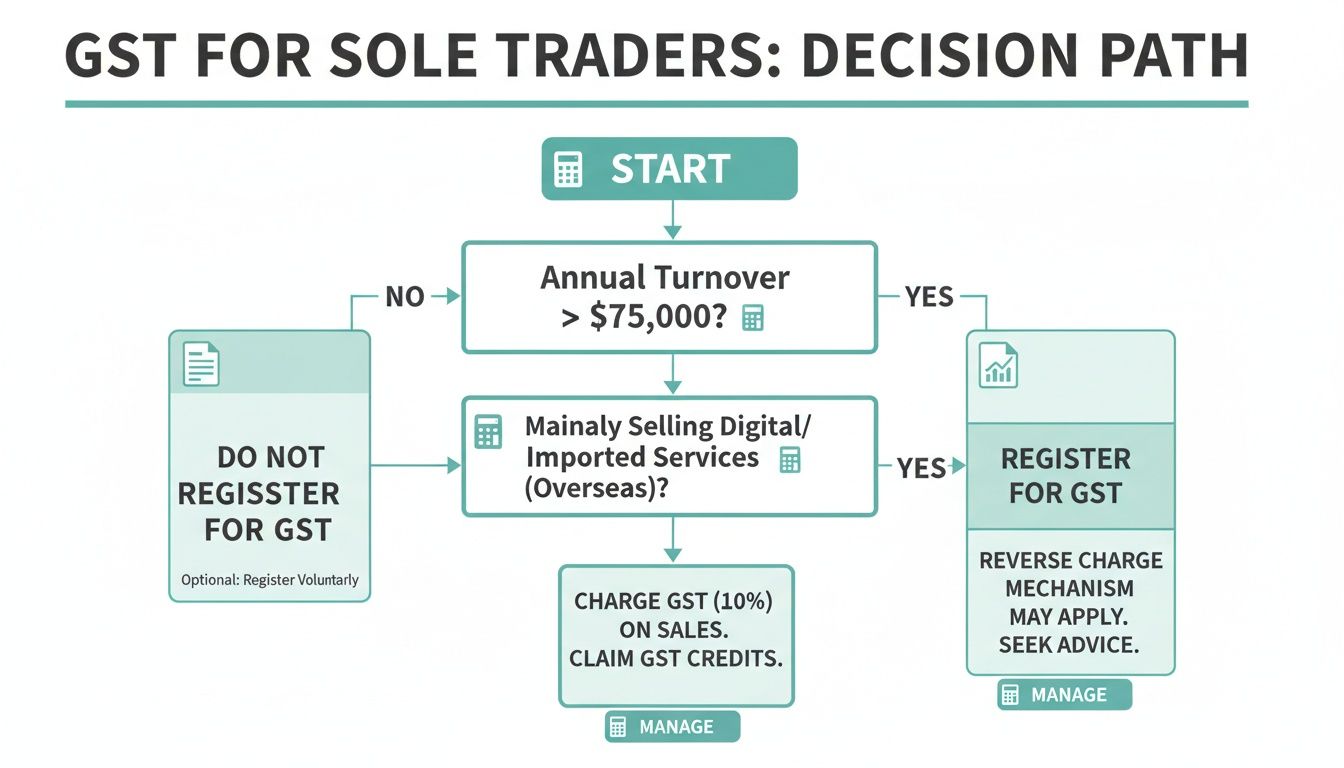
The core rule is tied to your GST turnover—which is your gross business income from sales connected with Australia, not your profit. The Australian Taxation Office (ATO) has set the mandatory registration threshold at $75,000 in a 12-month period. Once you reach this figure, or have good reason to believe you will, registration may become a legal requirement.
Getting a Handle on the GST Turnover Threshold
Your GST turnover is the total value of sales your business makes, though it generally does not include things like GST-free sales. The ATO requires businesses to be proactive. If you project that your turnover will cross the $75,000 threshold, you may need to act. The rule states that you have 21 days to register for GST once your turnover exceeds the threshold.
This suggests that keeping a close watch on your income is a prudent practice.
For example, a marketing consultant billing a steady $7,000 a month could, by their 11th month, have invoiced $77,000. Under current rules, they would need to register for GST within 21 days of that point to remain compliant.
Making this decision in a timely manner is a fundamental step in taking control of your tax obligations as a sole trader.
Voluntary Registration: A Strategic Consideration
What if your turnover is below the $75,000 mark? You still have a choice. You can register for GST voluntarily, but this decision comes with both potential benefits and new responsibilities. The appropriate path will depend on your business model, your expenses, and your customer base.
Choosing to register early can be a strategic move. It may allow you to claim back the GST on your business purchases, which can be beneficial for cash flow. On the other hand, it introduces regular reporting duties that demand disciplined bookkeeping.
Consider a freelance web developer starting their business. They might need to purchase a new computer and specialised software. By registering for GST voluntarily, they could potentially claim back the 10% GST portion of those costs, which may reduce the effective price of those significant items.
However, they would then need to add 10% GST to their invoices. This could make their services more expensive for clients who are not registered for GST themselves, such as the general public or other small businesses.
When deciding whether to register early, it is helpful to weigh the potential advantages and disadvantages for your specific situation.
Voluntary GST Registration: Potential Considerations
| Potential Advantages | Potential Disadvantages |
|---|---|
| Claim GST Credits: You can claim back the GST on business-related purchases, which may reduce your effective costs. | Higher Prices for Some: Adding 10% GST could make you more expensive for customers not registered for GST (e.g., the general public). |
| Cash Flow: Receiving GST credits could improve your cash flow, especially if you have high initial setup costs. | Administrative Load: You must lodge regular Business Activity Statements (BAS), which requires diligent bookkeeping. |
| Business Image: Being GST-registered can project a more established image, which may be helpful when dealing with larger corporate clients. | Complexity: It adds a layer of complexity to your accounting and pricing from the outset. |
Whether you decide to register voluntarily or wait until you reach the threshold, your approach to GST is a core part of your financial stewardship. It calls for awareness and a disciplined approach to your business administration.
A practical walkthrough of the registration process can be found in our guide on how to register for GST in Australia.
How to Manage GST in Your Daily Business Operations
Once you are registered for GST, the rhythm of your business finances may change. Managing GST effectively is not about memorising complex rules, but about building disciplined, consistent habits. GST can become a standard part of how you invoice, track expenses, and report to the tax office.
The cornerstone of this process is the Business Activity Statement (BAS). This is your regular report to the Australian Taxation Office (ATO). For most sole traders, this is a quarterly task—an opportunity to balance the GST you have collected against the GST you have paid on business purchases.
Issuing Compliant Tax Invoices
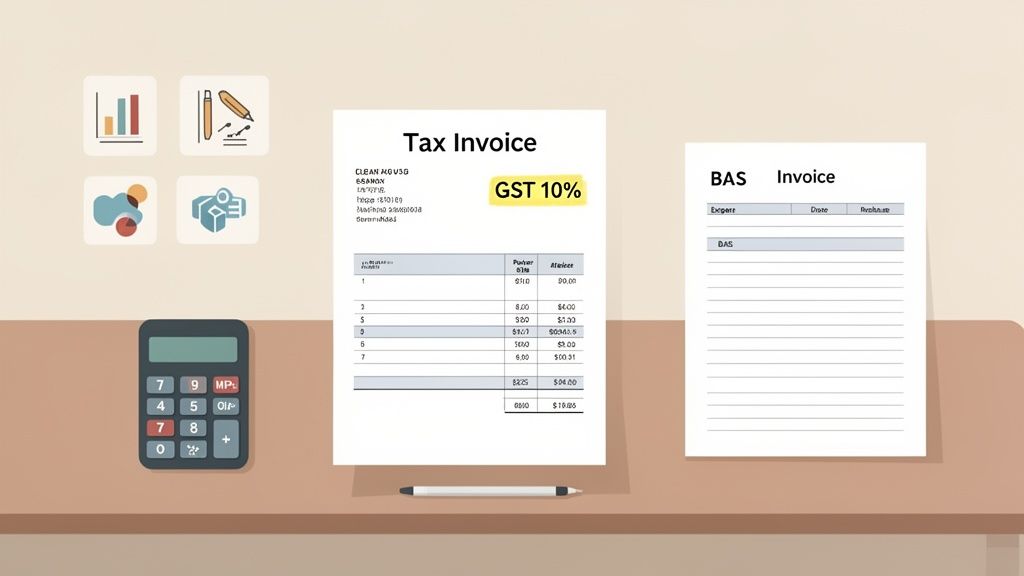
Your first and most immediate task is to ensure your invoices are compliant. A correct tax invoice is essential for your clients to claim their GST credits, but it is just as important for your own records. It is the primary evidence you will need for your own BAS.
The ATO has clear guidelines. For a sale under $1,000, a valid tax invoice must generally show:
- The words 'Tax Invoice'.
- Your identity and Australian Business Number (ABN).
- The date the invoice was issued.
- A brief description of the items sold.
- The total price including GST, often with a statement like "Total price includes GST".
For an invoice of $1,000 or more, you generally need to provide more detail. You must show the GST amount for each item separately, or state the total GST payable for the whole invoice. Many business owners use accounting or GST invoicing software to help ensure compliance.
Calculating and Reporting on Your BAS
Each reporting period—typically quarterly—you will need to complete your BAS. This process comes down to two core numbers: the total GST you collected on your sales and the total GST you paid on your business purchases.
The difference between these two figures determines whether you owe the ATO money or if a refund is due.
GST on Sales (Collected) – GST on Purchases (Paid) = Net GST Payable or Refundable
Let's consider an example. A graphic designer, operating as a sole trader, invoices a client $5,500 for a branding project. This total includes $500 of GST. In the same quarter, they purchase a new monitor for $1,100 (including $100 of GST) and a design software subscription for $330 (including $30 of GST).
When lodging their BAS, they would report:
- $500 in GST collected.
- $130 in GST credits ($100 + $30).
- The net amount payable to the ATO would be $370 for that period.
This reconciliation is the heart of the BAS process. Understanding these mechanics is key, and you can find a more detailed breakdown in our educational resource on how GST works in Australia.
Claiming GST Credits on Business Expenses
Claiming GST credits (also known as input tax credits) is one of the main potential benefits of being registered. It means you may be able to reclaim the GST component on eligible purchases you make for your business. To claim a credit, the purchase must be for business purposes, and you must hold a valid tax invoice from your supplier.
Common expenses where sole traders may claim GST credits include:
- Tools and Equipment: A carpenter buying a new power saw or a photographer upgrading a camera lens.
- Business Travel: The GST paid on flights and accommodation for a work-related trip.
- Professional Services: Fees paid to an accountant, lawyer, or business adviser.
- Utilities and Rent: A portion of phone, internet, or commercial rent costs directly related to business activities.
This is where diligent record-keeping is invaluable. Without a valid tax invoice for an expense, you generally cannot claim the GST credit. It reinforces the importance of organised finances as the foundation for meeting your obligations and maintaining healthy cash flow.
Keeping Records and Staying Compliant
Diligent record-keeping is the quiet engine of a well-run business. For a sole trader registered for GST, it becomes a fundamental legal obligation—a discipline that can safeguard your financial health and provide peace of mind. These records are not just for the Australian Taxation Office (ATO); they offer a clear account of your business's journey, providing valuable insights into your financial performance.
The foundation of GST compliance rests on your ability to substantiate the figures you report on your Business Activity Statement (BAS). This means keeping organised, accessible records of your business transactions.
The Core Documents to Retain
Managing GST as a sole trader involves a steady rhythm of collecting, paying, and reporting. The ATO requires you to keep specific documents that support this cycle. If you are unable to produce these records when requested, it may be difficult to substantiate your claims, which could lead to adjustments and penalties.
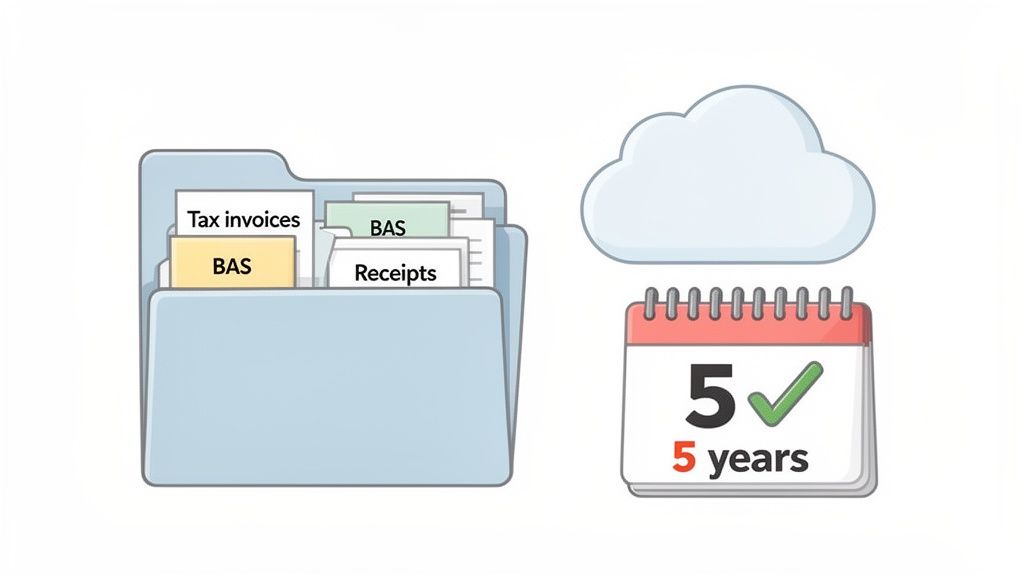
Your primary record-keeping duties may include retaining:
- All tax invoices for business purchases. This is the critical evidence needed to claim GST credits.
- Copies of tax invoices you issue to clients. These document the GST you have collected.
- Copies of your lodged BAS.
- Worksheets or calculations used to determine the figures on your BAS.
- Business bank statements to help verify transactions and separate them from personal spending.
Under ATO rules, these records must generally be held for a minimum of five years. Being aware of your obligations around key tax due dates helps maintain this discipline.
Common Missteps to Avoid
Even with the best intentions, simple errors in financial administration can create issues. One common pitfall is mixing business and personal finances. When funds are blended in a single account, it may become difficult to accurately track income, identify eligible expenses, and calculate the business-use portion of shared costs.
Another frequent issue is failing to obtain or keep valid tax invoices for expenses. A credit card statement or a generic receipt is often not sufficient to claim a GST credit; the document must meet the ATO's specific requirements for a tax invoice.
For sole traders building enduring ventures, understanding GST is a lesson in resilience and planning. GST is a cornerstone of the tax system, with the ATO reporting GST liabilities of $85,575 million in 2023–24. As sole traders represent a significant portion of Australian businesses, diligent record-keeping for GST credits is essential for managing cash flow. You can read more in the ATO’s taxation statistics.
Using Technology to Your Advantage
Modern accounting software can be an invaluable ally in maintaining compliance. Platforms like Xero or MYOB are designed to streamline the process, from creating compliant tax invoices to preparing your BAS.
By digitising your records, you may reduce the risk of losing physical receipts and create a clearer, real-time picture of your financial position.
A well-organised digital system can transform record-keeping from a chore into a strategic tool. It may allow you to focus on your business, confident that your financial foundations are secure.
This structured approach not only simplifies BAS lodgement but can also provide the data needed for informed business decisions. Establishing a robust system is an investment in your business’s long-term stability.
Navigating Complex GST Scenarios
As your business develops, you may encounter transactions that do not fit the standard model. While most goods and services in Australia are taxable, the system has specific classifications you should be aware of. Understanding these nuances is key to keeping accurate records and lodging a correct Business Activity Statement (BAS).
These situations are not uncommon, but they require careful consideration. Getting it right can help you meet your ATO obligations without overpaying tax.
GST-Free vs. Input-Taxed Sales: Understanding the Difference
Not all income is treated the same under GST law. The Australian Taxation Office (ATO) has two special categories: GST-free and input-taxed. Knowing which category your sales fall into is crucial, as it directly affects what you charge clients and which GST credits you can claim.
A GST-free sale is a sale with no GST added to the price. However, you can generally still claim the GST credits on business purchases made to generate that income.
Common examples of GST-free sales include:
- Most basic foods
- Certain medical, health, and education services
- Some exports
An input-taxed sale is different. You also do not charge GST on these sales, but the critical difference is that you generally cannot claim GST credits for business expenses related to earning that income. A common example is residential rent.
For some sole traders, a challenge may arise when the business offers a mix of taxable, GST-free, and input-taxed services. In these cases, you may need to carefully apportion your expenses to determine which GST credits you are entitled to claim.
A Practical Example: The Mixed Services Scenario
Consider a sole trader who is a registered psychologist. Most of their work involves therapeutic consulting, which is generally a GST-free health service. However, they also run corporate wellness workshops, which are taxable.
If they purchase a new computer for their practice, they may not be able to claim 100% of the GST back. They would need to make a reasonable estimate of how the computer is used for each activity. If they determine it is used 80% for their GST-free therapy sessions and 20% for their taxable workshops, they may only be able to claim 20% of the GST credit on that purchase. This careful apportionment is an example of compliance in practice.
Understanding these distinctions allows you to manage your GST obligations with greater precision. It is a reminder that good financial stewardship involves not just tracking what you earn and spend, but also the nature of each transaction.
The history of GST in Australia highlights the importance of these exemptions. Since its introduction, the portion of household spending subject to GST has shifted, partly due to these classifications. You can explore these trends by reading the Parliamentary Budget Office's report on GST revenue. For a sole trader, this underscores why attention to detail is vital for managing cash flow.
Claiming GST on Major Business Purchases
Making a significant capital purchase, like a new vehicle or expensive equipment, comes with its own set of GST considerations. While you can typically claim the full GST credit on assets used 100% for your business, there are limits that can affect the timing and amount of your claim.
For example, when buying a car, if the purchase price is more than the car limit for depreciation, you can only claim a GST credit based on that limit—not the full price. For the 2023–24 income year, the car limit is $68,108. This means the maximum GST credit you can claim is one-eleventh of that amount, which is $6,191, regardless of the total cost. Being aware of these rules before you purchase is a critical part of sound financial planning for business assets.
For any complex transaction, from mixed-use assets to non-standard sales, seeking professional advice may be appropriate. An adviser can help you understand how the rules apply to your specific situation.
If you would like to discuss your circumstances, our team offers specialist advisory services.
Your Practical Next Steps for GST Management
Managing your GST obligations is a learnable rhythm in the life of a sole trader. While it requires attention, it is a manageable part of building a successful business in Australia. With a clear framework, you can approach GST not with anxiety, but with quiet confidence.
Thoughtful planning is the key to financial clarity. By establishing simple, disciplined habits now, you are laying the foundation for stability and peace of mind as your business grows.
A Checklist for Moving Forward
To help bring structure to your GST management, you may wish to consider these practical actions. This is not a set of instructions, but a gentle guide to help you get organised.
- Monitor Your Turnover: Regularly check your gross business income against the $75,000 threshold. Accounting software or a simple spreadsheet can make this a routine task.
- Review Voluntary Registration: If you are below the threshold, periodically weigh the pros and cons of registering voluntarily. Consider your expected business expenses and your typical customer base.
- Establish a Record-Keeping System: Choose a method that works for you, whether it’s digital software or a meticulous physical filing system. The goal is consistency and accessibility.
- Calendar Your BAS Deadlines: Note your quarterly BAS lodgement and payment dates in your calendar with reminders. Meeting these deadlines is a simple way to maintain a good standing with the ATO.
This methodical approach helps turn abstract compliance duties into concrete, achievable tasks. A well-managed system supports not only your tax obligations but also your overall small business cash flow management.
The aim is not perfection overnight, but patient progress. Each step you take to organise your finances is an investment in your business’s resilience and your own capacity as its steward.
By putting these small disciplines in place, you build a robust financial framework that can support your business through every season. This proactive stance helps you remain in control of your financial story, turning compliance into a source of strength.
If you would like clarity on how these principles may apply to your own circumstances, you may wish to speak with a qualified adviser. You can get in touch with our team to arrange a discussion.
General Advice Warning: The information provided is general in nature and does not take into account your personal objectives, financial situation, or needs. You should seek personal advice from a qualified professional before making any financial decisions.
Frequently Asked Questions About Sole Trader GST
The finer details of GST often raise practical questions for sole traders. Here are some common queries, with general information based on Australian tax law.
As every business situation is unique, this information should not be taken as personal advice.
If I Register for GST, Do I Charge It on Everything?
Not necessarily. While you will likely add GST to most goods and services you sell, Australian tax law includes specific categories that are 'GST-free' or 'input-taxed'.
For example, most basic foods, some health services, and certain education courses are often GST-free. You do not charge the additional 10% on these sales, but you may still be able to claim GST credits on the business costs incurred to provide them.
Input-taxed sales, such as residential rent, are different. You do not add GST to these either, but the key difference is that you generally cannot claim GST credits on the expenses related to that income. Understanding which category your products or services fall into is an important first step.
What Happens If I Register Late for GST?
This is a situation that is best avoided. If your turnover crosses the $75,000 threshold and you do not register within the required 21 days, the Australian Taxation Office (ATO) may register you retrospectively.
This could mean you are liable for GST on all taxable sales you made from the date you should have been registered, even if you did not charge your clients GST. Penalties and interest could also apply. Monitoring your turnover is a cornerstone of prudent financial management.
Can I Claim GST on Items for Both Business and Personal Use?
Yes, this is often possible. For assets used for both business and private purposes, you may be able to claim a portion of the GST credit. The amount claimed should be a fair and reasonable reflection of the business-use percentage.
A common example is a mobile phone. If you determine it is used 70% for business calls and emails, and 30% for personal use, you may be able to claim 70% of the GST paid on the phone and its monthly plan. The responsibility is on you to have a reasonable basis for your calculation and to keep records that support your claim.
How Often Do I Need to Lodge a BAS as a Sole Trader?
For most sole traders new to GST, the ATO will typically place you on a quarterly reporting cycle for your Business Activity Statement (BAS). This sets a predictable rhythm for reporting and paying your GST obligations four times a year.
While monthly and annual reporting cycles exist, they are less common and usually apply in specific circumstances. The quarterly cycle generally strikes a balance between staying on top of your obligations without creating an overwhelming administrative burden.
If you would like clarity on how these principles may apply to your own circumstances, you may wish to speak with a qualified adviser. You can contact Everglow on 1300 913 929 or email contact@everglow.au to arrange a discussion.
General Advice Warning: The information provided is general in nature and does not take into account your personal objectives, financial situation, or needs. You should seek personal advice from a qualified professional before making any financial decisions.
Want help applying this to your situation?
Every situation is different. Book a time with our team to talk it through, or call us on 1300 913 929.