

Investing in property through your superannuation can be a considered strategy for building long-term wealth. For many Australians, it represents an opportunity to use retirement savings to acquire a tangible, real-world asset, combining the potential growth of property with the concessional tax environment of superannuation.
However, this path is not a simple one. It requires a disciplined approach and a comprehensive understanding of the strict rules established by the Australian Taxation Office (ATO) and other regulatory bodies.
Understanding Property Investment Within an SMSF
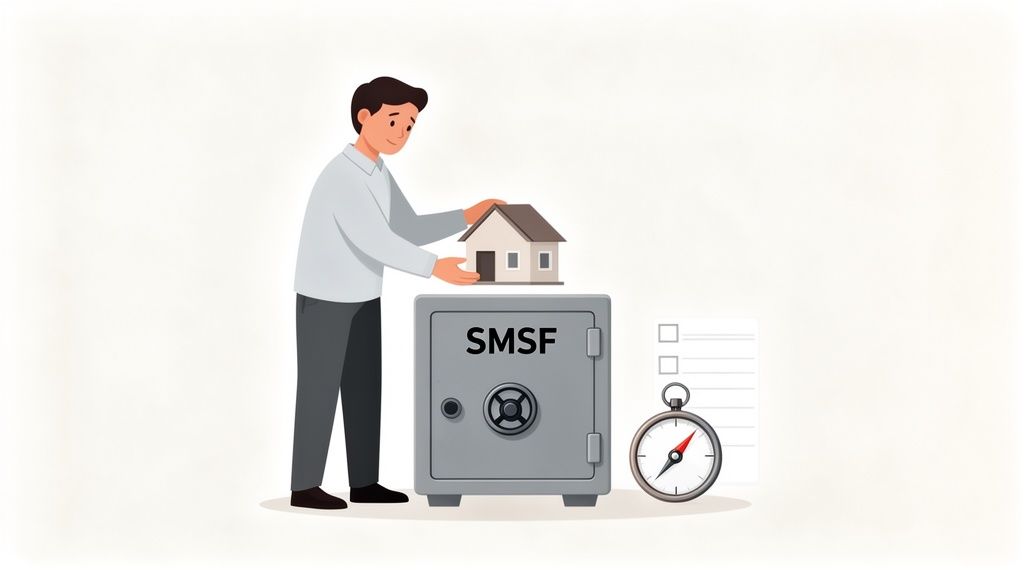
The idea of holding physical property within a retirement fund often resonates with Australians seeking greater control over their financial future. A Self-Managed Super Fund (SMSF) is the structure that may make this possible, though it is a journey that calls for careful planning, diligent compliance, and a long-term perspective.
At the heart of this strategy is the sole purpose test. This is a cornerstone of superannuation law, stipulating that a fund must be maintained for the sole purpose of providing retirement benefits to its members. Every decision, from property acquisition to ongoing management, must align with this fundamental principle.
Key Concepts to Consider
Before exploring this path, it is useful to understand a few foundational principles. These concepts form the bedrock of compliant SMSF and property investment and may shape every decision you make as a trustee.
- Acquisition Rules: Generally, an SMSF is prohibited from acquiring a residential property from a member or any other related party. A key distinction exists for commercial property, known as 'business real property', which an SMSF may be permitted to acquire from a related party under specific conditions. This can present strategic opportunities for business owners.
- Outright Purchase vs. Borrowing: If a fund has sufficient capital, it may purchase a property outright, which is often the most straightforward approach. Alternatively, an SMSF may borrow funds, but only through a specific structure known as a Limited Recourse Borrowing Arrangement (LRBA). This is the only permissible method for an SMSF to borrow, and it is governed by a complex set of rules.
Embracing the role of an SMSF trustee is an exercise in stewardship. The objective is not typically short-term gain but the patient cultivation of assets to help secure a stable and prosperous retirement.
Thinking through these initial points helps to frame the strategy correctly. Before focusing on the potential benefits, it is important to appreciate the responsibilities involved. To gain a broader view of the structure itself, it may be helpful to first understand the general advantages of Self-Managed Super Funds. This path is one of disciplined action, where sound financial decisions are informed by an understanding of both the potential and the duties involved.
Navigating the Core Rules of SMSF Property Investment

Successfully investing in property through an SMSF requires a steady hand and a clear understanding of the regulatory landscape. The Australian Taxation Office (ATO) has established a framework of specific rules designed to protect the integrity of retirement savings.
These are not mere suggestions; they are firm boundaries intended to ensure every decision aligns with the fund’s primary purpose: providing for your retirement.
Central to this framework is the requirement for all transactions to be conducted at ‘arm’s length’. This means any transaction your SMSF enters into—whether buying, selling, or leasing property—should be on commercial terms. The price paid and the rent charged ought to reflect the true market rate, as if the transaction were between unrelated parties. This helps prevent members from receiving a current-day benefit from their super, which could be a serious breach of superannuation law.
The Clear Line Between Residential and Commercial Property
One of the most critical distinctions in SMSF and property investment relates to who can use the property. The rules here are specific and allow for little interpretation.
For residential property, the law is particularly strict. An SMSF is prohibited from acquiring a residential property from a trustee or any related party. Furthermore, once the fund owns a residential property, no member of the fund or their relatives can live in it or rent it. It cannot be used as a holiday home or a residence for family members.
The situation may be different for business real property, which is defined as land and buildings used wholly and exclusively in one or more businesses. This is where a significant opportunity could arise for business owners.
- An SMSF can, in certain circumstances, acquire business real property from a related party, provided it is at market value.
- The business of a fund member or a related party can lease the commercial premises from the SMSF, provided the lease is on commercial terms.
This could allow a professional, such as a doctor or an accountant, to use their SMSF to acquire the premises from which their practice operates. Their business would then pay commercially competitive rent to the SMSF, contributing to their own retirement savings rather than a landlord's.
To clarify these differences, the following table compares key rules.
Comparing Residential vs. Commercial Property Rules in an SMSF
| Rule/Consideration | Residential Property | Commercial Property (Business Real Property) |
|---|---|---|
| Acquisition from a Related Party | Strictly prohibited. | Permitted, provided the transaction is at market value. |
| Leasing to a Related Party | Strictly prohibited. | Permitted, provided the lease is on commercial, arm's-length terms. |
| Personal Use by a Member | Strictly prohibited. Cannot be used as a primary residence or holiday home. | Permitted for business use, but not for personal or residential purposes. |
| "In-House Asset" Rules | N/A (as leasing to a related party is prohibited) | Generally exempt from in-house asset rules if leased to a related party. |
As illustrated, the rules for commercial property may offer a degree of strategic flexibility that does not exist for residential property within an SMSF.
Understanding Limited Recourse Borrowing Arrangements
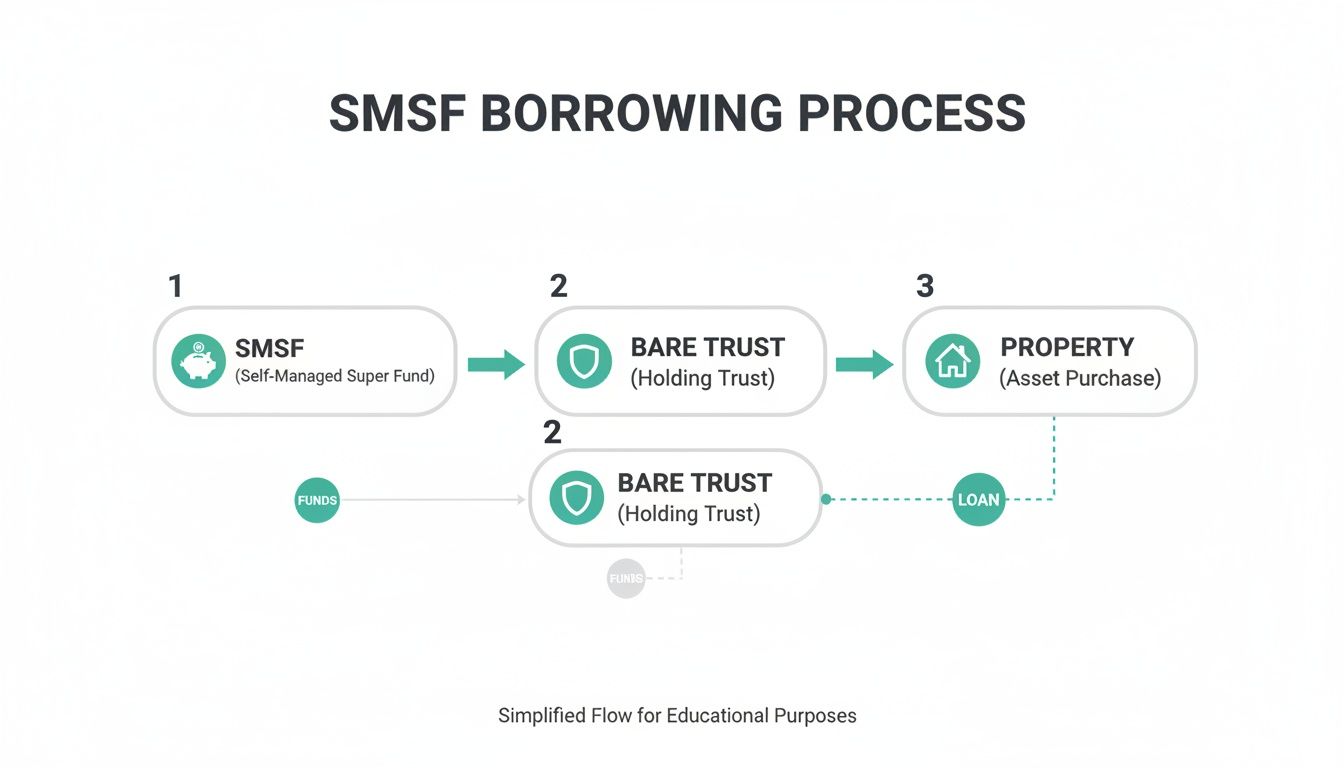
When an SMSF does not have sufficient cash to purchase a property outright, borrowing may be considered. However, superannuation law is exceptionally strict on this matter. An SMSF can only borrow money to purchase an asset through a very specific legal structure: a Limited Recourse Borrowing Arrangement (LRBA).
Understanding this structure is essential for anyone considering gearing for their SMSF property investment. This is not a standard mortgage; it is a specialised arrangement designed to protect the other assets within the super fund. The name itself is instructive—the lender’s recourse is ‘limited’.
In essence, if the fund were to default on the loan, the lender's claim is restricted solely to the asset purchased with the borrowed funds. The fund's other assets—such as shares, cash, and other investments—are protected.
The Structure of an LRBA
To create this protective barrier, an LRBA involves a precise setup: the SMSF, a lender, and a separate holding trust, often referred to as a bare trust.
- The SMSF: Provides the deposit and is responsible for making loan repayments.
- The Lender: Typically a bank or specialist lender with products designed for LRBAs.
- The Holding (Bare) Trust: A separate trust established to hold the legal title of the property on behalf of the SMSF until the loan is fully repaid.
The bare trust holds the legal title, while the SMSF holds the beneficial ownership, receiving all rental income and capital growth. Once the loan is repaid, the legal title can be transferred from the bare trust to the SMSF. The mechanics of this are important, and you can explore more about what a bare trust is in our educational resources.
Practical Lending Criteria and Considerations
Lenders assess SMSF loan applications differently from standard home loans. The process is often more rigorous because they are lending to a trust structure.
Lenders will typically look for:
- Sufficient Liquidity: They need assurance that the SMSF will have enough cash or liquid assets remaining after the purchase to cover loan repayments and property expenses. A common guideline is for the fund to hold at least 10% of the property’s value in liquid assets post-settlement.
- Strong Rental Yield: The property usually needs to demonstrate it can generate sufficient rental income to help service the loan.
- Personal Guarantees: It is standard practice for lenders to require personal guarantees from the SMSF trustees. This is a crucial point. While the lender’s recourse is limited in respect to the SMSF’s other assets, the trustees may be personally liable for any shortfall if the property must be sold for less than the outstanding loan.
The decision to borrow within an SMSF adds layers of complexity and risk. The structure must be correctly established and maintained to remain compliant with ATO requirements.
Given the complexities, setting up and maintaining an LRBA correctly is a task that often requires coordination between qualified financial, legal, and accounting professionals.
Risks, Responsibilities, and Practical Next Steps

While the opportunities of using an SMSF to invest in property can be appealing, the path requires a deep appreciation for the responsibilities involved. As a trustee, you are the fund’s steward, and the law holds you personally accountable for its decisions and compliance.
Acknowledging the Risks and Responsibilities
A considered approach involves looking beyond potential returns to understand the challenges. A property is a significant, singular asset, and its inclusion in a fund brings several key risks into focus.
- Lack of Diversification: Allocating a large portion of a super fund to a single property can lead to concentration risk. If the property market in that specific area stagnates or declines, it could have a significant impact on the fund’s overall performance.
- Liquidity Risk: Property is an illiquid asset; it cannot be quickly converted to cash. This could become problematic if the fund needs cash to pay benefits or expenses. Without sufficient cash reserves, the fund might be forced to sell the property at an inopportune time.
- Ongoing Compliance: Your duties as a trustee involve a continuous commitment to compliance. This includes maintaining the fund’s investment strategy, obtaining annual property valuations for reporting purposes, and meticulous record-keeping for the annual audit.
Practical Next Steps
Moving from idea to action should be a deliberate process, built on a solid foundation of assessment and professional guidance.
- Review Your Current Situation: Understand your total superannuation balance, how it is currently invested, and what fees you are paying.
- Define Your Retirement Goals: Articulate your vision for retirement, including your desired retirement age and income needs. This provides a clear objective for your investment strategy.
- Assemble Your Team: This is not a solo endeavour. The complexity of superannuation law, tax, and property transactions means that building a team of qualified specialists is a cornerstone of responsible management. This typically includes a financial adviser specialising in SMSFs, an accountant, a solicitor, and potentially a specialist mortgage broker.
For those interested in the broader regulatory framework, it may be beneficial to review the fundamental Self-Managed Super Fund rules.
A Concluding Thought
Investing in property through an SMSF is a commitment to the active stewardship of your future. It is a deliberate choice to take on greater responsibility in pursuit of greater control over your retirement outcome. Success in this area is typically measured not in months, but over decades of patient and disciplined management. It requires a significant super balance to be viable, a clear investment strategy, and the guidance of specialised professionals.
If you would like clarity on how these principles may apply to your own circumstances, you may wish to speak with a qualified adviser. You can contact Everglow on 1300 913 929 or email contact@everglow.au to arrange a discussion.
General Advice Warning: The information provided is general in nature and does not take into account your personal objectives, financial situation, or needs. Before acting on any information, you should consider the appropriateness of the information having regard to your own objectives, financial situation, and needs and seek personal advice from a qualified financial adviser.
Want help applying this to your situation?
Every situation is different. Book a time with our team to talk it through, or call us on 1300 913 929.
Book a meetingProperty finance and tax guide →See our fees →