

A Self-Managed Super Fund (SMSF) operates under a specific set of Australian laws, all designed to ensure it serves one primary objective: providing for your retirement. This structure is not a pathway to early access or creative financing; it is a vehicle for disciplined, long-term wealth stewardship.
At the heart of the self-managed super fund rules is your duty as the trustee. You are legally required to act in the best financial interests of all members, maintain a clear separation between the fund's finances and your personal or business affairs, and adhere strictly to the contribution and investment rules set by the Australian Taxation Office (ATO).
Understanding Your Role as an SMSF Trustee
Becoming an SMSF trustee is to accept a significant legal and financial responsibility as the custodian of your retirement savings. It is essential to understand the weight of your obligations from the outset, as every decision must be grounded in compliance and prudence.

These duties form the foundation upon which a secure retirement is built. Understanding this framework ensures that every action you take is stable, compliant, and aligned with ATO expectations. For business owners, professionals, and families, this level of control offers opportunity, but it demands diligence.
The Cornerstone of SMSF Rules: The Sole Purpose Test
The single most important principle governing an SMSF is the sole purpose test. This is the guiding star for every action you take as a trustee. It mandates that your fund must be maintained for the sole purpose of providing retirement benefits to its members, or to their dependants should a member pass away before retiring.
This is not a guideline; it is a legislated requirement. Every investment, expense, and transaction must clearly serve this one goal. Providing a current-day benefit to a member or a related party—such as using fund assets to support a business, acquire a holiday home for personal use, or lend money to a family member—is a serious breach of this rule.
A practical check for any decision is to ask: "Is this action taken exclusively to provide for the retirement of the fund's members?" If there is any hesitation in your answer, it is wise to pause and seek personal advice.
Who Can Be a Trustee?
Not everyone is eligible to be a trustee. The rules, as outlined by Australian law, require that every member of the fund must also be a trustee (or a director of the corporate trustee). You are generally eligible unless you are considered a 'disqualified person'.
This typically means you:
- Have been convicted of an offence involving dishonesty.
- Are an undischarged bankrupt.
- Have previously been issued a notice of non-compliance by the ATO for another fund.
This structure creates a direct line between control and accountability—the people who benefit from the fund are the same people legally responsible for its compliant operation. To understand why this appeals to many, exploring the specific benefits of an SMSF can provide deeper insight into the value of such direct oversight.
Individual Trustees vs a Corporate Trustee
When establishing your SMSF, you will face a critical decision regarding the trustee structure. This choice has lasting implications for administration, asset ownership, and succession planning.
Individual Trustees: In this model, each member is a trustee in their own name. A minimum of two individual trustees is required, and all fund assets are held in the personal names of all trustees (e.g., "John Smith and Jane Smith as trustees for the Smith Super Fund").
Corporate Trustee: Here, a proprietary limited company is established to act as the trustee. All members must be directors of that company, and the fund's assets are held in the company's name (e.g., "Smith Pty Ltd as trustee for the Smith Super Fund").
While an individual trustee structure may appear simpler initially, a corporate trustee often provides superior flexibility and administrative efficiency over the long term. For instance, if a member passes away or a new one joins, the company remains the trustee; only the directorships need updating. With individual trustees, the legal ownership of every single fund asset would require amendment. For funds involving families or business partners, a corporate trustee is often the more resilient and forward-thinking choice.
Getting the Money In and Making it Grow: Your Investment and Contribution Playbook
As an SMSF trustee, you are the steward of your retirement capital. Your role is to grow the fund's assets while adhering to a strict set of self-managed super fund rules. Success in this area requires a firm grasp of two distinct processes: how capital enters the fund (contributions) and how it is invested.
Think of it as managing the inflow of resources and directing the vessel. Both require your focused attention and a clear understanding of your duties under Australian law.
It All Starts with Your Investment Strategy
Before a single dollar is invested, you are legally required to have a formal investment strategy. This is not a static document to be filed and forgotten. It is a living blueprint that must guide every investment decision.
Your strategy must be in writing and should be reviewed at least annually, or whenever circumstances change significantly—such as a new member joining, a change in market conditions, or a member approaching retirement. The ATO and your auditor will expect to see that you have given due consideration to:
- Diversification: How have you spread investment risk across different asset classes, such as shares, property, and cash, to avoid over-concentration?
- Risk and Return: What is your approach to balancing the potential for risk with the level of return required to meet the fund's retirement objectives?
- Liquidity: Does the fund have sufficient cash or liquid assets to meet its obligations, such as paying expenses and member benefits, as they fall due?
- Insurance Needs: Have you considered whether the fund should hold life or Total and Permanent Disability (TPD) insurance for its members?
A well-considered strategy demonstrates to regulators that your investment choices are deliberate and aligned with the fund's sole purpose. A properly structured financial planning process can help ensure this document is robust and compliant.
The Rules of the Game: Contribution Caps
Contributions are the lifeblood of your SMSF, but government-imposed limits restrict how much you can add each year. It is crucial to understand the different types of contributions and their respective caps.
This table provides a simple breakdown of the key contribution types.
Contribution Caps and Types Overview
| Contribution Type | Description | General Annual Cap | Key Considerations |
|---|---|---|---|
| Concessional (Before-Tax) | Contributions from pre-tax income, such as employer contributions or salary sacrifice. | $27,500 per year. | Taxed at a concessional rate of 15% within the fund, which is often lower than personal income tax rates. Depending on your circumstances, you may be able to utilise unused cap amounts from previous years. |
| Non-Concessional (After-Tax) | Contributions from your after-tax income or savings. | $110,000 per year. | These are not taxed again on entry to the fund. A "bring-forward" rule may allow eligible individuals to contribute up to $330,000 at once, depending on age and total super balance. |
Adhering to these caps is non-negotiable. Exceeding them can result in additional tax, which can erode the benefits of managing your own super.
Keep it at Arm's Length: The Golden Rule for Transactions
One of the most fundamental rules is that all SMSF transactions must be conducted on an 'arm's length' basis. This simply means that any deal the fund enters into must be on commercial terms at market value—as if it were dealing with an unrelated party.
The arm's length rule exists to prevent trustees from using the fund to provide a non-commercial advantage to themselves, their relatives, or their businesses. For example, if your SMSF owns a commercial property leased to your business, the rent must reflect the current market rate. No special discounts are permitted.
The rules are even stricter when acquiring assets from related parties. For instance, an SMSF is generally prohibited from acquiring residential property from a member or their relatives. Understanding these boundaries is critical, particularly for trustees considering SMSF property investment, which has its own detailed guidelines.
This direct-control approach distinguishes SMSFs from other funds. Data from APRA superannuation statistics shows SMSFs tend to hold over 71% of their assets directly, whereas large APRA-regulated funds may hold only 12% directly. This highlights the profound responsibility trustees have and why a compliant investment strategy is essential.
Borrowing to Invest in Property Within Your SMSF
For many Australians, particularly business owners and professionals, using superannuation to acquire property is a significant strategic goal. Within an SMSF, this is possible, but it must be done through a highly regulated structure governed by specific self-managed super fund rules.
This compliant pathway is known as a Limited Recourse Borrowing Arrangement (LRBA). It is the only method an SMSF can use to borrow funds to purchase an asset like property. Understanding this structure is essential to protect your fund and maintain compliance with the ATO.
The Structure of an LRBA Explained
An LRBA is best understood as a mechanism for containing risk. It involves three parties: your SMSF, a lender, and a separate legal entity called a holding trust (or bare trust). The arrangement is designed to isolate the loan, creating a protective barrier around the other assets within your super fund.
Here is a simplified, step-by-step overview of the process:
- The Loan: Your SMSF obtains finance from a lender. This could be a commercial bank or a related party, provided the loan terms are strictly commercial and at arm's length.
- The Holding Trust: The borrowed funds, along with a deposit from your SMSF, are used to purchase the property. Critically, the legal title is held by the separate holding trust, not the SMSF directly.
- Beneficial Ownership: While the holding trust holds the legal title, your SMSF is the ‘beneficial owner’. This grants it the right to all rental income and any capital growth.
- Loan Repayments: Your SMSF makes the loan repayments. Once the loan is fully paid off, the legal title can be transferred from the holding trust to the SMSF.
The term ‘limited recourse’ is the key protection mechanism. If the fund were to default on the loan, the lender’s recourse is limited only to the specific asset held within that holding trust—the property. The lender has no claim over any other SMSF assets, such as shares or cash.
Key Rules You Must Follow
Navigating an LRBA requires careful and methodical execution. The rules are precise, and a minor error can lead to a significant compliance issue. It is a process that demands discipline from the very beginning.
The core principle of an LRBA is that the borrowed funds must be used to acquire a ‘single acquirable asset’. This means one loan cannot be used to purchase two separate properties or a block of land with the intention to build multiple dwellings. It is one asset, one arrangement.
This visual provides a high-level overview of the investment process, which is especially critical when undertaking a significant strategy like an LRBA.
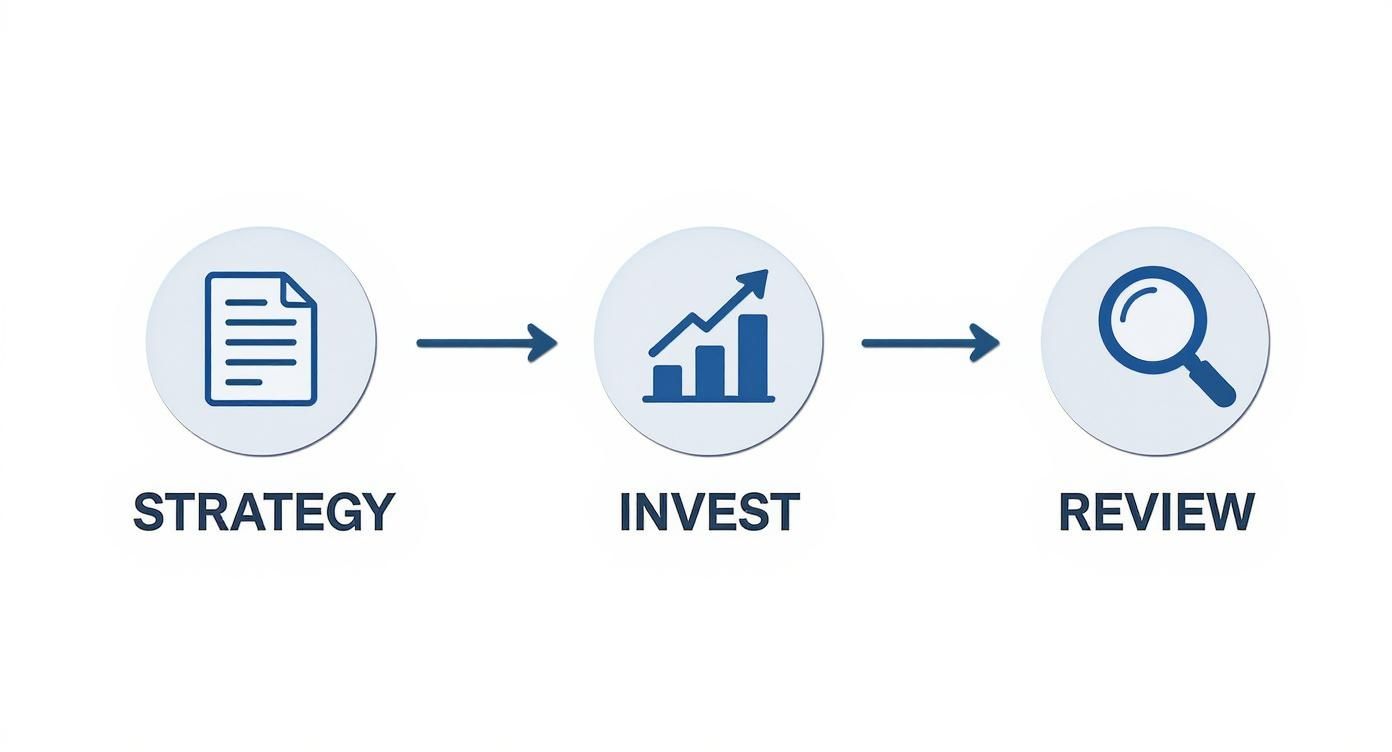
As shown, every investment—particularly one involving leverage—must begin with a documented strategy, be executed in a compliant manner, and be subject to regular review.
Using Business Property in Your SMSF
For business owners, an SMSF can provide a unique opportunity: the ability to acquire your commercial premises. Your fund could purchase your office, workshop, or clinic (using an LRBA if necessary) and lease it back to your operating business.
While this can be a powerful strategy, it must be managed with absolute diligence. The lease agreement between the SMSF and your business must be on a commercial, arm’s-length basis. This means the rental rate must be at fair market value, and the lease terms must be standard. For a deeper understanding of this area, our guide on how to navigate SMSF property investment offers further practical steps.
An LRBA can be an effective tool for wealth creation, but it is not a simple undertaking. It requires professional guidance, meticulous planning, and an unwavering commitment to compliance. Understanding your responsibilities is as important as recognising the potential rewards.
Cashing In: Accessing Your Super in the Pension Phase
This phase is the culmination of years of disciplined saving and planning. It is the point where your superannuation fund transitions from a savings vehicle to an income source to support your retirement.
However, accessing these funds is governed by a strict set of self-managed super fund rules to ensure the system is used for its intended purpose: genuine retirement. This represents a shift in focus from accumulation to the careful and compliant drawdown of your capital.
The Keys to the Kingdom: Conditions of Release
Before you can access your superannuation benefits, you must meet a “condition of release”. These are legally defined events that permit access. The government has established these conditions to preserve superannuation savings for retirement.
The most common conditions of release for accessing your full super balance are:
- Reaching your preservation age and retiring permanently. Your preservation age depends on your date of birth and falls between 55 and 60.
- Attaining age 65. Upon reaching 65, you can access your superannuation benefits regardless of your work status.
- Commencing a transition to retirement income stream (TRIS). This may be an option once you reach your preservation age but wish to continue working, allowing you to draw a limited income from your super.
Meeting one of these conditions is a legal prerequisite for the fund to begin paying benefits.
Lump Sum or Pension Stream? Your First Big Retirement Decision
Once a condition of release has been met, you must decide how to receive your benefits. There are two primary options, each with different implications for your financial position and tax obligations.
First, you could take a lump sum withdrawal. This involves withdrawing a single amount of cash. For most Australians over 60, this withdrawal is tax-free. However, once withdrawn, the funds are no longer within the concessionally taxed superannuation environment and will not benefit from its future investment growth.
The second option is to commence an account-based pension. This involves leaving your capital invested within the SMSF and drawing a regular income. This is a common strategy for creating a reliable income stream to fund living expenses throughout retirement.
The choice between a lump sum and a pension is a foundational retirement decision. An account-based pension keeps your capital invested in a tax-effective environment. A lump sum provides immediate access to funds for significant purposes, such as paying off a mortgage. This decision should be made with personal advice to ensure it aligns with your long-term objectives.
The Minimum Drawdown: A Rule You Can't Ignore
If you choose the pension pathway, you must adhere to an important annual requirement. You must withdraw a minimum percentage of your pension account balance each financial year. The specific percentage is determined by your age and is calculated based on your account balance as at 1 July.
For example, a person aged between 65 and 74 must withdraw a minimum of 5% of their pension balance. The ATO enforces this rule to ensure superannuation is used to provide retirement income, not simply as a vehicle to hold wealth in a tax-free environment. Failure to meet the minimum drawdown can result in the fund losing its tax concessions for that year—a significant financial penalty.
The Transfer Balance Cap: Your Lifetime Limit
Another critical rule is the transfer balance cap. This is a lifetime limit on the total amount of superannuation you can transfer from the accumulation phase into the tax-free retirement phase. This cap is currently set at $1.9 million.
This does not limit the total amount of super you can hold. It only restricts the amount you can move into a pension account where investment earnings are tax-free. Any capital above this $1.9 million limit must remain in an accumulation account, where earnings are typically taxed at 15%. Understanding this cap is a cornerstone of effective retirement planning.
Meeting Your Annual ATO Compliance Obligations
Operating a self-managed super fund is an active engagement, not a passive investment. It carries a clear set of non-negotiable annual obligations to maintain your fund's compliant status with the Australian Taxation Office (ATO). This yearly cycle is fundamental to good governance and protects your retirement savings.
This annual rhythm of responsibilities may seem daunting, but approached with a methodical mindset, it becomes a straightforward process of sound financial stewardship. Good management is built on patient, consistent action, and your annual compliance duties are where this principle is applied.
Your Yearly Compliance Checklist
Each year, as a trustee, you have several core duties. These are not suggestions but legal requirements under Australian superannuation law. The key to a smooth process is diligent record-keeping throughout the year.
Your primary annual duties include:
- Valuing Your Fund’s Assets: You are required to value all fund assets at their current market value as at 30 June each year. This is essential for preparing accurate financial reports and ensuring member balances are correct.
- Preparing Financial Statements: Your fund must have a full set of financial statements prepared annually, including an operating statement and a statement of financial position. These provide a clear view of your fund's financial health and performance.
- Lodging the SMSF Annual Return (SAR): This is the fund's annual report to the ATO, which combines its tax return and key regulatory information. Late lodgement can attract significant penalties, a topic covered in our guide on the late tax return fine.
The Mandatory Independent Audit
Before you can lodge your SAR, your fund must undergo an independent audit. This is perhaps the most critical checkpoint in your compliance calendar. You must appoint an approved SMSF auditor who is entirely independent of the fund—they cannot be a member, a relative, or involved in the preparation of the accounts.
The auditor's role is to provide an objective opinion on two key aspects:
- Financial Audit: They verify that your financial statements present a true and fair view of the fund's financial position.
- Compliance Audit: They examine whether the fund has complied with all relevant superannuation laws and regulations throughout the year.
This independent review provides a vital layer of assurance for both you and the regulators. The auditor's report will identify any breaches of the self-managed super fund rules, which must then be reported to the ATO. It is a safeguard designed to protect members' benefits. A clear auditor's report is often the result of a year of disciplined record-keeping, which a specialist accountant for your SMSF can help you maintain.
An auditor’s report is more than a formality. It is a professional assessment of your stewardship. A clean audit is the direct outcome of a year’s careful planning, disciplined action, and meticulous record-keeping.
The Importance of Diligent Records
Impeccable record-keeping is the bedrock of a smooth audit and lodgement process. This means maintaining clear, organised documentation for every transaction, decision, and event related to your fund throughout the year.
The SMSF sector represents a significant portion of Australia's retirement savings system. With 653,062 funds holding over $1.05 trillion in assets as of June 2025, it is understandable that the ATO maintains strict oversight. More insights on the scale of the SMSF sector at Superguide.com.au confirm the importance of a robust compliance framework for every trustee.
Your annual obligations are where your duties as a trustee are most tangible. By meeting these requirements diligently, you are reinforcing the security of your own retirement future.
Avoiding Common Compliance Pitfalls
Running an SMSF requires navigating a complex regulatory landscape. Even with the best intentions, trustees can inadvertently make mistakes. The intricacies of self-managed super fund rules mean that a simple oversight can lead to a compliance breach. The goal is to understand the common pitfalls to protect the retirement savings you have worked diligently to accumulate.

Understanding these common errors is your best defence. These are not minor technicalities but fundamental mistakes that can attract serious ATO scrutiny, with consequences ranging from education directives to financial penalties or even disqualification as a trustee.
The Prohibited Loan to a Member or Relative
This is one of the clearest prohibitions in the SMSF rulebook: you cannot provide a loan or any form of financial assistance from the fund to a member or their relatives.
This rule goes directly to the sole purpose test. Your superannuation is for your retirement, not a source of personal or business funding. A business owner facing a temporary cash flow issue might be tempted to "borrow" from their SMSF with the full intention of repaying it. However, this is a direct breach. The ATO views this as providing a current-day benefit, which contravenes the core purpose of superannuation.
Breaching the In-House Asset Rules
Another common issue is a breach of the in-house asset rule. This rule limits the fund's total investment in related parties to no more than 5% of its total asset value. A "related party" can include a member, their relatives, or any companies or trusts they control.
For example, an SMSF might invest in a private company controlled by one of its members. That investment is classified as an in-house asset. If its value grows and exceeds the 5% threshold of the fund's total assets, a breach has occurred.
The rationale behind this rule is to promote diversification and manage risk. It is designed to prevent a member's entire retirement savings from being excessively exposed to the performance of their own business ventures.
Failing the Arm’s-Length Transaction Test
Every transaction your SMSF engages in must be on a commercial, arm's-length basis. This means the terms must reflect fair market value, as if the transaction were between two unrelated parties. This principle ensures fairness and prevents members from gaining an unfair advantage.
Common examples of breaches include:
- Property Leases: An SMSF owns a commercial property and leases it to a member’s business at a discounted, non-market rental rate.
- Asset Sales: The fund acquires an asset from a related party at a price significantly different from its true market value.
A breach can have severe tax implications. The ATO may classify any income from a non-arm's length transaction as non-arm's length income (NALI), which is taxed at the highest marginal tax rate. A thorough SMSF audit is designed to detect such issues.
Wise stewardship means understanding both the opportunities and the responsibilities. By recognising these common compliance traps, you can better protect your fund and secure your financial future.
At Everglow Prosperity, we provide the integrated guidance you need to navigate the complexities of SMSF compliance with confidence. Our multidisciplinary team offers clear, reliable advisory to ensure your fund remains secure and on track to meet your long-term goals. Discover how we can support your journey at https://everglow.au.
General Advice Warning: The information in this article is general in nature and does not take into account your objectives, financial situation or needs. Before acting on it, consider whether it is appropriate for you and seek personal advice. Tax and superannuation rules can change. Financial advice is provided by Everglow Wealth Pty Ltd, a Corporate Authorised Representative (No. 1254987) of PGW Financial Services Pty Ltd (AFSL 384713). Tax advice is provided by Everglow Accounting Pty Ltd.
Want help applying this to your situation?
Every situation is different. Book a time with our team to talk it through, or call us on 1300 913 929.