
Self-managed super fund accounting is the engine room of your SMSF. It is the specialised discipline of recording, managing, and reporting your fund's financial activities to meet Australia's strict legal and tax obligations.
This is not merely an administrative task. Sound accounting forms the bedrock of a compliant retirement strategy, ensuring every transaction—from contributions and investments to pension payments—is correctly documented for the Australian Taxation Office (ATO).
Understanding Your SMSF Accounting Responsibilities
For many Australian professionals, business owners, and families, an SMSF may offer a significant degree of control over their retirement savings. It can open the door to investing directly in assets like property, shares, and other opportunities.
However, this control is accompanied by serious administrative and compliance duties. The task of self managed super fund accounting is far more than simple bookkeeping; it is a foundational pillar that supports your fund's integrity and long-term health.

Diligent accounting helps ensure your SMSF remains compliant with the rules set by the ATO and ASIC, which is essential for maintaining its valuable tax concessions. The scale of this responsibility is significant. The Australian superannuation landscape includes over 600,000 SMSFs managing substantial assets, highlighting the critical importance of robust financial stewardship.
This guide breaks down the complexities of SMSF accounting into clear, practical steps. We will cover key areas including:
- The core pillars of record-keeping and administration.
- Preparing annual financial statements and returns.
- Navigating the specific tax obligations unique to SMSFs.
- The essential role of the independent annual audit.
Understanding these duties is central to managing your fund with foresight and discipline. For a deeper insight into the regulatory framework, our detailed guide on the essential self managed super fund rules may be a useful resource. This journey through SMSF accounting is about equipping yourself with the knowledge to manage your retirement savings with quiet confidence and prudence.
The Core Pillars of SMSF Record-Keeping and Administration
The records of your SMSF can be thought of as the architectural blueprints for a house. Each document, from trustee meeting minutes to investment contracts, provides the essential proof that your fund has been built and maintained according to the strict codes set by Australian law. This is not just about paperwork; it is the fundamental evidence of your diligence as a trustee.

Effective self managed super fund accounting begins and ends with disciplined record-keeping. It is the process of capturing every financial decision and transaction, creating a clear, auditable trail. This is a primary responsibility and the bedrock of a healthy, compliant fund.
Why Meticulous Records Matter
The need for detailed records is embedded in Australian superannuation law. These documents serve multiple, critical purposes: they substantiate the figures in your annual return, demonstrate compliance with legislative requirements, and provide a transparent history for members and auditors. Without this trail of evidence, it may be difficult to prove your fund has been managed correctly.
The law is clear on timelines. Trustees are generally required to keep records for a minimum of five years, though some documents, such as minutes of trustee decisions, must be held for ten years. This long-term obligation underscores the enduring nature of managing superannuation.
Key Documents to Maintain
A well-run fund typically has a system for filing and maintaining its essential documents. While every fund’s circumstances may differ, these are the non-negotiable cornerstones of compliant administration:
- Trustee Meeting Minutes: Formal records documenting significant decisions, from updating the investment strategy to authorising a major asset purchase.
- Investment Strategy: A written plan outlining the fund's objectives and the mix of assets it will hold to achieve them. This document should be reviewed regularly.
- Contribution Records: Detailed proof for all money coming into the fund, including employer and personal contributions, clearly showing which member it belongs to and the contribution type.
- Benefit Payments: Evidence of all payments made to members, whether as lump sums or pensions, including calculations and necessary paperwork to prove their validity.
- Contracts and Agreements: Copies of all legal contracts tied to the fund's assets, such as property purchase agreements or loan documents.
Keeping these records organised is about more than ticking a compliance box. It can provide clarity and confidence in financial decision-making. It is an act of careful planning that may pay significant dividends, especially when it is time for the annual audit and tax lodgement.
Practical Example: A Business Owner's Property Investment
Consider a local business owner who uses their SMSF to purchase a commercial property to operate their business from. The record-keeping for this single transaction is extensive. The trustees would need to maintain:
- Minutes from the trustee meeting where the decision to buy the property was formally approved.
- An updated investment strategy reflecting the fund’s new allocation to direct property.
- The contract of sale and all associated settlement documents.
- An independent valuation to confirm the property was acquired at market value.
- The commercial lease agreement between the SMSF and the business, ensuring it is on commercial, arm’s-length terms.
Each document tells a piece of the story, and together they help prove the transaction was compliant. Diligent accounting helps ensure these details are always ready, which may simplify the entire year-end process.
Preparing Annual Financial Statements and Returns
At the end of each financial year, diligent record-keeping culminates in the preparation of the fund’s annual financial statements and the lodgement of the SMSF Annual Return (SAR). This annual reporting cycle translates a year's worth of transactions into a clear, structured narrative.
This process demonstrates how investments have performed and helps confirm the fund has been managed in line with both its investment strategy and Australian superannuation laws. It is the moment where stewardship becomes tangible on paper.
The Key Components of Your Financial Reports
Your annual financial statements are composed of several key documents, each offering a different perspective on your fund's health and activities. Understanding these reports is central to effective self managed super fund accounting.
- Operating Statement (Profit and Loss): This document tracks the fund's income (such as dividends or rent) and expenses (such as accounting fees or the supervisory levy) over the financial year.
- Statement of Financial Position (Balance Sheet): This provides a snapshot of what the fund owns (assets) and what it owes (liabilities) on 30 June. Assets may include cash, shares, and property; liabilities might include an outstanding loan balance.
- Member Statements: These are individual statements for each member, detailing their opening balance, any contributions, earnings allocated, and their closing balance. For members in the pension phase, it will also show payments made.
Developing the skill of how to read balance sheets can empower trustees to move beyond just seeing the numbers and to understand what they mean for the fund's performance.
Valuing Assets at Market Value
One of the ATO’s critical requirements is that all SMSF assets must be valued at their current market value as at 30 June each year. This is not just an accounting formality; it is about ensuring the financial statements reflect the fund's true and accurate worth.
Accurate market valuations are essential for correctly calculating member balances, determining minimum pension payments, and ensuring the fund’s financial reports are a true and fair representation of its position. This underpins the integrity of the entire reporting process.
For listed shares and cash, this is straightforward. However, for assets like direct property or unlisted investments, a formal valuation from a qualified, independent valuer may be required to provide objective, supportable evidence.
The Annual SMSF Accounting Timeline
Understanding the annual rhythm of compliance can make staying organised much easier. While specific dates can shift depending on a fund's circumstances, the yearly cycle follows a predictable pattern.
Here is a simplified look at how the typical year unfolds for an SMSF.
Annual SMSF Compliance and Accounting Timeline
| Phase | Typical Period | Key Activities | Considerations |
|---|---|---|---|
| Year-End Finalisation | July – October | Gather all financial records from 1 July to 30 June. Reconcile bank accounts and finalise asset valuations. Prepare draft financial statements. | Proactive record-keeping during the year can make this phase significantly smoother. |
| Independent Audit | August – January | Provide all financial statements and supporting documents to an approved SMSF auditor for review of financial accuracy and legal compliance. | The audit must be completed before you can lodge the SMSF Annual Return. |
| Lodge SAR | October – May | Once the audit is complete, lodge the SMSF Annual Return with the ATO. This includes the fund's tax return, regulatory information, and member details. | The exact lodgement date depends on the fund's circumstances and prior lodgement history. |
| Tax Payment | February – June | Pay any income tax liability owed by the fund for the financial year. | This is typically due at the same time as, or shortly after, the SAR lodgement deadline. |
This structured timeline helps turn what might seem like a daunting task into a manageable, step-by-step process. It reinforces the idea that good SMSF governance is a year-round discipline, not a last-minute scramble.
Navigating SMSF Tax Obligations
Understanding the tax landscape for your SMSF is a core part of being a responsible trustee. An SMSF operates in a concessionally taxed environment designed to encourage retirement savings. Navigating this correctly is key to protecting and growing members' retirement nest eggs.
The tax a fund pays on its investment earnings generally depends on whether its members are in the accumulation phase (still working) or the retirement phase. For members in accumulation, the fund's earnings are typically taxed at a concessional rate of 15%. Once a member enters the retirement phase and starts an eligible pension, the investment earnings that support their pension income stream are generally tax-free. This distinction is a cornerstone of Australia's superannuation system.
This visual timeline breaks down the key milestones in the SMSF annual cycle, from daily record-keeping to the final ATO lodgement.
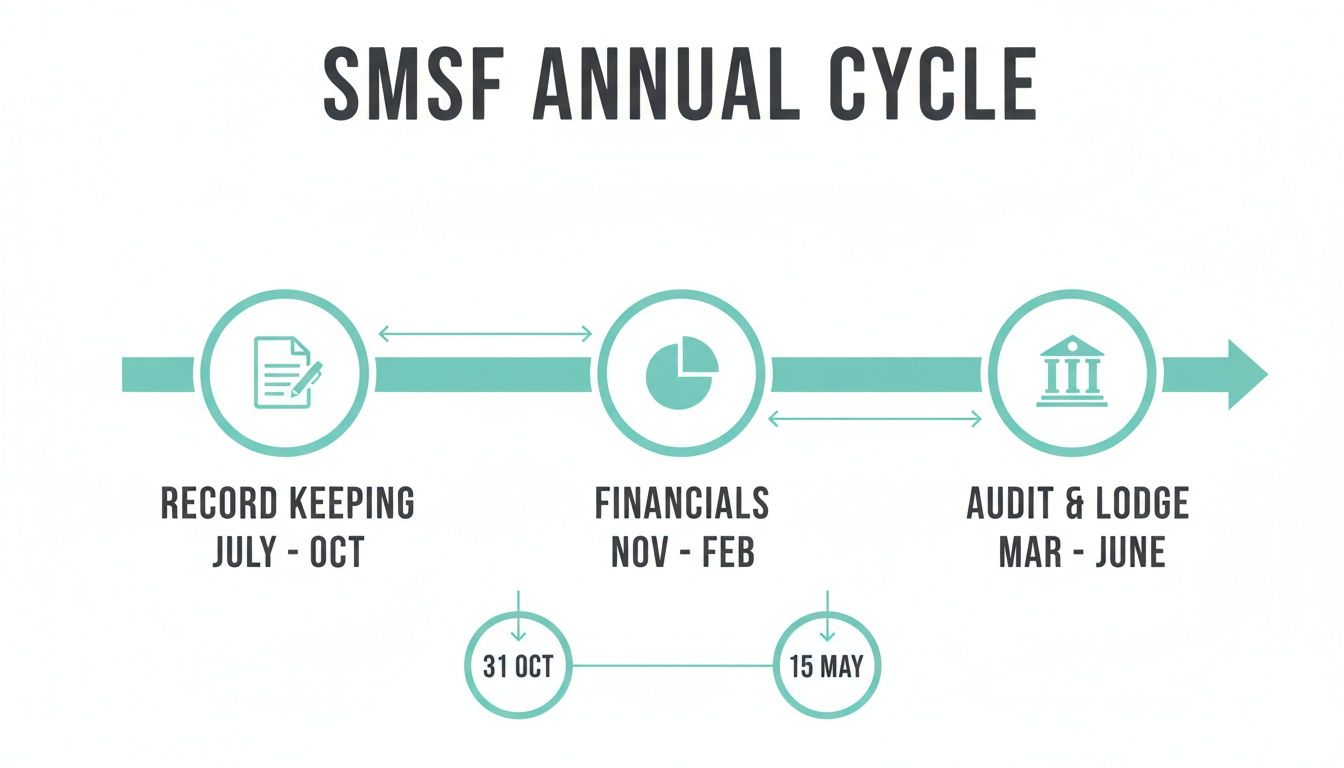
As the graphic illustrates, diligent accounting is a year-round activity that culminates in the critical audit and lodgement phases, which help demonstrate the fund's compliance.
Managing Contributions and Deductions
A crucial part of an SMSF's tax management is correctly classifying all money coming into the fund. Contributions are generally categorised in two ways:
- Concessional contributions: These are pre-tax contributions, like employer payments or personal contributions for which a member claims a tax deduction. They are generally taxed at 15% inside the fund and are subject to an annual cap.
- Non-concessional contributions: These are after-tax contributions made from personal savings. As tax has already been paid on this money, it is not taxed again when it enters the fund. These also have annual limits.
Exceeding these caps can result in additional tax, so careful monitoring is important. On the other side of the ledger, a fund may claim deductions for expenses incurred in running the fund, which typically include the ATO supervisory levy, accounting and audit fees, and investment management costs.
CGT, GST, and Other Tax Considerations
When a fund sells an asset for a profit, it may have a Capital Gains Tax (CGT) liability. The rules here can also be concessional. If an asset has been held for more than 12 months, the fund may be entitled to a one-third discount on the taxable gain. For assets that are supporting a member's retirement phase pension, the capital gain may be entirely tax-free, depending on the circumstances.
Some SMSFs may also need to register for GST. This most commonly occurs when the fund owns a commercial property and the rental income is over the GST registration threshold. In that scenario, the fund must collect GST on the rent and can generally claim credits for the GST it pays on property expenses.
Navigating these rules is about ensuring your fund meets its obligations while legitimately benefiting from the concessions available under Australian law. A clear understanding of your fund’s specific circumstances is paramount, and professional advice may be appropriate.
Practical Example: A New Migrant's Contributions
Consider a professional who has recently migrated to Australia and established an SMSF. They make a personal after-tax contribution of $50,000 from savings they brought with them. For this to work smoothly, the fund's accounting must be precise.
The $50,000 needs to be recorded as a non-concessional contribution in their member statement. No contributions tax is payable on this amount. Careful tracking is still required to ensure they remain within their annual non-concessional cap. Proper accounting makes this whole process seamless and compliant.
The Independent Audit: Your Final Compliance Checkpoint
After a year of careful record-keeping and preparing financial statements, the final, non-negotiable step in the self managed super fund accounting cycle is the independent audit. This is a critical safeguard required by law to protect the integrity of the fund and the retirement savings of its members.

The audit must be carried out by an approved SMSF auditor who is independent of the fund. They act as an objective, third-party reviewer, providing a crucial check and balance on the fund's operations. This process should be seen as a valuable exercise in good governance that can deliver genuine peace of mind.
The Two Halves of an SMSF Audit
An SMSF audit is a two-pronged review, examining both the financial health and the regulatory compliance of the fund. The auditor is tasked with forming an opinion on two distinct but connected parts.
The Financial Audit: The auditor reviews the fund’s financial statements, checking that the numbers presented are accurate and supported by evidence. A key focus is verifying that assets exist and have been valued correctly at their market value as at 30 June.
The Compliance Audit: The auditor assesses whether the fund has complied with superannuation laws, primarily the Superannuation Industry (Supervision) Act 1993 (SISA), throughout the financial year.
What an Auditor Examines
During the compliance audit, an auditor will focus on several key areas where trustees may encounter issues. These often include:
- The Sole Purpose Test: Confirming every fund activity was for the sole purpose of providing retirement benefits to members.
- Loans to Members: Verifying the fund has not lent money or given financial assistance to a member or their relatives, which is strictly prohibited.
- Related-Party Transactions: Ensuring any transactions with related parties were conducted on a commercial, arm’s-length basis.
- Investment Strategy Compliance: Checking that the fund’s investments are consistent with its written investment strategy.
- Separation of Assets: Making sure the fund's assets are held entirely separate from the personal or business assets of the trustees.
The audit report is the final piece of the puzzle and must be completed before you can lodge your SMSF Annual Return. A qualified audit report, which flags potential breaches, can lead to scrutiny and potential penalties from the regulator.
Responding to an Audit Finding
If an auditor identifies a potential breach, they are required by law to report significant issues to the ATO via an Auditor Contravention Report (ACR). This reinforces the serious nature of a trustee's compliance duties. Ultimately, the annual audit is a constructive process. It confirms that diligent accounting practices have paid off, providing trustees with confidence that their fund is being managed with care, prudence, and in accordance with the law.
What's the Next Step for Your Fund?
Managing a self managed super fund is a year-round commitment to careful stewardship. From diligent record-keeping and timely reporting to thoughtful tax management and the final audit—these are not just administrative chores. They are the core duties that protect retirement savings and keep a fund compliant with Australian law.
This guide was designed to provide a clear map of those responsibilities. The real measure of success for any trustee is feeling confident and clear about their fund’s financial health and compliance.
Take a Moment to Assess Your Approach
Now may be a good time to reflect on your own processes. Is your current accounting approach—whether handled yourself or with professional support—giving you the assurance you need?
You might ask yourself a few questions:
- Are my records organised, complete, and ready for an audit?
- Am I confident that every transaction from the past year complies with superannuation law?
- Do I have a clear picture of the fund’s tax position and the basis for its asset valuations?
If you feel any uncertainty, it may signal that a conversation with a professional could be worthwhile.
When to Seek Professional Guidance
Seeking guidance is an act of foresight. Financial rules can shift, and a fund's circumstances will naturally change. Professional advice may be particularly valuable when considering a complex transaction, like acquiring property, or simply to gain a second opinion on the fund's structure and compliance. An adviser can offer an objective perspective, helping to spot potential risks or opportunities.
Ultimately, the goal is to build a foundation of disciplined action and thoughtful planning. If you feel that a discussion about your specific circumstances would bring you greater clarity, you may wish to arrange a discussion with our team.
If you would like clarity on how these principles may apply to your own circumstances, you may wish to speak with a qualified adviser. You can contact Everglow on 1300 913 929 or email contact@everglow.au to arrange a discussion.
General Advice Warning: The information provided is general in nature and does not take into account your personal objectives, financial situation, or needs. Before acting on any information, you should consider the appropriateness of the information having regard to your own objectives, financial situation, and needs and seek personal advice from a qualified financial adviser.
