

Financial stewardship often involves looking at familiar things in a new way. Salary sacrificing is a well-established, Australian Taxation Office (ATO) compliant strategy that allows you to do just that with your income. It is a formal arrangement with your employer where you receive part of your pre-tax salary as benefits instead of cash.
The principle is straightforward: to lower your taxable income. Depending on your circumstances, this may reduce the tax you pay, freeing up resources to support your financial goals.
What Is Salary Sacrificing and How Does It Work
At its heart, salary sacrificing is about restructuring your remuneration to be more tax-effective. Instead of your entire salary being paid into your bank account, you formally agree to forgo a portion of it. In return, your employer provides you with benefits of an equivalent value.
This exchange occurs before your income tax is calculated. As a result, the income on which you are assessed is lower. This simple adjustment can have a significant effect, potentially reducing the tax you pay over the financial year.
The Basic Mechanics
The process relies on a formal agreement with your employer, often called a salary packaging or remuneration agreement. It is critical under Australian tax law that this is established before you have earned the income you intend to sacrifice. You cannot apply this strategy retrospectively to pay you have already received.
Consider your gross salary as the starting point. The cost of your chosen benefits is deducted first. The remaining amount is what the ATO uses to calculate your income tax.
For example, a professional earning $120,000 per annum could arrange to sacrifice $10,000 into their superannuation. Their taxable income would then be calculated on $110,000, not the full $120,000. This is a common and effective use of the strategy, but it is one of many possibilities. For anyone considering this path, understanding how to cut tax to 15% using super is a practical next step.
Key Principles for Good Stewardship
To approach this strategy with foresight, it is wise to understand a few guiding principles. These arrangements are governed by ATO rules and require careful planning to be effective and compliant.
A salary sacrifice arrangement is more than a transaction; it is a strategic decision that should align with your broader financial plan. Good stewardship demands that we consider not just the immediate tax benefit, but the long-term impact on our savings, debts, and retirement planning.
This means paying close attention to a few key points:
- Formal Agreement: Ensure a clear, written agreement is documented with your employer.
- Prospective Application: The arrangement must apply to future earnings only.
- ATO Compliance: Both you and your employer must adhere to tax laws, including any Fringe Benefits Tax (FBT) that may arise.
By understanding these fundamentals, you can begin to see how salary sacrificing can be a disciplined and effective tool for financial management.
How Salary Sacrifice Can Improve Your Financial Position
At its core, salary sacrifice is an arrangement designed to make your income work more efficiently. The central benefit is simple: it lowers your taxable income, which in turn may reduce the amount of tax you pay each year. It is a structured way to achieve a better financial outcome from the salary you already earn.
By redirecting a portion of your income before tax is calculated, you effectively reduce the amount of your earnings the Australian Taxation Office (ATO) can tax. For some individuals, this reduction may be enough to place them in a lower marginal tax bracket, leading to further savings.
This diagram illustrates the simple but powerful flow of how salary sacrifice can reduce your final taxable income.
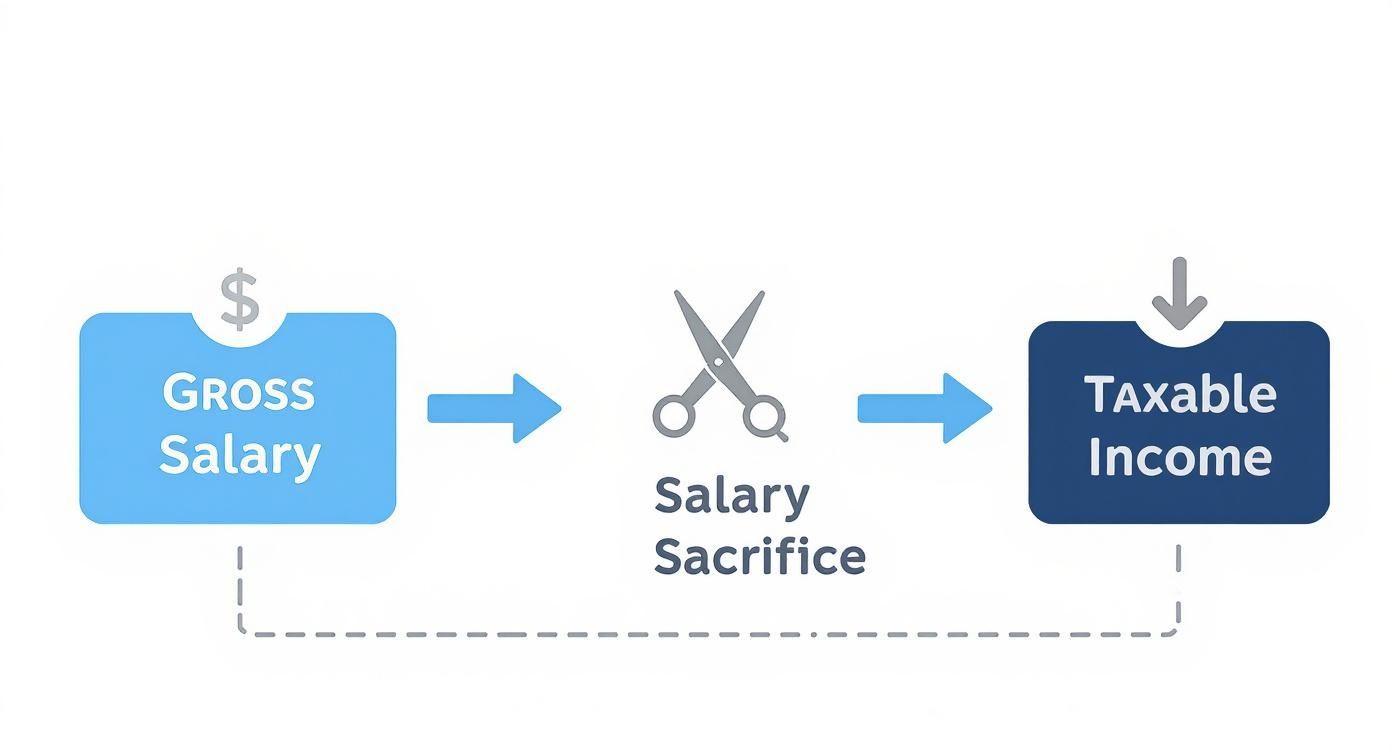
As you can see, the payment for the benefit is taken from your gross salary before tax is calculated. That is the key to the strategy.
Building Your Wealth Through Tax Efficiency
Beyond immediate tax considerations, salary sacrifice can be a powerful tool for building long-term wealth, particularly for retirement. Directing additional funds into your superannuation this way is one of the most tax-effective methods for growing your retirement savings.
These extra super contributions are generally taxed at a flat, concessional rate of 15% within the superannuation fund. For most Australian professionals, this is significantly lower than their personal marginal income tax rate, which can be as high as 45% (plus the Medicare levy). This tax differential means more of your money may remain invested and working for your future. You can discover more about how to cut tax to 15% using super in our detailed guide.
Let’s examine how this could work with a simple table.
Potential Annual Tax Savings via Superannuation Salary Sacrifice
This table shows the potential tax savings for an individual earning $120,000 a year who decides to salary sacrifice $10,000 into their super, based on 2026–27 resident tax rates and the 2% Medicare levy.
| Scenario | Without Salary Sacrifice | With Salary Sacrifice |
|---|---|---|
| Gross Salary | $120,000 | $120,000 |
| Salary Sacrificed to Super | $0 | $10,000 |
| Taxable Income | $120,000 | $110,000 |
| Income Tax & Medicare Levy (Approx.) | $28,920 | $25,720 |
| Super Contributions Tax (15%) | $0 | $1,500 |
| Total Tax Paid | $28,920 | $27,220 |
| Net Tax Saving | $1,700 |
Note: This is a simplified example. Seek personal advice to understand the impact based on your specific circumstances.
As the numbers suggest, sacrificing $10,000 into super in this scenario could result in an immediate tax saving of $1,700 for the year. That is money that can now compound within your super fund instead of being paid to the ATO.
Making Big Expenses More Manageable
Salary sacrifice also provides a practical way to make major expenses more affordable. A novated lease for a car is perhaps the most well-known example of this.
With a novated lease, your car payments and many of its running costs—such as fuel, insurance, registration, and maintenance—can be bundled and paid for with your pre-tax income. This may significantly reduce the overall cost of owning and running the vehicle compared to paying for it with your after-tax income.
This approach is not a universal solution and requires a careful assessment of Fringe Benefits Tax (FBT) and the total cost over the lease term. However, for the right person, it could provide a clear financial advantage for a necessary expense.
Ultimately, the benefits of salary sacrifice are realised through disciplined planning. It is a powerful mechanism that, when used wisely, can enhance your financial health by reducing tax, building wealth, and making essential costs more manageable. Each decision should always be weighed against your personal financial situation and your long-term goals.
Common Items You Can Salary Sacrifice
Understanding the practical options is the first step in determining if salary sacrifice fits into your financial plan. While the range of possibilities can be broad, a few common choices are favoured by Australian professionals, business owners, and families for their clear value and effectiveness.
The goal is always to select items that genuinely support your financial objectives while remaining compliant with Australian Taxation Office (ATO) guidelines. Each arrangement offers a different path to tax efficiency, and the right one for you will depend on your personal circumstances, your income, and what your employer offers.
Let’s walk through some of the most popular choices.

Additional Superannuation Contributions
Directing a portion of your pre-tax income into superannuation is one of the most common and powerful ways to use salary sacrifice. It is a disciplined method for building your retirement savings while potentially lowering your immediate tax bill.
These contributions are generally taxed at a concessional rate of 15% inside your super fund. For most working Australians, this is considerably lower than their marginal income tax rate. This creates an immediate tax advantage, allowing more of your earnings to be invested for the long term.
It is a patient strategy, one that steadily contributes to your future financial stability. If you wish to explore this further, our guide on superannuation strategies provides deeper insight.
Novated Car Leases
Another very popular benefit is a novated lease for a vehicle. This is a three-way agreement between you, your employer, and a finance company, which allows you to pay for a car and its running costs directly from your pre-tax salary.
The appeal of a novated lease lies in a few key potential benefits:
- Paying for the vehicle with pre-tax dollars, which can make it more affordable than a standard car loan.
- Bundling running costs like fuel, insurance, registration, and servicing into one regular payment.
- Access to potential fleet discounts on the purchase price of the car.
It is vital to approach novated leasing with careful consideration. While the tax benefits can be appealing, you must weigh them against the total cost of the lease and the Fringe Benefits Tax (FBT) implications, which your employer is required to manage.
This option is particularly relevant for professionals who rely on a vehicle for their work or daily life, offering a structured and often tax-effective way to manage a significant household expense.
Work-Related Portable Electronic Devices
Salary sacrificing can also extend to work-related tools. An employer may permit you to package a portable electronic device—such as a laptop, tablet, or mobile phone—provided it is used primarily for work purposes.
Under ATO guidelines, an employee can typically package one such device per FBT year without incurring Fringe Benefits Tax. For a business owner needing current technology or a consultant staying connected with clients, this can be a tax-effective way to acquire essential tools.
Other Potential Benefits
Beyond these common items, some employers offer the ability to package other expenses. These could include:
- Professional membership fees and subscriptions relevant to your career.
- Self-education expenses that are directly related to your current employment.
- Other employer-provided benefits such as on-site childcare or health insurance premiums, depending on workplace policies.
Each of these items comes with its own specific set of rules and compliance obligations. The true value of any salary sacrifice benefit lies not just in the potential tax saving, but in how well it integrates with your broader financial plan and life.
Navigating ATO Rules and Responsibilities
Wise financial stewardship requires understanding both opportunities and obligations. While the benefits of salary sacrifice are clear, they exist within a structured framework set by the Australian Taxation Office (ATO). Approaching this strategy with care and discipline helps ensure you remain compliant and achieve your intended outcomes without unforeseen issues.
A cornerstone of any valid arrangement is that it must be documented in a formal, written agreement with your employer. Crucially, this agreement must be in place before you earn the income you intend to sacrifice. It cannot be applied retrospectively to salary or wages you have already received; it must always relate to future earnings.
Understanding the Contribution Caps
When you salary sacrifice into superannuation, you must be mindful of the government-set limits. These contributions are classified as concessional contributions, which also include your employer's compulsory Superannuation Guarantee payments.
The general concessional contributions cap is regularly reviewed. It is your responsibility to track all contributions made to your super fund to ensure you do not exceed this limit. If the cap is breached, the excess amount will be included in your assessable income and taxed at your marginal rate, which negates the tax benefit.
A well-structured salary sacrifice plan respects these limits as firm boundaries. Careful monitoring and planning with your payroll department or financial adviser are essential for disciplined execution.
High-income earners should also be aware of the Division 293 tax. If your income and concessional super contributions combined exceed a certain threshold (currently $250,000), an additional 15% tax is levied on those contributions. This is an important consideration for many senior professionals, PSI earners, and business owners when structuring their remuneration.
Anyone managing their own retirement savings should also understand the broader compliance landscape, including the specific Self-Managed Super Fund rules that govern these investment vehicles.
The Broader Impact on Your Finances
A salary sacrifice arrangement can influence other areas of your financial life. The ATO uses a measure called 'Adjusted Taxable Income' (ATI) to determine eligibility for certain government benefits and liabilities. This calculation adds back your sacrificed amounts to your taxable income.
This means your salary sacrifice arrangement could affect:
- HELP Debt Repayments: Your repayment obligations are calculated based on your ATI, so sacrificing salary will not reduce the income figure used for this purpose.
- Child Support Payments: Assessments are also based on an adjusted income figure, ensuring sacrificed amounts are accounted for.
- Government Benefits: Eligibility for certain benefits, like the Family Tax Benefit, is means-tested against your adjusted income.
It is also important to consider how lenders view these arrangements. When you apply for a mortgage, lending criteria differ. Some lenders will assess your borrowing capacity based on your gross income before the sacrifice, while others may focus on your reduced take-home pay, potentially impacting how much you can borrow.
Engaging in a salary sacrifice arrangement is a significant financial decision. It requires a clear view of both the immediate benefits and the wider responsibilities.
Putting Your Salary Sacrifice Plan into Action
Understanding salary sacrifice is the first step; putting it into practice with care is where you can build real financial momentum. To move forward with confidence, it is helpful to follow a clear, measured process. This is not about rushing into an agreement, but about turning a sound concept into a wise financial decision that is right for your circumstances.
Each step builds on the last, providing clarity and helping to ensure the final arrangement aligns with your personal circumstances and long-term goals.

A Checklist for Getting Started
Prudence and diligence are your allies here. Consider the following checklist as a guide to ensure all aspects are considered.
Review Your Foundations: First, check your employment contract and your employer’s policies on salary sacrifice. Understanding what options are available and any internal rules is the essential starting point.
Define Your Objectives: Clarify your financial goals. Are you aiming to boost your superannuation for retirement, manage the cost of a vehicle, or pay for work-related equipment? Your goals will point you to the most appropriate benefits.
Calculate the Real-World Impact: Run the numbers to understand how the arrangement will affect your take-home pay and household budget. It is vital to ensure the reduction in your net pay is sustainable and will not create financial pressure.
Seek Independent Counsel: It is always wise to seek professional guidance. A qualified financial adviser can help confirm the strategy is appropriate for your unique situation and assist you in navigating the details in line with ASIC requirements.
Formalise the Agreement: Once you are ready, approach your employer or HR department. You must have a written salary sacrifice agreement in place, and it is critical this is done before you earn the income you wish to sacrifice. The arrangement must always be for future earnings.
These arrangements are becoming more common. A 2025 survey found that 81% of employees would be willing to adopt such schemes if they were offered, with superannuation and mortgage payments being popular targets. This reflects a growing desire among Australians to use their pre-tax income more effectively. You can explore the full findings from Robert Walters Australia to see what else employees are seeking.
By following these deliberate steps, you can move forward with a clear head, confident that your decision is well-considered and strategically sound. For a discussion tailored to your personal situation, feel free to contact us.
A Path to Smarter Financial Stewardship
The path to financial security is built on a series of deliberate, well-considered decisions. Salary sacrifice is a powerful and legitimate strategy under Australian law that may improve your financial position, but it is not a universal solution. Its success hinges on careful planning, a clear understanding of the rules, and ensuring the strategy aligns with your personal goals.
This is not about finding loopholes; it is about applying established financial principles with discipline. Good stewardship means making patient and informed decisions, understanding that the best outcomes are often realised over many years. The real benefit comes from structuring your finances in a way that serves your long-term objectives, whether that is building a robust retirement nest egg or managing major life expenses more effectively.
Your Next Steps
Before taking action, it is prudent to step back and look at your complete financial picture. Consider how a salary sacrifice arrangement might interact with your other commitments and future plans, such as preparing for a comfortable life after work. For those planning ahead, understanding how to structure a retirement income stream is a logical next step in your financial education.
The most effective financial strategies are those that are not only tax-efficient but are also deeply rooted in your personal circumstances and aspirations. A patient, disciplined approach will always serve you better than a reactive one.
Ultimately, the power of salary sacrifice lies in its ability to make your income work harder for you. By thoughtfully redirecting pre-tax dollars, you may accelerate your progress towards a more secure financial future. This requires foresight, diligence, and a commitment to managing your resources with wisdom.
The key takeaway is that salary sacrifice is a tool, not a guarantee. When used correctly and with professional guidance, it can be a valuable component of a sound financial plan, helping you build wealth with patience and purpose.
Unpacking the Common Questions Around Salary Sacrifice
When exploring ways to manage your finances more effectively, questions will naturally arise. This is a positive sign of careful consideration. Here are a few of the most common queries we hear from clients as they begin to explore how salary sacrifice might work for them.
These are not just technical questions; they often touch on significant life events like changing careers, buying a home, or planning for a family's future. Gaining clear, practical answers is the first step toward making a confident decision.
Can I Salary Sacrifice into My Partner’s Superannuation Account?
This is a thoughtful question, but under Australian law, the answer is no. A salary sacrifice arrangement is strictly between an employee and their employer, and the contributions can only be directed into that employee's own superannuation fund.
However, this does not prevent you from supporting your partner's retirement savings. You may be able to make after-tax contributions directly to their super fund. Depending on your circumstances, you could be eligible for a tax offset for doing so. This is a separate strategy from salary sacrifice, with its own set of rules, but it can be a valuable tool for couples planning their financial future together.
What Happens to My Arrangement If I Change Jobs?
Your salary sacrifice agreement is tied directly to your current employer. It is effectively part of your remuneration package with them. When your employment ceases, the arrangement automatically ends. It does not transfer to your next role.
Upon starting with a new company, you will need to initiate a new discussion about salary sacrificing. Not all employers offer this option, and those that do may have different policies or available benefits. It is a good practice to inquire about this early in the onboarding process to understand what may be possible.
Does Salary Sacrificing Affect My Ability to Get a Home Loan?
This is a critical consideration, and the answer is: it may. While salary sacrificing reduces your taxable income, lenders have different methods for assessing your borrowing capacity.
Some lenders will assess your gross income before the sacrifice, recognising your true earning capacity. Others, however, might only consider your lower, post-sacrifice take-home pay when determining serviceability. This could reduce the amount they are willing to lend you. Before applying for a loan, it is essential to have a frank conversation with your mortgage broker or lender to understand exactly how they will assess your income under their specific lending criteria.
Navigating these decisions requires a steady hand and clear advice. The team at Everglow Prosperity can provide the guidance you need to structure your finances with foresight and confidence.
Get in touch with us to start the conversation
General Advice Warning: The information provided in this article is general in nature and has been prepared without taking into account your personal objectives, financial situation, or needs. Before acting on any of this information, you should consider the appropriateness of the information having regard to your own objectives, financial situation, and needs, and seek personalised professional advice.
Want help applying this to your situation?
Every situation is different. Book a time with our team to talk it through, or call us on 1300 913 929.
Book a free meetingAustralian tax guide →Estimate your fees →
Keep exploring