

For decades, you have diligently built your superannuation savings. Now, as you approach the end of your working life, the question looms: how do you turn that nest egg into a reliable, steady income?
This is where a retirement income stream comes in. It is the mechanism that converts your accumulated super into a regular series of payments, much like the salary it is designed to replace. Think of it as shifting gears from accumulating wealth to thoughtfully drawing it down. It is one of the most significant financial transitions you will ever make.
Understanding Your Financial Life After Work
For many Australians, retirement isn’t an end point—it’s a new beginning. But it requires a fundamental change in mindset. The focus moves from growth to preservation and creating a predictable, sustainable income that will support you for the decades to come.
A well-structured retirement income stream is the cornerstone of this new chapter, designed to provide financial stability and peace of mind.

This guide will walk you through the Australian system, showing you how your super, investments, and any Age Pension entitlements may be combined into a cohesive flow of funds. The goal isn't just to have savings; it's to have a dependable plan for turning those savings into cash flow.
The Core Components of Retirement Funding
At its heart, building a retirement income stream is about making strategic decisions about how and when to access your capital. The main pillars of this strategy in Australia typically include:
- Superannuation Pensions: The most common method is an account-based pension, which lets you draw a regular income directly from your super balance.
- Annuities: These products may offer a guaranteed income for a set term or for life, providing a layer of certainty against market movements and the risk of outliving your money.
- Government Age Pension: For those who meet the assets and income tests, the Age Pension provides a foundational safety net.
- Other Investments: Income can also be drawn from sources outside super, such as rental properties, dividend-paying share portfolios, or managed funds.
A thoughtful retirement plan is less about chasing high returns and more about building a resilient and predictable cash flow. It is an exercise in stewardship, ensuring the resources you’ve gathered can sustain you for the decades to come.
Understanding how to integrate these components is crucial. For instance, a medical professional with a significant super balance might structure an account-based pension to minimise tax, while a new migrant may need guidance on integrating overseas pension assets with their local superannuation.
Each path requires careful, forward-thinking planning. For many business owners and professionals, a self-managed fund is a key part of the structure, so it’s wise to explore our guide on understanding the Self-Managed Super Fund rules before making any decisions.
The Three Pillars of Australian Retirement Income
Building a stable financial future in retirement is a bit like constructing a sturdy building; you can’t rely on just one support. In Australia, your retirement income is typically built on three foundational pillars, each with its own job to do. Understanding how they work—both on their own and together—is the first step to creating a plan that will see you through your post-work years.
These pillars aren't mutually exclusive. In fact, for most Australians, combining them provides the most balanced and secure outcome, depending on their circumstances.
Pillar One: Account-Based Pensions
This is the most common way Australians turn their super into an income. Think of an account-based pension as converting your super savings account into a regular transaction account for retirement. You remain in control.
You generally decide how much you want to draw and how often you get paid, as long as you meet the government-mandated minimums. These drawdown rates are based on your age and are there to ensure your super is used for its intended purpose—funding your retirement.
Key features of an account-based pension include:
- Flexibility: You can usually adjust your payment amounts or take out lump sums if your circumstances change.
- Investment Control: Your remaining super balance stays invested, giving it the potential to keep growing. Of course, this also means it remains exposed to market risk.
- Tax Advantages: For most people over 60, the income payments and any withdrawals you make from an account-based pension are tax-free.
This structure offers significant flexibility, which is incredibly useful for managing the variable expenses that life brings in retirement. Many retirees find holding dividend-paying shares within their pension account is a sound way to generate income. To see how this works in practice, you can explore our detailed guide on the benefits of a fully franked dividend.
Pillar Two: Annuities
Where an account-based pension gives you flexibility, an annuity offers certainty. An annuity is a financial product you buy from a life insurance company, usually with a lump sum from your super. In return, it provides a guaranteed series of payments for a fixed term or for the rest of your life.
This pillar is designed to protect you from market volatility and, importantly, longevity risk—the risk of outliving your savings. By locking in a predictable income, an annuity can act as a financial bedrock to cover your essential living costs, providing peace of mind.
But this security comes with trade-offs. The money used to buy the annuity is generally locked away, offering far less flexibility than an account-based pension. The returns might also be more modest compared to what you could get from market-linked investments during a period of strong growth.
Pillar Three: The Government Age Pension
The third pillar is the Government Age Pension, which serves as a vital safety net for millions of Australians. It is not an automatic entitlement. To receive it, your financial situation is assessed by Centrelink through strict income and assets tests, which determine if you qualify for a full pension, a part pension, or nothing at all.
The Age Pension provides a foundational income floor, ensuring a basic standard of living. For many, it complements their own savings rather than replacing them entirely, filling any gaps left by their private retirement income stream.
The rules are complex and change over time, so it's critical to understand how your super, investments, and other assets will be assessed. For instance, your family home is usually excluded from the assets test, but other investments, including the balance of your account-based pension, are counted.
The retirement landscape is shifting. Recent data shows a growing reliance on super, with 35% of retirees now citing it as their main income source, while reliance on the government pension is decreasing. Australians are also planning to retire later, at an average age of 65.6 years, reflecting a trend toward building stronger private savings. You can find more of these insights in the Australian Bureau of Statistics' latest retirement intentions release. This shift highlights the importance of diligent superannuation planning, while still understanding how the Age Pension might fit into your overall strategy.
Comparing Your Australian Retirement Income Options
To help you understand your choices at a glance, this table compares the key features of the three main retirement income pillars in Australia.
| Feature | Account-Based Pension | Annuity | Age Pension |
|---|---|---|---|
| Source of Funds | Your accumulated superannuation balance. | A lump sum from your super or savings. | Government-funded social security benefit. |
| Income Type | Variable income payments drawn from your invested capital. | Guaranteed, fixed income payments for a set term or for life. | A regular, government-set payment. |
| Flexibility | High. You can adjust payments and make lump sum withdrawals. | Low. Your capital is generally locked in for the term of the annuity. | None. Payments are fixed by Centrelink rules. |
| Investment Control | High. Your remaining balance stays invested under your control. | None. The insurance company manages the funds. | Not applicable. |
| Market Risk | Your balance is exposed to investment market fluctuations. | None. Your income is guaranteed, regardless of market performance. | None. Payments are guaranteed by the government. |
| Longevity Risk | You bear the risk of your funds running out if you live a long time. | Protected. A lifetime annuity guarantees payments for as long as you live. | Not applicable, as it's a safety net. |
| Tax on Income (60+) | Tax-free. | Generally tax-free from a super source. | Taxable, but eligibility for tax offsets may reduce or eliminate tax payable. |
| Eligibility | Must meet a condition of release (e.g., reaching preservation age and retiring). | Available for purchase, often using superannuation funds. | Must pass Centrelink's income and assets tests, and meet age requirements. |
Each option has a distinct role to play. An account-based pension offers growth potential and flexibility, an annuity provides certainty, and the Age Pension acts as a safety net. For many people, the most effective retirement plan may involve a thoughtful blend of these pillars, tailored to their specific needs and goals.
Navigating Tax and Superannuation Rules
To build a strong retirement income stream, you need to understand Australian tax and superannuation rules. These systems aren't just about saving money; they are designed with specific rules and concessions to assist you in your post-work years. The key is approaching them with quiet confidence and clear knowledge to unlock their potential.
The single most powerful benefit for most people kicks in once you turn 60. Any income you draw from a super-based pension—like an account-based pension—is completely tax-free. This is a cornerstone of our retirement system, making your savings work as efficiently as possible when you need them most.
However, this is balanced by a framework of rules. Sound financial management means understanding both the opportunities and the responsibilities these rules create.
This simple diagram shows how your main retirement income options—Account-Based Pensions, Annuities, and the Age Pension—may fit together.
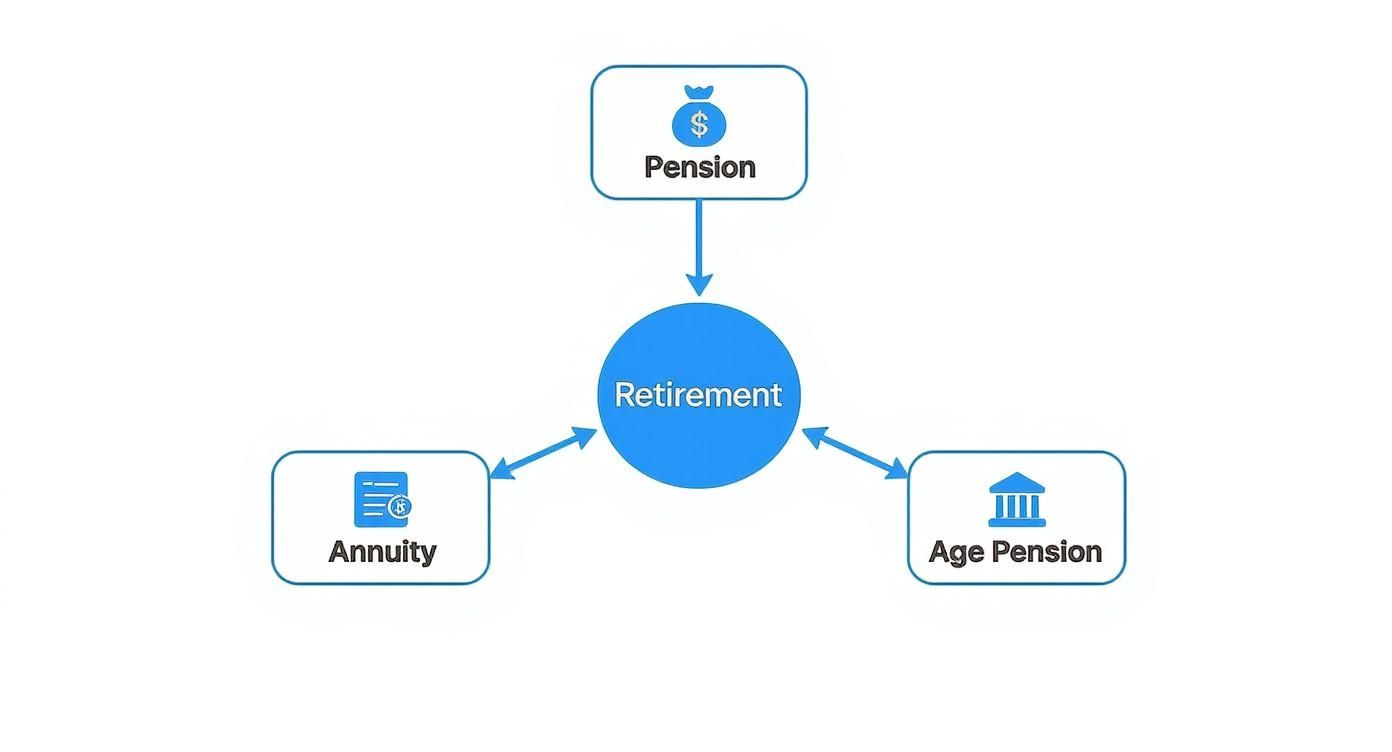
As you can see, while they are all distinct, they are interconnected parts of the same puzzle: funding a secure retirement. The rules governing one often impact the others.
Understanding the Key Caps and Ages
Two concepts are critical to how you access your super and its tax benefits: preservation age and the transfer balance cap.
Your preservation age is the first point at which you can legally access your super, provided you meet a condition of release, such as retirement. This age is set by law and depends on your date of birth. It is vital to know yours, as early access is only allowed in very limited, specific circumstances.
The transfer balance cap is different. It puts a lifetime limit on how much super you can move into the tax-free retirement phase. Any savings you have above this cap must remain in an accumulation account, where the investment earnings are still taxed at the concessional rate of 15%. This rule is designed to limit the tax concessions available to individuals with very large super balances.
This is where good planning comes into its own. Structuring your finances to work within these caps while drawing your income in the most tax-effective way is the mark of a sound retirement strategy. Depending on your situation, this might involve coordinating with your spouse or managing assets both inside and outside the super system.
The Growing Importance of Superannuation
As Australia's super system has matured, it has had a profound impact on how we retire. The number of Australians aged 65-74 with superannuation jumped to 65% by 2023, a significant increase from 54% back in 2015.
This growth, driven by the steady rise of the superannuation guarantee, is giving more people retirement security. The system's importance is undeniable: without it, average retiree incomes would be lower, putting far more strain on the Age Pension. You can explore more of this data in the comprehensive SMC report on super's coming of age.
Integrating Other Income Sources
It is rare for a retirement plan to lean on super alone. You might have income from investment properties, a share portfolio, or even part-time work. Each of these streams has its own tax implications and can affect your eligibility for the Age Pension.
For instance, the income you receive from a rental property is assessed for both tax and by Centrelink. For professionals with a self-managed super fund (SMSF), the rules can be even more intricate, and knowing how to manage fund assets and income streams compliantly is critical. If that describes your situation, it would be wise to review our detailed guide on the essential self-managed super fund rules to ensure you're on the right track.
The goal is to build a cohesive strategy where every part of your financial life works together. This takes a clear grasp of the rules, patient planning, and seeking personal advice to ensure every decision is right for your unique circumstances.
Strategic Planning for Your Life Path
While the core principles of retirement funding apply to everyone, the right strategy is always deeply personal. Your profession, your family, and your specific journey through life all shape the ideal retirement income stream for you. A calm, disciplined approach isn't about chasing the latest trend; it's about tailoring these timeless principles to your unique circumstances.
This means moving beyond generic advice to build a structure that feels like a natural extension of your life. The path for a small business owner approaching a sale is fundamentally different from that of a new migrant navigating the Australian system for the first time.
For Business Owners and PSI Earners
If you own a small or medium-sized business or earn Personal Services Income (PSI), your retirement planning is intrinsically linked to your business. The goal is to methodically transfer wealth from the business into your personal retirement savings in the most tax-effective way possible.
This comes down to a few key disciplines:
- Maximising Concessional Contributions: This is a powerful, straightforward strategy. Systematically contributing pre-tax business profits or income into your super, up to the annual cap, may reduce the business's taxable income while building your nest egg in a low-tax environment.
- Planning a Business Exit: A successful sale or succession plan is a critical retirement event. With careful planning, the proceeds may be eligible for significant capital gains tax (CGT) concessions, and thoughtful structuring is needed to direct these funds into superannuation.
- Managing Fluctuating Income: For professionals with variable income, it's vital to smooth out super contributions. Using strategies like 'catch-up' concessional contributions may allow you to make the most of those highly profitable years when they come.
This disciplined approach helps ensure your business doesn't just provide an income today but becomes the engine for your retirement funding tomorrow.
For Medical and Legal Professionals
Professionals in fields like medicine and law often manage variable income and complex practice structures. Your retirement strategy needs to be resilient enough to handle these fluctuations while focusing on long-term, tax-efficient growth.
Structuring your investments within superannuation can be particularly effective. For instance, holding assets that generate franked dividends inside a super fund can provide significant tax benefits. For a deeper understanding of these mechanics, you can explore our guide on how to cut tax to 15% using super. This may allow you to build a robust retirement income stream that is shielded from your higher marginal tax rates.
True financial stewardship is not about reacting to market noise, but about building a sound structure that quietly and consistently works for you over many financial seasons.
For New Migrants and Local Families
Navigating the Australian superannuation and tax systems can be a significant undertaking for new migrants. The primary challenge is often integrating overseas pensions or assets with local regulations. It's crucial to seek advice on how foreign-sourced income is treated and how to consolidate funds compliantly to build an effective retirement income stream here in Australia.
For local families, coordinating strategies as a couple can unlock powerful benefits. By balancing superannuation contributions between partners, you may be able to maximise your combined assets while potentially optimising future Centrelink entitlements. This collaborative approach helps ensure the household as a whole is well-prepared for a secure retirement.
Each of these examples highlights a simple truth: your unique journey requires a personalised plan. Patient planning and disciplined action, grounded in your specific circumstances, are the cornerstones of building a resilient financial future.
Common Retirement Pitfalls and How to Avoid Them
After years of guiding clients through many financial seasons, certain patterns emerge—the common missteps that can unravel even the most diligent saver’s plans. Building a resilient retirement income stream isn’t just about making clever investments; it’s about sidestepping the behavioural traps and planning oversights that can quietly sabotage your future.
Thinking about these challenges is not meant to be intimidating. It's about developing foresight. Acknowledging where others have stumbled is the first step toward building a strategy that lasts.

Underestimating Your Own Longevity
One of the biggest risks in retirement is deceptively simple: not planning to live long enough. As Australian life expectancies continue to climb, a retirement stretching 30 years or more is no longer the exception; it is becoming the reality. If your income plan is built to stop at age 85, you could be left financially exposed just when you’re most vulnerable.
A prudent approach means planning for a longer-than-average life, ensuring your capital is structured to go the distance. This often involves a careful balance of flexible income sources, like an account-based pension, with specific products that may offer longevity protection, depending on what’s right for you.
The Corrosive Effect of Inflation
Inflation is the silent thief. It is the invisible force that chips away at the buying power of your savings, year after year. An income that feels perfectly comfortable today could feel tight in a decade. A common mistake is to lock in fixed payments that don't account for the rising cost of living.
A wise financial plan is built not just for the present, but for the future you cannot yet see. It anticipates the slow, steady pressure of inflation and builds resilience against it.
An effective way to counter this is to ensure your portfolio includes growth-oriented assets. While these investments come with market risk, their potential to deliver returns that outpace inflation over the long haul is what helps preserve the real-world value of your income. Understanding Risk Management in Investment Portfolios is a key part of this process.
Drawing Down Funds Too Quickly
In those first exciting years of retirement, it can be tempting to start spending more freely. The widely known ‘4% rule’—withdrawing 4% of your starting portfolio value each year, adjusted for inflation—is a useful guidepost, but it is not an unbreakable law. Drawing down too aggressively, especially if the market takes a downturn early in your retirement, can permanently damage your capital base.
A practical method for managing this risk is the ‘bucket strategy’. This is about mentally (and perhaps physically) segmenting your funds:
- Bucket One: This holds 1-3 years of your living expenses in cash or very stable, cash-like investments. It’s your buffer, insulated from market swings.
- Bucket Two: This is filled with conservative, income-producing assets. Its job is to steadily replenish your cash bucket.
- Bucket Three: This is your long-term engine room, allocated to growth assets for capital appreciation over the long haul.
This structure provides breathing room. It allows you to ride out market turbulence without being forced to sell your growth assets at the worst possible time, bringing a welcome sense of stability to your income.
Finally, it's crucial to ground your plan in reality. In Australia, the average super balance at retirement for those aged 60-64 is around $420,000 for men and $355,000 for women. For many, this amount, even when combined with the Age Pension, falls short of the $690,000 that ASFA suggests couples need for a comfortable retirement. This data, which you can explore further via Australian retirement savings statistics on WealthLab.com.au, underscores the absolute importance of disciplined planning and realistic drawdown strategies from day one.
Charting Your Course to a Secure Retirement
You now have a solid understanding of how retirement income streams work—the building blocks for a comfortable life after work. However, turning this knowledge into a practical, resilient plan is a different undertaking. Every person’s journey is unique; your profession, your family, and your financial history all shape the strategy that is right for you.
The next step is to bridge the gap between general principles and specific, actionable advice. Navigating Australian tax law, superannuation compliance, and financial structuring is not something you should have to do alone. Having an expert guide can help translate these concepts into a tangible plan where every piece works together.
The best financial decisions are born from understanding both the opportunities ahead and the responsibilities they carry. Seeking guidance is an act of stewardship for the future you’ve worked so hard to build.
If you are ready to move forward with clarity and confidence, we invite you to Book a Consultation with our team.
For those wanting to dive deeper into specific strategies, our guide on the essential Self-Managed Super Fund rules is a sound starting point. You might also find real value in our insights on how to cut tax to 15% using super.
Taking this next step puts you on a clearer, more capable path. A resilient financial future is built not by chance, but through careful planning, patience, and disciplined action.
Frequently Asked Questions
As you start thinking about turning your super into a reliable income, it's natural for questions to arise. Here are some of the most common ones we hear, answered with the Australian financial landscape in mind.
How Much Super Do I Need to Retire Comfortably?
This is a very personal question, because the answer depends on the kind of life you wish to live. While you might see benchmarks like the ASFA ‘Comfortable Standard’, it is important to see them as a general guide, not a personal target.
Your own vision for retirement is what truly matters. Will you be travelling extensively? Supporting family? Staying close to home? Your health, hobbies, and where you choose to live all shape the financial reality. A trusted adviser can help you put a real number on those goals, providing a personalised savings target that brings clarity to your planning.
Can I Work While Receiving a Pension From My Super?
Yes, this is possible. It is quite common for people to ease into retirement by working part-time while drawing an income from their super. However, it is a decision that needs careful thought.
Any income you earn from employment could affect your eligibility for the government Age Pension, as it gets factored into Centrelink’s income test. The Australian Taxation Office (ATO) also has specific rules about continuing to contribute to your super while you are working past a certain age. It is always best to seek personal advice and check the latest guidance from both the ATO and Centrelink before you combine work with a retirement income stream.
What Happens to My Retirement Income Stream When I Die?
When you pass away, any money left in your super account is paid out to your beneficiaries as a death benefit. How that happens comes down to the instructions you leave behind, which is why considering your estate plan is such a critical part of managing your wealth.
A valid Binding Death Benefit Nomination (BDBN) is a legally enforceable direction to your super fund's trustee. It ensures your remaining super is paid precisely as you wish—to your chosen dependants or to your estate.
Without a valid BDBN in place, the trustee has the discretion to decide who receives your super, and their decision might not align with your intentions. The tax treatment can also change dramatically depending on who receives the money—a spouse or a minor child is treated very differently from an adult child, for example. Getting the structure right is essential to ensure your legacy is passed on smoothly and as tax-effectively as possible.
General Advice Warning
The information provided in this article is general in nature only and has not taken into account your personal objectives, financial situation, or needs. Before acting on any information, you should consider the appropriateness of the information having regard to your own objectives, financial situation, and needs and seek professional financial advice.
Want help applying this to your situation?
Every situation is different. Book a time with our team to talk it through, or call us on 1300 913 929.
Book a free meetingAustralian tax guide →Estimate your fees →
Keep exploring