
Using superannuation to invest in property is a considered strategy for building long-term wealth, but it is a path that requires careful navigation. This approach is typically only available through a Self-Managed Super Fund (SMSF), a structure that grants you direct control over your retirement savings and investment choices.
Understanding Property Investment Through a Super Fund

For many Australian professionals, business owners, and families, the concept of using their superannuation to acquire a tangible asset like property can be compelling. It may present an opportunity to grow retirement savings within a tax-effective structure, potentially creating a lasting legacy.
However, this is distinct from a standard industry or retail super fund. It involves establishing and managing your own fund—a decision that brings both greater control and significant responsibilities.
The Role of a Self-Managed Super Fund
The vehicle that may unlock property investment with superannuation is the Self-Managed Super Fund. Unlike large public funds where investment decisions are managed on your behalf, an SMSF places you and up to five other members in the role of trustees. This means you are directly responsible for all investment decisions and for ensuring the fund complies with Australia's comprehensive superannuation and tax laws.
The appeal of greater control is a significant driver for many. A medical professional with a stable income, for instance, or a business owner with personal services income might view an SMSF as a way to align their retirement savings more closely with their financial strategy. It may allow for the purchase of a specific asset, such as a commercial property to house their own business premises, under what are known as "business real property" rules.
An SMSF is not merely an investment account; it is a trust, and as a trustee, you are at the helm. Success is often built on a foundation of diligent planning, a clear understanding of your duties, and a commitment to meeting all regulatory obligations set by the ATO and ASIC.
This path may not be suitable for everyone. It demands a significant investment of time, a proactive approach to financial management, and a willingness to engage with the complexities of compliance. The potential benefits of an SMSF can be considerable, but they should be weighed carefully against the duties you will be undertaking.
Before proceeding, it is important to understand that this is a long-term commitment. The journey from consideration to acquisition involves several stages, from establishing the fund and structuring it correctly to sourcing finance and managing the asset. Each step requires patience, discipline, and often, professional guidance to ensure every decision serves the fund's ultimate purpose—providing for your retirement.
The Mechanics of a Self-Managed Super Fund
To use superannuation to buy property, a Self-Managed Super Fund (SMSF) is the structure that makes it possible. Unlike a standard industry or retail fund, an SMSF positions you as the trustee, granting you direct control over the fund’s investment strategy and assets. It is a structure often considered by professionals and business owners who seek more direct command over their financial future.
With that control comes significant personal responsibility. As a trustee, you are legally accountable for all decisions and for ensuring the fund remains compliant with Australia’s strict superannuation and tax laws. This is not a passive role; it demands active involvement, meticulous record-keeping, and a clear understanding of your duties.
The Core Duty of a Trustee: The Sole Purpose Test
The most important principle governing every SMSF is the Sole Purpose Test. This is a non-negotiable requirement enforced by the Australian Taxation Office (ATO). It means your fund must be maintained for the sole purpose of providing retirement benefits to its members, or to their dependants if a member passes away before retiring.
Every decision, from acquiring a property to paying an expense, must satisfy this test. The property cannot be used as a holiday home, nor can it be rented to a family member or other related parties if it is residential. Breaching this rule may trigger severe penalties, which is why disciplined and compliant management is critical. For a deeper understanding of these obligations, it may be useful to explore the detailed self-managed super fund rules that the ATO expects trustees to follow.
The Scale and Role of SMSFs in Australia
SMSFs represent a significant part of Australia’s superannuation landscape, particularly for those who prefer to take a direct hand in building their wealth. According to APRA statistics for June 2025, there were 653,062 SMSFs in Australia, managing an estimated $1.05 trillion in assets for over 1.2 million members. The average balance per member was approximately $881,000, which illustrates the substantial capital held within these private funds.
Property, alongside cash and listed securities, is a common component of many SMSF strategies. This reflects a considered choice by some trustees to hold tangible assets in a tax-effective environment where fund earnings are typically taxed at a concessional rate of 15% during the accumulation phase. You can find more details in these superannuation statistics from APRA.
Key Responsibilities at a Glance
Stepping into the trustee role means accepting several key duties. These include:
- Investment Strategy: You must formulate, regularly review, and act in accordance with a written investment strategy. This document must consider diversification, risk, potential returns, and the liquidity needs of the fund’s members.
- Administration and Record-Keeping: You need to maintain meticulous records of all transactions, decisions, and meetings. Depending on the document, these must be kept for a minimum of five to ten years.
- Annual Audit: Your SMSF must be audited each year by an approved, independent auditor who will check your financial statements and verify your compliance with superannuation law.
- ATO Reporting: An annual SMSF return must be lodged with the ATO, detailing the fund’s income, expenses, tax liabilities, and member contributions.
Understanding this framework is an essential first step. An SMSF is a commitment to stewardship that requires patience and a deep respect for the rules designed to protect your retirement savings.
Borrowing to Acquire Property Within Superannuation
If you are considering using borrowed funds to purchase property within your SMSF, it is important to know that this is a specific, highly regulated process. A standard investment loan is not permitted. Instead, you must use a special arrangement known as a Limited Recourse Borrowing Arrangement (LRBA).
An LRBA is a purpose-built financial tool with a crucial safety feature: it is designed to protect the other assets held within your super fund.
This arrangement involves several distinct parties: your SMSF, a lender, and a separate legal entity known as a holding trust (often called a 'bare trust'). Each has a precise role, and correct structuring is a non-negotiable legal requirement.
The chart below provides a simple illustration of how you, your super fund, and the property are connected.
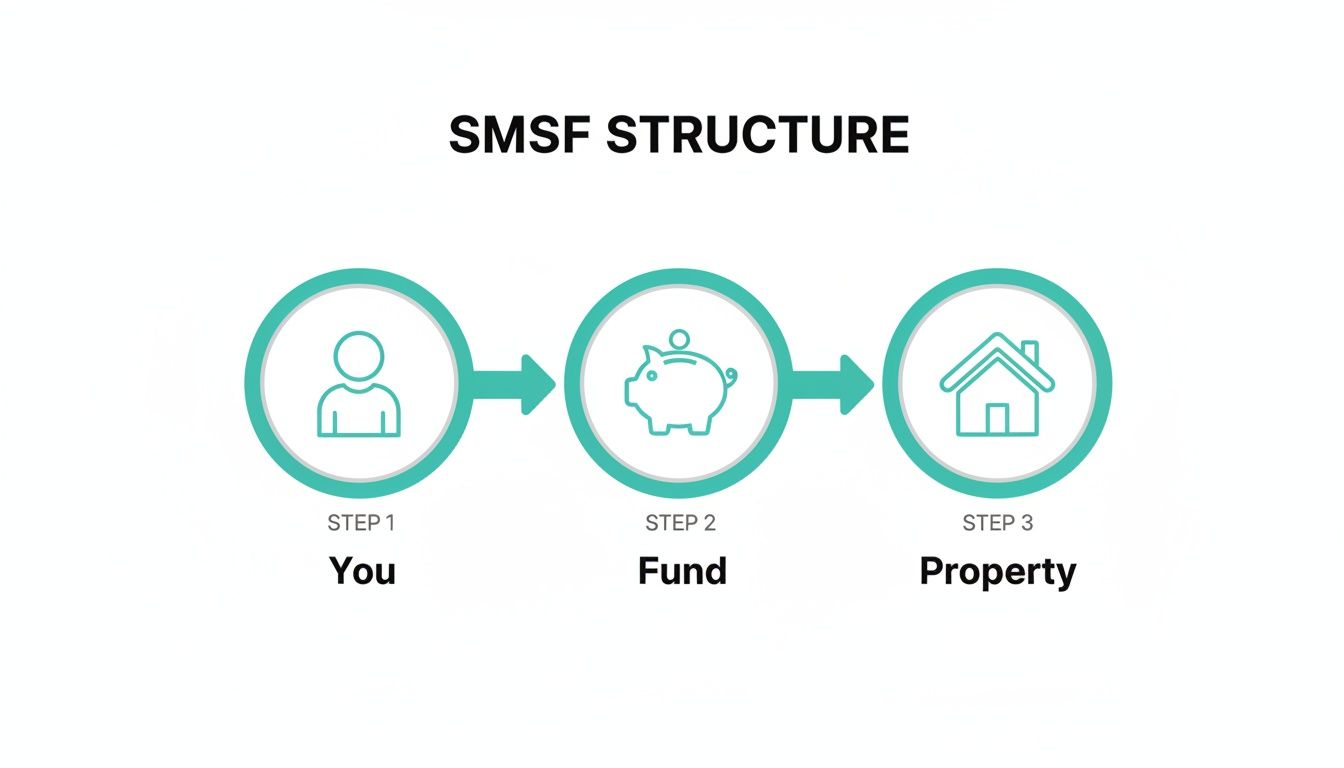
It shows how your contributions support the fund, potentially enabling it to purchase a significant asset like property and form a cornerstone of your investment strategy.
Understanding the Principle of 'Limited Recourse'
The most important aspect of an LRBA is the term ‘limited recourse’. This is the safety net. It means that if your SMSF were to default on the loan, the lender’s right to recovery is limited to the specific property acquired with that loan.
The lender has no claim—or recourse—on any of the other assets in your fund, such as shares, cash, or other investments. This legislative safeguard effectively quarantines the risk, separating your broader retirement savings from the property debt.
This protection often comes with stricter lending criteria from financial institutions. You may be required to provide a larger deposit, often in the range of 30-40% of the property’s value, and may find that interest rates are higher than those for a standard investment loan.
The Function of the Bare Trust
When an SMSF borrows to purchase a property, it cannot hold the legal title to that property directly while the loan is outstanding. This is where the bare trust is essential.
A bare trust is established as a separate legal entity for the sole purpose of holding the property title on behalf of your SMSF. Your SMSF is the ‘beneficial owner’—it receives all rental income and benefits from any capital growth—while the bare trust simply holds the legal title.
This structure is the foundation of a compliant LRBA. Once the loan is fully repaid, the legal title of the property can be transferred from the bare trust to the SMSF. For a deeper explanation of this entity, our guide explains in more detail what is a bare trust.
An LRBA is a precise mechanism, not a flexible line of credit. The arrangement must be carefully managed to ensure every action, from the initial purchase to the eventual loan repayment, adheres to the strict rules set by the ATO.
To clarify the components, here is a summary of the key features of an LRBA structure.
Key Features of an LRBA Structure
| Component | Role and Key Considerations |
|---|---|
| SMSF | The borrower and beneficial owner. It receives all income, pays all expenses, and makes loan repayments. |
| Lender | Provides the finance. This can be a commercial bank or a related party, but the loan terms must be strictly on a commercial basis. |
| Bare Trust | A separate legal entity that holds the legal title of the property on behalf of the SMSF until the loan is paid off. |
| Limited Recourse | The lender’s claim in a default is limited only to the asset held under the LRBA. Other SMSF assets are protected. |
| Single Asset Rule | The loan can only be used to purchase a single, acquirable asset (e.g., one property on a single title). |
This table highlights how specific the rules are. An error in any of these components could lead to serious compliance issues.
The 'Single Acquirable Asset' Rule
Another cornerstone of borrowing in super is the ‘single acquirable asset’ rule. The loan taken out under an LRBA can only be used to purchase a single asset.
For property, this typically means a property on a single title. You could not, for example, use one LRBA to purchase two separate apartments, even if they are in the same building.
The rules also restrict what you can do with the borrowed money after purchase. You cannot use it for improvements that fundamentally alter the property's character, such as adding another storey. While you can use loan funds for repairs and maintenance, any significant renovations must be paid for with other cash already in your SMSF, which adds another layer of financial planning.
Given these complexities, it may be helpful to understand the full spectrum of loans to invest in real estate to provide broader context. Navigating these arrangements requires a clear strategy from the outset.
Navigating Risks and Responsibilities
A prudent financial strategy involves a balanced view, weighing potential opportunities against the inherent risks. Using superannuation to invest in property is a significant undertaking, and a clear-eyed assessment of both sides of the ledger is the first step in being a responsible trustee. While this path may offer compelling advantages, it also comes with serious duties you are legally required to fulfil.
Opportunities may include using leverage through an LRBA to acquire a significant asset that might otherwise be out of reach. Over the long term, this property could experience capital growth within the tax-effective superannuation environment.
However, these opportunities are matched by equally significant responsibilities and financial risks that demand your full attention.
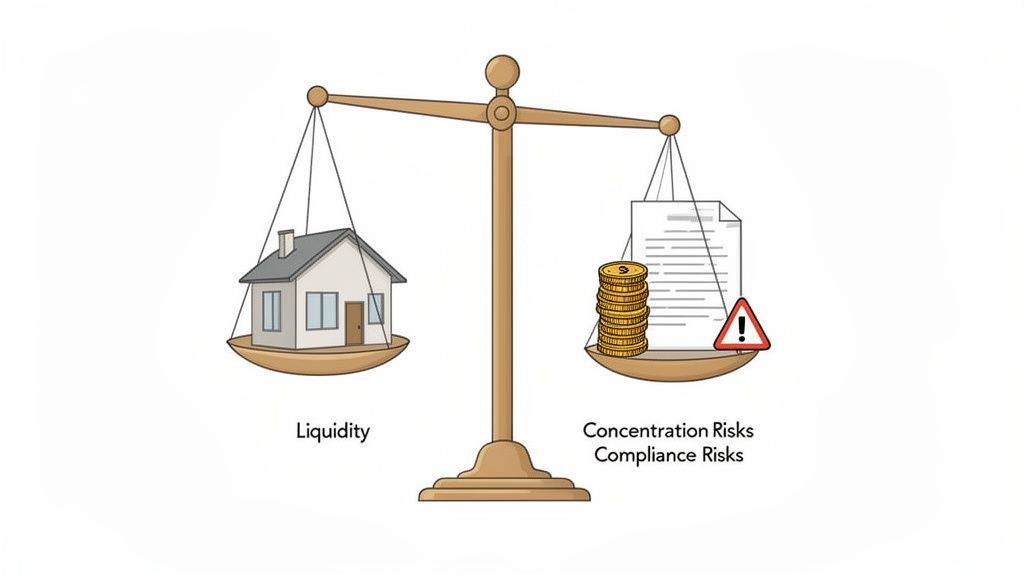
Key Risks to Consider
Embarking on property investment with your superannuation means being prepared for several specific challenges. Each requires foresight and a sound plan for management.
- Concentration Risk: This is a primary consideration. Allocating a large portion of your super balance into a single asset—one property—can leave your fund under-diversified. If the property market were to decline, it could have a disproportionate impact on your retirement savings.
- Liquidity Risk: Property is an illiquid asset; it cannot be sold quickly to raise cash. This can become a problem if your fund needs to pay a pension or cover an unexpected expense. You cannot sell a portion of the property to free up capital.
- Interest Rate Risk: If you have used an LRBA to borrow, your fund is exposed to interest rate movements. A rise in rates would mean higher loan repayments, putting pressure on your fund's cash flow and potentially requiring additional contributions.
Good stewardship is not about avoiding risk, but about understanding it, planning for it, and making thoughtful decisions that align with your fund's long-term objectives. It is a mindset built on patience and disciplined action.
The Administrative and Compliance Burden
Beyond the financial risks, the day-to-day administration of managing an SMSF with a property is significant. These are not passive investments; they demand your active involvement as a trustee. This includes arranging annual audits, lodging tax returns with the ATO, and keeping meticulous records for every transaction related to the property.
A robust due diligence process is essential before committing. Tools such as a comprehensive ultimate real estate due diligence checklist can provide a useful framework for this vital step.
Compliance is non-negotiable. The ATO has strict rules, and failure to comply can lead to severe penalties. Navigating these obligations is complex, and it is critical to understand the seriousness of non-compliance. It is a path that rewards diligent planning and thoughtful execution. Making an informed decision means having a complete picture of these responsibilities from the very start.
Practical Next Steps
Considering the use of superannuation to acquire property is a serious decision. It is a powerful but complex strategy that may be suited for individuals who have the financial capacity and discipline to manage it over the long term.
If this path appears to align with your long-term goals, the next steps you take are critical. This is not a process to be rushed. It is about taking a series of deliberate, measured actions to ensure you are prepared for the responsibilities involved.
Laying the Groundwork
The first logical step is to gain a clear picture of your financial position. This involves more than just checking your superannuation balance; it requires a complete and honest assessment of your entire situation.
Consider following this sequence:
- Assess your current superannuation. Review your statements to understand exactly what funds you have, how they are performing, and the fees you are paying. Is your balance sufficient to cover a property deposit, stamp duty, and legal costs, while still leaving an adequate buffer for diversification and liquidity?
- Evaluate your risk tolerance. How do you feel about having a large, illiquid asset within your retirement fund? This concentration of risk is a significant factor, and a frank self-assessment now may prevent stress later.
- Map out the financial commitment. It is important to model the ongoing costs, including loan repayments, insurance, rates, maintenance, and annual SMSF compliance and audit fees. Your fund must have a reliable cash flow to manage these expenses without strain.
Assembling Your Team of Experts
This is not a solo endeavour. Success in this area often depends on having a coordinated team of qualified professionals. Attempting to manage this alone may lead to costly mistakes.
For professionals, business owners, and families, getting the structure of the SMSF and the property purchase right from the outset is non-negotiable. Correcting compliance issues after the fact can be a difficult and expensive exercise. Our advisory services for professionals and business owners are designed to assist with navigating these complexities.
The soundest strategies are not built in haste. They are the product of patient, diligent planning. Using your superannuation to invest in property can be an effective way to build wealth, but that potential is best realised with a deep respect for the rules and a clear view of the long-term commitment it demands.
If you would like clarity on how these principles may apply to your own circumstances, the next step may be to speak with a qualified adviser who can provide context for your situation.
You can contact Everglow on 1300 913 929 or email contact@everglow.au to arrange a discussion.
General Advice Warning: The information provided in this article is general in nature and does not take into account your personal objectives, financial situation, or needs. You should seek personal financial, legal, and taxation advice before making any decisions based on this content.
