

Successful property investment strategies in Australia are built on a foundation of diligence and patience, not speculation. The most prudent approaches are those that balance long-term capital growth with steady rental income, all while aligning with your personal financial circumstances and life goals.
Building Your Foundation in Australian Property
Investing in property is a significant financial commitment—one that rewards careful planning over hasty decisions. The journey does not begin with property listings; it begins with understanding the fundamental principles that create wealth in this asset class. It demands a mindset of discipline, foresight, and a clear grasp of your responsibilities as an investor.
The Australian property landscape is shaped by regulatory bodies like the Australian Taxation Office (ATO) and the Australian Securities and Investments Commission (ASIC). The ATO sets the rules for tax on rental income and capital gains, while ASIC oversees financial services and consumer credit. Understanding their roles is a foundational step toward investing responsibly and ensuring compliance.
The Two Pillars of Property Returns
Every property investment strategy is a balance between two core objectives. A wise approach considers how to blend them to match your life stage and financial capacity.
- Capital Growth: This is the cornerstone of long-term wealth creation. It represents the increase in your property's value over time, realised when you eventually sell the asset.
- Rental Yield: This is the income your property generates, calculated as a percentage of its value. A strong yield provides the cash flow needed to cover the mortgage, council rates, and maintenance.
To illustrate, a young professional with a high personal income may adopt a strategy focused on capital growth, potentially using negative gearing to manage their tax obligations while the asset appreciates. Conversely, a business owner approaching retirement might seek a positively geared property that generates immediate, reliable income.
The key is to make a conscious choice based on your circumstances. A sound starting point is gaining a firm handle on your financial position and exploring how to structure your investments correctly.
Historical data shows the potential of the asset class. According to the Australian Bureau of Statistics, the total value of Australia's residential property market is substantial. You can review historical trends by visiting sources like the Australian property price history on globalpropertyguide.com.
Ultimately, your strategy is a personal blueprint. It must reflect your appetite for risk, your financial goals, and the time you can dedicate to managing a portfolio. A well-considered plan provides the clarity to make sound decisions through all market cycles.
Choosing the Right Investment Strategy for Your Goals
Your financial journey is unique, so your property investment strategy must be a direct reflection of your personal goals. There is no single "best" approach. Instead, Australia offers several established paths, each suited to different circumstances, risk tolerances, and financial objectives.
Understanding these differences is the first step toward making a calm, deliberate choice.
It typically begins with a fundamental question: are you aiming to build wealth over the long term through asset appreciation, or do you require a steady income stream to supplement your current earnings?
This flowchart offers a visual guide to help align your goals with a suitable strategy.
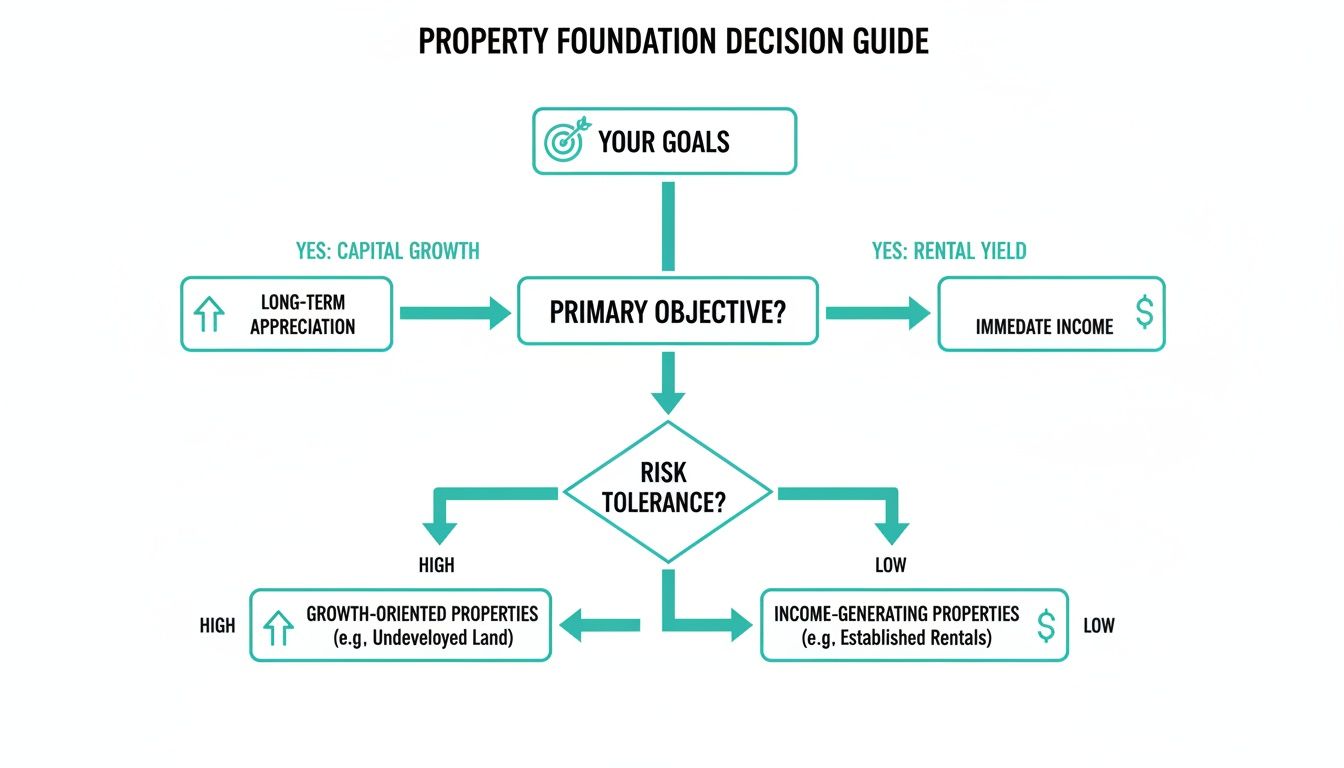
As shown, your primary financial driver—be it capital growth or rental yield—points you toward a specific strategic path. To help you understand these core approaches, here is a comparison.
Comparing Core Property Investment Strategies
This table breaks down the main strategies, the investors they typically suit, and the key financial and regulatory factors to consider.
| Strategy | Primary Goal | Typical Investor Profile | Key Considerations (Tax & Risk) |
|---|---|---|---|
| Negative Gearing | Long-Term Capital Growth | High-income earners (e.g., professionals, business owners) seeking to reduce taxable income. | Success depends on the property's value increasing. Involves a short-term cash flow deficit. Tax deductions for the net loss may be available under current ATO rules. |
| Positive Cash Flow | Immediate, Regular Income | Investors seeking an additional income stream to supplement earnings or build a self-sustaining portfolio. | Generates a net rental profit, which is considered taxable income. Less reliant on market-driven capital growth for viability. |
| Buy and Hold | Balanced Growth & Income | The patient, long-term investor focused on allowing the asset to appreciate over many years. | Underpins both gearing strategies. Success requires a long time horizon. Capital Gains Tax (CGT) is a major consideration upon sale. |
| Renovate and Sell (Flipping) | Short-Term Profit | Active, hands-on investors with expertise in renovation and project management. | High-risk, high-reward. Subject to market fluctuations, budget overruns, and significant CGT implications, often without the 12-month discount. |
Each strategy represents a different tool. The key is selecting the one that aligns with your financial situation and objectives.
Negative Gearing for Capital Growth
Negative gearing is a strategy often considered by individuals with a higher personal income, such as professionals or those earning Personal Services Income (PSI). It occurs when the costs of owning a property—mortgage interest, council rates, maintenance—exceed the rental income it generates.
Under current Australian Taxation Office (ATO) guidelines, this resulting net loss can, in some circumstances, be offset against other income, which may reduce an investor's overall tax liability.
The core principle is that the anticipated long-term capital growth of the property will outweigh the short-term holding costs. This approach requires patience and sufficient personal cash flow to cover the ongoing shortfall.
For instance, a medical specialist in Melbourne might purchase a well-located property where the rent does not fully cover the mortgage. The annual loss may be claimed at tax time, easing the cash flow pressure while the property potentially appreciates over a decade. Success is contingent on the asset growing in value; without capital growth, it is simply a cash flow negative investment.
Positive Cash Flow for Immediate Income
Conversely, a positive cash flow strategy focuses on generating immediate, regular income. In this scenario, the total rental income is greater than all the property's expenses, leaving a surplus.
This approach is often favoured by those looking to supplement current earnings, like small business owners or families desiring an additional income stream. It creates a self-sustaining asset from the outset.
A major benefit is the reduced reliance on market-driven capital growth for the investment to be viable. It is important to remember, however, that this net rental profit is considered taxable income by the ATO, so careful financial planning is essential. We recommend seeking tailored advice on Navigating Tax Obligations and Opportunities.
Other Common Property Investment Strategies
Beyond these two primary approaches, other strategies cater to different risk profiles and time horizons.
- Buy and Hold: This is the classic long-term approach, forming the foundation of both negative and positive gearing. It is a philosophy of patience, focused on letting the asset appreciate over many years while rental income helps to service the debt.
- Renovate and Sell (Flipping): This is a more active, short-term strategy. It involves acquiring an undervalued property, adding value through renovations, and selling it for a profit. This path carries higher risks, including budget overruns and market shifts, along with significant Capital Gains Tax (CGT) implications. The CGT discount generally does not apply to assets held for less than 12 months.
Choosing the right path requires a clear-eyed assessment of your finances, your long-term vision, and your capacity to manage the responsibilities each strategy entails. It is about building a foundation for steady, sustainable progress.
How to Structure and Finance Your Property Investment
While choosing a property is a significant step, how you own it and finance it is just as critical. These decisions form the foundation of your investment strategy, with long-term consequences for your tax position, asset protection, and estate planning.
Getting this right from the outset may save considerable expense and complication later. A suitable structure provides control and clarity, while the right finance offers the stability to navigate different economic seasons.
Choosing the Right Ownership Structure
The name on the title deed is more than a formality; it dictates how rental income is taxed and how well the property is shielded from personal or business liabilities. The best choice depends on your personal circumstances.
Common ownership structures in Australia include:
- Individual Name: The simplest structure. You own the property in your name, and all income and capital gains are taxed at your marginal rate.
- Joint Tenants: Common for couples. Both parties own the property equally, and if one owner passes away, their share automatically transfers to the survivor.
- Tenants in Common: Allows for unequal ownership shares (e.g., 60/40). Income and expenses are split accordingly, which can be a useful tool for tax planning.
- Trusts (Discretionary/Family): A trust holds the property for the benefit of beneficiaries. This can offer asset protection and flexibility in distributing income, helping to manage tax effectively under ATO rules.
- Company: Owning property through a company creates a clear separation between the asset and your personal finances. However, it is a more complex and often more costly structure to manage, with its own tax rules.
For business owners and professionals, separating investment assets from business risk is often a key consideration. In these cases, a trust or company structure may provide a vital layer of protection, but they must be established and maintained with professional guidance.
Investing Through Your Self-Managed Super Fund (SMSF)
Using a Self-Managed Super Fund (SMSF) to buy property has become a popular strategy. It allows you to use superannuation to invest directly in real estate, but this path is governed by strict, non-negotiable rules.
The cornerstone of SMSF compliance is the 'sole purpose test'. This means the fund must be maintained for the sole purpose of providing retirement benefits to its members. Every investment decision must satisfy this test, under the oversight of the ATO and ASIC.
Non-compliance can lead to severe penalties. For example, you or a related party cannot live in or rent a residential property owned by your SMSF. The rules around borrowing within an SMSF, known as a Limited Recourse Borrowing Arrangement (LRBA), are also highly specific and require precise execution.
Securing the Right Finance
Lenders today are focused on an investor's ability to service a loan. They will conduct a thorough assessment of your financial position before granting approval.
A key metric is the Loan to Value Ratio (LVR)—the loan amount as a percentage of the property's value. Most lenders prefer an LVR of 80% or less. Borrowing above this threshold typically requires Lenders Mortgage Insurance (LMI).
Well-prepared investors continue to find opportunities to secure finance. Recent data from bodies like the Australian Bureau of Statistics often shows a continued appetite for investment loans. You can review the latest housing data from the Australian Bureau of Statistics to understand current trends.
Understanding lending criteria and presenting your finances clearly is crucial. A qualified mortgage broker can be a valuable ally, helping you navigate loan products to find one that fits your long-term vision. Our guide explains how to choose a mortgage broker who can support you.
Your structure and finance are the bedrock of your investment. Taking the time to build this foundation correctly is an act of financial stewardship that can pay dividends for years to come.
Mastering Market Selection and Due Diligence

The most prudent property investments are built on a foundation of diligent, methodical research, not market hype. A seasoned investor learns to look past headlines and focus instead on the underlying drivers of long-term value. This disciplined approach is what separates sustainable wealth creation from speculation.
The goal is to identify locations with strong, enduring demand. This demand is fuelled by tangible economic and social factors that can be measured and assessed. Success comes from understanding these fundamentals, not from attempting to time the market.
Identifying Fundamental Growth Drivers
Before reviewing property listings, your focus should be on the bigger picture. A desirable location is one where people want to live and work, not just today but for years to come.
Key indicators to analyse include:
- Population Growth: Consistent and diverse population growth is a primary engine of demand. For a new migrant family, access to good schools and community networks in suburbs like Chatswood in Sydney or Box Hill in Melbourne may create sustained demand for housing.
- Infrastructure Investment: Look for significant government and private sector projects. New transport links, hospital upgrades, or technology hubs create jobs and improve liveability, which in turn supports property values. The Inland Rail project, for example, is reshaping the economic prospects of many regional centres along its route.
- Employment Hubs: A diverse and growing local economy is vital. A town reliant on a single industry is far riskier than a city with strong health, education, and professional services sectors.
These elements create a resilient economic ecosystem that can better withstand market cycles. This forms the bedrock of a sound Australian property investment strategy.
The Critical Steps of Due Diligence
Once you have identified a promising market, your focus must narrow to the specific property. This is the due diligence phase—a non-negotiable process of verification. Its purpose is to uncover hidden issues that could turn a promising asset into a financial burden.
Due diligence is an exercise in prudence. It is your responsibility to verify every detail, ensuring the asset you acquire is what it appears to be. This protects your capital and provides peace of mind.
Your due diligence checklist should always include these steps:
- Professional Building and Pest Inspection: This is essential. A qualified inspector can identify structural defects, termite damage, or other costly problems invisible to the untrained eye.
- Thorough Strata Report Review: If you are considering an apartment or townhouse, the strata report is a window into the building's financial health and management. Look for a healthy sinking fund, check for planned major works, and scan for any history of disputes.
- Legal Review of the Contract of Sale: Your solicitor or conveyancer must meticulously review the contract. They will check for unusual clauses, verify title details, and ensure all legal obligations are clear before you sign.
This process is about confirming facts and managing risk. It demands patience and attention to detail—the very qualities that define a successful investor. Understanding this process is vital, which is why we guide clients through the practical steps of managing your investment property.
Navigating Tax Obligations and Opportunities
When you invest in Australian property, you enter into a relationship with the Australian Taxation Office (ATO). While it is easy to view tax as merely a cost, a more prudent approach is to see it as a clear set of rules. Understanding these rules allows you to manage your obligations effectively.
This comes down to diligent record-keeping and a clear grasp of both your duties and your entitlements.
Every dollar of rental income must be declared on your annual tax return. However, the ATO also allows you to claim deductions for many expenses incurred in generating that income. This is where strategic management begins.
Claiming Legitimate Expenses
For an expense to be deductible, it must be directly related to managing and maintaining your investment property. You can only claim deductions for periods when the property was genuinely available for rent.
Common deductible expenses include:
- Loan Interest: The interest component of your mortgage repayments is often the largest single deduction.
- Management Costs: This covers property manager fees, leasing costs, and advertising for tenants.
- Council and Water Rates: These standard holding costs are generally deductible.
- Repairs and Maintenance: Fixing a leaking tap or replacing a storm-damaged fence are examples of repairs. These costs are usually deductible in the financial year they are paid.
It is crucial to distinguish between a repair (which restores something to its original condition) and an improvement (which enhances the asset). An improvement, such as a full kitchen renovation, is treated as a capital expense by the ATO and is typically claimed over several years as depreciation.
Understanding Depreciation and Capital Works
Depreciation is a significant "non-cash deduction" available to property investors, meaning you do not have to spend money during the year to claim it.
It is an allowance for the natural wear and tear on a building’s structure (capital works) and the assets within it (plant and equipment), such as carpets, ovens, and blinds.
To claim these deductions correctly and maximise your position, a tax depreciation schedule is essential. This one-off report, prepared by a qualified quantity surveyor, outlines all claimable items for the life of the property and can result in substantial tax savings over many years.
Managing Capital Gains Tax
When you eventually sell your investment property, you will need to account for Capital Gains Tax (CGT). This tax applies to the profit—the difference between the sale price and the property's ‘cost base’ (which includes the purchase price plus other associated costs).
The ATO offers a significant incentive for long-term investors. If you hold an asset for more than 12 months, you may be eligible for a 50% CGT discount as an individual investor. This means tax is only payable on half of the capital gain.
This rule provides a powerful reason to adopt a patient, 'buy and hold' strategy. Navigating the nuances of CGT is critical, which is why we break it down further in our guide to capital gains tax strategies in Australia.
Ultimately, effective tax management comes down to discipline. Keep organised records, seek professional advice when needed, and you can meet your obligations with confidence while ensuring your investment is working as efficiently as possible.
Building a Resilient Portfolio and Managing Risk

Long-term success in property investing is not about avoiding risk, but about understanding and managing it with quiet confidence. A resilient portfolio is built to withstand inevitable financial seasons—market swings, interest rate cycles, and unexpected vacancies. The goal is steady, sustainable growth, grounded in disciplined action.
Costly mistakes often stem from emotional decisions driven by market noise. A prudent investor, however, focuses on controlling what is within their power. This begins with preparing for the key risks in Australian property, providing the fortitude to stay the course.
Fortifying Your Financial Position
Your first line of defence is a solid financial buffer. This is not simply spare cash; it is a dedicated reserve set aside to absorb unexpected costs without causing financial stress. Think of it as a shock absorber for your investment journey.
Common challenges to anticipate include:
- Interest Rate Changes: A variable rate loan is exposed to market movements. You should model how your repayments would change if rates were to rise, ensuring you could comfortably manage the increase.
- Tenant Vacancies: No property is tenanted 100% of the time. Prudent budgeting means factoring in potential vacant periods so you can continue to cover holding costs.
- Unexpected Repairs: A burst hot water system or a storm-damaged roof can occur without warning. A financial buffer turns these necessary expenses from a crisis into a manageable event.
A well-structured portfolio is built on foresight. By anticipating challenges like rate rises and maintenance costs, you transform potential crises into manageable events, protecting both your asset and your peace of mind.
Practical Risk Management Techniques
Beyond a cash reserve, several practical steps can add security to your portfolio. One powerful tool is landlord insurance. This specialised cover can protect against tenant-related risks like malicious damage or loss of rent, providing a crucial safety net.
Another prudent step is to consider fixed-rate loans for a portion of your debt. Fixing your interest rate provides certainty over repayments for a set period. This insulates you from short-term market volatility and makes cash flow more predictable—a common tactic for investors who value stability.
Diversification also plays a vital role. Holding properties in different locations or of different types—for instance, a mix of city apartments and regional houses—can reduce your exposure to a downturn in a single market. This approach spreads risk, ensuring your portfolio’s performance is not tied to one set of economic circumstances. It is a key part of learning how to structure your investments correctly for the long term.
By embracing these disciplined measures, you shift from being a reactive owner to a proactive steward of your assets. You begin building a portfolio designed not just for growth, but for endurance.
A Final Word on Your Property Journey
Building wealth through property is a long-term endeavour, not a race. The journey is defined by patient, disciplined action grounded in sound research and a clear understanding of your financial capacity.
The various property investment strategies Australia offers are tools. Their effectiveness depends entirely on how they are applied to your personal circumstances. By focusing on quality assets, managing risk diligently, and maintaining a long-term perspective, you can build a portfolio that serves your future. This path demands patience and a commitment to making decisions based on careful analysis, not market noise.
Your greatest asset on this journey is not a single property, but knowledge. Continue to learn, ask pertinent questions, and seek professional guidance tailored to your situation. This is the surest way to ensure your decisions are both confident and compliant.
This commitment to careful planning is what transforms a property purchase into a cornerstone of lasting financial security.
General Advice Warning
The information provided in this article is general in nature and has been prepared without taking into account your personal objectives, financial situation, or needs. It does not constitute personal financial advice. Before acting on any information, you should consider its appropriateness in light of your own objectives, financial situation, and needs, and seek independent professional advice.
At Everglow Prosperity, we provide integrated financial guidance to help you build a resilient and prosperous future. Contact us to discuss your financial goals.
Want help applying this to your situation?
Every situation is different. Book a time with our team to talk it through, or call us on 1300 913 929.
Book a meetingProperty finance and tax guide →See our fees →