

Receiving a notice from the Australian Taxation Office (ATO) regarding an overdue tax return can be unsettling. However, for busy professionals, growing businesses, and new migrants navigating a complex system, administrative deadlines can sometimes be missed. It is a common occurrence.
When a tax return is significantly late, the ATO may issue a Failure to Lodge (FTL) penalty. It may be helpful to view this not as a personal reprimand, but as an automated part of the tax administration system designed to encourage timely lodgement. Understanding how this process works is the first step toward managing the situation with quiet confidence.
The ATO’s Perspective on Late Tax Returns
The penalty framework is a standard component of Australia's tax system, intended to ensure fairness and functionality for all taxpayers. Its purpose is to encourage voluntary compliance. The FTL penalty is a tool the ATO may use to prompt action when lodgements are overdue. With a clear understanding of the process, it becomes a manageable issue.
The ATO's preference is generally for taxpayers to lodge their returns voluntarily. An FTL penalty may be applied to prompt action when obligations are not met on time. It is a situation that can be methodically addressed.
To gain a comprehensive view, it may be beneficial to be aware of broader compliance topics. The penalty itself is calculated using 'penalty units'. The ATO may apply one penalty unit for every 28-day block that a return is overdue, up to a maximum of five units.
It is also important to distinguish between an FTL penalty and a General Interest Charge (GIC), as they are separate matters.
- FTL Penalty: This is a charge that may be applied for not lodging a return by its due date.
- GIC: This is compounding interest that may be charged on an unpaid tax liability.
Familiarity with the specific tax return deadlines in Australia is fundamental to maintaining compliance. Ultimately, the ATO’s process is structured and predictable. With the right information, you may be able to take measured steps to resolve any overdue lodgements and protect your compliance record.
How the Failure to Lodge Penalty Is Calculated
When a Failure to Lodge (FTL) penalty notice arrives from the Australian Taxation Office (ATO), it may seem arbitrary. However, the calculation follows a clear and structured method based on a system of penalty units.
A penalty unit is a standard measure for certain fines, and its dollar value is set by the government and periodically updated. The calculation begins from the day your tax return becomes overdue. For each 28-day period (or part thereof) that your lodgement is late, the ATO may apply one penalty unit, continuing up to a maximum of five units.
The Role of Entity Size in Penalty Calculation
The final penalty amount may also be influenced by the size of the entity. The ATO classifies entities into three tiers—small, medium, and large—based on factors such as turnover or assessable income.
This tiered system means the base penalty may be multiplied, which can have a significant financial impact as a business grows. This approach reflects the ATO's position that larger organisations generally have greater resources and, therefore, a greater responsibility to meet their compliance obligations.
- Small entities (with an aggregated turnover or assessable income under $1 million) are subject to the standard, unmultiplied penalty rate.
- Medium entities (with turnover between $1 million and $20 million) may have their penalty doubled.
- Large entities (with turnover over $20 million) may see their penalty multiplied by five.
The financial consequences can escalate quickly. For a small entity, the fine may be one penalty unit for each 28-day block, capped at five units. For a medium business, that penalty may be doubled. Large businesses could face a multiplier of five. You may wish to learn more about how a late tax return fine is applied in different circumstances.
This table breaks down how penalties could escalate depending on entity size.
ATO Failure to Lodge Penalty Calculation by Entity Size
This table illustrates how the Failure to Lodge (FTL) penalty may escalate based on the size of the entity and the number of days the tax return is overdue. The penalty unit value is assumed to be $330.
| Days Overdue | Penalty Units | Small Entity Penalty (Under $1M Turnover) | Medium Entity Penalty ($1M – $20M Turnover) | Large Entity Penalty (Over $20M Turnover) |
|---|---|---|---|---|
| 1-28 days | 1 | $330 | $660 | $1,650 |
| 29-56 days | 2 | $660 | $1,320 | $3,300 |
| 57-84 days | 3 | $990 | $1,980 | $4,950 |
| 85-112 days | 4 | $1,320 | $2,640 | $6,600 |
| 113+ days | 5 (Max) | $1,650 | $3,300 | $8,250 |
As shown, the financial implications of a late lodgement are often directly tied to an entity's scale.
Distinguishing Between Penalties and Interest
It is important to understand that an FTL penalty is entirely separate from the General Interest Charge (GIC). They are two distinct charges, though they may appear on the same notice.
The FTL penalty relates to the administrative failure to lodge on time. The GIC, on the other hand, is compounding interest charged on an outstanding tax debt.
This means an FTL penalty could be applied even if the ATO owes you a refund. The penalty concerns the missed deadline, not the tax liability. Conversely, the GIC only applies when tax is owed to the ATO. If a return is lodged late and there is a tax bill to pay, both charges could be applied.
This flowchart shows how an initial ATO notice can lead down two separate paths for FTL penalties and GIC.
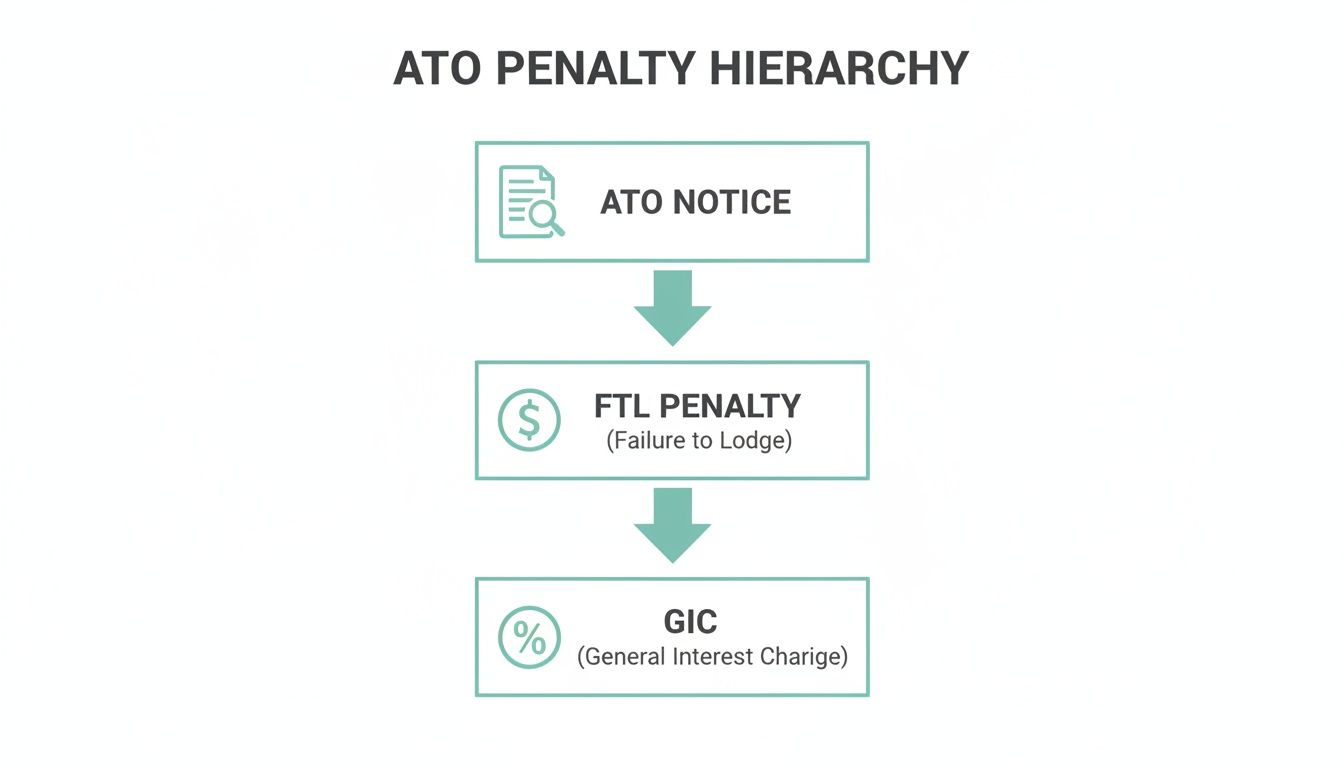
Understanding these components—the penalty unit, the size multiplier, and the separate nature of GIC—can provide clarity. It allows for a precise assessment of the financial situation and helps in forming clear, effective steps toward resolution.
Real-World Scenarios of Late Lodgement Penalties
Tax rules can seem abstract until their practical application is observed. The Australian Taxation Office's (ATO) penalty system is generally predictable. Once its practical workings are understood, much of the anxiety associated with an overdue tax return can be alleviated.
Let's explore a few common situations faced by Australian professionals and business owners. These examples are intended not to cause alarm, but to build a practical understanding of how penalties may be applied.
A Medical Specialist with PSI
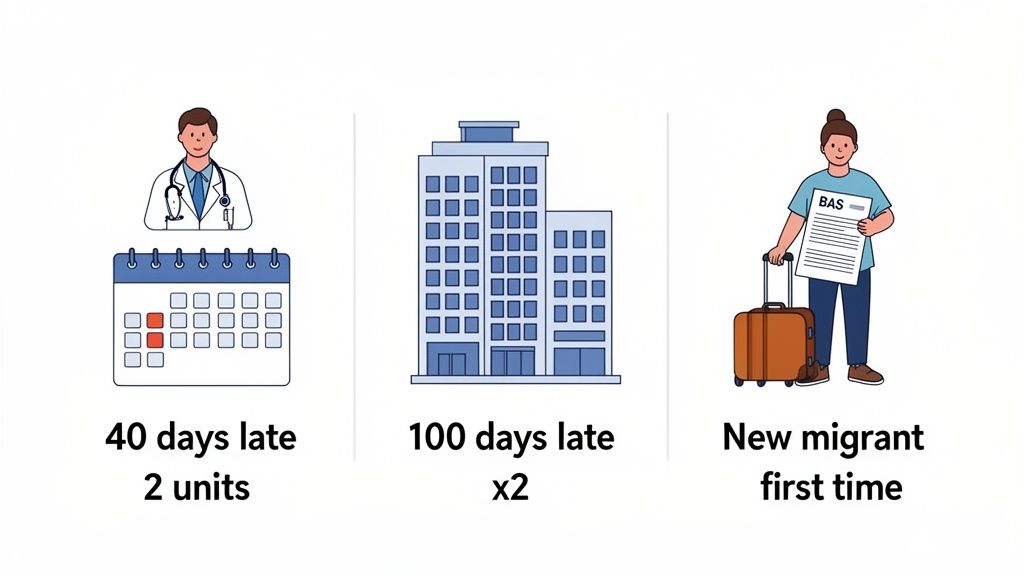
Consider a General Practitioner in Melbourne operating as a sole trader and earning Personal Services Income (PSI). Between managing a busy practice and family commitments, she lodges her individual tax return 40 days late.
Because her turnover is under $1 million, the ATO classifies her as a small entity. A 40-day delay places her in the second 28-day penalty block (days 29-56).
- Penalty Units Applied: Two units.
- Calculation: 2 units x $330 per unit = $660.
While the calculation is straightforward, even a relatively short delay may result in a tangible penalty. Crucially, the Failure to Lodge (FTL) penalty can be applied even if she was due a refund. The charge relates to the act of lodging late, not whether tax is owed.
A Growing Property Development SME
Now, let's consider a Brisbane-based property development company with an annual turnover of $4.5 million, placing it in the medium entity category.
Due to complex project completions, the company tax return is lodged 100 days late. This delay spans four 28-day periods, meaning four penalty units could be applied.
A key principle is that the penalty often scales with the size of the entity. The ATO's position is that larger businesses may have greater resources and, therefore, a greater responsibility for timely compliance.
Here is how the penalty might be calculated for a medium-sized business:
- Base Penalty: 4 units x $330 per unit = $1,320.
- Medium Entity Multiplier: This base amount may then be multiplied by two.
- Total FTL Penalty: $1,320 x 2 = $2,640.
In addition, if the late return revealed a tax liability of, for example, $80,000, the General Interest Charge (GIC) would begin to accrue from the original due date. This illustrates how a single delay can lead to multiple, compounding costs. Disciplined administration is vital, and property investors may find value in exploring broader strategies for managing an investment property.
A New Migrant Business Owner
Finally, consider a skilled migrant who has recently launched a consulting business in Sydney. As he is still familiarising himself with the Australian tax system, he lodges his first Business Activity Statement (BAS) 20 days late.
As a new small business owner, he is classified as a small entity. The 20-day delay means he is one 28-day period overdue.
- Penalty Units Applied: One unit.
- Calculation: 1 unit x $330 per unit = $330.
While this is the smallest penalty, it serves as an important lesson. Navigating Australian tax law can be a learning process for new arrivals. The ATO may show leniency for a first-time oversight, particularly if there is a clean compliance record and proactive communication. However, this is not guaranteed.
The system is designed to encourage all taxpayers to lodge on time. These scenarios demonstrate that the overdue tax return penalty framework is structured and predictable. By understanding how entity size and the length of the delay fit into the calculation, it becomes clear why meeting lodgement deadlines is a cornerstone of sound financial management.
If you would like clarity on how these principles may apply to your own circumstances, you may wish to speak with a qualified adviser. You can contact Everglow on 1300 913 929 or email contact@everglow.au to arrange a discussion.
General Advice Warning: The information provided in this article is general in nature and does not take into account your personal objectives, financial situation, or needs. Before acting on any information, you should consider the appropriateness of the information having regard to your own objectives, financial situation, and needs and seek personal advice from a qualified financial adviser.
A Practical Roadmap for Managing an Overdue Return
The realisation that a tax return is overdue is an experience many people share. While it can feel overwhelming, the situation can be managed with a calm, methodical approach. The key is to shift from reacting to the problem to taking thoughtful, disciplined action. By following a clear roadmap, you can work toward a positive resolution with the Australian Taxation Office (ATO).
The objective is not to find a quick fix, but to take steady, deliberate steps that demonstrate a commitment to meeting your responsibilities and restoring good standing.
The First Step: Lodge Immediately
The single most critical action is to lodge all outstanding returns as soon as possible. The Failure to Lodge (FTL) penalty is calculated in 28-day blocks, and each passing day brings the risk of the penalty increasing. Lodging immediately stops the penalty from escalating further.
Delaying may compound the problem, potentially increasing the total overdue tax return penalty and prolonging the period of uncertainty. When you lodge, you provide the ATO with the necessary information to finalise your account, which is the essential first step toward resolving the matter.
Review and Understand the Assessment
Once you have lodged, the ATO will issue a Notice of Assessment. This document serves as a guide to your current situation. It will typically set out:
- Your taxable income and tax liability for the relevant year.
- Any FTL penalty that has been applied.
- Any General Interest Charge (GIC) if a tax debt has arisen.
- The final amount you either owe or will be refunded.
It is advisable to review this notice carefully. Understanding each component provides a full financial picture and allows you to plan your next steps with clarity. If anything is unclear, seeking professional advice at this stage may be appropriate to ensure you have a complete understanding of your position.
Exploring Penalty Remission
After lodging, you may have the option to request that the ATO reduce or cancel the penalty. This is known as requesting a remission. The ATO considers these requests on a case-by-case basis, and a successful outcome is never guaranteed.
A request for remission may be more likely to be considered favourably if you have a strong compliance history and can demonstrate that circumstances beyond your control led to the late lodgement.
The ATO may take into account factors such as:
- Exceptional or Unforeseen Events: Circumstances like a natural disaster, a serious illness, or the death of a close family member may be considered valid reasons.
- Good Compliance History: If you have consistently lodged and paid on time in the past, the ATO may be more inclined to show leniency for a one-off delay.
- Action Taken to Rectify: By lodging the return and demonstrating proactive steps to prevent recurrence, you show good faith.
A remission request should be made in writing, clearly explaining your circumstances and providing any available supporting documents. An honest, well-reasoned explanation is a sound approach. Staying informed of the relevant Australian tax due dates is a key part of maintaining a good compliance history for the future.
Managing Any Resulting Tax Debt
If lodging the return results in a tax debt that you cannot pay immediately, it is vital to contact the ATO. Ignoring a debt may lead to further interest charges and potentially more serious collection action.
The ATO offers payment plans for individuals and businesses facing financial difficulty. You can propose a plan to pay off the debt in manageable instalments over an agreed period. This demonstrates your commitment to meeting your obligations and can prevent the ATO from taking more severe measures, such as issuing a garnishee notice.
By taking these measured steps—lodging, reviewing, requesting remission where appropriate, and arranging a payment plan if needed—you can transform a stressful situation into a manageable process. It is a matter of patience and disciplined financial stewardship.
If you would like clarity on how these principles may apply to your own circumstances, you may wish to speak with a qualified adviser. You can contact Everglow on 1300 913 929 or email contact@everglow.au to arrange a discussion.
General Advice Warning: The information provided in this article is general in nature and does not take into account your personal objectives, financial situation, or needs. Before acting on any information, you should consider the appropriateness of the information having regard to your own objectives, financial situation, and needs and seek personal advice from a qualified financial adviser.
The Broader Impact of a Poor Compliance History
An overdue tax return penalty from the Australian Taxation Office (ATO) can be more than a one-off financial cost. It may cast a shadow over your financial affairs, influencing how lenders, government agencies, and potential business partners perceive your reliability. Good financial stewardship involves recognising that a clean, consistent compliance history is a valuable asset.
Beyond the initial fine, a pattern of late lodgements can trigger wider, often unseen, consequences. These ripple effects may quietly limit your ability to build wealth, secure funding, or act on opportunities as they arise.
How a Poor Record Can Affect You
A history of falling behind with tax obligations can become a significant obstacle at critical financial moments. Lenders, for example, often use tax compliance records as a measure of financial discipline.
- Credit Assessments: When applying for a home or business loan, lenders will almost always request evidence of up-to-date tax lodgements. A history of late returns or outstanding tax debts may be interpreted as a sign of financial instability, potentially impacting your borrowing capacity or leading to a higher interest rate.
- Government Grants and Tenders: Eligibility for many government grants and contracts can be contingent on having a clean compliance record. A history of late lodgements could render a business ineligible for support or contracts that might otherwise foster its growth.
A strong compliance history is a foundational element of a resilient long-term financial strategy. It signals reliability and foresight—qualities that lenders, investors, and regulatory bodies value.
Escalating Consequences for Directors and Entities
For business owners and company directors, the responsibilities are even greater, and the consequences of poor compliance can escalate.
The ATO has several tools to enforce compliance that can have a profound impact. For instance, if a company persistently fails to meet its pay-as-you-go (PAYG) withholding or superannuation guarantee obligations, the ATO can issue a Director Penalty Notice (DPN). This may make a director personally liable for the company's tax debt.
Furthermore, if a return is significantly overdue, the ATO has the power to issue a default assessment. This means the ATO will estimate your tax liability based on the data it holds, which may result in a higher tax bill and more substantial penalties than if you had lodged the return yourself. For directors, understanding the full scope of ATO compliance, including complex topics like the promoter penalty laws, is critical.
Navigating these potential challenges requires a proactive stance. Viewing tax compliance not as a chore but as an integral part of your financial health is a perspective that can yield benefits over time. It reinforces stability, opens doors to opportunities, and helps protect you and your business from unnecessary financial and reputational harm.
If you would like clarity on how these principles may apply to your own circumstances, you may wish to speak with a qualified adviser. You can contact Everglow on 1300 913 929 or email contact@everglow.au to arrange a discussion.
General Advice Warning: The information provided in this article is general in nature and does not take into account your personal objectives, financial situation, or needs. Before acting on any information, you should consider the appropriateness of the information having regard to your own objectives, financial situation, and needs and seek personal advice from a qualified financial adviser.
What To Do Next
Facing an overdue tax return penalty can be a daunting prospect, but it is a manageable situation. The Australian Taxation Office has a clear and predictable system in place, designed primarily to encourage compliance rather than to impose undue financial strain. By understanding the process, you can approach it with confidence and work toward restoring your good standing.
The path forward is built on taking prompt, responsible action. It begins with understanding your obligations and then taking clear steps to meet them. It is an opportunity to acknowledge the responsibility and return to a solid financial footing.
First Principles for Getting Back on Track
Ultimately, dealing with a late lodgement involves a few key actions. Taking these steps can prevent further penalties from accruing and demonstrate to the ATO your commitment to rectifying the situation.
- Lodge Now: This is the most critical step. Lodging all outstanding returns immediately stops the penalty clock and is the first concrete move toward resolving the issue.
- Know How It's Calculated: Understand that the overdue tax return penalty is not arbitrary. It is calculated using set penalty units, the number of 28-day periods overdue, and a size multiplier based on your entity type.
- Ask for Remission: Remember that it may be possible to have the penalty reduced or cancelled. If you have a good compliance history and can show a valid reason for the delay, such as an unforeseen event, the ATO may grant a remission.
Your compliance history is more than just a record with the tax office; it is a reflection of your financial discipline and can impact everything from loan applications to your eligibility for government grants.
Taking Practical, Sensible Steps
If you are feeling uncertain, seeking clarity is a prudent course of action. Being proactive is generally preferable to waiting for the situation to evolve. If you require assistance navigating your obligations, professional Tax and Accounting Services can provide guidance tailored to your specific situation.
For further insight into how the system operates, it may be helpful to review resources on Understanding the ATO's Stance on Late Tax Returns. Taking the time to understand the rules is a key part of sound financial management. The immediate goal is to move from a position of uncertainty to one of control.
If you would like clarity on how these principles may apply to your own circumstances, you may wish to speak with a qualified adviser. You can contact Everglow to arrange a discussion.
General Advice Warning: The information provided in this article is general in nature and does not take into account your personal objectives, financial situation, or needs. Before acting on any information, you should consider the appropriateness of the information having regard to your own objectives, financial situation, and needs and seek personal advice from a qualified financial adviser.
Want help applying this to your situation?
Every situation is different. Book a time with our team to talk it through, or call us on 1300 913 929.
Book a free meetingAustralian tax guide →Estimate your fees →
Keep exploring