
When navigating the landscape of Australian property and tax, one guiding principle stands above all others: the purpose of your loan determines its tax treatment. This foundational concept, established by the Australian Taxation Office (ATO), is the key to understanding your obligations and opportunities.
If you have borrowed funds to acquire the home you live in, the interest is a private expense and cannot be claimed. However, if the loan is for an investment property that is intended to generate income, the character of that interest expense changes entirely.
The Core Distinction: Your Home vs. Your Investment
In Australian tax law, a clear line separates your principal place of residence from an investment property. Grasping this distinction is the cornerstone of correctly claiming mortgage interest. Once this is understood, other details tend to fall into place.
Consider the home you and your family live in. The ATO views any costs associated with it, including your mortgage interest, as a personal or domestic expense. It belongs in the same category as your household bills or transport costs. Because these outlays are not incurred in the process of earning assessable income, the interest on your home loan is not tax-deductible.
The situation is quite different when you take out a loan to purchase a rental property.
Now, the loan is being used to acquire an income-producing asset. The interest you pay is no longer a private expense; it is a cost incurred in generating rental income. This change in purpose is what may allow the interest payments to become tax-deductible.
To illustrate this clearly, consider this comparison:
Interest Deductibility: Owner-Occupier vs Investment Property
| Scenario | Owner-Occupied Property (Your Home) | Investment Property (Rental) |
|---|---|---|
| Loan Purpose | To purchase a primary residence for personal use. | To purchase a property to generate rental income. |
| ATO View | A private or domestic expense. | A business or investment expense. |
| Interest Deductibility | No, interest is not tax-deductible. | Yes, interest is generally tax-deductible against rental income. |
| Example | You pay interest on the mortgage for the house you live in. | You pay interest on a loan for an apartment you rent out to tenants. |
This table summarises the core rule. The tax treatment follows the property's function—is it a home for your family, or an asset held for investment?
As an investor, you are essentially operating a small enterprise. The ATO recognises that, like any business, there are legitimate costs involved in earning your income. The interest on your loan is often one of the most significant. As a homeowner, your loan facilitates your personal life.
"The loan's purpose is everything. It is the compass that directs whether your interest payments are a private cost you bear or a potential deduction that can support your investment journey."
It is important to note that Australia's approach differs from that of some other countries. For example, unlike in the United States, Australian homeowners do not receive a tax deduction for their home loan interest. This treatment is reserved for property investors. ATO data from the 2020-21 financial year confirms that deductions for rental interest were only available for income-producing properties. For a deeper dive into how tax systems compare globally, Experian.com.au offers some useful insights.
Establishing this fundamental understanding from the outset is a critical step in responsible financial stewardship. It helps ensure your decisions align with Australian tax law, mitigating compliance risks while allowing you to build your investment strategy with quiet confidence.
How to Calculate the Deductible Interest on Your Investment Loan
Once you have confirmed your loan’s purpose is for investment, the next practical step is to determine precisely how much interest you may be able to claim.
It is a common misconception that the total interest paid on an investment loan is always fully deductible. The reality can be more nuanced, and the ATO requires accurate calculations.
The Apportionment Rule Explained
The key principle here is apportionment. The Australian Taxation Office (ATO) is clear on this matter: you can only claim the portion of your mortgage interest that is directly attributable to generating assessable income.
This is particularly relevant if a single loan has been used for multiple purposes. You cannot claim interest on any portion of a loan that was used for private expenses. This might include purchasing a car for personal use, funding a holiday, or consolidating personal debts.
This is why disciplined record-keeping is not merely good practice, but an essential obligation. To correctly calculate your deductible interest, you must maintain a clear and logical paper trail that connects the borrowed funds directly to the income-producing asset.
The flowchart below outlines this decision path, from loan origination to the final tax outcome.
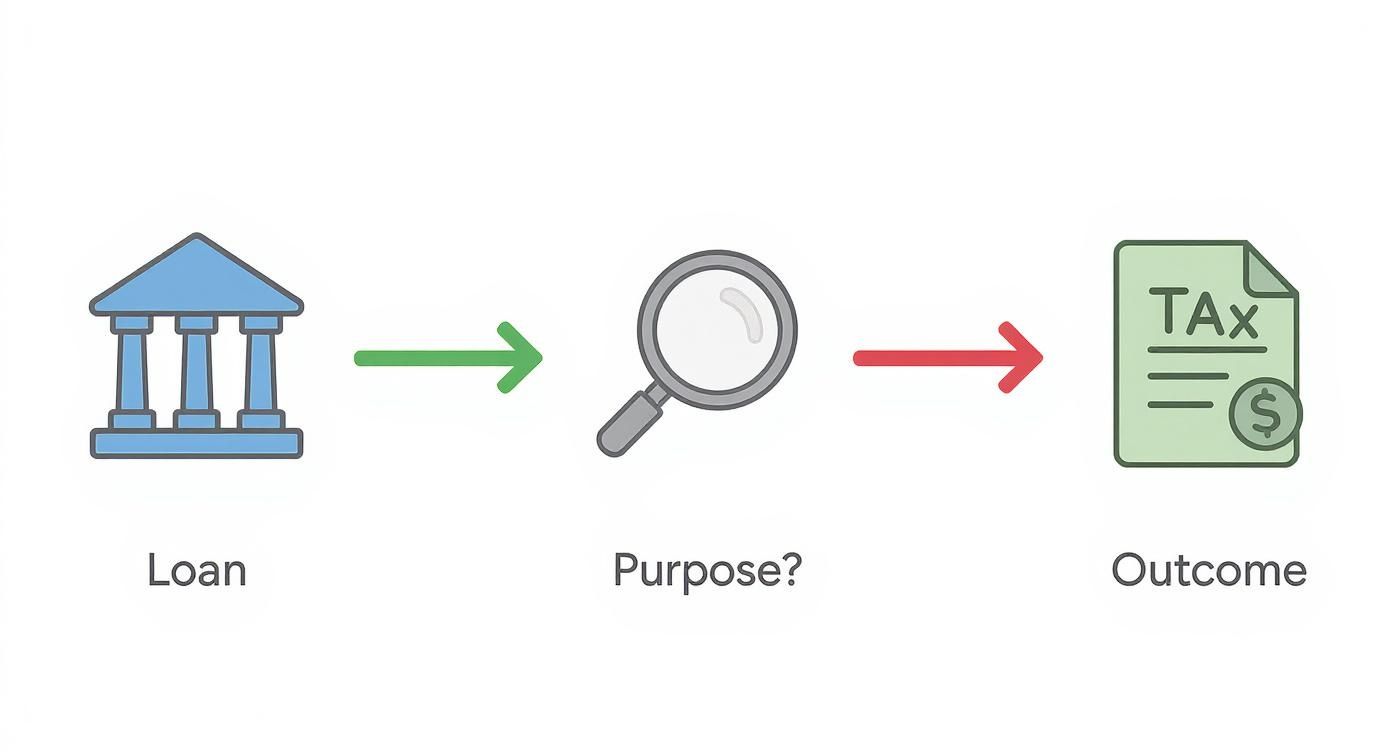
As shown, the loan's original purpose is the determinant of its tax treatment. This reinforces the need for clear financial separation and precise calculations.
A Real-World Example of Apportionment
Let's consider a common scenario for an Australian professional.
Meet Dr. Anya, a Brisbane-based medical specialist earning Personal Services Income (PSI). She has a loan on her family home but decides to refinance, drawing on the equity to purchase an investment apartment.
Here are the figures:
- Original Home Loan Balance: $400,000
- New Refinanced Loan Amount: $600,000
- Equity Used for Investment: $200,000 (The portion used for the apartment deposit)
- Total Interest Paid for the Year: $30,000
Because this is a mixed-use loan, Dr. Anya cannot claim the full $30,000 interest. She must calculate the portion that relates exclusively to her investment.
The formula is straightforward:
(Investment Portion of Loan ÷ Total Loan Amount) × Total Interest Paid = Deductible Interest
Applying Dr. Anya’s figures:
- ($200,000 ÷ $600,000) × $30,000 = $10,000
One-third of her loan ($200,000 of $600,000) was used for an income-producing purpose. Therefore, Dr. Anya may claim one-third of the total interest—$10,000—as a tax deduction against her rental income. The remaining $20,000 in interest relates to her private residence and is not deductible.
This example highlights why precision is vital. While refinancing to invest can be a sound strategy, the ATO requires that you can clearly trace and justify the application of all funds. A prudent approach is to explore tax-effective wealth creation strategies for business owners before making significant financial decisions.
When dealing with mixed loans, the most prudent course of action is to seek personal advice from a qualified tax agent or financial adviser. This ensures compliance and provides peace of mind.
How Negative Gearing Impacts Your Tax Position
‘Negative gearing’ is a widely discussed term in Australian property investment, yet its practical meaning is often misunderstood.
At its core, negative gearing is not a strategy one chooses, but a financial outcome. It occurs when the deductible expenses of owning an investment property—including mortgage interest, strata fees, and repairs—exceed the rental income it generates.
This results in a net rental loss. Under current Australian tax law, this loss can often be offset against your other assessable income, such as your salary. This is how it may impact your overall tax position for the financial year.

The potential to reduce one's overall tax liability makes negative gearing an attractive concept for investors. It can effectively turn a paper loss into a tax refund, which may assist with the property's cash flow shortfall. However, it is vital to remember that you are still incurring a financial loss; the tax benefit cushions this outcome, it does not erase it.
A Practical Scenario for a Sydney Family
Let us ground this in a realistic example. The Patels, a professional couple from Sydney, have recently purchased an investment apartment in Parramatta. Their objective is long-term capital growth to support their retirement planning.
Here is a simplified overview of their annual finances for the apartment:
- Total Rental Income: $26,000 ($500 per week)
- Total Expenses:
- Mortgage Interest: $22,500
- Strata Fees: $4,000
- Council Rates: $1,600
- Repairs & Maintenance: $1,400
- Property Management Fees: $2,000
- Total Deductible Expenses: $31,500
Subtracting income from expenses ($26,000 – $31,500) reveals the Patels have a net rental loss of $5,500 for the year. Their property is negatively geared.
If Mr. Patel’s taxable income from his employment is $150,000, he can use this $5,500 loss to reduce it. His new taxable income becomes $144,500. As he has been paying tax on the higher income throughout the year via his employer's payroll, this reduction typically results in a tax refund upon lodging his tax return.
The central concept of negative gearing is that a cash flow loss on an investment property may be converted into a tax benefit by offsetting it against other income. This approach, however, relies heavily on the property's value growing over time to compensate for the annual shortfall.
Understanding Both Sides of Negative Gearing
It is important to approach negative gearing with a balanced perspective, acknowledging both its potential benefits and its inherent risks.
Potential Opportunities:
- Tax Reduction: As illustrated with the Patel family, the primary appeal is the potential to lower your overall taxable income.
- Capital Growth: The viability of the strategy depends on the expectation that the property's value will appreciate over the long term, ultimately delivering a capital gain that outweighs the accumulated annual losses.
Inherent Responsibilities and Risks:
- Cash Flow Pressure: You must have sufficient income from other sources to cover the financial shortfall each month. The tax refund is typically received annually, while expenses are ongoing.
- Market Dependency: Your ultimate financial success is tied to the property market's performance. If capital growth is slow, stagnant, or negative, you could accumulate losses without an increase in the asset's value.
- Interest Rate Sensitivity: This outcome is highly sensitive to changes in interest rates. Historical data on Australian home loans demonstrates significant volatility, which directly impacts mortgage costs. Rates reached 17% in January 1990 and 9.6% during the 2008 global financial crisis. Such shifts can place considerable strain on an investor's budget. You can explore the history of Australian interest rates to appreciate how these movements can affect financial planning.
Negative gearing is a financial outcome that demands careful cash flow management, a long-term outlook, and a clear understanding that you are sustaining an annual loss in anticipation of future capital gains. Your personal financial circumstances and risk tolerance should always guide your decisions.
Managing Loans With Mixed Private and Investment Use
Financial affairs are rarely confined to neat categories. It is common for a single loan facility to be used for both personal needs and investment goals. The Australian Taxation Office (ATO) refers to this as a "mixed-use loan," and correctly managing the tax implications is essential.
The guiding rule remains constant: you may only claim a deduction for interest incurred on the portion of the loan that is used for an income-producing purpose. Any portion applied to private matters—such as acquiring a vehicle, funding a holiday, or clearing personal debt—is not eligible for a tax deduction. Delineating clearly between these two uses is a non-negotiable compliance obligation.
The Critical Need for Apportionment
This is where the practice of apportionment becomes critical. It is the methodical process of dividing your loan and its associated interest into private and investment components. Incorrect apportionment is a frequent error identified by the ATO and can lead to audits and penalties. It is your responsibility to maintain clear records that substantiate the use of funds and justify every dollar of interest claimed.
Consider these common scenarios for Australian professionals and business owners:
- The Entrepreneur: A Melbourne-based business owner uses their home loan's redraw facility to access $50,000 as working capital for their company. The interest that accrues on this $50,000 portion is likely deductible as a business expense, provided it meets all other criteria.
- The New Migrant Family: A family recently settled in Perth refinances their home loan, borrowing an additional $80,000. They use $60,000 to acquire a portfolio of Australian shares and the remaining $20,000 for their children's school fees. Only the interest related to the $60,000 share purchase may be claimed, as that is the portion intended to produce assessable income.
In both instances, the onus is on the taxpayer to perform the calculations accurately.
Think of apportionment as more than just a compliance task. It is a hallmark of good financial discipline. It demonstrates clear intent and builds a robust, defensible position should your tax affairs ever be reviewed.
A Practical Calculation for Mixed-Use Debt
How does this work in practice? Let's walk through a clear, step-by-step example.
Imagine you have a $500,000 home loan. You refinance and redraw $100,000 to use as a deposit on a rental property, bringing your total loan balance to $600,000.
This table shows how to correctly apportion the interest for your tax return.
Example Apportionment Calculation for a Mixed-Use Loan
| Step | Description | Example Calculation |
|---|---|---|
| 1. Identify Loan Portions | First, separate the loan into its private and investment components. | Private (Home): $500,000 Investment (Rental): $100,000 Total Loan: $600,000 |
| 2. Calculate Investment Percentage | Determine what percentage of the total loan is for your investment. | ($100,000 ÷ $600,000) = 16.67% |
| 3. Determine Total Interest Paid | Find the total amount of interest you paid on the entire $600,000 loan for the financial year. | Let's assume you paid $36,000 in total interest. |
| 4. Calculate Deductible Interest | Apply the investment percentage to your total interest paid. This is your deductible amount. | $36,000 × 16.67% = $6,001.20 |
Based on this calculation, you may claim $6,001.20 as a mortgage interest deduction. The remainder is a private expense.
The most straightforward way to manage mixed-use debt is to avoid it where possible. Establishing separate loan accounts or utilising a split loan facility from the outset creates a clean paper trail and simplifies tax compliance. As you plan your finances, understanding how to choose the right home loans for FY2026 can help structure your lending for clarity. Seeking professional advice before mixing funds is always a prudent step.
Your Essential Record-Keeping Checklist for the ATO
When claiming mortgage interest, the strength of your tax deduction rests entirely on the quality of your evidence. When you claim a deduction, you are making a declaration to the Australian Taxation Office (ATO) that an expense was incurred to earn income. The responsibility to substantiate this claim lies with you. Meticulous records are your primary tool for demonstrating compliance.
The integrity of your claim depends on your ability to prove two key facts: the original purpose of the loan, and every dollar of interest paid. This is not simply a compliance exercise; it is sound financial governance that reflects discipline and clarity in your investment approach.

Core Documents the ATO Expects to See
Your records should tell a clear and consistent story of your investment. An ATO auditor will look for a direct, unbroken link from the borrowed funds to the income-producing asset.
Here are the essential documents you must retain, generally for five years after lodging your tax return:
- Original Loan Agreement: This foundational document states the loan amount, the borrower, the lender, and the security property. It establishes the loan's initial purpose.
- All Loan Statements: Every statement for the financial year is crucial. These detail opening and closing balances, all transactions, and, most importantly, the exact amount of interest charged.
- Bank Records of Interest Payments: These serve as proof of payment, showing that the interest charged on your loan statements was actually paid from your account.
- Rental Income Records: To demonstrate that the property was genuinely used to generate income, you need records of all rent received. This includes bank statements showing deposits and summaries from your property manager.
Keeping organised records is more than a legal obligation; it is a discipline that fosters financial clarity. An audit-ready file provides the confidence that your investment is being managed with diligence and care.
Making Record-Keeping a Manageable Habit
Managing paperwork for several years can seem daunting, but modern tools make it a straightforward process. The key is to establish a system and adhere to it.
- Go Digital: Create a dedicated digital folder for each investment property. Within this, create sub-folders for each financial year (e.g., "FY2025," "FY2026").
- Scan or Save Immediately: When you receive a document, save the digital version or scan the paper copy promptly. Avoid letting paperwork accumulate.
- Use Accounting Software: For multiple properties or more complex finances, software such as Xero or MYOB can be invaluable. They can help automate tracking, providing a clean, continuous record of income and expenses.
Building these simple habits transforms record-keeping from an annual chore into a seamless part of your investment management. This disciplined approach is fundamental to managing your investment property effectively for FY2026 and beyond.
Your records are the definitive chronicle of your investment journey. Treat them with the attention they deserve to build a resilient and defensible tax position.
Common Traps and When to Seek Professional Guidance
Navigating the rules around mortgage interest deductions requires careful attention. Even with sound intentions, it is possible to make simple errors that may attract the scrutiny of the Australian Taxation Office (ATO).
Understanding common pitfalls is the most effective way to avoid them. Several specific mistakes recur frequently, often stemming from genuine misunderstandings of how loan structures and deductions function. A disciplined investor is aware of both the opportunities and the responsibilities.
Frequent Errors to Watch Out For
Here are three common errors that can lead to incorrect tax claims. They all relate to the core principle of maintaining a clear loan purpose and immaculate records.
Using a Redraw Facility for Personal Use: This is a significant issue. An investor might use a redraw facility on their investment loan to fund a personal expense, such as a family holiday or a new car, yet continue to claim 100% of the loan interest. The moment those funds are used for a non-investment purpose, that portion of the loan is considered to have a private purpose. From then on, the interest must be apportioned, which can complicate tax calculations considerably.
Incorrect Apportionment Calculations: When a loan is correctly identified as having a mixed purpose, errors in calculation are common. Taxpayers may forget to update calculations as loan balances change or apply an incorrect percentage. The ATO requires precise, justifiable figures that reflect the loan's use throughout the financial year.
Claiming Interest When a Property is Not Genuinely Available for Rent: You may only claim interest for periods when your property is either tenanted or genuinely available for rent on the market. If you reserve the property for your own use or allow family to stay free of charge, you cannot claim the interest for that period. This requires diligent tracking of dates and usage.
True financial stewardship is not only about pursuing opportunities but also about diligently managing your obligations. Avoiding these common mistakes is a sign of a patient and compliant investor.
Knowing When You Require Expert Counsel
While this guide provides a solid foundation, tax and finance can become complex. Certain situations should act as a clear indicator that it is time to engage a qualified tax adviser or financial planner.
Consider seeking professional guidance if your circumstances involve:
- Complex loan structures, such as cross-collateralisation of multiple properties or entangled mixed-purpose loans.
- Investing through a trust or a self-managed super fund (SMSF), which are governed by their own strict regulatory frameworks.
- A significant property portfolio, where strategic advice on tax optimisation and risk management is required.
- Interactions between business income, Personal Services Income (PSI) rules, and your property investment deductions.
A trusted adviser does more than ensure your tax return is correct. They can help you structure your finances to align with your long-term goals while operating safely within Australian law. This foresight and planning are what distinguish a disciplined and successful investor. For those seeking deeper insights, exploring smart investment tax strategies for Australian investors can provide a broader perspective.
Your Top Questions Answered
While the principles of mortgage interest and tax deductions are clear, applying them to specific real-life situations can raise questions. Let's address some of the most common queries from Australian property investors, with ATO guidance as our framework.
Can I Claim Interest on a Loan to Build a Rental Property?
Yes, this is often possible, but the timing is critical. You may begin claiming interest on a construction loan from the point the property is completed and genuinely available for rent.
Interest costs incurred during the construction phase—before a tenant can occupy the property—cannot be claimed as an immediate deduction. Instead, these costs are typically capitalised. This means they are added to the property's cost base, which may reduce your Capital Gains Tax (CGT) liability when you eventually sell the property. Given the nuances, seeking personal tax advice is a prudent step.
What Happens If I Live in My Investment Property Temporarily?
If you choose to reside in your investment property, it temporarily ceases to be an income-producing asset. Consequently, you cannot claim the mortgage interest as a deduction for the period you are living there.
You will need to apportion the interest for that financial year, claiming it only for the days the property was actually rented or genuinely available for rent. This personal use may also impact your CGT position, as the main residence exemption could apply. It is non-negotiable to keep precise records of dates, and we recommend consulting a tax adviser to ensure you manage this correctly.
A property's purpose dictates its tax treatment. When its use changes from investment to private, even temporarily, your entitlement to deductions must be adjusted accordingly.
Is Interest on an Interest-Only Loan Tax-Deductible?
Yes. Provided the loan is for an income-producing investment property, the interest paid on an interest-only loan is generally tax-deductible. The structure of your loan repayments—whether interest-only or principal and interest—does not alter the fundamental tax principle.
The interest is considered an expense incurred in earning rental income and is therefore claimable. However, an interest-only loan is a specific financial strategy with its own risks and benefits. This decision should be carefully considered with your financial adviser and mortgage broker to ensure it aligns with your overall financial plan.
The path to sound financial stewardship is built on careful planning, disciplined action, and an understanding of both opportunities and responsibilities. By grounding your decisions in established rules and seeking guidance when needed, you can navigate your investment journey with quiet confidence.
At Everglow Prosperity, we provide integrated financial guidance to help you make these decisions with clarity and foresight. To build a financial structure that aligns with your long-term goals, connect with our team at https://everglow.au.
