

The main residence exemption 6-year rule is a significant provision within Australian tax law, offering homeowners flexibility in response to life’s changing circumstances. In essence, it may allow you to move out of your home, use it to produce an income (such as by renting it out), and continue to treat it as your main residence for Capital Gains Tax (CGT) purposes for a period of up to six years.
This means that if you sell the property within that six-year timeframe, you could, depending on your circumstances, be eligible for a full CGT exemption, as if you had been living there the entire time. It is a rule designed to accommodate the personal and professional shifts that many Australians experience.
A Foundation for Financial Flexibility
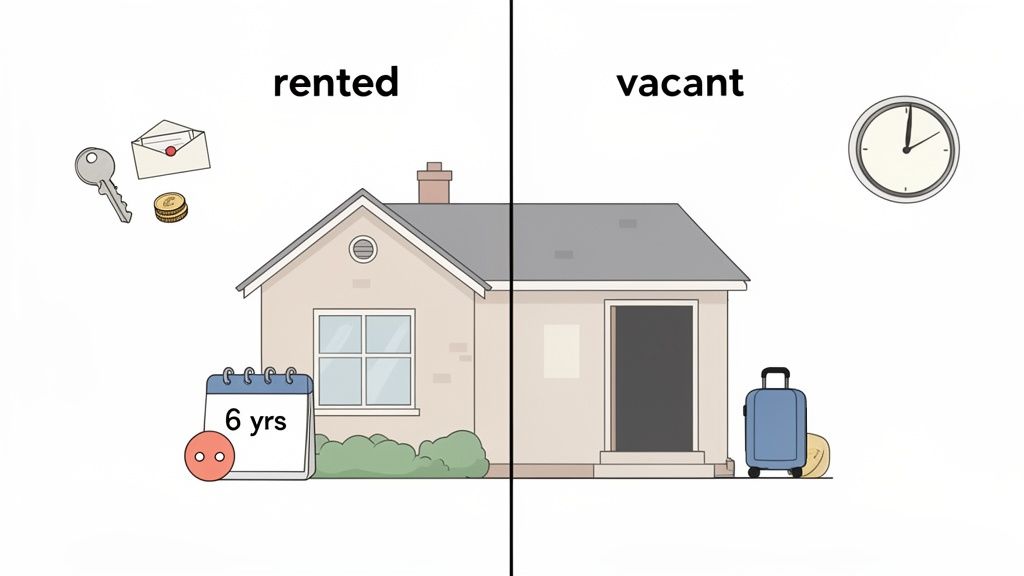
Ordinarily, the sale of your primary home in Australia is exempt from Capital Gains Tax. However, life is rarely static. A work secondment interstate, a need to move to care for family, or a decision to travel for a few years are common scenarios.
The 6-year rule can be thought of as a mechanism that allows you to pause your property's tax-exempt status. It is a recognition within the tax system that you may need to be absent from your home for a period, without being immediately penalised with a potentially significant tax liability upon sale.
This provision may allow you to convert your home into an income-producing asset for up to six years while protecting its CGT-free status, provided certain key conditions are met.
Who Might Find This Rule Relevant?
This Australian Taxation Office (ATO) provision can be helpful for a range of individuals who need to be away from their home temporarily. Depending on individual circumstances, this could include:
- Professionals on temporary work assignments: For example, a doctor undertaking a regional placement or an executive seconded to another city for a multi-year project.
- Families needing to relocate: This may occur when moving to care for an elderly parent or to access specialised schooling for a child.
- New migrants establishing themselves: It is not uncommon to buy a home in one city before deciding to experience life in another part of Australia before settling permanently.
- Individuals taking an extended sabbatical: Using rental income from a home to help fund travel or further study is a practical application of this rule.
A core principle is that the property must first be genuinely established as your main residence before you move out and begin using it to produce income. Without this foundational step, the six-year provision generally cannot be applied.
Understanding the various Capital Gains Tax exemptions in Australia is a component of thoughtful property ownership. The 6-year rule is one piece of this framework, but it is one that offers considerable potential for sound financial planning. It allows for life to happen, supporting mobility without necessarily forcing a sacrifice of the financial benefits earned through home ownership. As with all tax matters, careful planning is essential to ensure eligibility criteria are met.
How the 6-Year Absence Rule Works in Practice
Before the 6-year rule can be considered, the first step is critical: the property must have been your genuine main residence. This is the foundation upon which the entire exemption is built.
The Australian Taxation Office (ATO) looks for practical, real-world evidence that a property was truly your home. The assessment is not based on a single factor, but rather a collection of them that together create a clear picture of your life being centred at that address.
Establishing Your Main Residence
To be considered 'absent' from your home, you must first have been present in it. The ATO typically looks for straightforward indicators such as:
- Your personal belongings were located there: This demonstrates it was your primary home, not merely a holiday property.
- Your mail was delivered to the address: Having personal and professional correspondence sent there is a strong indicator of residency.
- You were registered on the electoral roll at that address: This is a formal declaration of your primary place of residence.
- Utility accounts were in your name: Connecting electricity, gas, and internet demonstrates you were responsible for the running of the home.
Once this foundation is firmly in place, you can then consider the mechanics of the 6-year absence rule.
Understanding the Absence Period
The application of the rule may differ depending on how the property is used after you move out.
If you use your former home to generate income—by renting it out, for example—you can continue to treat it as your main residence for a cumulative total of up to six years. This is the most common application of the rule.
If the property does not produce any income while you are away (for instance, it remains vacant or a family member resides there rent-free), the exemption may potentially continue indefinitely.
This timeline illustrates the typical journey when using the 6-year rule for an income-producing property.

This progression—establishing it as your home, moving out, and then renting it for up to six years—is the core of how this tax provision operates.
The 'Reset' Mechanism
A valuable feature of the main residence exemption 6-year rule is its 'reset' mechanism. If you move back into the property and re-establish it as your main residence, the six-year clock for income-producing use may restart if you later decide to move out again.
This can provide long-term flexibility, particularly if your career or family circumstances involve periodic relocations. It allows for multiple absences over the life of owning the property, provided you meet the residency conditions each time you move back in. For anyone considering a temporary move, understanding the potential tax implications for Australian expats is a prudent step.
For example, a medical professional in Sydney buys a home in 2015 for $800,000 and lives there until 2020, establishing it as their main residence. A career opportunity takes them to Brisbane, and they rent out the Sydney property. Under the 6-year rule, they may continue to treat the Sydney home as their principal residence for CGT purposes. If the property's value increases to $1.5 million by 2025, a sale within that six-year window could result in the capital gain being exempt from CGT.
Risks and Responsibilities
Utilising the 6-year main residence exemption is an opportunity that comes with clear responsibilities. It is not a passive strategy; it requires disciplined attention to detail. The Australian Taxation Office (ATO) expects clear evidence to support any claim, making meticulous record-keeping a fundamental part of the process.
Sound financial stewardship involves building a strong, defensible case for your tax position. Good records protect this position and provide clarity should the ATO ever review your circumstances.
The Cornerstone of Compliance: Record-Keeping
Effective management begins with good records. When you decide to apply the absence rule, you are creating a timeline of your property’s use that must be verifiable.
Key documents to retain may include:
- Dates of Residency and Absence: A clear log of the exact dates you lived in the property as your main residence, the date you moved out, and any periods you returned.
- Rental Agreements and Income: All tenancy agreements, statements from property managers, and records of rental income are essential.
- A Market Valuation: Obtaining a formal market valuation of the property at the time it was first used to produce income is a critical step. This establishes the property’s ‘cost base’ from that point forward. Without it, calculating a partial exemption later may become more complex and could result in a less favourable tax outcome.
- Utility Bills and Correspondence: Retaining bills and mail from the period you lived in the home helps establish a clear timeline of residency.
This disciplined approach helps transform a complex tax situation into a manageable, well-documented history.
The Single Main Residence Rule
A critical point to understand is that you can generally only have one main residence for tax purposes at any given time. While you are applying the six-year absence rule to your original home, you typically cannot treat another property you own as your main residence for Capital Gains Tax purposes. A choice must be made.
This has direct implications for:
- Couples and families who own multiple properties.
- Individuals who buy a new home to live in while their previous one is rented out.
- Business owners who may maintain residences in different cities.
The ATO is clear on this principle, with very limited exceptions (such as a short overlap when moving between homes).
Specific Considerations for Migrants and Expats
The rule is particularly relevant for individuals moving to or from Australia. However, circumstances can become more complex for those who become non-residents for tax purposes. Recent legislative changes have significantly impacted the ability of non-residents to claim the main residence exemption. Understanding your status as a non-resident for tax purposes in Australia is crucial, as this could affect your eligibility.
In these situations, professional advice may be appropriate to ensure compliance and support informed financial decisions. Eligibility often depends on a series of connected factors: your residency status, your property choices, and a disciplined approach to how you nominate your main residence over time.
Practical Australian Examples
Applying tax principles to real-world scenarios helps clarify their practical value. The following examples reflect circumstances that Australian professionals, business owners, and new migrants may encounter. They are designed to illustrate the mechanics of the rule, including how a partial exemption may be calculated if the six-year period is exceeded.
Example 1: A Professional's Interstate Secondment
Dr. Anya Sharma bought her Sydney apartment in 2016 for $700,000. She lived there for four years, establishing it as her main residence. In 2020, she accepted a three-year specialist contract in Perth and rented out her Sydney apartment.
Crucially, she chose to rent in Perth rather than buy another property. This allowed her to continue treating the Sydney apartment as her main residence under the 6-year rule.
At the end of her contract in 2023, she decided to sell her Sydney apartment to help fund an overseas move, with a sale price of $1,100,000. Because she sold it within six years of first renting it out and had not nominated another main residence, the $400,000 capital gain was exempt from CGT.
Example 2: A Business Owner's Extended Overseas Project
Ben Carter, a small business owner, purchased a house in Brisbane in 2014 for $800,000. He and his family lived there for five years. In 2019, an opportunity to expand his business into Southeast Asia arose, and the family moved to Singapore.
They rented out their Brisbane home. The project ran longer than planned, and the family stayed in Singapore for seven years, returning to Australia in 2026. They then sold the Brisbane house, now worth $1,600,000. Because their seven-year absence exceeded the six-year limit, they were only eligible for a partial exemption.
A critical step Ben took in 2019 was getting a formal market valuation when he first rented out the property. The valuation was $1,100,000. This figure becomes the new cost base for calculating the capital gain made during the income-producing period.
The capital gain is calculated on the growth from that valuation date: $1,600,000 – $1,100,000 = $500,000. The taxable portion of the gain is proportionate to the non-exempt period (one year out of seven): ($500,000 ÷ 7 years) x 1 non-exempt year = $71,429. As he owned the asset for more than 12 months, Ben could apply the 50% CGT discount, reducing his assessable capital gain to $35,714.50. The valuation was key to achieving this outcome.
Example 3: A New Migrant Family's Relocation
The Li family migrated to Australia and bought a home in Adelaide in 2018 for $650,000. They lived there for two years, establishing it as their home. In 2020, a job offer prompted a move to regional Victoria.
They rented out their Adelaide home while renting in Victoria. This allowed them to apply the 6-year rule to their Adelaide property. After four years, they decided to return to Adelaide and moved back into their original home in 2024, re-establishing it as their main residence. This action effectively reset the six-year clock. Should they need to move again, a new six-year period could commence. This illustrates the flexibility the rule offers for evolving life plans.
Practical Next Steps
Understanding the 6-year main residence exemption is the first step; applying it correctly is the next. Tapping into its potential requires careful planning and good stewardship of your financial records.
- Assess Your Eligibility: Review the core criteria. Was the property genuinely your main residence before being rented out? Have you nominated another property as your main residence during the same period?
- Collate Your Documentation: Gather your records—residency dates, rental agreements, and the crucial market valuation from when the property was first rented—to create a clear timeline.
- Align with Long-Term Goals: Consider how using this rule fits with your broader financial plans. Is it supporting a temporary relocation, or is it part of a longer-term property investment strategy?
- Seek Professional Guidance: The application of tax law is highly dependent on individual circumstances. A qualified adviser can help provide clarity on your specific situation.
Taking these measured steps can help ensure your property decisions align with your long-term financial goals.
A Concise Takeaway
The main residence exemption 6-year rule is a valuable provision in Australian tax law that offers homeowners flexibility. It may allow you to treat your property as your main residence for CGT purposes for up to six years after you move out, provided it is used to generate income and you do not nominate another property as your main residence. Its successful application rests on careful planning, meticulous record-keeping, and a clear understanding of your responsibilities, particularly the need for a market valuation when the property is first rented.
If you would like clarity on how these principles may apply to your own circumstances, you may wish to speak with a qualified adviser. You can contact Everglow on 1300 913 929 or email contact@everglow.au to arrange a discussion.
General Advice Warning: The information provided is general in nature, does not take into account personal objectives, financial situation, or needs, and readers should seek personal advice before acting.
Want help applying this to your situation?
Every situation is different. Book a time with our team to talk it through, or call us on 1300 913 929.