

Receiving a letter from the Australian Taxation Office (ATO) can cause a moment of concern. If it is a notice regarding a late tax return fine, the first step is to remain calm. This communication, formally known as a Failure to Lodge (FTL) penalty, is not an arbitrary punishment but a standard process the ATO uses to encourage the timely submission of tax information.
Understanding the ATO Failure to Lodge Penalty

The Australian tax system is a cooperative framework that depends on timely participation from every individual and business. When a tax return is not lodged by its due date—typically 31 October for self-lodgers—it creates an information gap for the ATO.
The FTL penalty is the system’s formal mechanism to prompt the closure of that gap. Rather than viewing it as a source of stress, it is more productive to see it as a call to action. The ATO is signalling that it is missing necessary information and has initiated a standard administrative procedure to resolve the matter.
The Purpose of the Penalty Framework
At its core, the FTL penalty serves the principle of fairness. Timely lodgements are essential for the government to accurately forecast and budget for public services such as healthcare, infrastructure, and education. Delayed submissions can disrupt this critical process.
This penalty framework provides a consistent and predictable consequence for all taxpayers, from sole traders to large corporations. The penalties are scaled according to the entity's size and the length of the delay, ensuring the approach is structured and not arbitrary.
A Common Occurrence
It is important to recognise that you are not alone. Each year, many Australians miss the lodgement deadline for a variety of reasons. Life events can intervene. For instance, ATO data often shows millions of returns outstanding as the 31 October deadline approaches.
This is a common administrative issue for which the ATO has a well-defined process. Depending on your circumstances, penalties for individuals and small businesses may climb to $1,650, while larger companies can face substantially higher fines.
A penalty notice is fundamentally a communication. It is the ATO’s way of requesting your attention on a specific compliance matter. A measured and methodical response is always the most effective path forward.
For many business owners, including those considering the advantages of operating as a sole trader, understanding these compliance obligations is a key component of sound financial stewardship. Once the FTL penalty is understood as a standard administrative process, you can move past the initial concern and take clear, confident steps toward resolution.
How the ATO Calculates Your Penalty
If you have received a late tax return fine, the first step is to understand how the ATO arrived at that figure. The calculation is not arbitrary; it follows a clear, methodical system based on established rules. Understanding this logic is key to determining your next steps and appreciating why delays can increase the financial consequence.
The system is based on a standard measure known as a penalty unit. The government sets the monetary value of this unit, which is periodically updated to reflect economic changes.
The ATO applies these units based on a simple timeframe. For each 28-day period (or part thereof) that your return is overdue, one penalty unit is applied. This ensures a predictable and consistent process.
The Core Calculation
The calculation is straightforward. The ATO counts the number of 28-day blocks that have passed since your lodgement due date and multiplies that number by the current value of a penalty unit.
However, there is a cap, which provides some certainty for most individuals and small businesses. The penalty is typically limited to a maximum of five units. Therefore, even if a return is many months late, there is a ceiling on that specific fine.
How Your Business Size Affects the Penalty
This is where the calculation becomes more nuanced. The ATO recognises that a fine that is significant for a sole trader might be negligible for a large corporation. To address this, the penalty is scaled based on the size of your entity.
It is structured into three tiers according to your turnover or assessable income:
- Small Entities: This group includes most individuals and businesses with a turnover of less than $1 million. They are subject to the standard, base penalty rate.
- Medium Entities: For a business with a turnover between $1 million and $100 million, the base penalty amount is doubled.
- Large Entities: For corporations with a turnover of $100 million or more, the base penalty is multiplied by five.
This tiered approach ensures the penalty is proportionate to the entity's scale. It serves as a reminder that understanding your business tax obligations is a fundamental responsibility, regardless of your business's size.
The table below outlines how the ATO applies these multipliers.
ATO Failure to Lodge Penalty Calculation by Entity Size
This table illustrates how late lodgement penalties are calculated based on the entity's size for each 28-day period the return is overdue.
| Entity Size | Assessable Income/Turnover | Penalty Multiplier | Penalty Per 28 Days (1 Unit) | Maximum Penalty (5 Units) |
|---|---|---|---|---|
| Small | Less than $1 million | 1x | $330 | $1,650 |
| Medium | $1 million to <$100 million | 2x | $660 | $3,300 |
| Large | $100 million or more | 5x | $1,650 | $8,250 |
As illustrated, the financial impact grows significantly with the size of the business, highlighting why larger organisations must maintain diligent compliance with lodgement deadlines.
A Practical Example
Let’s apply this framework to a common scenario.
Consider a small business owner who lodged their company’s tax return 60 days after the due date.
- Count the Overdue Periods: A 60-day delay covers two full 28-day periods and a portion of a third. The ATO counts any part of a period, resulting in three blocks.
- Determine the Penalty Units: At one penalty unit per block, the total is 3 penalty units.
- Calculate the Final Fine: With a single penalty unit currently valued at $330, the total fine would be 3 units × $330 = $990.
The ATO applies similar logic to other late lodgements, such as activity statements, to encourage timely compliance across the board. The costs can accumulate quickly. You can explore further details on various Australian tax penalties and how to avoid them. This clear, step-by-step process is key to managing your tax affairs with confidence and preventing unwelcome financial surprises.
Understanding Interest and Other Associated Charges
A fine for a late tax return is often just one component of the total amount payable. While the Failure to Lodge (FTL) penalty addresses the act of lodging late, if that return also reveals an unpaid tax liability, another layer of charges will likely apply. It is vital to understand these to grasp the full financial picture.
The FTL penalty can be thought of as a fee for late submission. Any interest charges, however, relate to the money you owe the ATO. The tax office applies these charges to compensate for the period they did not have access to funds that were legally due.
The General Interest Charge
The most common charge accompanying an FTL penalty is the General Interest Charge (GIC). This is not a penalty but a commercially calculated interest that applies to unpaid tax liabilities. It begins accruing from the original payment due date and continues until the debt is settled in full.
The GIC rate is linked to official bank rates, plus a legislated uplift factor of seven percentage points. It is updated quarterly, so the rate may change over time. As it is calculated and compounded daily, even a modest unpaid tax liability can grow substantially if left unaddressed.
The Shortfall Interest Charge Explained
You may also encounter the Shortfall Interest Charge (SIC), which applies in a different context. SIC is relevant when you amend a previous tax assessment and the amendment results in a higher tax liability. The rate is lower than the GIC because the ATO generally considers this an unintentional error rather than a failure to pay on time.
For most people dealing with a late lodgement, the GIC is the primary concern. Its purpose is to ensure that those who pay late do not gain an unfair financial advantage over taxpayers who met their obligations on time.
The infographic below illustrates how penalties are scaled based on business size—a key aspect of the ATO’s compliance framework.
As you can see, the financial consequences of non-compliance increase significantly as a business grows. This demonstrates the importance of diligent tax management for all entities, from sole traders to large corporations.
A Practical Example for a Professional
Let’s consider a real-world scenario.
An IT consultant operates her business through a company structure. She lodges her company tax return 95 days late, and the assessment shows an income tax liability of $15,000. Her business is classified as a small entity.
Here is a breakdown of how the costs could accumulate:
- Failure to Lodge Penalty: A 95-day delay spans four 28-day periods (95 ÷ 28 = 3.39). This may trigger four penalty units, resulting in a fine based on the current rate per unit.
- General Interest Charge: GIC will be calculated daily on the outstanding $15,000 tax debt, from the original due date until the payment is made. Over three months, this could easily add hundreds of dollars to the total amount owed.
- Total Payable: The final amount she must pay is the original $15,000 tax debt, plus the FTL penalty, plus all the accrued GIC.
This example highlights a critical point: resolving a late lodgement is a two-step process. One must lodge the return and pay any associated tax debt. Many business owners are caught out by focusing only on the FTL fine. Proactive financial management is essential, especially when navigating obligations under the promoter penalty laws and tax compliance. Addressing both aspects promptly is the only way to protect your finances and prevent costs from escalating.
Real-World Examples for Australian Taxpayers

Understanding the rules and penalties is one thing, but seeing their application in real-world situations provides much-needed clarity. Financial regulations can feel abstract until their tangible impacts are examined. Let’s walk through a few common scenarios to see how different circumstances, entity types, and taxpayer actions can lead to very different outcomes.
Each story traces the journey from a missed deadline to the final financial consequence, illustrating how penalties and interest are calculated. By seeing how these principles affect everyday Australians, you can gain a clearer understanding of how they might apply to your own situation.
Example 1: The Freelance Graphic Designer
Anya is a talented freelance graphic designer who operates as a sole trader. While highly skilled in her creative field, she sometimes finds administrative tasks challenging. Overwhelmed by a major project, she misses the 31 October lodgement deadline for her individual tax return.
She eventually lodges her return 75 days late. The resulting ATO assessment shows a tax liability of $4,500.
How does the ATO calculate her total amount payable?
- Failure to Lodge (FTL) Penalty: A 75-day delay falls into three separate 28-day periods. This may result in 3 penalty units. The total FTL fine is calculated based on the current monetary value of these units.
- General Interest Charge (GIC): In addition to the fine, GIC begins to accrue on her $4,500 tax debt from the original payment due date. Over two and a half months, this daily compounding interest adds another layer of cost.
Ultimately, Anya is responsible for the $4,500 tax debt, the FTL penalty, and the accumulated GIC. For a sole trader, this can be an unexpected and significant financial setback. This scenario underscores the importance of allocating time for tax compliance, regardless of professional workload, and highlights the value of seeking advice on managing personal services income.
Example 2: The Family-Run Café
The Chen family owns and operates a popular local café through a small proprietary limited company. Their business generates an annual turnover of $1.2 million, placing them in the "medium entity" category for penalty purposes.
Their bookkeeper unexpectedly takes extended sick leave, causing administrative disruption. As a result, the company’s tax return is lodged 100 days late. The assessment reveals a tax liability of $22,000.
For a business, a late lodgement is more than an administrative oversight—it is a financial event that can directly impact cash flow. Understanding the scaled penalty system is essential for maintaining the financial health of the business.
Here is how the financial consequences unfold:
- FTL Penalty Calculation: A 100-day delay covers four 28-day periods (100 ÷ 28 = 3.57). This means the business may be liable for 4 penalty units.
- Medium Entity Multiplier: Because the company’s turnover exceeds $1 million, the standard penalty rate is doubled. This makes the fine substantially larger than it would be for a smaller business.
- Accrued GIC: The doubled fine is compounded by GIC, which is calculated daily on the $22,000 tax debt for the entire 100-day period.
The Chen family now faces a considerable liability: the original tax debt, a doubled FTL fine, and several months of compounding interest. This story demonstrates how quickly costs can escalate for businesses and why robust systems—or a reliable tax agent—are a necessity for sound financial planning.
Example 3: The New Migrant Navigating the System
Li recently moved to Australia for a skilled professional role. As he is lodging an Australian tax return for the first time, he is unfamiliar with the local system and its deadlines. He misses the lodgement date by 40 days.
However, his tax return shows that he is due a $1,200 refund.
In this situation, the outcome is quite different. Because Li does not have a tax debt, no GIC can be charged. While the ATO could technically apply an FTL penalty, it may exercise discretion in such cases.
The ATO's primary objective is to encourage ongoing compliance. Given that Li is new to the Australian tax system and is owed a refund, the ATO is more likely to issue a warning letter for a first-time oversight rather than a fine. This serves an educational purpose without being punitive. This outcome is not guaranteed, however, and a subsequent late lodgement would almost certainly result in a fine.
These examples show that while the rules are fixed, the final outcome depends on your specific circumstances—your entity structure, whether you have a tax debt or are due a refund, and your compliance history. Each story reinforces a simple truth: being proactive and lodging on time is always the most prudent and cost-effective approach. If you are ever unsure, seeking guidance early can make a significant difference, and our team is always available to provide clarity and support.
What to Do When You Receive a Penalty Notice
An official letter from the ATO has arrived. It is a penalty notice for a late tax return, and it is natural to feel some apprehension. However, this is not a dead end; it is a signal to take considered action.
The first and most critical step is to lodge the overdue return immediately. No other action can be effectively taken until this is complete. The longer the delay, the higher the penalty may become, and the more interest may accrue on any associated debt.
Once the return is lodged, you will have a clear understanding of your position and can begin to address the penalty itself.
Can You Request a Remission of the Penalty?
The ATO has the discretion to reduce or cancel a penalty, a process known as remission. While not guaranteed, it is a worthwhile avenue to explore if you have a compelling reason for the delay.
A successful request typically requires demonstrating that circumstances beyond your reasonable control prevented you from lodging on time. Such circumstances may include:
- A serious illness or accident involving you or a close family member.
- A natural disaster, such as a flood or bushfire, that affected your home, business, or access to records.
- Other significant and unforeseen personal hardships.
To request a remission, you or your tax agent should contact the ATO, usually in writing. You will need to provide a clear explanation of what occurred and supply supporting evidence where possible, such as a medical certificate or documentation of a natural disaster. A good compliance history with the ATO will also strengthen your case, a principle we discuss in our article on promoter penalty laws and tax compliance.
What if You Cannot Pay the Full Amount at Once?
If the penalty stands and you are unable to pay the full amount—which may include the fine, the tax liability, and any interest—do not ignore the debt. Inaction will only worsen the situation.
The ATO can be quite reasonable and offers payment plans to help individuals and businesses manage their debts over time. This allows you to break down the total amount into smaller, regular instalments. You can often arrange a plan through myGov or by contacting the ATO directly.
Be prepared to discuss your financial situation openly. The ATO will want to establish a payment schedule that you can realistically maintain.
A proactive approach is always viewed more favourably. Contacting the ATO to arrange payment demonstrates responsibility and a commitment to meeting your obligations, which is a cornerstone of good financial stewardship.
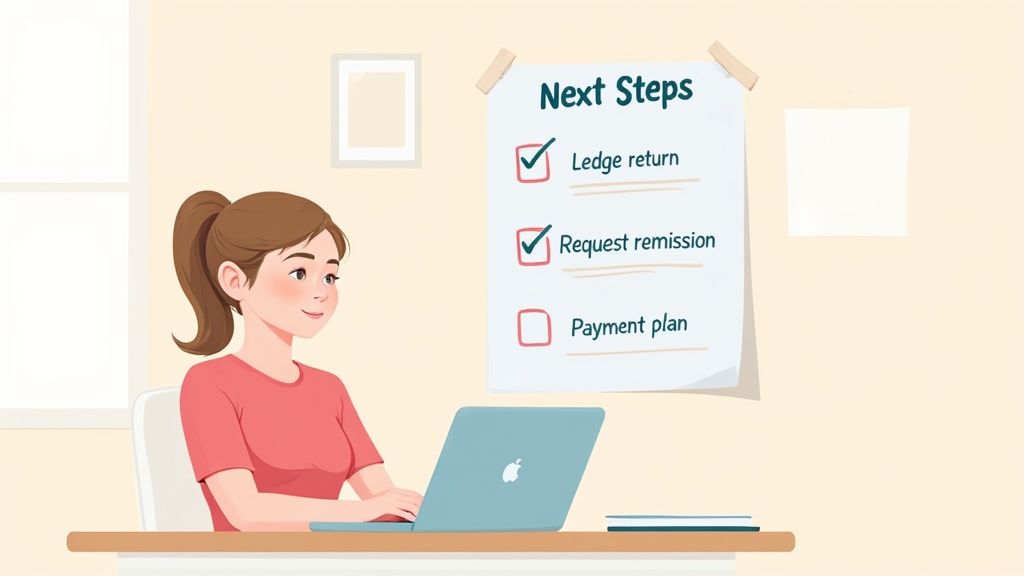
Your Step-by-Step Action Plan
Responding to a penalty notice requires a calm, methodical approach. Panic is unproductive, but a clear plan is empowering.
- Lodge Immediately: Prioritise lodging your overdue return. This stops any further penalty units from being applied.
- Assess the Situation: Once lodged, carefully review the notice. Understand the total amount owed, including the penalty and any interest charges.
- Request Remission: If you have valid grounds, submit a request to have the penalty remitted. Ensure you include all relevant supporting evidence.
- Engage with the ATO: If you are required to pay, do not wait for follow-up action. Proactively contact the ATO to arrange a suitable payment plan.
Receiving a late lodgement fine is more common than many realise. By following these steps, you can navigate the process with confidence and restore your compliance standing. Should you need assistance, our team is here to provide professional, confidential advice tailored to your circumstances.
How to Avoid Future Late Lodgement Fines
The most effective way to manage a late tax return fine is to prevent it from occurring in the first place. Responding to penalties is a reactive measure; the goal should be to shift to a proactive stance.
The foundation of this approach is building sound financial habits. It is about cultivating foresight and consistency to avoid last-minute pressure. This discipline not only helps in avoiding fines but also contributes to long-term financial wellbeing and reduces stress.
Cultivating Financial Discipline
The cornerstone of timely lodgement is organisation. A complex system is not required; a dedicated digital folder or a simple physical file for tax-related documents can be highly effective.
Develop the habit of tracking income and expenses as they occur. If you wait months, important details may be forgotten. For business owners, this is a fundamental aspect of good bookkeeping. For individuals, it can be as simple as taking photos of receipts for work-related expenses and saving them in a dedicated album on your phone.
This small discipline transforms tax preparation from a frantic search for documents into a calm, orderly review. Use your calendar strategically. Instead of setting a single reminder for the final deadline, schedule one for a month or two in advance. This provides ample time to gather information, consult with an adviser, and manage any unexpected issues without pressure.
The Strategic Advantage of a Tax Agent
Engaging a registered tax agent is more than outsourcing a task; it is a strategic decision. When you work with a registered agent, you often gain access to extended lodgement deadlines not available to self-lodgers. This additional time can be invaluable.
An agent's role extends beyond mere compliance. They act as a guide, helping you understand your obligations and opportunities, ensuring your financial structure is sound and your lodgements are accurate and timely.
They provide a broader perspective. For instance, an agent can offer crucial advice when you are managing an investment property for tax purposes.
Their involvement can transform tax from an annual obligation into a proactive component of your overall financial strategy. They help ensure you meet all your compliance responsibilities while identifying opportunities to optimise your financial position within the bounds of the law.
By planning ahead, maintaining organised records, and seeking the right professional guidance, you can build a system that prevents late lodgement issues from arising. This approach not only saves you money on potential fines but also provides a sense of control and confidence over your financial affairs.
Common Questions About ATO Late Fines
Navigating a late tax return fine can be complex, and it is natural to have questions. Let’s address some of the most common queries we receive from clients to provide greater clarity.
What is the Maximum Fine for a Late Tax Return?
For individuals and small businesses (with a turnover under $1 million), the ATO places a cap on the Failure to Lodge (FTL) penalty. The maximum fine for a single overdue return is currently $1,650, which corresponds to five penalty units. This ceiling is typically reached once a return is more than 140 days late.
However, penalties begin to accrue as soon as the deadline passes, increasing for each 28-day period of delay. This structure is designed to encourage prompt action. You can find further details on how ATO late lodgement penalties work over at etax.com.au.
Will I Still Be Fined if the ATO Owes Me a Refund?
This is a frequent point of confusion. Legally, the ATO has the authority to issue a fine for late lodgement regardless of whether you are due a refund. In practice, however, they may exercise discretion.
If you are due a refund and have a good compliance history, the ATO may issue a warning letter for a first-time delay. It is not wise to rely on this, as the penalty system is designed to promote timely lodgement for all taxpayers. If late lodgement becomes a pattern, a fine is likely, even if a refund is expected.
Can I Dispute a Fine if I Believe It Is Unfair?
Yes, you have the right to lodge a formal objection to a penalty if you believe it was applied incorrectly according to the law. This is a distinct process from requesting a remission due to hardship. An objection requires you to outline the specific legal reasons for your disagreement.
It is highly advisable to seek professional advice before proceeding with a formal objection. A strong case requires a solid understanding of tax law. An adviser can assess the merits of your position and assist in preparing a well-reasoned submission.
An objection is generally appropriate when there is a dispute over facts or the interpretation of the law. If your situation is primarily about unforeseen circumstances that made it difficult to lodge on time, a remission request is the more appropriate first step. The best way to avoid these complexities is to remain compliant, which includes understanding specific rules such as those for Personal Services Income for professionals.
Navigating tax obligations requires careful planning and a clear understanding of your responsibilities. A late tax return fine is a manageable issue when addressed with a calm, methodical approach. Good financial stewardship—disciplined record-keeping and proactive engagement—is the key to avoiding such issues and maintaining a healthy financial life. If you find yourself needing guidance, remember that professional advice is a valuable tool for achieving clarity and confidence.
At Everglow Prosperity, we provide the steady, expert guidance needed to handle complex tax matters with confidence. If you are facing a penalty notice or wish to put your financial affairs in good order, we invite you to connect with our team of experienced advisers.
General Advice Warning: The information in this article is general in nature and does not take into account your objectives, financial situation or needs. Before acting on it, consider whether it is appropriate for you and seek personal advice. Tax and superannuation rules can change. Financial advice is provided by Everglow Wealth Pty Ltd, a Corporate Authorised Representative (No. 1254987) of PGW Financial Services Pty Ltd (AFSL 384713). Tax advice is provided by Everglow Accounting Pty Ltd.
Want help applying this to your situation?
Every situation is different. Book a time with our team to talk it through, or call us on 1300 913 929.