

For professionals and business owners in Australia, understanding the laptop depreciation rate is a fundamental aspect of sound financial stewardship. In simple terms, this rate reflects how a work-related laptop is considered to lose value over time, a loss which may be claimed as a tax deduction. The Australian Taxation Office (ATO) has determined the effective life for a laptop is typically two years. This provides a clear framework for accounting for this necessary business tool.
What is Laptop Depreciation and Why Does It Matter?
Depreciation may sound like a complex accounting term, but it is a practical concept. It is the ATO’s acknowledgement that essential business assets, such as laptops, have a limited lifespan. They lose value through use, wear and tear, and the constant evolution of technology.
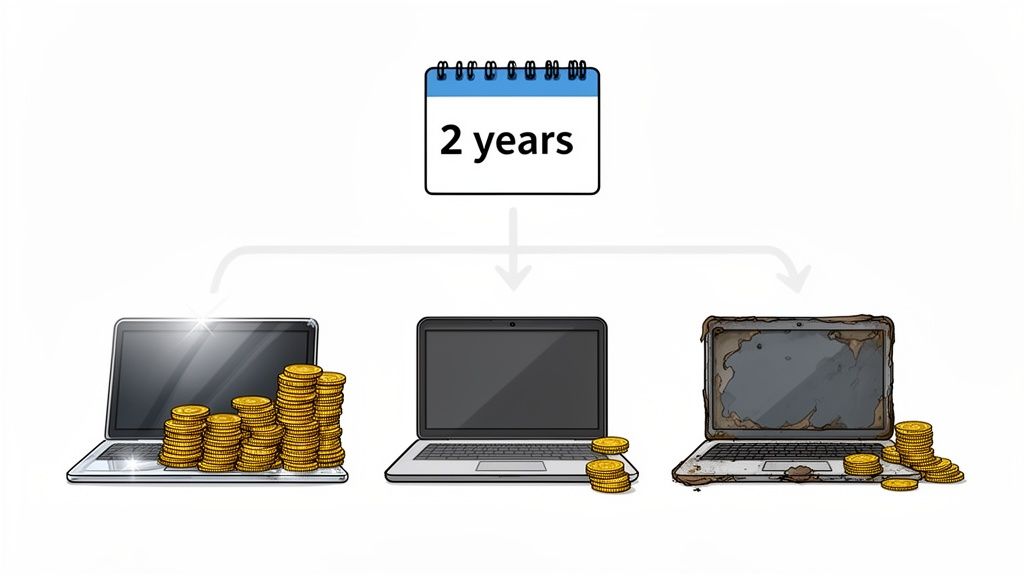
This understanding allows you to claim that loss in value each year as a tax deduction, turning a necessary business expense into an opportunity for thoughtful financial management.
The central concept is an asset's 'effective life'. The ATO has determined that laptops have a two-year lifespan, reflecting their rapid obsolescence.
This structured approach to valuing assets offers a predictable way to account for capital expenditure. It helps ensure your financial records accurately reflect the diminishing value of your equipment, which is a cornerstone of responsible asset management.
The Strategic Value of Depreciation
Understanding how to calculate and claim depreciation is more than a compliance task; it can be a strategic component of your financial planning. By correctly applying the laptop depreciation rate, you may be able to manage your business’s taxable income more effectively over the two years you use the device.
This principle is one of the many practical considerations when seeking ways to reduce your business tax bill. It serves as an example of how sound financial decisions often arise from understanding both opportunities and responsibilities. This requires patience and disciplined action, allowing you to make informed choices that support your long-term financial wellbeing.
Navigating the ATO's Rules for Laptop Depreciation
When a business invests in a laptop, it is acquiring a tool to help generate income. The Australian Taxation Office (ATO) provides a clear framework for how this expense may be claimed over time. The rules are designed to match the cost of the asset to the period it provides value to your business.
The key principle is the effective life of an asset. For laptops and other portable computers, the ATO has generally set this at two years. This determination reflects the rapid pace of technological change and the typical wear and tear these devices endure, particularly when compared to desktop computers.
Key Thresholds and How They Work
The initial consideration is the purchase price. If a new laptop costs less than $300, you may be able to claim an immediate deduction for the full business-use portion in the same financial year it was purchased.
For laptops costing $300 or more, the claim is typically spread over its two-year effective life. This process, known as depreciation, ensures that a more significant capital expense is accounted for over the entire period it contributes to the business.
It is also important to note the distinction the ATO makes between laptops and desktop computers. A desktop PC is generally assigned a longer four-year effective life, which alters the depreciation calculation. This is a relevant detail when managing your deductions, particularly for those claiming working from home expenses, where both types of devices might be in use.
How Depreciation Rates Are Calculated
The two-year effective life informs the depreciation rate. There are a couple of methods available for the calculation, and the choice you make can affect how much you claim each year.
Using the prime cost method (also known as the straight-line method), the rate is 50% per year. Alternatively, the diminishing value method allows for a claim at a 100% rate, which could mean deducting the entire business portion in the first year. For detailed official guidance, referring to the ATO Depreciation Rates is advisable.
As a practical example, a medical professional purchases a new $2,000 laptop for her practice. Using the prime cost method, she could claim a $1,000 deduction in the first year and another $1,000 in the second. This offers a predictable way to manage tax planning that mirrors the gradual decline in the laptop's value.
These standardised rules help ensure a consistent approach for all entities, from sole traders to small businesses. Familiarity with the ATO’s effective life schedules is a key part of maintaining compliance and making prudent financial decisions.
Two Methods for Calculating Laptop Depreciation
When calculating depreciation for a business asset like a laptop, the Australian Taxation Office (ATO) provides two distinct methods. Your choice is not merely an accounting detail—it can have a tangible impact on your business's cash flow and tax position. Understanding each approach is therefore a worthwhile exercise.
This decision tree helps illustrate when depreciation becomes a consideration for business assets.
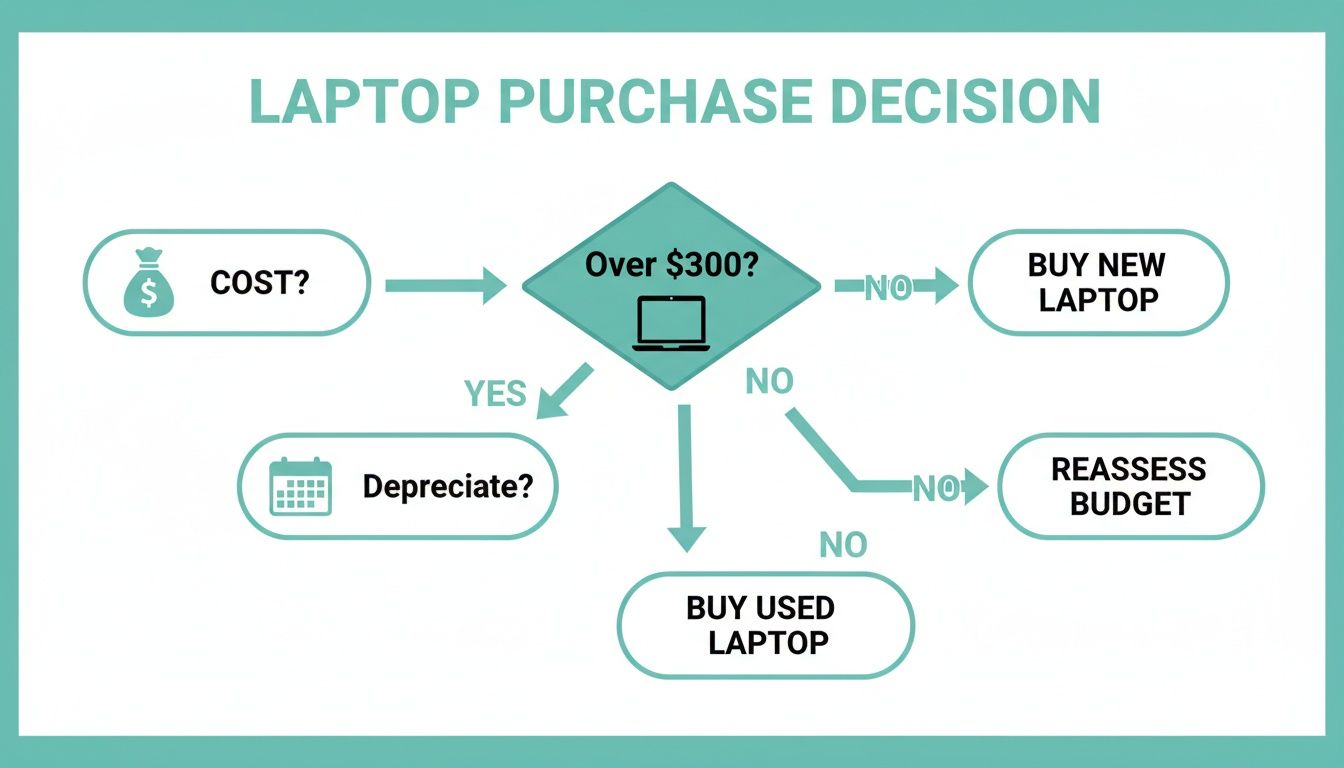
As shown, once a work-related laptop purchase exceeds the $300 threshold, its cost is generally claimed over its effective life.
The Prime Cost Method
The Prime Cost method can be thought of as a 'straight-line' approach. It is steady and predictable. Using this method, the laptop’s value is reduced by the same amount each year over its two-year effective life. The calculation involves spreading the asset's cost evenly across its lifespan.
For a laptop, this means claiming 50% of its business-use value each year for two years. Many business owners who value consistency and clear financial forecasting may find this method aligns well with their planning.
The Diminishing Value Method
In contrast, the Diminishing Value method allows for a larger deduction in the first year. This approach calculates the claim based on the asset's reduced value in subsequent years. For a laptop with a two-year effective life, this method may allow you to claim 100% of its value in the first year.
This can be a strategic consideration for a business seeking to maximise deductions in a particular year, perhaps to offset higher income. It front-loads the tax benefit, which may be more suitable for certain cash flow strategies. The logic is similar in principle to understanding how to claim depreciation on rental property, where different assets also have specific depreciation schedules.
Choosing a method is a strategic decision. Depending on your circumstances, one approach might offer more immediate tax relief, while the other provides stable, predictable deductions over time. Reflecting on your business's financial outlook is key to making an appropriate choice.
Practical Examples of Laptop Depreciation
While understanding the rules is important, seeing how they apply in practice brings clarity. Let's explore some scenarios relevant to Australian professionals and business owners to illustrate the mechanics of depreciation.
These examples are designed to show how these choices might look in a real-world financial context.
Example 1: A Medical Professional
Dr. Chen, a GP operating as a sole trader, purchases a high-end laptop for $2,800 to manage patient records and telehealth consultations. She keeps a log and determines that she uses it 80% of the time for her practice and 20% for personal matters.
The business portion—the depreciable value of her asset—is therefore $2,240 ($2,800 x 80%).
Here is how her deductions could be calculated over the laptop's two-year effective life:
- Prime Cost Method: This steady approach would allow her to claim a deduction of $1,120 in the first year (50% of $2,240) and the remaining $1,120 in the second year.
- Diminishing Value Method: This method front-loads the deduction. She could claim the full $2,240 in the first year (100% of $2,240), providing a larger tax benefit upfront.
The most suitable path depends on her expected income for each year and her broader financial strategy. A higher deduction in year one might be beneficial if she has had a particularly profitable year.
Example 2: A New Migrant's Business
Sofia, a recent migrant to Australia, has started a small marketing agency. She buys three laptops for her new team, each costing $1,500, for a total of $4,500. As these are used 100% for the business, the full cost is depreciable.
Australian tax law allows businesses to group low-cost assets into a pool for depreciation, which can simplify record-keeping. Instead of tracking each laptop individually, Sofia could treat the $4,500 as a single pool. Using the Diminishing Value method, her business could potentially claim the full $4,500 in the first year. For further reading, there are many useful technology and laptop tax tips on hrblock.com.au.
This pooling approach can be efficient for a growing business, helping it manage assets without becoming burdened by tracking every item separately.
Apportioning Use for PSI Earners
For professionals earning Personal Services Income (PSI)—such as IT contractors, consultants, and freelancers—accurately apportioning the work/personal split is critical. The ATO requires that a laptop be used more than 50% of the time for income-producing purposes to be eligible for a depreciation claim.
Consider a consultant who buys a $2,400 laptop. A detailed logbook shows 70% work-related use. Only that portion—$1,680—can be depreciated. The remaining 30% is considered a private expense and cannot be claimed.
This illustrates why diligent record-keeping is not just good practice; it is essential for substantiating claims and meeting compliance obligations.
The following table summarises different scenarios to show how the numbers can change based on individual circumstances.
Laptop Depreciation Scenarios: A Comparison
This table shows potential claims for a $2,500 laptop over its two-year effective life, based on the work-use percentage and the chosen method.
| Scenario | Method | Year 1 Deduction | Year 2 Deduction |
|---|---|---|---|
| 100% Business Use | Prime Cost (50%) | $1,250 | $1,250 |
| 100% Business Use | Diminishing Value | $2,500 | $0 |
| 75% Business Use ($1,875 depreciable) | Prime Cost (50%) | $937.50 | $937.50 |
| 75% Business Use ($1,875 depreciable) | Diminishing Value | $1,875 | $0 |
As the table shows, the difference between methods can be significant, especially in the first year. The Diminishing Value method provides a faster tax write-off, which could be a prudent choice to reduce taxable income in a high-earning year.
These examples show that while the rules provide a clear framework, they also offer flexibility. The key is to apply them carefully, supported by accurate records and a sound understanding of your personal circumstances. If you require guidance on managing your business assets and tax obligations, our team provides tailored tax and accounting services. To discuss your specific needs, you may wish to contact us to arrange a meeting.
Laptops vs. Desktops: A Key Distinction for Tax Purposes
In the context of business assets, the Australian Taxation Office (ATO) makes a clear distinction between a laptop and a desktop computer. This may seem like a minor detail, but it has a direct impact on tax deductions and how you might plan your technology investments.
The ATO's reasoning is based on practical use. A desktop computer typically remains in a single, stable location, such as an office. It is less exposed to physical wear and is therefore assigned a longer four-year effective life. Laptops, by their nature, are portable. They are carried in bags, used in various environments, and are more susceptible to the risks of daily transport and use.
Consequently, the ATO assigns a much shorter 2-year effective life for laptops. This simple difference has significant financial implications.
A 2-year life allows for faster depreciation. Using the prime cost method, the claim is 50% per year. With the diminishing value method, it could be 100% in the first year. In contrast, a desktop’s 4-year life allows for a claim of 25% (prime cost) or 50% (diminishing value) per year.
For a small business or professional practice, this difference matters. A $4,000 laptop could translate to a $4,000 deduction in its first year. The same $4,000 spent on a desktop would, at most, provide a $2,000 deduction in the first year. You can find more practical examples of depreciating assets on itp.com.au.
Strategic Purchasing Considerations
This knowledge allows you to make procurement decisions that align with your financial strategy. For example, a new business wanting to maximise deductions to preserve cash flow might find that investing in laptops is a prudent move, as it provides a larger upfront tax benefit.
Conversely, an established practice may prefer the slower, more predictable depreciation schedule of desktops, which aligns with a more permanent infrastructure plan.
Understanding this distinction enables you to structure asset purchases in a way that best supports your business's financial rhythm and strategic goals.
This kind of foresight is a hallmark of good financial management. It involves making patient, informed choices that build resilience over time, a discipline central to small business cash flow management.
Records and Responsibilities
Claiming depreciation on a business laptop is a valid strategy, but it comes with the responsibility of maintaining clear and accurate records. The Australian Taxation Office (ATO) requires substantiation for all claims. This is not about creating administrative burdens; it is about upholding the integrity of the tax system.
Fulfilling these obligations with care provides peace of mind and builds a solid foundation for your business finances, demonstrating that your claims are legitimate and well-supported.
What You Need to Substantiate Your Claim
To meet ATO requirements, you must be able to document the entire lifecycle of the asset—from its purchase to its ongoing use in your business. This involves more than simply retaining a receipt; it requires demonstrating its role in generating your income.
Essential records to keep include:
- Proof of purchase: The tax invoice or receipt, clearly showing the supplier, date, cost, and a description of the item.
- Evidence of use: If the laptop is used for both business and private purposes, you need to substantiate the business-use percentage. A logbook or diary maintained over a representative four-week period is a common way to establish this.
- Calculation records: A note of how you calculated your depreciation claim, including the method chosen (Prime Cost or Diminishing Value) and the asset's effective life.
Maintaining these documents is a core compliance responsibility. It may be helpful to view this not as a chore, but as the careful assembly of a clear, verifiable, and accurate financial narrative.
Modern accounting software or a well-organised spreadsheet can streamline this process. The key is consistency. These records should be stored securely for at least five years from the date you lodge the relevant tax return. This discipline helps ensure you are always prepared, especially as key dates like the tax return deadline in Australia approach.
A Concise Takeaway
The principles of laptop depreciation, when understood and applied thoughtfully, can be a valuable component of your financial planning. It is more than a simple compliance task.
The key takeaways are straightforward: the ATO generally assigns a laptop a two-year effective life; you may choose between the Prime Cost and Diminishing Value methods depending on your circumstances; and meticulous record-keeping is essential to substantiate any claim.
Practical Next Steps
A practical first step might be to review your recent asset purchases. Examine your receipts, confirm the dates, and assess your current record-keeping system. Does it provide a clear and defensible account of your business expenses?
Considering depreciation is not just a year-end activity; it provides a clearer, more accurate picture of your financial position at any given time.
A disciplined approach to managing your assets does more than maintain compliance. It can turn a standard tax rule into a strategic lever for financial stability and growth.
If you would like clarity on how these principles may apply to your own circumstances, you may wish to speak with a qualified adviser. You can contact Everglow on 1300 913 929 or email contact@everglow.au to arrange a discussion.
General Advice Warning: The information provided is general in nature and does not take into account your personal objectives, financial situation, or needs. You should seek personal advice from a qualified professional before making any financial decisions.
Want help applying this to your situation?
Every situation is different. Book a time with our team to talk it through, or call us on 1300 913 929.
Book a free meetingAustralian tax guide →Estimate your fees →
Keep exploring