

Determining how to value a business for sale is a considered process, blending objective financial analysis with an understanding of market realities. It involves looking beyond a simple profit and loss statement to understand the business’s sustainable earnings, its intangible strengths, and its future potential. A clear, realistic valuation is the cornerstone of any successful and well-managed sale.
Understanding Your Business's True Worth
Putting a business on the market is a significant step, and a well-supported valuation provides a sound starting point. It may shift the conversation from subjective feelings to objective analysis, giving you and a potential buyer a common language to speak.
A proper valuation can be a strategic review that may reveal hidden strengths and pinpoint operational weaknesses you might not have noticed.
A valuation grounded in Australian standards has several layers. It leans heavily on financial statements and verifiable data, but it also requires a feel for market sentiment, industry trends, and the value of intangible assets like brand reputation and loyal customer relationships.
For example, a medical practice's value may be built just as much on its consistent cash flow as it is on the goodwill it has built over decades. Maintaining financial health is critical; understanding principles of small business cash flow management can offer some practical insights here.
Core Valuation Concepts
At its heart, a business valuation attempts to arrive at a fair market value. This is often considered the price a willing buyer would pay and a willing seller would accept, with neither party under undue pressure to act.
You may come across a few key terms:
- Future Maintainable Earnings (FME): This is not just last year's profit. It represents the business's underlying profitability after adjusting for any one-off expenses or unusual income, giving a clearer picture of its ongoing earning power.
- Goodwill: This is the intangible value tied to a business's reputation, customer base, and brand. It is what may allow the business to generate profits above and beyond what its physical assets alone could produce.
- Capitalisation Rate: This is the rate often used to convert a single earnings figure into a capital value. It is a reflection of the risk and growth prospects tied to those earnings—the higher the perceived risk, the higher the capitalisation rate may be.
Familiarising yourself with these ideas may prepare you for more productive discussions with buyers and advisers. The specific methods used can change depending on the industry. For a detailed look at how an educational institution is valued, for instance, you might find it useful to read about how to value a private school for sale. This kind of measured approach may allow you to enter the sales process with quiet confidence.
Exploring Core Business Valuation Methods
Determining what a business is worth is not a simple case of using a single formula. A seasoned adviser may look at the business from a few different angles, using several established methods to arrive at a balanced and defensible price range.
The appropriate approach often depends on the business itself—its industry, its age, and its financial health. Understanding these core valuation methods is a practical first step. These are frameworks that buyers, banks, and even the Australian Taxation Office (ATO) may use to assess a business. Each method offers a unique lens: one focuses on future potential, another on present market reality, and a third on the tangible sum of its parts.
The Income Approach: What is the Future Earning Potential?
The Income Approach is forward-looking. It values a business based on the profits or cash flow it is expected to generate in the future. The core idea is that a buyer is essentially purchasing a future stream of income, and the value of that stream today is what the business may be worth.
This method could be particularly suitable for businesses with a solid track record of profitability and predictable revenue, such as professional services firms, medical practices, or established software companies with recurring subscriptions.
A common technique here is the Discounted Cash Flow (DCF) analysis. While technical, its logic is sound:
- You may start by projecting the business’s cash flows for a set period, often 3-5 years.
- Then, you might calculate a “terminal value”—a number representing the business's worth beyond that initial projection period.
- Next, you would determine a discount rate. This crucial number reflects the risk of achieving those future cash flows. Higher risk implies a higher discount rate, which in turn lowers the valuation.
- Finally, you would discount all those future cash flows back to their value in today's dollars to arrive at a valuation.
Consider a physiotherapy clinic in Sydney with long-term patient loyalty and recurring contracts. Its predictable future earnings may make it a suitable candidate for a DCF model.
The Market Approach: What Are Similar Businesses Selling For?
The Market Approach provides a reality check. It anchors your valuation by looking at what comparable businesses have recently sold for. The principle here is one of substitution—a prudent buyer may not pay more for your business than what it would cost to buy a similar one.
This approach relies on access to reliable data on recent sales. It is often most effective in industries where transactions are common, such as cafes, retail shops, or childcare centres.
The process involves finding comparable sales and determining valuation multiples. A common example is a multiple of Seller's Discretionary Earnings (SDE).
For example, if several accounting practices in Brisbane with around $1 million in annual revenue have recently sold for an average of 1.2 times their revenue, you could apply that multiple to a similar practice to get an approximate figure.
This method can be powerful because it reflects current market sentiment. It indicates what real buyers may be willing to pay. In Australia's M&A market, for instance, recent trends show that even when deal volumes are down, the value of those deals can still be high, meaning buyers may be paying a premium for quality assets. You can read the full research about Australian M&A trends to get a better feel for these market dynamics.
Before diving in, it may be worthwhile to ask yourself if you are ready for the valuation process.
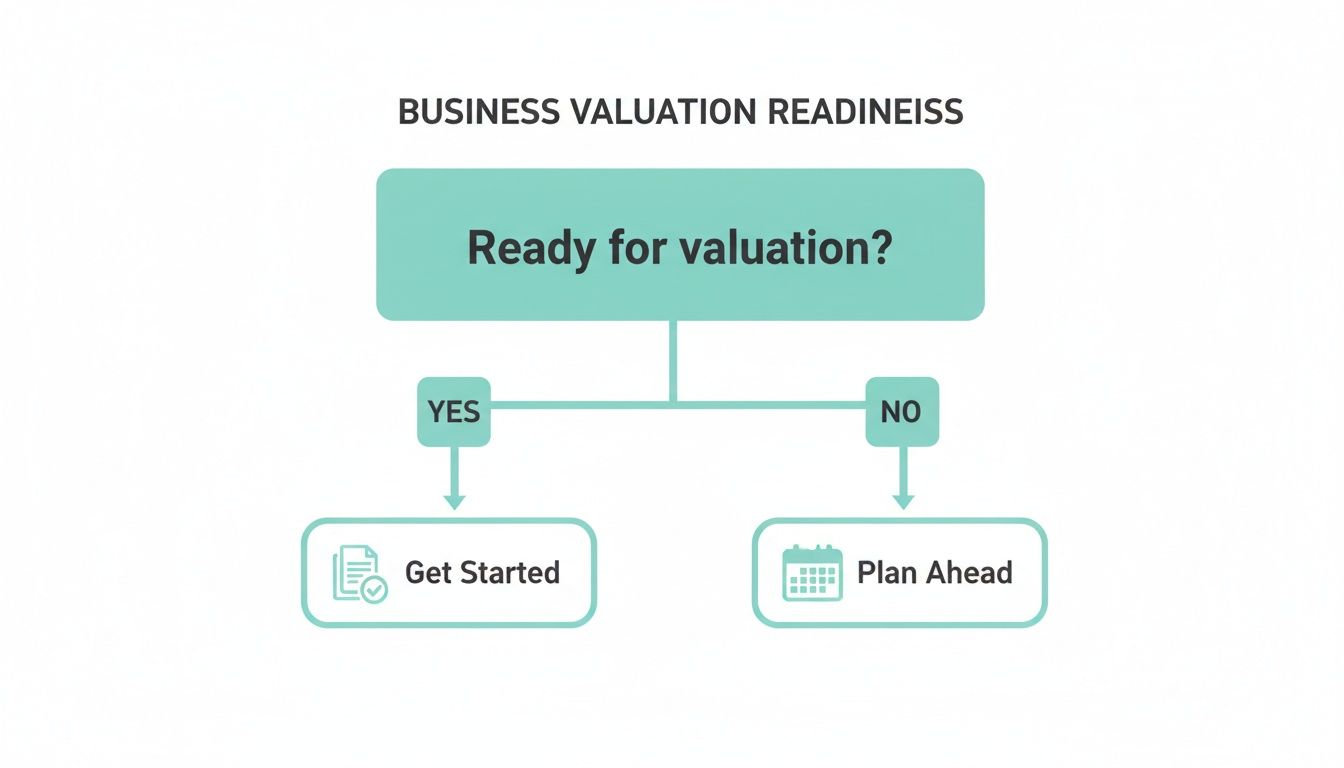
This flowchart provides a clear decision point, reinforcing the idea that a successful valuation often starts with good preparation.
The Asset Approach: What is the Sum of the Parts?
The Asset Approach calculates value based on the fair market value of everything the business owns, minus its liabilities. This is sometimes seen as the "floor" value—what the assets could be worth if the business were to be wound up and everything sold.
This method may be suitable for:
- Asset-heavy businesses like manufacturing, construction, or property development.
- Businesses that are not profitable but hold valuable assets, such as patents or real estate.
- Situations where a business is being wound up.
The calculation is typically: Total Assets – Total Liabilities = Net Asset Value. The complexity lies in adjusting asset values. The "book value" on your balance sheet might not reflect the true market value, especially after years of depreciation. A family-owned vineyard in the Barossa Valley, for example, might own land and equipment that have appreciated significantly beyond what is recorded in the books. An asset-based valuation could capture that underlying worth.
Overview of Key Business Valuation Methods
Each of these valuation methods tells a different part of the story. To make sense of them, it can be helpful to see them side-by-side. The table below summarises the core principle of each approach, where it may work best, and a key consideration for Australian businesses.
| Valuation Method | Core Principle | Best Suited For | Key Consideration |
|---|---|---|---|
| Income Approach | Value is based on the business's ability to generate future cash flow. | Profitable businesses with predictable revenue (e.g., professional services, SaaS). | The choice of discount rate is critical and subjective, reflecting the specific risks of the business. |
| Market Approach | Value is determined by what similar businesses have recently sold for. | Industries with frequent, public transactions (e.g., retail, hospitality, trades). | Relies entirely on the availability of reliable, comparable sales data in the Australian market. |
| Asset Approach | Value is the net worth of the company's assets minus its liabilities. | Asset-heavy industries (e.g., manufacturing, property) or non-profitable businesses. | Requires adjusting assets from book value to their current fair market value, which can be complex. |
Ultimately, no single method will give you the perfect answer. A robust valuation often involves using two or more methods and then reconciling the different results. This triangulation may create a more credible and defensible valuation range.
If you are thinking about the next chapter for your business, exploring our Business and Corporate Advisory services can provide clarity on which valuation approaches may be the right fit for your specific situation.
If you would like clarity on how these principles may apply to your own circumstances, you may wish to speak with a qualified adviser. You can contact Everglow on 1300 913 929 or email contact@everglow.au to arrange a discussion.
General Advice Warning
The information provided is general in nature and does not take into account your personal objectives, financial situation, or needs. Before acting on any information, you should consider the appropriateness of the information in regard to your own objectives, financial situation, and needs, and you should seek personal advice from a qualified professional.
Making Sense of Financial Adjustments and Normalisation
When you look at a business’s financial statements, what you see is often a picture prepared for tax purposes. It may not tell the full story for a potential buyer. To arrive at the real, ongoing profitability of the business, one must look past the reported numbers and make certain adjustments.
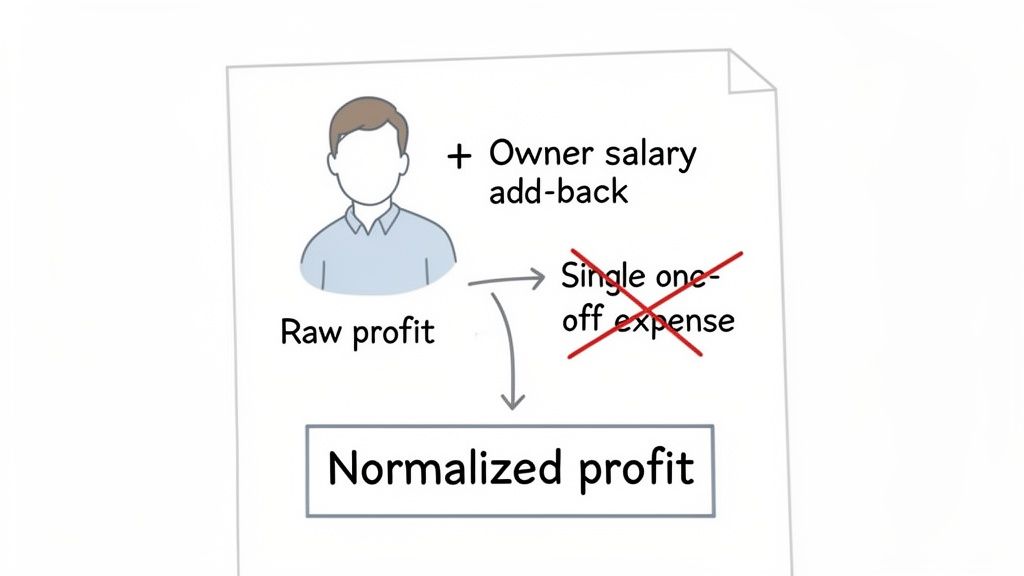
This process is called 'normalisation', and it is about removing items that are not part of core, ongoing operations to get a clear view of the business's sustainable earning power. It is a cornerstone of any credible valuation, providing clarity to both the seller, who wants to show the business’s true potential, and the buyer, who needs to understand what return they might expect.
Identifying Common Adjustments
Normalisation involves removing items that are not part of core, day-to-day operations. These adjustments, often called 'add-backs', should be carefully considered and clearly documented.
Common adjustments may include:
- Owner's Salary and Benefits: An owner might pay themselves a minimal salary for tax reasons. The adjustment involves replacing the owner’s actual drawings with what it would cost to hire a manager to perform the same role at a fair market rate.
- One-Off or Non-Recurring Expenses: If the business had a large, unusual expense last year, such as a significant legal dispute or a major office relocation, these costs may be added back to the profit because they are not expected to recur.
- Discretionary Spending: Personal travel, family mobile phone plans, or other non-essential costs run through the business accounts are typically considered for add-back. Understanding what constitutes a legitimate business expense is key—our guide on small business tax deductions can be a helpful reference.
- Non-Market Rate Transactions: If the business rents its premises from a property owned by the business owner's SMSF at a rate that is above or below market value, an adjustment may be made to reflect a fair commercial rental expense.
Preparing clean and normalised financial data is a foundational part of a solid business valuation. Using reliable tools like a bank statement converter software may help streamline the preparation of your records for this type of analysis.
A Practical Australian Example
Let’s imagine a family-run café in a Melbourne laneway. The financial statements show a net profit of $150,000 for the last financial year. This is the starting point, but it may not be the full picture.
Upon review, a few items could be considered for adjustment:
- Owner's Salary: The owner works full-time as the manager but only paid himself a salary of $50,000. The market rate for a similar role may be closer to $85,000.
- One-Off Expense: They spent $25,000 on a major kitchen fit-out, an expense not expected to recur for many years.
- Discretionary Expenses: Around $10,000 in personal travel and vehicle costs were processed through the business.
To arrive at the normalised profit, or what is often called Seller's Discretionary Earnings (SDE), we would start with the net profit and make these adjustments. This may provide a clearer view of the café's earning power for a new owner.
This process transforms the reported profit into a figure that may better reflect the business's operational performance. It is a critical step that could significantly influence the final valuation, ensuring it is based on maintainable earnings rather than tax-driven accounting figures.
Risks and Responsibilities in Normalisation
The normalisation process is not just an opportunity; it comes with responsibilities. While it can rightfully increase a business's valuation, every adjustment should be transparent, justifiable, and supported by evidence.
A potential buyer and their advisers will likely review these add-backs carefully during due diligence. If they are overstated or include items that are not genuinely one-off or discretionary, it could undermine trust and jeopardise the sale. Good stewardship involves presenting a financial picture that is both optimistic and honest—a fair and sustainable view of the business’s profitability. Seeking professional advice may be appropriate to ensure every adjustment is defensible.
If you would like clarity on how these principles may apply to your own circumstances, you may wish to speak with a qualified adviser. You can contact Everglow on 1300 913 929 or email contact@everglow.au to arrange a discussion.
General Advice Warning
The information provided is general in nature and does not take into account your personal objectives, financial situation, or needs. Before acting on any information, you should consider the appropriateness of the information in regard to your own objectives, financial situation, and needs, and you should seek personal advice from a qualified professional.
Assessing Intangible Assets and Business Risks

While the profit and loss statement provides a starting point for any discussion on how to value a business for sale, it seldom tells the whole story. The enduring worth of a business is often tied to things you cannot see on a balance sheet—the intangible assets that make it competitive and resilient.
A prudent valuation digs deeper than raw numbers. It involves taking a clear-eyed look at these non-financial strengths while also being honest about the risks that could affect future profits. It is this balance between opportunity and vulnerability that may separate a stable investment from a riskier one in a buyer's mind.
Identifying and Valuing Intangible Strengths
Intangible assets are the non-physical economic advantages a business possesses. They do not appear as neat line items, but their power to generate consistent earnings can be significant. A potential buyer understands they are acquiring these strengths just as much as any physical equipment.
Common intangible assets may include:
- Goodwill and Brand Reputation: This is the value that comes from a strong public image and customer loyalty. For a well-regarded professional practice in a growing regional town, this goodwill could be its most significant asset.
- Client Relationships and Contracts: Long-term, recurring revenue from a diverse and loyal client base can be very valuable. A business relying on a handful of major clients may be perceived as riskier than one with many smaller, steady customers.
- Intellectual Property (IP): This can cover everything from trademarks and patents to proprietary software or unique internal processes. For a technology business or a specialised manufacturer, protected IP can create a defensible market position.
- A Skilled and Stable Workforce: An experienced team that operates effectively without constant owner oversight is a considerable advantage. It suggests the business’s success is built into its culture and systems, not just reliant on one person.
A business is more than a collection of assets; it is a living ecosystem. The strength of its client relationships, the efficiency of its processes, and its standing in the community are often what truly drive its long-term value and resilience through different economic seasons.
Understanding and Mitigating Business Risks
Just as intangible strengths can enhance a valuation, certain risks can reduce it. Any prudent buyer will be looking for vulnerabilities that could disrupt earnings after they take over. Identifying these risks early allows you to address them, which may reinforce the stability and attractiveness of your business.
Common areas of risk for buyers could include:
- Key-Person Dependency: If the operation relies heavily on the owner’s personal contacts or unique skills, the value may be discounted. This can be a significant issue for many family businesses. Implementing clear systems and empowering a capable team are core parts of effective succession planning for a family business, which directly addresses this risk.
- Customer Concentration: A business where more than 15-20% of revenue comes from a single client could be seen as a high-risk proposition. The loss of that one account could impact profitability.
- Outdated Systems or Technology: Relying on old software or ageing equipment may signal to a buyer that they will need to invest significant capital to modernise. They may factor that future cost into their offer.
- Market or Regulatory Changes: Businesses in industries prone to rapid technological shifts or heavy government regulation carry external risks that may be out of their control.
By carefully assessing both the hidden strengths and the inherent risks, a much more realistic and defensible valuation can come into focus. This comprehensive view demonstrates foresight, can build confidence with potential buyers, and ultimately may pave the way for a smoother and more successful sale.
If you would like clarity on how these principles may apply to your own circumstances, you may wish to speak with a qualified adviser. You can get in touch with our Everglow team on 1300 913 929 or email contact@everglow.au to arrange a discussion.
General Advice Warning
The information provided is general in nature and does not take into account your personal objectives, financial situation, or needs. Before acting on any information, you should consider the appropriateness of the information in regard to your own objectives, financial situation, and needs, and you should seek personal advice from a qualified professional.
Want help applying this to your situation?
Every situation is different. Book a time with our team to talk it through, or call us on 1300 913 929.