
Navigating Australia’s tax system is a key part of sound financial stewardship. The goal is not to avoid tax, but to understand the established frameworks and make informed decisions that align with your long-term financial objectives. This involves a considered, year-round approach, grounded in Australian tax law, rather than a last-minute scramble before the end of the financial year.
This guide is intended for Australian professionals, business owners, and families seeking clarity on how to manage their tax position responsibly. It focuses on breaking down complex topics—such as deductions, superannuation, and investment structures—into practical, understandable steps. It is a discussion of opportunities and responsibilities, reinforcing that prudent financial management comes from disciplined planning and a clear understanding of the rules.

Foundational Principles of Tax Management
Before exploring specific strategies, it is important to understand the core principles that underpin tax management in Australia. Your taxable income is calculated by subtracting allowable deductions from your assessable income. The objective is to ensure you are claiming all legitimate deductions to which you are entitled, while meeting your obligations to the Australian Taxation Office (ATO).
- Allowable Deductions: These are expenses directly incurred in the course of earning your assessable income. The consistent and accurate claiming of these deductions is the most fundamental aspect of managing your taxable income.
- Income Deferral: In some circumstances, it may be possible to legitimately defer the receipt of income to a future financial year. This could be a consideration if you anticipate being in a lower tax bracket in the future.
- Tax Offsets: It is important to distinguish offsets from deductions. While deductions reduce your assessable income, offsets provide a dollar-for-dollar reduction of the final tax you are required to pay.
A well-considered tax strategy is not built overnight. It is the result of patience, disciplined action, and a clear understanding of both the opportunities and the responsibilities involved.
For many Australians, from new migrants establishing their financial footing to seasoned business owners, grasping these concepts is the first step toward building a resilient financial future. By exploring these compliant strategies, you may take a more active role in shaping your financial outcomes. For a practical application of these principles, our educational resource on Claiming Working from Home Expenses may be a useful starting point.
Utilising Superannuation Strategically
Superannuation is primarily a vehicle for retirement savings, but it also offers one of the most effective and established frameworks for managing your current taxable income. A thoughtful approach to superannuation contributions may provide significant benefits within the Australian tax system.
The primary mechanism for this is through concessional contributions, which are payments made from pre-tax income. Within a superannuation fund, these contributions are generally taxed at a concessional rate of 15%. For many individuals, this rate is considerably lower than their marginal tax rate, and this difference is what makes the strategy potentially effective.
Understanding Concessional Contributions
The most common method for making concessional contributions is a salary sacrifice arrangement. This is a formal agreement with your employer to direct a portion of your pre-tax salary into your super fund. By doing so, you may reduce your assessable income for the financial year, as the sacrificed amount is no longer counted as part of your personal taxable income. You can explore the potential salary sacrifice benefits in more detail on our service page.
Consider an IT consultant, who is an employee earning $130,000 annually. Under current tax thresholds, they pay a marginal tax rate of 37 cents for every dollar earned over $120,000 (plus the Medicare levy). If this individual enters into a salary sacrifice arrangement to contribute $10,000 to their super, that amount would be taxed at 15% inside the fund, rather than at their higher marginal rate. The potential tax difference is clear.
The dual benefit of making additional super contributions is evident: it may help lower immediate tax obligations while simultaneously building a more substantial retirement nest egg. It is a disciplined approach that balances current financial management with long-term security.
Navigating the Rules and Contribution Caps
This strategy operates within strict rules set by the ATO. Adherence to these rules is essential to avoid potential penalties. The most important is the annual concessional contributions cap. For the 2024-25 financial year, this cap is $30,000 for most individuals. This limit includes all concessional contributions, including your employer's mandatory Superannuation Guarantee (SG) payments and any additional salary sacrificed or personal deductible contributions. Exceeding this cap may result in the excess amount being taxed at your marginal rate, along with an additional charge.
Another consideration is the carry-forward unused concessional contributions rule. If your total super balance was below $500,000 at the end of the previous financial year, you may be eligible to contribute more than the annual cap by utilising any unused cap amounts from the past five financial years. This can be a valuable opportunity for individuals who have had a period away from the workforce or have received a one-off payment, such as a bonus, and wish to manage the resulting tax impact. Determining eligibility and calculating the available cap space requires careful review of your superannuation history.
Maximising Work-Related Deductions
A disciplined approach to claiming work-related deductions is another direct way to manage your taxable income. This is not about seeking obscure loopholes, but rather the patient practice of claiming every legitimate expense incurred in the course of earning your income, as permitted under ATO guidelines.
Three fundamental rules govern all claims for work-related deductions:
- You must have spent the money yourself and were not reimbursed.
- The expense must directly relate to earning your income.
- You must have a record to prove the expense. This is a critical compliance obligation.
These principles apply universally, whether you are a medical professional attending a conference or a consultant maintaining a home office.
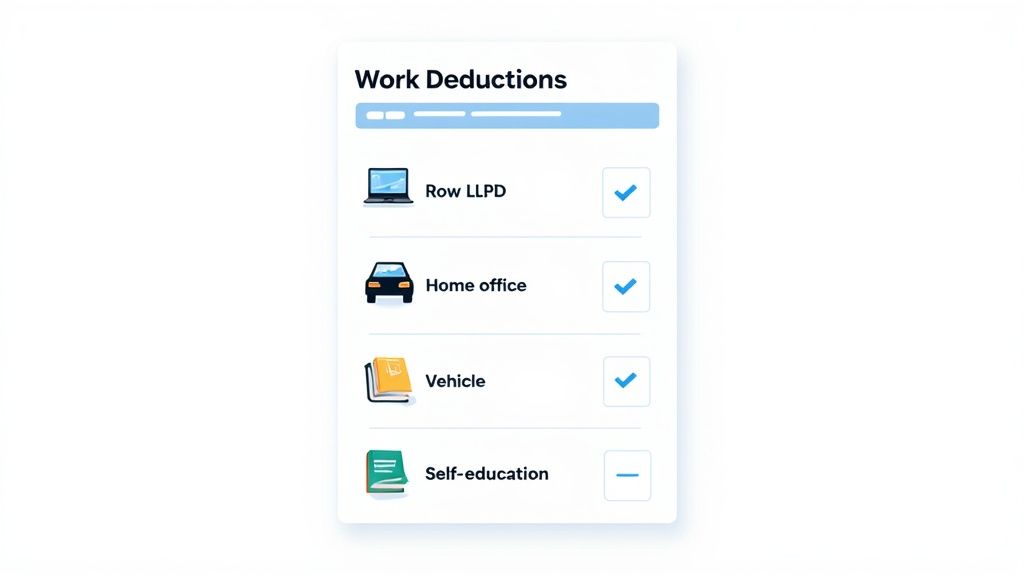
Common Areas for Deductions
A thoughtful review of your annual expenditure often reveals opportunities for deductions you may have previously overlooked. This methodical process of financial housekeeping can yield significant results over time.
For example, a freelance graphic designer working from home may incur expenses for a portion of their internet, electricity, and phone bills. They may also have costs related to software subscriptions, computer equipment, and stationery. Each of these individual expenses, when properly documented, contributes to lowering their overall taxable income. Similarly, a project manager in the construction industry might incur costs for protective clothing, professional association fees, and potentially the use of their personal vehicle for travel between work sites.
The Unwavering Importance of Record Keeping
The strength of any deduction claim rests on the quality of the records kept. The ATO is vigilant in its review of unsubstantiated claims, which underscores the necessity of meticulous documentation. This is not a suggestion but a legal requirement.
Good financial habits are built on the discipline of documentation. A well-organised system for receipts and a clear diary of work-related activities are the foundations upon which a compliant and effective tax strategy is built.
The table below offers a simple guide to the types of records the ATO generally expects for common expense claims. Organising your documents this way reinforces your compliance position and provides peace of mind.
| Expense Category | Type of Record Required | ATO Requirement Summary |
|---|---|---|
| Vehicle & Travel | Logbook, receipts for flights/accommodation, travel diary. | Must distinguish between private and work-related travel. A logbook is often required to establish a work-use percentage. |
| Home Office | Diary/timesheet for hours worked (Fixed-Rate method), or receipts and usage calculations (Actual Cost method). | Records must substantiate the calculation method chosen. |
| Clothing & Uniforms | Receipts for purchase and cleaning. | Must be a compulsory, non-conventional uniform or protective clothing. Laundry claims require a reasonable basis for calculation. |
| Self-Education | Receipts for course fees, textbooks, travel. | The course must have a sufficient connection to your current employment to maintain or improve required skills. |
| Tools & Equipment | Receipts for purchase; depreciation schedule for items over $300. | Must be used for work purposes. The cost must be apportioned between work and private use where applicable. |
This discipline ensures that your claims are not only maximised but also fully compliant and defensible.
Risks, Responsibilities, and Next Steps
Effective tax planning involves understanding established pathways within the Australian tax system. Every decision, from making a super contribution to claiming a deduction, must be anchored in ATO guidelines. This process rewards patient, disciplined action over hasty moves and requires an awareness of potential risks.
Navigating Common Pitfalls
Certain areas can present challenges if not handled with care. A clear understanding of these is as important as knowing the strategies themselves.
- Personal Services Income (PSI) Rules: For consultants, contractors, and many independent professionals, the PSI rules are critical. They determine how your income is taxed and can limit the deductions you may claim. Incorrect application of these rules can lead to significant tax adjustments and penalties.
- Unsubstantiated Claims: The ATO’s position is clear: a claim without proof is a compliance risk. Every deduction must be supported by organised, accessible records.
- Capital Gains Tax (CGT): The sale of an asset like an investment property or shares will likely be a CGT event. While the 50% CGT discount for assets held over 12 months is a valuable concession, its application requires careful planning. For a deeper understanding of this topic, our guide to capital gains tax strategies in Australia may offer valuable insights.
Sound financial decisions are born from a balanced perspective—one that acknowledges potential risks with the same clarity as it sees potential rewards. This thoughtful approach ensures that your strategies are not only effective but also sustainable and compliant.

A Concise Takeaway
True financial progress comes from understanding that managing your tax is a year-round discipline. It involves thoughtful planning, diligent record-keeping, and a clear grasp of your obligations. The goal is to create a financial structure that serves your life goals while respecting the rules of the system in which it operates. This balance is the hallmark of a responsible and effective financial plan.
If you would like clarity on how these principles may apply to your own circumstances, you may wish to speak with a qualified adviser. You can contact Everglow on 1300 913 929 or email contact@everglow.au to arrange a discussion.
General Advice Warning: The information provided in this article is general in nature and does not take into account your personal objectives, financial situation, or needs. Before acting on any information, you should consider the appropriateness of the information having regard to your own objectives, financial situation, and needs, and seek personal advice from a qualified professional.
