
Navigating Australia's tax system is not about seeking loopholes, but about thoughtful and responsible planning. It is a matter of understanding the legitimate strategies approved by the Australian Taxation Office (ATO) to manage the difference between your assessable income (what you earn) and your taxable income (the amount on which you are taxed).
The Foundations of Sound Australian Tax Planning
Effective tax management is rarely the result of a single action taken once a year. It stems from consistent, sound financial habits developed over time. This involves a shift in perspective—viewing tax not as a reactive obligation, but as a proactive component of a long-term financial strategy, aligned with your personal, family, and business objectives.
In principle, the process is straightforward: your assessable income, less your allowable deductions, equals your taxable income. The goal is to ensure every legitimate deduction is claimed, your financial affairs are structured appropriately for your circumstances, and the timing of your income and expenses is carefully considered.
The Core Pillars of Tax Management
Effective tax planning in Australia generally revolves around four key areas. The right combination of these will depend on an individual's specific circumstances, and professional advice may be appropriate to determine a suitable approach.
- Allowable Deductions: This is perhaps the most direct pillar. It involves claiming legitimate expenses directly related to earning your income, from work-related costs for professionals to operational expenses for business owners.
- Tax Offsets: Often confused with deductions, offsets can be more impactful. While a deduction reduces your taxable income, an offset (or rebate) may directly reduce the final tax payable, dollar for dollar, depending on eligibility.
- Superannuation: Superannuation remains one of the most tax-effective vehicles available in Australia for building long-term wealth. The ability to make contributions from pre-tax income, within certain legislative limits, is a cornerstone of prudent financial planning.
- Entity Structuring: The structure through which you earn your income—as a sole trader, in a partnership, or through a company or trust—may have significant and long-lasting implications for your overall tax position. Careful consideration of this from the outset can be crucial.
Sound financial strategy is not solely about the figures on a tax return. It is about building a resilient structure that supports your goals while ensuring you meet your obligations with integrity. True financial stewardship often involves patience, disciplined action, and foresight.
A Broader Perspective
For those with international ties, such as recent migrants or business owners with overseas interests, planning may extend further. Understanding compliant cross-border tax planning strategies could make a material difference to an overall tax position.
For every Australian taxpayer, the starting point is a foundational concept: knowing at what point tax obligations begin. You can gain clarity on this by reading our guide explaining what is the tax-free threshold in Australia.
Ultimately, learning to minimise your taxable income is about making informed, responsible decisions. It requires a clear-eyed view of both potential benefits and inherent responsibilities, ensuring every step taken is compliant, commercially sound, and aligned with your long-term financial wellbeing. This foundation provides the context for the more detailed strategies we will explore next.
Choosing Your Financial Architecture
The structure used to earn income and hold assets is one of the most important financial decisions one can make. It affects not just the current year's tax liability, but also sets the foundation for asset protection, succession planning, and the ability to reinvest and grow wealth. Getting this right may require foresight and a clear understanding of how each option operates under Australian law.
There is no single correct answer. The appropriate path for a freelance consultant may be quite different from that of a family-run café or a medical professional with a busy practice. Each structure—sole trader, partnership, company, or trust—offers a different balance between simplicity, protection, and strategic flexibility.
The objective is to legally and efficiently manage the journey from total earnings (assessable income) to the final amount on which tax is levied (taxable income).
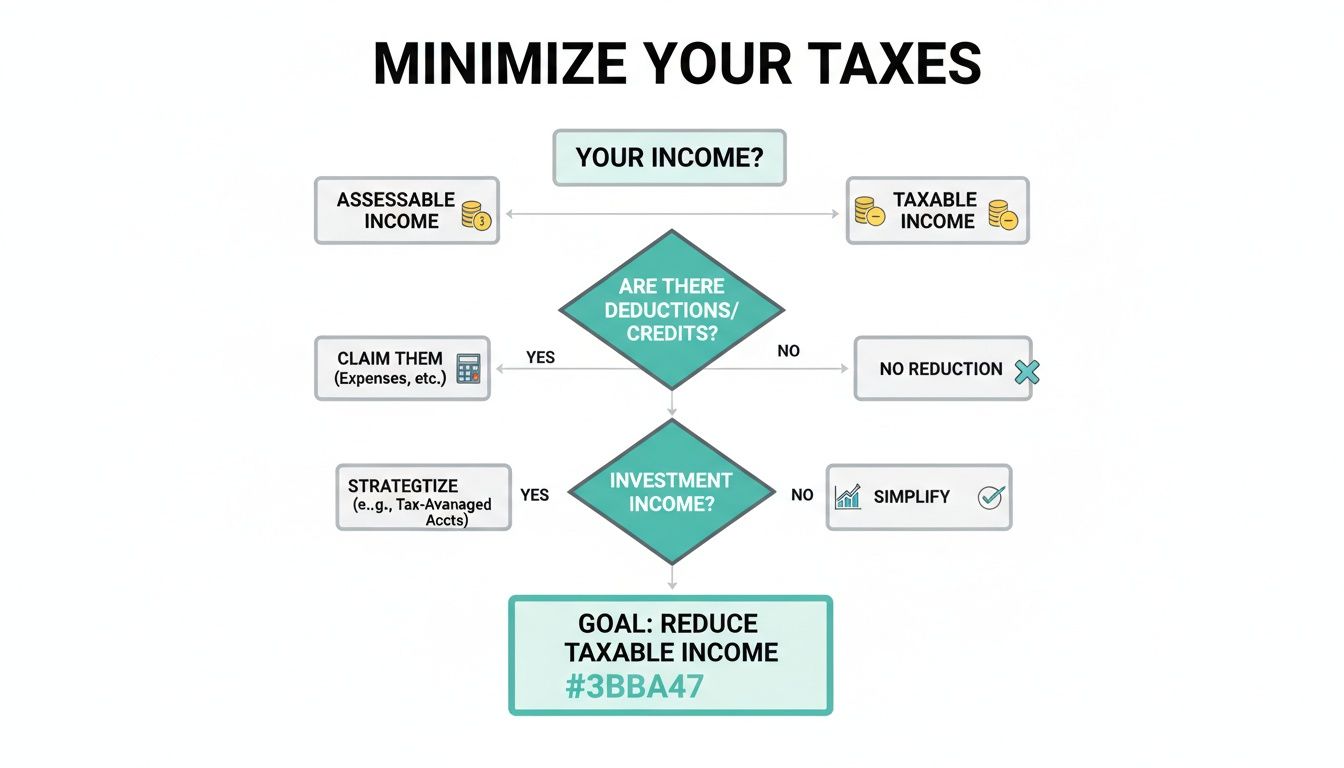
This flowchart brings the process back to its fundamentals. A key goal may be to legally reduce taxable income, and choosing an appropriate structure can be a powerful first step.
Common Structures and Their Strategic Use
For many individuals starting a business, operating as a sole trader is the simplest approach. Business income is treated as personal income. While straightforward, this structure offers no legal separation between personal and business assets. This may be suitable initially, but as income and risk profiles grow, other options might be considered.
A company structure creates a separate legal entity, which can be a significant change. One potential advantage is the capped tax rate on profits retained within the company, currently 30% (or 25% for eligible base rate entities). This may allow a business to reinvest its earnings for growth more efficiently than if those profits were paid to an individual in a high personal tax bracket.
Trusts, on the other hand, can offer flexibility.
A trust is not a legal entity like a company. It may be better understood as a relationship where a trustee holds assets for the benefit of others (the beneficiaries). Its potential strength lies in its ability to distribute income.
Consider a family business operating through a discretionary trust. The trustee may have the discretion to stream profits to adult family members who are on lower marginal tax rates. For example, if an adult child is at university with little income, distributing a portion of the trust's profit to them could be a tax-effective way to support their living expenses, as that income would be taxed at their lower marginal rate. For a deeper look at the mechanics, our guide explains how a trust operates.
Understanding Personal Services Income (PSI)
For consultants, contractors, and specialists, the Personal Services Income (PSI) rules are a critical consideration. The ATO introduced these rules to address situations where individuals earning income from their personal skills might use companies or trusts primarily to reduce their tax obligations.
If income is deemed to be PSI and certain tests are not met (such as the results test or having unrelated clients), the income is treated as the individual's personal income for tax purposes. This generally means the range of deductions available is more limited, similar to that of an employee. Navigating these rules carefully is essential, as they directly impact structuring and claimable expenses.
Risks and Responsibilities in Structuring
Choosing a structure is not just a tax minimisation exercise; it comes with significant responsibilities.
- Compliance Obligations: Companies and trusts typically have higher setup costs and ongoing administrative requirements, such as those stipulated by ASIC, and may require more complex annual tax returns.
- Commercial Reality: The ATO expects to see a sound commercial reason for any structure. Arrangements that appear to exist solely to reduce tax may attract scrutiny.
- Asset Protection: While companies and trusts can help shield personal assets from business liabilities, this protection is not absolute. Directors may still be held personally liable in certain circumstances.
- Long-Term View: The ideal structure today may not be suitable in ten years. Life events—such as bringing on a partner, planning for retirement, or family succession—may necessitate a review and adaptation of the structure.
Making this foundational decision requires a calm assessment of one's current position and future aspirations. It is about building a framework that is not only potentially tax-effective but also robust, compliant, and supportive of long-term success.
Maximising Deductions and Superannuation Contributions
Once a suitable financial structure is in place, the ongoing work begins. Consistent, effective tax planning often comes down to two elements: the day-to-day discipline of claiming every legitimate deduction and the long-term strategy of using superannuation effectively.
This is not about finding obscure loopholes. It is about methodically and correctly applying the rules as they stand, which requires diligence, forward-thinking, and a clear understanding of what the Australian Taxation Office (ATO) considers a legitimate claim.
At its most basic, a deduction is an expense incurred in the course of earning assessable income. The ATO provides a straightforward framework for this, often referred to as the 'golden rules' of deductions.

The Three Golden Rules for Deductions
Before claiming an expense, it may be prudent to assess it against these three tests.
- Direct Connection to Income: The expense must have been paid by you and not reimbursed. Crucially, it must be directly related to earning your income.
- Substantiation: You must have a record to prove the expense. This is typically a receipt, but bank statements, logbooks, or other documents may also be acceptable.
- Apportionment: If an expense was for both work and private use, only the work-related portion can be claimed.
For instance, consider a medical specialist attending an international conference. The flights, accommodation, and conference fees may be deductible as self-education expenses, as they directly maintain or improve the skills required for their profession.
However, if they extend the trip for a week-long holiday, that portion is private in nature, and those costs cannot be claimed. Apportionment is critical.
Superannuation as a Tax-Effective Vehicle
While deductions reduce taxable income, superannuation offers a powerful way to build wealth in a tax-advantaged environment. For many professionals and business owners, making additional superannuation contributions is a key part of their strategy to manage their annual tax liability.
The main tool for this is concessional contributions, which are payments made from pre-tax income. This includes an employer's compulsory super guarantee payments, as well as any additional amounts contributed through salary sacrificing or as personal deductible contributions. Our guide on the benefits of salary sacrificing unpacks this in more detail.
The potential advantage lies in the tax treatment. Instead of being taxed at an individual's marginal tax rate (which can be up to 47% including the Medicare levy), these contributions are generally taxed at a flat rate of 15% within the superannuation fund. This immediate tax differential can significantly accelerate the growth of a retirement nest egg.
Of course, it is important to understand the full picture, particularly for high-income earners. If an individual's combined income and super contributions exceed $250,000, the Division 293 tax rule may apply, adding an extra 15% tax on their concessional contributions. While this brings the total tax to 30%, it may still represent a significant saving compared to the top marginal rate.
Staying Informed of the Rules
The tax landscape is dynamic, and staying informed is important. For example, the concessional superannuation contribution cap is set to rise to $30,000 from 1 July 2024. For small businesses with an aggregated turnover of less than $10 million, the temporary immediate asset write-off allows for the full deduction of eligible assets costing less than $20,000 (if purchased and installed ready for use before 30 June 2025).
Understanding how to use these legislative provisions may be key. It can also be worthwhile to investigate specific investment structures. For those interested in property, understanding the potential Real Estate Syndication Tax Benefits could open up another avenue for considered financial planning.
The key is to view deductions and superannuation not as separate tasks, but as integrated parts of an overall financial plan, underpinned by diligent record-keeping and a proactive mindset.
The Strategic Importance of Timing
Beyond structures and deductions, one of the most practical tools in tax planning is the calendar. Much of effective financial management comes down to thoughtful timing—understanding how the flow of income and expenses across financial years can influence a final tax bill. This is not about tax avoidance; it is about making deliberate, compliant choices that align with one's financial rhythm.

The period leading up to 30 June is a critical window. It presents an opportune time to assess one's financial position and make considered moves that may legitimately reduce the tax liability for the current year.
Managing Income and Expenses Across Financial Years
One of the most direct timing strategies involves managing cash flow. The principle is straightforward: where it makes commercial sense, one might look to accelerate deductions into the current financial year and defer assessable income into the next.
Consider a consultant finalising a major project in late June who has some discretion over invoicing. By issuing the invoice in the first week of July instead of the last week of June, that income now falls into the next financial year. This simple shift could be advantageous if they anticipate a lower income in the following year, potentially placing them in a more favourable tax bracket.
Conversely, bringing forward deductible expenses can be equally powerful. This could involve:
- Prepaying expenses: Small businesses can often claim an immediate deduction for certain prepaid expenses, such as paying for a 12-month insurance policy or a key software subscription in June.
- Timing of purchases: If new equipment or tools are needed for work, purchasing them before 30 June means any applicable deductions may be claimed in the current financial year.
- Making donations: Charitable donations are deductible in the year they are made. Bringing forward planned donations can be a way to reduce a current tax bill while supporting a valued cause.
Of course, staying on top of key dates is crucial. A clearer picture of important deadlines can be found in our guide on Australian tax due dates.
Timing and Capital Gains Tax
Nowhere is the principle of timing more important than when dealing with investments and capital assets. Australian tax law offers a significant incentive for patient, long-term investors through the Capital Gains Tax (CGT) discount.
If an individual holds an asset—such as shares or an investment property—for more than 12 months before selling, they may be eligible to reduce the taxable capital gain by 50%. This is a foundational element of long-term wealth strategy in Australia.
This makes the calendar a vital tool. The difference between selling an asset at 11 months versus 13 months can have a profound impact on the tax outcome. It is a simple rule, but one that can be easily overlooked.
Furthermore, timing the realisation of capital losses can be a prudent move. If a capital gain has already been realised during the financial year, selling other investments at a loss may offset those gains, reducing the net taxable gain. Thoughtful portfolio management is not just about what you buy, but also about when you choose to sell.
Viewing the financial calendar as a flexible planning tool, rather than a series of rigid deadlines, is a hallmark of prudent financial stewardship. It empowers calm, informed decisions that serve both immediate tax obligations and broader, long-term goals.
Grappling with PSI Rules and Bracket Creep
For many Australian professionals and business owners, two quiet challenges are often at play in the background: the complexities of Personal Services Income (PSI) rules and the slow, steady effect of bracket creep. These are not merely abstract tax concepts; they can directly impact take-home pay and the deductions that may be legitimately claimed.
Addressing these is not about finding clever loopholes, but about understanding the nuances of the system in order to plan effectively and remain compliant.
Demystifying Personal Services Income
If you are a consultant, IT contractor, medical professional, or earn your living primarily from your personal skills and effort, the PSI rules are a critical piece of the puzzle. The ATO implemented these rules to ensure that individuals cannot use a company or trust structure solely to reduce their tax bill by claiming deductions that would not be available to a regular employee.
The first step is to determine if your income is classified as PSI. If it is, you then need to ascertain if you are operating a Personal Services Business (PSB). This involves passing one of several strict ATO tests, such as the 'results test', which examines whether you are paid to produce a specific outcome and are responsible for rectifying any defects in your work.
If you do not qualify as a PSB, the PSI rules generally apply, which typically means:
- The income is automatically attributed back to the individual who performed the work, regardless of the business structure it was earned through.
- The range of claimable deductions is significantly limited, bringing them more in line with what a typical employee could claim. For instance, payments to an associate for non-principal work are generally not deductible.
These rules demand careful navigation. Structuring business affairs to be compliant while allowing for growth is a considerable challenge, and an area where seeking professional advice early can prevent future complications.
The Silent Erosion of Bracket Creep
While PSI is an active set of rules that must be navigated, bracket creep is a more subtle force that can quietly erode financial progress. It occurs when inflation pushes nominal income into a higher tax bracket, even if real purchasing power has not increased.
The tax thresholds remain fixed while wages rise, meaning a larger portion of earnings is directed to the tax office.
Bracket creep is the quiet consequence of a growing income meeting stationary tax thresholds. It underscores why proactive tax planning is not a one-off event, but an ongoing discipline required to preserve the real value of one's earnings.
This is a tangible issue for many Australians. As incomes rise to keep pace with inflation, more people are pushed over tax thresholds into higher brackets. You can read more on tax strategies to manage this on hudsonfinancialplanning.com.au.
Here is a simple illustration of how this can play out.
Impact of Bracket Creep on Take-Home Pay
The table below shows how a modest pay rise, intended to cover inflation, can lead to a higher effective tax rate because the tax thresholds have not moved.
| Metric | Year 1 | Year 2 (with Inflation) |
|---|---|---|
| Annual Salary | $90,000 | $94,500 (5% increase) |
| Marginal Tax Rate Applies to Top Portion | 32.5% | 32.5% |
| Total Income Tax (Approx.) | $19,822 | $21,630 |
| Average Tax Rate | 22.02% | 22.89% |
| Take-Home Pay | $70,178 | $72,870 |
| Increase in Take-Home Pay | N/A | +3.83% |
In this example, although the individual received a 5% pay rise, their take-home pay only increased by 3.83%. The difference was absorbed by a higher tax bill—this is bracket creep in action.
One of the effective ways to manage this may be through additional superannuation contributions. By directing pre-tax income into the low-tax superannuation environment, it is possible to lower taxable income, potentially keeping it below a higher tax bracket. Our guide explains how you might be able to cut your tax to 15% using super.
Understanding both the direct regulations of PSI and the indirect pressure of bracket creep is key to resilient financial planning. It encourages forward-thinking, prompting decisions made not just for today, but with a clear view of their future impact.
Risks, Responsibilities, and Seeking Guidance
Prudent tax planning is not only about identifying opportunities; it is about balancing them with responsibilities. Every decision made to minimise taxable income carries a corresponding duty of compliance. This final element is less about strategy and more about stewardship—understanding your obligations and the distinction between legitimate planning and illegal tax evasion.
At the core of this is one non-negotiable principle: every financial arrangement must have a sound commercial basis. The Australian Taxation Office (ATO) has a sharp focus on structures that appear to exist solely for a tax benefit. Any strategy should be underpinned by a genuine business or investment purpose.
Meticulous Records and ATO Areas of Focus
The absolute foundation of compliant tax management is meticulous record-keeping. Without clear, organised, and contemporaneous records, even the most legitimate deductions may be challenged and disallowed by the tax office.
The ATO consistently focuses its attention on a few key areas where claims are often scrutinised:
- Work-Related Expenses: Claims for a home office, vehicle use, or self-education need to be carefully apportioned between work and private use. Detailed records like logbooks and receipts are required to substantiate the work-related portion.
- Rental Property Deductions: Owners of investment properties must keep diligent records of all income and expenses. The ATO pays close attention to interest expense claims and ensures capital works are depreciated correctly over time, rather than claimed as an upfront deduction.
- Business Deductions: For business owners, the distinction between private and business expenses is paramount. Claiming personal expenses through the business is a significant red flag for auditors.
Good tax management is built on diligence and integrity. It is about confidently claiming what you are entitled to because you have clear evidence to support it, all while respecting the spirit and the letter of the law.
Knowing When to Seek Professional Counsel
While understanding the principles of tax planning is empowering, there comes a point where complexity may outgrow general knowledge. Recognising this threshold is a sign of financial maturity. Professional guidance may become a necessity when your situation involves:
- Establishing a business or investment structure like a company or trust.
- Navigating the Personal Services Income (PSI) rules.
- Managing a significant capital gains event, such as the sale of a property or a business.
- Addressing international tax matters as a migrant or with overseas assets.
- Planning for business succession or retirement.
A qualified adviser does not offer secret loopholes. They provide clarity and foresight, helping to ensure your financial architecture is not only potentially tax-effective but also robust, compliant, and aligned with your long-term goals. If you are navigating these complexities, our tax advisory services may provide the clarity needed to move forward with confidence.
Practical Next Steps
Putting these principles into practice is not a one-off task; it is a long-term discipline built on informed and patient decisions. The strategies discussed provide a framework, but their application will always depend on your personal goals, income, and financial structure.
It may be useful to reflect on which areas offer the most immediate opportunity for you. Is it structuring? Maximising deductions? Or perhaps better timing of financial decisions?
Whatever the focus, the first step is always the same: immaculate record-keeping. It is the bedrock of every legitimate tax claim and the only way to truly understand how to minimise taxable income effectively. For a refresher on foundational principles, our educational resource on financial planning essentials is a good place to start.
As your financial world grows, the value of professional guidance often becomes clearer. If you find yourself navigating the complexities of business expansion or significant investments, our tax advisory services can provide the clarity needed to move forward with confidence. Ultimately, thoughtful stewardship of your finances is a journey, not a destination.
If you would like clarity on how these principles may apply to your own circumstances, you may wish to speak with a qualified adviser. You can contact Everglow on 1300 913 929 or email contact@everglow.au to arrange a discussion.
General Advice Warning
The information provided in this article is general in nature, does not take into account personal objectives, financial situation, or needs, and readers should seek personal advice before acting.
