

Managing your financial affairs thoughtfully is a cornerstone of building long-term security. A key part of this stewardship involves understanding your taxable income, a figure that reflects your financial story for the year. The objective, for many, is to ensure this amount is managed as efficiently as possible within the bounds of Australian law. This typically involves two core principles: making sure all legitimate deductions are accounted for, and making considered use of concessional arrangements such as superannuation.
This process is not about avoiding obligations, but about applying the rules correctly and with foresight. By reducing your assessable income through legitimate, ATO-guided methods, you may lower the final figure upon which your tax is calculated.
Understanding Your Taxable Income Framework
Before exploring specific strategies, it is important to understand what taxable income represents within the Australian system. It is less a number to be feared and more a calculation that, with careful planning, may be managed as part of your overall financial health.
Adopting this perspective shifts the focus from tax as an uncontrollable expense to a manageable component of your financial life.
The Australian Taxation Office (ATO) applies a straightforward formula: your assessable income minus your allowable deductions. Sound tax management, therefore, is about ensuring this calculation is as accurate and efficient as your circumstances permit, while remaining fully compliant with your responsibilities.
The Core Components
The key pieces of this financial puzzle are:
- Assessable Income: This is the starting point. It may include your salary and wages, business income, investment returns, and other earnings that must be declared.
- Allowable Deductions: These are the specific, eligible expenses you may have incurred to earn that income. Claiming these correctly is a direct way to reduce your taxable income.
A Measured and Compliant Approach
Thoughtful financial stewardship involves understanding the legitimate tools at your disposal. This guide explores some of the well-established pillars of tax planning in Australia, from maximising deductions and leveraging superannuation to the timing of income and expenses.
For many people, this journey begins with foundational concepts like the tax-free threshold. For a detailed explanation, you may find it helpful to understand what is the tax-free threshold in Australia, as this sets the initial context for how your income is assessed.
Navigating your tax obligations is a marathon, not a sprint. The goal is to build a sustainable financial position year after year, grounded in sound principles and a clear understanding of the rules.
Whether you are a medical professional managing personal services income (PSI), a small business owner reinvesting in your enterprise, or a family planning for the future, getting these fundamentals right is the first step. It can empower you to meet your responsibilities with confidence while building long-term financial wellbeing.
If you would like clarity on how these principles may apply to your own circumstances, you may wish to speak with a qualified adviser. You can contact Everglow on 1300 913 929 or email contact@everglow.au to arrange a discussion.
General Advice Warning: The information provided in this article is general in nature and does not take into account your personal objectives, financial situation, or needs. Before acting on any information, you should consider the appropriateness of the information in regard to your own situation and seek professional advice.
Maximising Legitimate Deductions and Concessions
One of the most direct ways to manage taxable income is to claim every deduction to which you are legally entitled. This extends beyond simply tallying work-from-home expenses; it requires a thoughtful review of every cost incurred in earning your income. The guiding principle from the Australian Taxation Office (ATO) is that an expense must have a direct connection to how you generate your income.
For a doctor, this could include not only professional equipment but also costs for continuing professional development, subscriptions to medical journals, or specific professional indemnity insurance premiums. These expenses may be deductible because they are essential for maintaining and improving their ability to provide care.
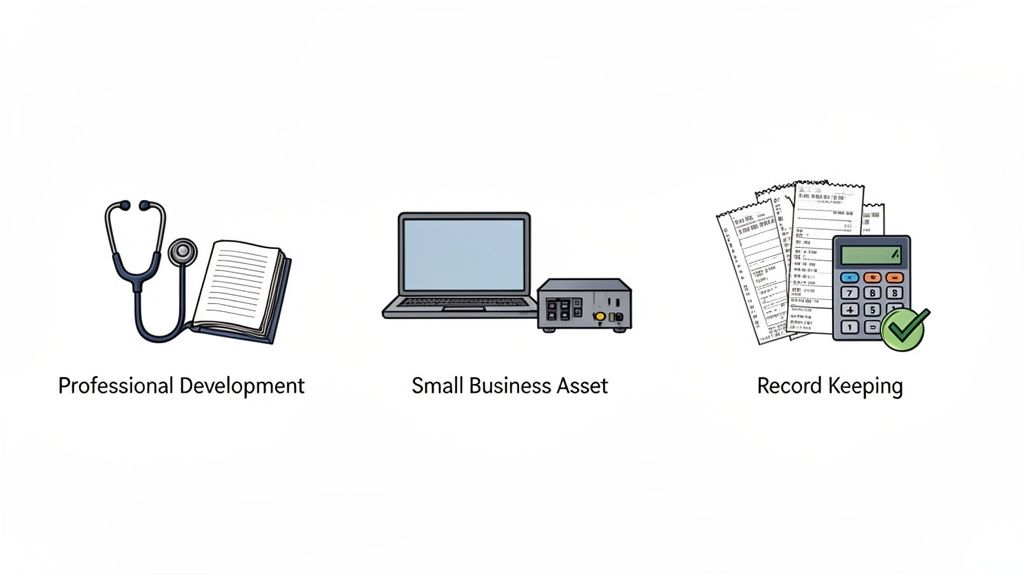
This same logic applies to business owners. A local construction company, for instance, might be able to immediately deduct the cost of eligible new equipment under instant asset write-off provisions, rather than depreciating it over many years. Depending on the circumstances, this could have a significant impact on their taxable profit for the financial year. In every case, the crucial element is the direct link between the expenditure and the income-producing activity.
The Cornerstone of Substantiation: Record Keeping
Your ability to claim a deduction is entirely dependent on your ability to prove it. Without meticulous records, even the most legitimate expense claim can be questioned by the ATO. Good financial stewardship begins with diligent record-keeping. This involves more than collecting receipts; it requires a systematic approach to documenting your financial activities.
- Digital Records: Consider using accounting software or dedicated applications to capture and categorise receipts as they are received.
- Logbooks: If a vehicle is used for both business and private purposes, maintaining a detailed, contemporaneous logbook is often essential for claiming motor vehicle expenses.
- Contemporaneous Notes: For travel or other complex claims, noting the purpose, date, and details of an expense can provide important context if the ATO seeks clarification.
A well-organised set of records is your most powerful tool in any discussion with the ATO. It demonstrates diligence and provides a clear, defensible narrative for your financial activities.
This discipline is not just about compliance; it provides clarity. When you can see precisely where your funds are allocated, you are in a stronger position to make informed decisions about future spending and investment.
Common Deductions Across Professions and Businesses
While specific entitlements vary, certain types of deductions are relevant to many Australians. Our guide on small business tax deductions explores this topic in more detail.
Consider a freelance graphic designer operating from a home office. Depending on their circumstances, they may be able to claim a portion of their home internet, electricity, and phone bills. They might also be able to deduct the cost of industry-specific software or membership fees for professional associations. Similarly, a new migrant to Australia running a consulting business may be able to claim certain initial costs of establishing their ABN and business registration.
The key is to think critically about every cost associated with your work.
Example: A Sole Trader IT Consultant
An IT consultant who travels to client sites may be able to compliantly claim:
- The cost of fuel and maintenance for their vehicle, correctly apportioned for business use via a logbook.
- Premiums for public liability and professional indemnity insurance.
- The decline in value (depreciation) of their laptop and other essential technology.
- Fees for ongoing certification courses that maintain their industry-relevant skills.
Each of these expenses could be directly tied to their ability to secure contracts and deliver services, potentially making them legitimate deductions that help to lower taxable income.
A Note on Apportionment
It is vital to remember the concept of apportionment. If an item is used for both work and private purposes—such as a mobile phone or car—you may only be able to claim the work-related portion. The ATO expects a reasonable and defensible method for calculating this division, which brings us back to the importance of keeping detailed records.
When you approach your deductions with diligence and a solid understanding of the rules, you can meet your tax obligations with confidence, ensuring you do not pay more tax than necessary.
If you would like clarity on how these principles may apply to your own circumstances, you may wish to speak with a qualified adviser. You can contact Everglow on 1300 913 929 or email contact@everglow.au to arrange a discussion.
General Advice Warning: The information provided in this article is general in nature and does not take into account your personal objectives, financial situation, or needs. Before acting on any information, you should consider the appropriateness of the information in regard to your own situation and seek professional advice.
Leveraging Superannuation for Tax Effectiveness
While superannuation is primarily a vehicle for retirement savings, it is also a powerful, government-endorsed structure for managing taxable income throughout your working life. This is not about finding loopholes but about using the system as it was designed. With foresight, you may be able to align your immediate tax planning needs with your long-term goal of building wealth.
Making thoughtful contributions to your superannuation fund can be a direct and compliant way to lower your assessable income for the year. The primary tool for this is concessional contributions—contributions made from your pre-tax income.
Inside the superannuation fund, these contributions are generally taxed at a flat rate of 15%. For many professionals and business owners, this rate may be considerably lower than their personal marginal tax rate.
This can be achieved in two main ways:
- Salary Sacrificing: An arrangement with your employer where they direct a portion of your pre-tax salary into your superannuation fund.
- Personal Deductible Contributions: If you are self-employed or your employer does not offer salary sacrificing, you may be able to make a contribution from your own funds and then claim it as a tax deduction.
Understanding the Financial Impact
The potential benefit lies in the difference between your personal tax rate and the 15% tax rate within superannuation. For higher-income earners, this difference may be substantial. It is important to remain within your annual contribution cap. For the 2026–27 financial year, the general concessional contributions cap is $32,500.
For example, a medical specialist earning over $180,000 per annum is in a 37% tax bracket (plus the 2% Medicare levy). A $27,500 concessional contribution to their superannuation could reduce their taxable income by that amount, potentially lowering their personal tax bill by around $10,725. The contribution itself would be taxed at 15% inside the super fund ($4,125), but the potential net tax saving for the year could still be a significant $6,600.
Illustrative Tax Savings from Concessional Superannuation Contributions
This table provides a simplified comparison of the potential tax outcomes for an individual with and without making a personal deductible superannuation contribution.
| Scenario | Without Contribution | With $20,000 Contribution |
|---|---|---|
| Taxable Income | $180,000 | $160,000 |
| Marginal Tax Rate (+ Levy) | 39% | 39% |
| Personal Income Tax | $51,567 | $43,767 |
| Tax Paid within Super | $0 | $3,000 (15% of $20,000) |
| Total Tax Paid | $51,567 | $46,767 |
| Potential Net Tax Saving | $4,800 |
Note: Figures are illustrative and based on 2023-24 tax rates. They do not constitute financial advice.
As this illustration shows, a $20,000 contribution could result in a tangible tax benefit. It is a disciplined action that may offer tax effectiveness now and supports compounding growth over the long term.
The decision to contribute more to superannuation is a commitment to your future self. It involves preserving capital for retirement, a disciplined action that rewards patience with both tax effectiveness now and compounding growth over time.
This strategy requires planning. You must stay within the caps and be comfortable with the funds being preserved until you meet a condition of release. For a deeper understanding of the mechanics, our article on how to cut tax to 15% using super may be a useful resource.
A Strategy for Higher Income Years
The superannuation rules also include carry-forward concessional contributions. This provision may allow you to use any of your unused concessional cap amounts from the previous five financial years, provided your total super balance was under $500,000 at the end of the prior financial year.
This can be particularly useful for people with fluctuating incomes. A consultant who completes a large project, a business owner who has an exceptional year, or an employee who receives a significant bonus may be able to make a larger deductible contribution in that high-income year by utilising unused caps from previous, leaner years. This could help to reduce their tax liability when it is highest.
This requires diligent record-keeping of past contributions and balances, but it can be a valuable planning tool.
If you would like clarity on how these principles may apply to your own circumstances, you may wish to speak with a qualified adviser. You can contact Everglow on 1300 913 929 or email contact@everglow.au to arrange a discussion.
General Advice Warning: The information provided in this article is general in nature and does not take into account your personal objectives, financial situation, or needs. Before acting on any information, you should consider the appropriateness of the information in regard to your own situation and seek professional advice.
The Impact of Structuring and Timing
For business owners and investors, two factors can have a significant impact on tax outcomes: how your financial affairs are structured, and when you make key decisions. The right structure lays the foundation for how income is treated, assets are protected, and profits are distributed. Beyond this, the timing of financial actions can lawfully shift tax liabilities between financial years, offering greater control over cash flow.
Choosing the Right Business Structure
The entity you operate under—be it as a sole trader, a partnership, a company, or a trust—has profound implications for your tax position. Each comes with its own set of rules, responsibilities, and strategic opportunities.
- A sole trader structure is the simplest. The business and the individual are legally one and the same, and business income is taxed at the individual's marginal rate. It can be suitable when starting out but may offer limited asset protection and tax planning options as income grows.
- A company is a separate legal entity. Its profits are taxed at the company tax rate (currently 25% for base rate entities). This can be advantageous for retaining profits to fund growth, but it requires more formal compliance under ASIC regulations.
- A trust is a common and powerful structure for family businesses and investment holdings. A trust distributes its income to beneficiaries, who are then taxed at their own marginal rates. This can offer considerable flexibility for tax planning. You can learn more about how a discretionary trust works for further context.
The optimal structure is rarely static. As a business or investment portfolio matures, its needs evolve. What was suitable in the first year of operation may become inefficient in the tenth.
An Example of Structure in Action
Consider a family-run physiotherapy clinic that began as a sole tradership. As the clinic grew, the founder's personal taxable income increased, pushing them into a higher tax bracket. By restructuring to a company or a discretionary trust, more options may become available. A company structure could cap the tax on retained profits at the lower company rate, freeing up capital for reinvestment. A trust might allow for income to be distributed to family members in lower tax brackets who are legitimately involved in the business, which could lower the family’s overall tax liability.
This flowchart illustrates how timing a super contribution in a high-income year may lead to a lower tax bill.

The key takeaway is that strategic action, taken at the right time, can have a direct and positive impact on your tax liability for that financial year.
The Art of Timing Your Financial Decisions
Just as important as structure is the timing of your income and expenses. With careful planning, you may be able to influence which financial year certain amounts are assessed in.
Two common strategies are:
- Prepaying Expenses: Some small businesses may be able to claim an immediate deduction for certain prepaid expenses covering a period of up to 12 months. This could include insurance premiums, subscriptions, or rent paid before 30 June.
- Deferring Income: Where commercially sensible and allowable, you might time the issue of invoices so that payment is received in the next financial year. This may be relevant for contractors or consultants with some control over their billing cycles.
A Measured View on Negative Gearing
For property investors, negative gearing is a well-known strategy. It occurs when the deductible expenses of an investment property—such as interest, council rates, and maintenance—exceed the rental income it generates. This net rental loss may then be offset against other assessable income, potentially reducing an individual's overall taxable income for the year.
This is not a guaranteed path to wealth. Negative gearing requires a long-term view and careful cash flow management, as you are funding a shortfall each month. The strategy often relies on the expectation that the property's capital growth over time will outweigh the cumulative losses incurred. It is a decision that demands a clear understanding of both the potential tax benefits and the real financial risks involved.
If you would like clarity on how these principles may apply to your own circumstances, you may wish to speak with a qualified adviser. You can contact Everglow on 1300 913 929 or email contact@everglow.au to arrange a discussion.
General Advice Warning: The information provided in this article is general in nature and does not take into account your personal objectives, financial situation, or needs. Before acting on any information, you should consider the appropriateness of the information in regard to your own situation and seek professional advice.
Navigating Your Risks and Responsibilities
While the strategies discussed may offer legitimate ways to manage your finances, they are accompanied by a clear set of responsibilities. Effective tax planning is about diligent and ethical financial stewardship, not the pursuit of aggressive loopholes. This means every decision must be transparent, sustainable, and entirely defensible under Australian law.
The Australian Taxation Office (ATO) has a robust framework to protect the integrity of the tax system, including anti-avoidance provisions designed to counter arrangements created solely for a tax benefit. Building lasting prosperity means making choices that stand on solid commercial ground.
The Non-Negotiables of Compliance
Every strategy to manage your taxable income is built on the principle of meticulous compliance. This is an active, ongoing process of good financial governance.
Key responsibilities include:
- Impeccable Record-Keeping: Every deduction claimed and every financial action taken should be supported by clear, contemporaneous documentation. This is your first and best line of defence.
- Adherence to ATO Guidelines: You must operate within established rules, whether claiming expenses, making superannuation contributions, or structuring business affairs.
- Understanding the Dominant Purpose: For any arrangement, the ATO will consider its dominant purpose. If the main goal is simply to obtain a tax benefit, rather than a genuine commercial outcome, it may be challenged.
A thoughtful and compliant approach to tax planning is about ensuring your financial structures are robust enough to withstand scrutiny. It is a measure of prudence and foresight.
Understanding the Potential Consequences
It is important to understand the potential consequences of overly aggressive or poorly documented strategies. This is not to cause alarm, but to reinforce the value of a measured and informed approach.
Potential outcomes of non-compliance can include:
- ATO Audits and Reviews: The ATO uses sophisticated data-matching technology to identify anomalies, which can trigger a review or audit of your financial affairs.
- Penalties and Interest Charges: If an audit finds a tax shortfall, significant penalties and interest charges may be applied in addition to the original tax owed.
- Reputational Damage: For professionals and business owners, a public dispute with the ATO can carry serious reputational risk.
Navigating these complexities requires a clear understanding of the law. You can learn more about the ATO’s stance by reading our insights on promoter penalty laws and tax compliance. Building a prosperous financial future is best achieved through patience, discipline, and a deep respect for your obligations.
If you would like clarity on how these principles may apply to your own circumstances, you may wish to speak with a qualified adviser. You can contact Everglow on 1300 913 929 or email contact@everglow.au to arrange a discussion.
General Advice Warning: The information provided in this article is general in nature and does not take into account your personal objectives, financial situation, or needs. Before acting on any information, you should consider the appropriateness of the information in regard to your own situation and seek professional advice.
Where to From Here? Practical Next Steps
Having explored various ways to manage your financial position, the next step is to move from understanding to action. This is best approached not with sudden changes, but with calm, deliberate steps grounded in your unique circumstances.
A proactive approach often begins with getting organised. Reviewing your financial records and your previous year’s tax return can help pinpoint which areas we have discussed—deductions, superannuation, and structuring—are most relevant to you. This simple process can often highlight immediate opportunities for consideration.
Building a Clear Action Plan
With your information at hand, the next phase is about asking the right questions. Are there legitimate deductions you may have overlooked? Could your superannuation be structured more effectively? Does your current business or investment structure still align with your long-term goals?
Answering these questions forms the foundation of your strategy. A step-by-step plan might look like this:
- Reviewing Deductions: Methodically review your expenses against ATO guidelines to ensure you are claiming everything to which you may be entitled.
- Assessing Superannuation: Examine your contribution strategy, particularly if you have had a high-income year and may be able to use carry-forward contributions.
- Evaluating Structure: Consider whether your current setup—be it as a sole trader or through a company—remains the most suitable for your future direction.
Sound financial decisions are rarely made in haste. They are the result of patient review, thoughtful consideration, and, when necessary, seeking guidance from those with deep experience.
Seeking Personalised Guidance
Because every financial situation is unique, advice tailored specifically to you is often the most sensible path. A qualified adviser can bring clarity, helping you understand how these principles apply to your personal financial landscape and assisting you with your Tax and Accounting Services.
If you would like to gain clarity on how these strategies could apply to your own circumstances, we invite you to get in touch. You can contact Everglow on 1300 913 929 or email contact@everglow.au to arrange a discussion.
General Advice Warning: The information provided in this article is general in nature and does not take into account your personal objectives, financial situation, or needs. Before acting on any information, you should consider the appropriateness of the information in regard to your own situation and seek professional advice.
Want help applying this to your situation?
Every situation is different. Book a time with our team to talk it through, or call us on 1300 913 929.
Book a free meetingAustralian tax guide →Estimate your fees →
Keep exploring