

To claim depreciation on your Australian rental property, the process begins with understanding two distinct categories defined by the Australian Taxation Office (ATO): the building's structure (Capital Works) and the removable assets within it (Plant and Equipment). The next essential step is to engage a qualified quantity surveyor to prepare a tax depreciation schedule. This document provides the ATO-compliant annual deduction amounts, which you or your tax agent can then report under the 'Capital Allowances' section of your tax return to reduce your taxable income.
A Guide to Rental Property Depreciation for Australian Investors
For property investors in Australia, depreciation is a significant tax deduction, yet it is often overlooked. It is a non-cash deduction, which means you do not need to spend money each year to be eligible to claim it.
Instead, the Australian Taxation Office (ATO) allows you to claim a deduction for the decline in value of your building and its assets over time due to wear and tear.
Correctly applying these rules may make a meaningful difference to your annual taxable income and, in turn, could improve your property's cash flow. This is not about seeking loopholes; it is about the diligent application of established Australian tax law. A clear, grounded understanding of the rules is the first step toward the prudent stewardship of your investment.
The Two Pillars of a Depreciation Claim
To navigate depreciation correctly, it is essential to understand the two distinct categories the ATO uses. Each has its own set of rules and is treated differently on your tax return.
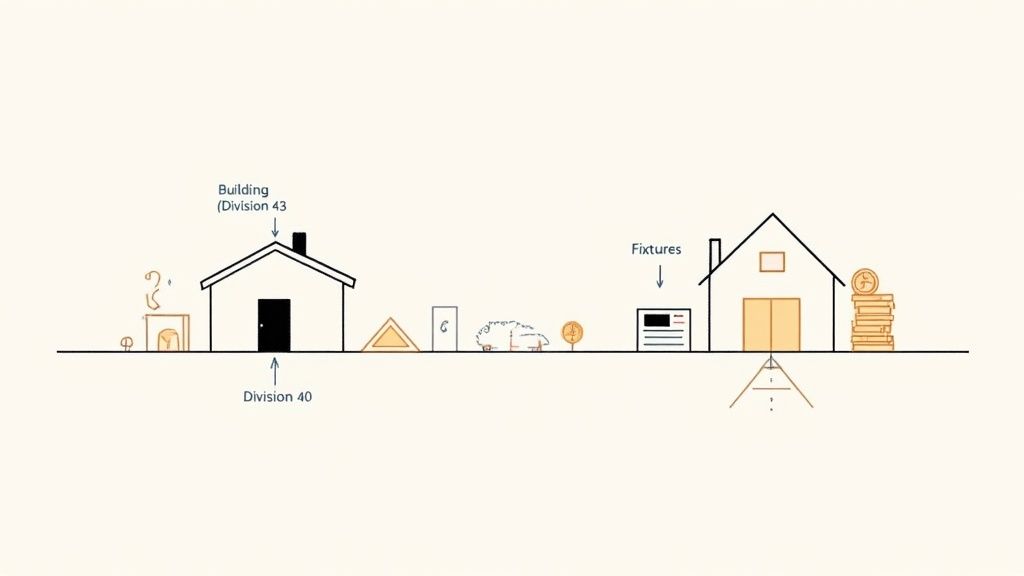
Division 43 (Capital Works): This covers the building's structural elements. Consider the foundations, walls, roof, tiling, and other permanently fixed items. It represents the decline in value of the physical structure itself.
Division 40 (Plant & Equipment): This relates to the fixtures and fittings within the property. These are items generally considered to be easily removable, such as carpets, blinds, ovens, smoke alarms, and air conditioning units.
The potential impact of these claims can be material. Depending on the property's age and purchase date, these deductions can amount to thousands of dollars annually. Legislative changes introduced in 2017 have a significant bearing on what can be claimed, particularly for second-hand assets—a crucial detail we will explore further.
Depreciation at a Glance: Key Concepts
This table breaks down the two main depreciation categories to help you quickly grasp the core concepts under Australian tax law.
| Depreciation Category | What It Covers | Governing ATO Division | Typical Deduction Rate |
|---|---|---|---|
| Capital Works | The building's structure, including walls, roof, floors, and foundations. | Division 43 | 2.5% or 4% per year (depending on age) |
| Plant & Equipment | Removable fixtures and fittings like carpets, ovens, and air conditioners. | Division 40 | Varies based on the asset's effective life. |
As you can see, each category follows a distinct set of rules. This is why a professional depreciation schedule is so important for ensuring your calculations are compliant.
Depreciation is an exercise in foresight. It acknowledges that assets lose value over their useful life, and the tax system allows you to account for this decline annually, rather than only when you sell.
This deduction works alongside your other claims, such as the interest on your home loan. Understanding how mortgage interest and tax deductions work together is a key part of prudent investment management. This guide serves as a practical map to help you claim what you may be entitled to, whether this is your first investment property or a long-held part of your portfolio.
Capital Works vs. Plant & Equipment: The Core Distinction
To prepare a compliant depreciation claim, you first need to understand how the Australian Taxation Office (ATO) views your property. It’s not just one big asset. Instead, it is two distinct parts: the durable structure itself, and the various items inside it that wear out more quickly.
Getting this distinction right is the bedrock of a sound, compliant depreciation claim.
The first category is what the ATO calls Capital Works. This falls under Division 43 of the tax act and covers the building’s fixed structure. This includes the foundations, walls, roof, doors, and windows—the core elements that give the building its form. It also covers permanently fixed items like driveways, fences, and built-in cupboards.
These parts of the property have a long, predictable lifespan, so the tax office allows you to claim their decline in value at a steady, prescribed rate.
The second category is Plant and Equipment, covered by Division 40. This includes all the removable or mechanical assets within the property. These are the items that make a rental liveable but have a much shorter effective life than the building itself.
Understanding Division 43 Capital Works
Capital Works deductions are linked to the original cost of constructing the property. For any residential building where construction commenced after 15 September 1987, you can typically claim a deduction at 2.5% per year on that historical construction cost. This claim is available for a maximum of 40 years from the day construction was completed.
Crucially, this deduction is not based on the price you paid for the property. It’s tied to the original construction cost, which is why a professional assessment is vital if records are unavailable. For most investors, this steady, long-term deduction may form the largest part of their annual depreciation claim, quietly reducing their taxable income year after year.
Identifying Division 40 Plant and Equipment
In contrast, Plant and Equipment assets depreciate more quickly because they wear out faster. These are the items that tenants use day-to-day.
Common examples include:
- Carpets and vinyl flooring
- Blinds and curtains
- Ovens, cooktops, and rangehoods
- Dishwashers
- Air conditioning units
- Hot water systems
- Smoke alarms
Each of these assets has an 'effective life' determined by the ATO, which dictates how quickly you can write off its value. For example, if a family in Melbourne purchases their first investment property and installs a brand-new oven and dishwasher, they can begin claiming depreciation on those items straight away under Division 40.
Understanding the difference between these two categories is the first step. For a deeper dive, our guide on capital allowance vs capital works offers more detail.
The distinction isn't just tax jargon; it reflects reality. A roof might last for decades, but a dishwasher could need replacing in less than ten years. The tax system acknowledges this, allowing your deductions to align with the real-world lifespan of each asset.
Grasping this fundamental split is crucial for every property investor. Properly separating these assets helps ensure you are not only compliant but are also claiming the legitimate deductions your investment property generates.
Navigating the 2017 Depreciation Rule Changes
The landscape of property depreciation saw a significant adjustment in 2017. While the fundamentals of claiming wear and tear on an investment property remain, the ATO introduced specific rules that every investor must understand and apply correctly.
The foundational principle has not changed: you can only claim deductions for the period your property was either rented out or genuinely available for rent. This reinforces that depreciation is an allowance for the decline in value of an income-producing asset.
This flowchart gives you a visual breakdown of the two depreciation pathways.
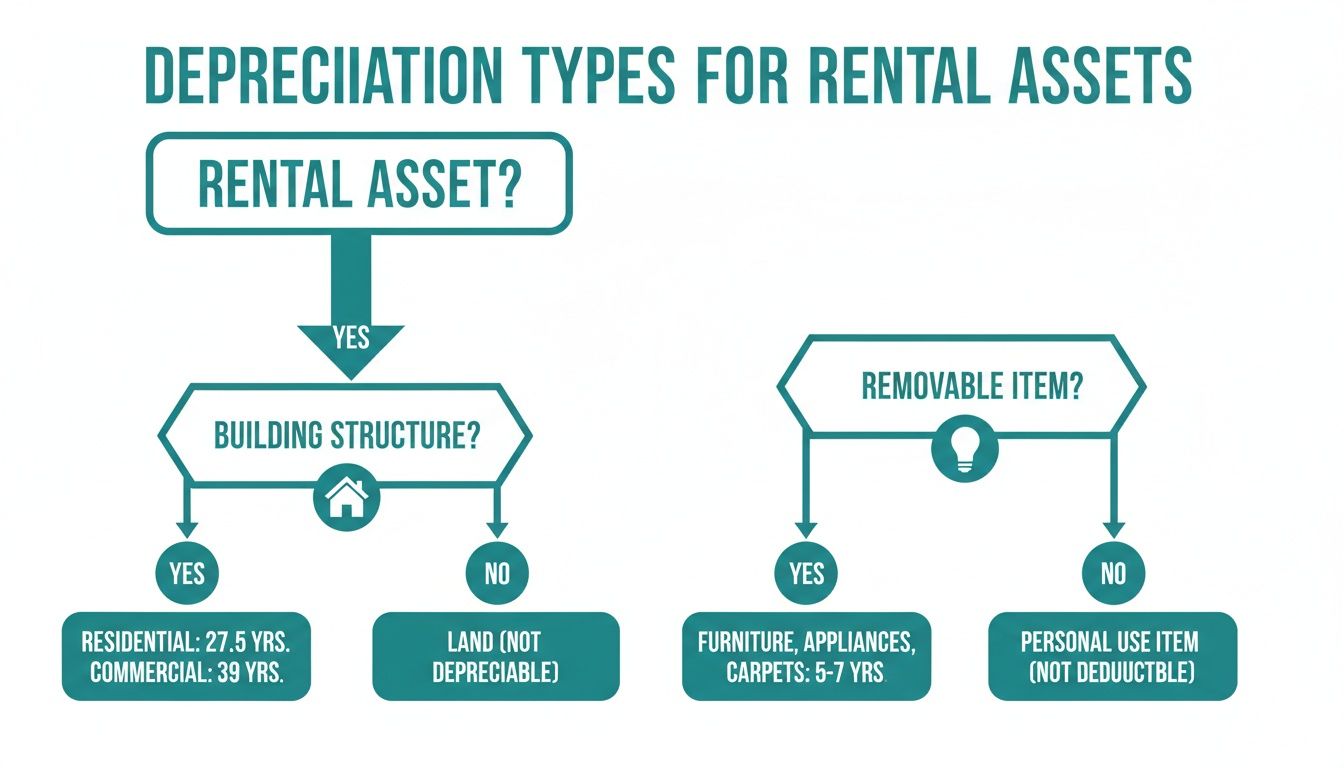
As you can see, the first step is always to separate the building's fixed structure from all the removable assets. From there, you will know which set of rules to follow.
The Impact on Previously Used Assets
This is the most critical change to be aware of. As of 9 May 2017, the rules for claiming Plant and Equipment (Division 40) in second-hand residential properties were tightened.
If you entered into a contract to purchase a residential investment property after that date, you generally can no longer claim depreciation on any of the existing, previously used Plant and Equipment assets. This means items like the oven, dishwasher, carpets, and blinds that were already in the property when you bought it are not eligible for depreciation claims.
This change was designed to prevent successive owners from claiming deductions on the same assets. However—and this is a key point—it does not stop you from claiming Capital Works (Division 43) deductions on the building itself, provided it qualifies based on its construction date.
What You Can Still Claim
The 2017 changes may seem restrictive, but they primarily clarified the rules. There are still many legitimate depreciation claims that property investors can and should make.
You can still claim depreciation on:
- Brand-new Plant and Equipment that you purchase and install. For instance, if you buy an established apartment and install a new air conditioner, that new unit is a depreciable asset.
- All qualifying Plant and Equipment in a brand-new residential property. If you are the first owner of a newly constructed home or unit, you can claim everything from the carpets to the cooktop.
- Assets in commercial properties, as these rules were aimed specifically at residential investments.
Let's consider a practical example. A small business owner in Adelaide purchases two rental properties after May 2017. One is a brand-new townhouse, and the other is an established house from the 1990s.
For the new townhouse, they can claim depreciation on both the building’s structure (Capital Works) and every new appliance and fitting inside (Plant and Equipment).
For the older house, the situation is different. They can claim Capital Works on the structure (if it qualifies), but the existing stove and hot water system are not deductible. However, if they replace the old carpet, that new carpet becomes a depreciable asset for them.
The 2017 legislation changes have a significant impact on how investors can claim depreciation. The table below clarifies what you can and can't claim based on your property type and purchase date.
Depreciation Claims After the May 2017 Changes
| Scenario | Capital Works (Division 43) | New Plant & Equipment (Division 40) | Previously Used Plant & Equipment (Division 40) |
|---|---|---|---|
| Purchased a brand-new residential property | Yes | Yes | N/A (all assets are new) |
| Purchased a second-hand residential property after 9 May 2017 | Yes (on qualifying structure) | Yes (on items you install) | No |
| Purchased a second-hand residential property before 9 May 2017 | Yes (on qualifying structure) | Yes (on items you install) | Yes (on existing items) |
| Purchased a commercial property (any date) | Yes | Yes | Yes |
This comparison highlights that while some claims on older assets have been curtailed, substantial deductions are still available, especially for new assets and capital works. For a deeper understanding of investment property management, you might find our guide on smart moves for managing your investment property helpful.
The core takeaway from the 2017 changes is the distinction between new and used assets. Your focus as an investor in an established property should be on the value of new assets you introduce, not those you inherit.
Getting this distinction right is crucial for accurate tax reporting. It ensures you claim everything you may be entitled to without breaching ATO guidelines, which is the hallmark of a diligent investor.
Why a Quantity Surveyor Is Your Most Important Partner
While your accountant is essential for lodging your tax return, a qualified quantity surveyor is their key partner when it comes to depreciation. Engaging one is not merely a suggestion; it is the foundational step for a compliant and properly calculated claim.
The Australian Taxation Office (ATO) is very clear on this. They specifically recognise quantity surveyors as one of the few professions qualified to estimate construction costs for depreciation purposes. This is especially important for the Capital Works (Division 43) part of your claim, where original building cost records may be unavailable.
Attempting to estimate these costs yourself or using a real estate appraisal is not compliant with ATO guidance. A quantity surveyor provides the independent, expert assessment the system requires, forming the bedrock of your claim for up to 40 years.
The Role of a Tax Depreciation Schedule
The key document you receive from a quantity surveyor is a tax depreciation schedule. This is not a simple summary. It is a comprehensive, multi-page report that meticulously catalogues every single depreciable asset in your property.
Think of it as the master blueprint for your depreciation claims for the life of your investment. This document will typically detail:
- The value and effective life of every Division 40 (Plant & Equipment) asset, from the carpets to the cooktop.
- The estimated historical construction cost for your Division 43 (Capital Works) claim.
- A clear, year-by-year forecast of the total deductions you can claim for up to 40 years.
- Calculations using both the Prime Cost and Diminishing Value methods, so you and your tax adviser can choose the most suitable strategy for your circumstances.
This schedule becomes a permanent part of your property’s financial records. Each year, your tax agent can simply take the relevant figure from the report and include it in your tax return. It removes guesswork and provides a clear, defensible basis for your claims.
An Act of Good Financial Stewardship
Investing in a professionally prepared depreciation schedule is a one-off cost that can pay for itself many times over. For a new migrant family setting up their first Australian investment, this schedule provides immediate clarity in a new tax system. For a seasoned business owner, it is simply prudent due diligence to ensure compliance and optimise financial outcomes.
Furthermore, the fee for preparing the schedule is generally 100% tax-deductible, making the decision even more straightforward. It is an act of good financial stewardship—careful planning upfront that can yield benefits through accurate deductions and peace of mind.
A quantity surveyor doesn't just look at what's visible. They understand the hidden value in your property—from the wiring in the walls to the cost of the original foundations—and translate that into a legitimate tax deduction recognised by the ATO.
By engaging a specialist, you are not just ticking a box. You are building your claim on a solid, compliant foundation that can protect you from potential ATO audits and helps you manage your investment’s financial performance responsibly. For more on structuring your property investments, consider our insights on the right entity setup for your circumstances.
How to Apply the Depreciation Schedule to Your Tax Return
With your professionally prepared depreciation schedule in hand, the next steps are procedural. This document has translated your property's declining value into clear, annual figures for your tax return. From here, the focus shifts from complex calculation to correct application.
Your schedule is the roadmap. It lays out the deductions you may be entitled to claim for the financial year, giving you a clear path forward.
Choosing Your Calculation Method
A comprehensive depreciation schedule will present your potential claims using two distinct, ATO-approved methods. The choice between them could impact your cash flow, so it is a strategic decision best discussed with your tax adviser.
Prime Cost Method: This is a straight-line approach. The value of an asset is written off in equal amounts over its effective life. For example, a $2,000 air conditioner with a 10-year life would provide a $200 deduction each year. It is predictable and consistent.
Diminishing Value Method: This is an accelerated method. It allows for larger deductions in the early years of an asset's life, with the amount reducing over time. This approach may be favoured by investors looking to maximise deductions upfront to improve cash flow in the early stages of ownership.
Your accountant can help you model the long-term impact of each method on your tax position, helping you decide which one best aligns with your financial strategy. For many, the Diminishing Value method is appealing, but your individual circumstances should always guide the most prudent choice.
Lodging the Claim in Your Tax Return
When it is time to prepare your tax return, the process is direct. The total depreciation amount for the financial year—a figure that will be clearly stated in your schedule—is entered into the appropriate section of your tax lodgement.
This is typically labelled ‘Capital Allowances’ on the supplementary section of the tax return where you detail your rental property income and expenses.
For a professional earning PSI or a business owner who also holds a rental property, the process is even simpler. Your depreciation schedule becomes one more essential document to provide to your tax agent, alongside rental income statements and records of other expenses. Your agent will then ensure the total claim is reported correctly.
The Importance of Apportionment and Diligence
A critical responsibility for any property investor is to ensure your claim accurately reflects the property's use as an income-producing asset. The ATO requires you to apportion your claim if the property was not genuinely available for rent for the entire year.
This means if the property was vacant for a period while you were not actively seeking a tenant, or if you used it for personal purposes, your total depreciation claim for that year must be reduced proportionally. For instance, if you used the property personally for one month (30 days), you could generally only claim depreciation for the remaining 335 days of the year.
Diligent record-keeping is the foundation of a compliant claim. Your responsibility is to maintain clear records of rental periods, vacancies, and any personal use. This discipline ensures that your claim is not just optimised, but also defensible.
Ultimately, your depreciation schedule provides the figures, but your records provide the context. Good stewardship of your investment means marrying the expert data from your quantity surveyor with your own meticulous records. This careful approach is key to a smooth and compliant tax lodgement year after year. For a broader view on managing your investment, our guide on smart moves for FY2026 may offer valuable insights.
Common Mistakes and Investor Responsibilities
Wise property investment is a discipline, requiring a firm grasp of both opportunities and compliance obligations. When it comes to depreciation, a few common oversights can prove costly.
One frequent error is assuming an older property offers no depreciation benefits. While the 2017 rule changes curbed claims on used plant and equipment, there may still be substantial Division 43 capital works deductions available if the building itself qualifies. Dismissing an older property's potential without a proper assessment could mean leaving legitimate deductions unclaimed.
Another pitfall is attempting to estimate construction costs yourself. The ATO is clear: if original costs are unknown, a qualified quantity surveyor is required to make that determination. A self-assessment is not compliant and may attract unwanted ATO scrutiny.
Fulfilling Your Obligations
As an investor, the ultimate responsibility for accurate record-keeping rests with you. This is not just about compliance; it is a fundamental part of good financial stewardship.
Your key duties are straightforward:
- Keep detailed records of any new assets you purchase for the property, including receipts and installation dates.
- Avoid claiming what is not permitted. This means no deductions for ineligible second-hand items in properties purchased after 9 May 2017.
- Provide complete information to your tax agent. This includes the full depreciation schedule and accurate details about the property's availability for rent during the financial year.
This disciplined approach helps ensure every claim you make is sound and defensible. For a wider view of responsible ownership, our guide on smart moves for managing your investment property offers further context.
Thinking Ahead to a Sale
It is also crucial to understand the long-term implications. When you eventually sell your investment property, the depreciation you have claimed over the years will affect your capital gains tax (CGT) calculation.
The total depreciation claimed for capital works reduces your property’s cost base for tax purposes. A lower cost base can result in a higher capital gain on paper. This is not a reason to avoid claiming depreciation—far from it—but it is a critical piece of financial planning that should be discussed with your tax adviser well before a sale.
Good stewardship means being informed and proactive. It involves not only claiming what you are entitled to today but also understanding how those decisions will shape your financial position tomorrow.
By acknowledging both the benefits and the responsibilities of property depreciation, you position yourself as a savvy, forward-thinking investor, prepared for the long journey of wealth creation.
Your Depreciation Questions, Answered
Managing an investment property often brings up recurring questions about depreciation. Here are grounded answers to some common queries.
Can I Still Claim Depreciation if My Rental Property is Making a Loss?
Yes. In fact, this is one of the key reasons depreciation is so valuable for property investors.
Depreciation is a non-cash deduction, meaning you do not have to spend money in a given year to claim it. If your property is already negatively geared (your rental expenses are higher than your rental income), adding depreciation simply increases your net rental loss for tax purposes.
Depending on your circumstances and the structure through which you hold the property, this larger on-paper loss may be offset against your other assessable income, potentially reducing your overall tax payable. This should be discussed with a qualified tax adviser.
What Happens if I Renovate My Rental Property?
Renovations can be an excellent way to increase your depreciation claims, provided you account for them correctly.
Any structural work—such as a new extension, kitchen, or bathroom—will likely qualify as capital works (Division 43). This means you can begin depreciating the cost of that new work over 40 years from its completion date.
Additionally, consider the old assets you dispose of. If you remove an old oven or carpet, you may be able to claim a deduction for any remaining depreciable value in that same year. This is known as a ‘scrapping’ deduction. It is wise to have a quantity surveyor update your schedule after any significant renovation to ensure all new deductions are captured correctly.
Do I Need a New Depreciation Schedule Every Year?
No. A professionally prepared tax depreciation schedule is a one-off report intended to last for the life of the property.
It is designed to forecast your potential deductions for up to 40 years, providing a clear, year-by-year breakdown. The only time you would need to update it is if you undertake major capital improvements, like a significant renovation, that add new depreciable items to the property.
At Everglow Prosperity, we believe that building enduring wealth comes from understanding the details and making informed decisions with quiet confidence. Our integrated approach to tax, advisory, and wealth management helps ensure every aspect of your financial life works in harmony. To learn how our experienced team can support your journey, visit us at https://everglow.au.
General Advice Warning: The information provided in this article is general in nature and does not constitute personal financial advice. It has been prepared without taking into account your personal objectives, financial situation, or needs. Before acting on any information, you should consider the appropriateness of the information, having regard to your own objectives, financial situation, and needs, and seek professional advice from a qualified financial adviser, tax agent, or legal expert.
Want help applying this to your situation?
Every situation is different. Book a time with our team to talk it through, or call us on 1300 913 929.