
When considering how much superannuation to salary sacrifice, the most important figure to know for the 2025-26 financial year is the general concessional contributions cap: $30,000. This limit represents the total of all your pre-tax contributions, meaning it includes both your employer's compulsory super payments and any additional amounts you may choose to salary sacrifice.
Understanding Your Salary Sacrifice Capacity for 2026

At its heart, salary sacrificing is a straightforward arrangement you may make with your employer to direct a portion of your salary into your super fund before income tax is calculated. It can be a disciplined strategy for long-term financial stewardship.
This arrangement may achieve two objectives at once. First, it could lower your taxable income for the financial year, potentially reducing your tax bill. Second, it may accelerate the growth of your retirement savings, which could contribute to greater financial stability in the future.
The Concessional Contributions Cap
It may be helpful to think of your annual concessional contributions cap as a bucket. For the 2025-26 financial year, this bucket can hold up to $30,000. Every dollar that goes into your super from your pre-tax income helps to fill it.
To determine how much room you have left for salary sacrificing, you first need to account for what is already going into the bucket. This simple table shows what counts towards your $30,000 limit.
Concessional Contribution Cap Breakdown (2025-26)
| Contribution Type | Description | Counts Towards Your Cap? |
|---|---|---|
| Employer SG Contributions | The compulsory 12% your employer must pay into your super. | Yes |
| Salary Sacrificed Contributions | The voluntary amounts you direct from your pre-tax pay. | Yes |
| Personal Deductible Contributions | Contributions you make from your after-tax pay and then claim as a tax deduction. | Yes |
Essentially, the space left in your ‘bucket’ after your employer's mandatory contributions have been made is the maximum amount you may be able to salary sacrifice for the year.
For example, an Australian professional earning $90,000 before tax will receive $10,800 in employer super contributions (12%). This leaves $19,200 of their $30,000 cap available for salary sacrificing or personal deductible contributions. Because these funds are generally taxed at 15% inside super rather than at their higher marginal income tax rate, this strategy may create significant tax savings depending on individual circumstances.
Understanding this calculation is a key step in using salary sacrifice effectively. It is one of several compliant strategies professionals and business owners may use to build wealth while managing their financial obligations. For those looking to manage their tax position, it can also be useful to learn more about how to reduce taxable income through other available methods.
While the rules are detailed, they are manageable with careful planning. Approaching salary sacrifice as a thoughtful, disciplined strategy is important for building enduring prosperity over many financial seasons.
Calculating Your Maximum Salary Sacrifice Amount
Let's move from theory to a practical number you could use. Working out your maximum salary sacrifice amount is not necessarily complex, but it does require careful attention to a few key figures. The goal is to find out how much of your annual contribution cap is left after your employer has paid their part.
The entire calculation starts with the annual concessional contributions cap, which for the 2025-26 financial year is $30,000. From this, we need to subtract the superannuation your employer is already paying for you.
Determining Your Available 'Sacrifice Room'
The key to figuring out how much you might contribute is a straightforward piece of maths. You start with the cap and work backwards.
Annual Concessional Cap
– Employer Superannuation Guarantee (SG) Contributions
= Your Maximum Salary Sacrifice Amount
Your employer’s SG contribution is calculated on your Ordinary Time Earnings (OTE). For the 2025-26 financial year, that rate is 12%. The exact dollar amount your employer contributes should be clearly itemised on your payslip—this is the first number you need to deduct from the $30,000 cap.
For example, consider a business owner operating through a company structure and paying themselves a salary of $120,000. The company would contribute $14,400 in SG for the year ($120,000 x 12%). This leaves a remaining capacity of $15,600 that they could choose to salary sacrifice into their super fund ($30,000 – $14,400).
To see how different sacrifice amounts might affect your net pay, using a dedicated salary calculator pro can be a helpful step in your financial planning.
Considerations for High-Income Earners
There is an important detail that high-income earners need to watch closely: the maximum super contribution base. This is an income threshold set by the government each year. For 2025-26, it’s $65,070 per quarter.
If your income is above this quarterly amount, your employer is only legally required to pay the 12% SG on that capped figure, not on your full salary.
An executive earning $300,000 a year ($75,000 per quarter) is a practical example. Her employer would typically calculate her super based on the $65,070 quarterly cap. This means her annual SG contribution would be $31,233.60 ($65,070 x 4 quarters x 12%), which already puts her over the $30,000 concessional cap.
In this scenario, there is no room left for salary sacrificing. In fact, an excess contribution may have already been made by the employer alone. This highlights why understanding the details is so important.
A careful review of your payslips, and if needed, a calm conversation with your payroll department, will give you the precise numbers you need. This kind of financial diligence is the foundation of sound wealth management. Taking the time to get the numbers right gives you the quiet confidence to act effectively.
Using the Carry-Forward Rule for Strategic Contributions
While the annual contribution cap sets a clear yearly limit, a powerful rule offers more flexibility over the long run. It is known as the ‘carry-forward’ rule, and it can be particularly useful for those whose income may be inconsistent from year to year.
A business owner might have one stellar year after several lean ones. A professional could receive a large, long-awaited bonus. This is where the carry-forward rule can be beneficial, allowing you to go back and use the contribution cap space you did not use in previous years.
Eligibility and How It Works
To use this strategy, there is one key test you need to meet. The Australian Taxation Office (ATO) requires that your total superannuation balance was less than $500,000 on the 30th of June of the financial year before the one you want to make the catch-up contribution in.
If you meet that condition, you may be able to reach back and access any unused concessional cap amounts from the previous five financial years. It is a rolling window of opportunity.
First, you need to know your baseline. The simple visual below shows how your standard salary sacrifice room is calculated before you consider adding any carry-forward amounts.
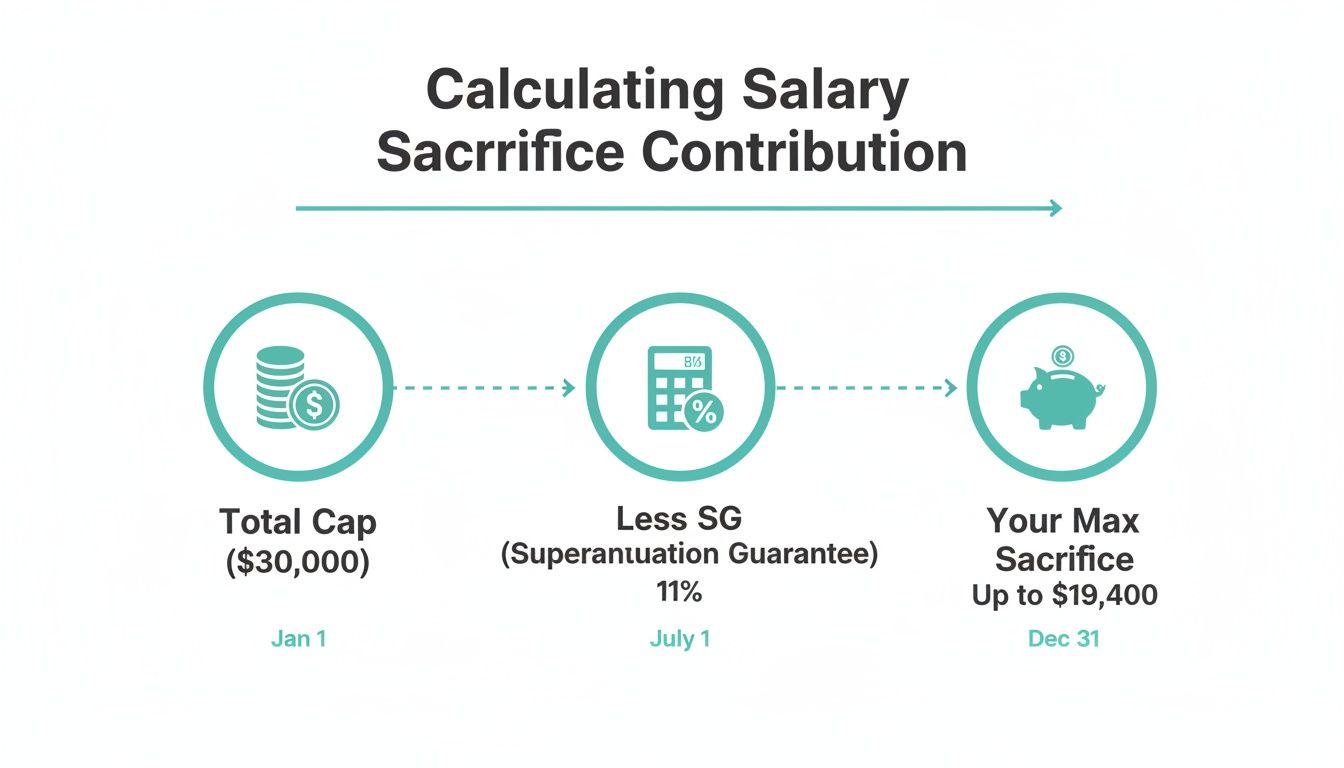
This is your starting point. The carry-forward rule may then let you strategically add to this capacity.
A Practical Example of Carry-Forward Contributions
Let’s look at a practical scenario. Imagine a consultant who spent years building her practice with a modest income. In those early years, her total super contributions were well below the annual cap, leaving a lot of unused space.
This year, she landed a significant project, and her income has spiked. Because her total super balance was under $500,000 on the previous 30 June, she may be in a position to act. She could use the current year’s $30,000 cap plus the unused amounts from the past five years.
This move could allow her to make a substantial contribution to her retirement savings while potentially reducing her taxable income for the high-income year—all in line with ATO rules. For more detail on how these contributions work, you can find helpful information on pre-tax super contributions on SuperGuy.com.au.
The Importance of Timely Planning
It is important to note that this is a “use it or lose it” system. Unused cap amounts from a specific financial year will expire if they are not used within five years. For instance, any unused cap from the 2020-21 financial year would need to be used by the end of the 2025-26 financial year, or it is gone for good.
This five-year timeframe encourages proactive planning. It is not a set-and-forget benefit; it may reward those who regularly check their financial position and act when the time is right.
It can be a sound practice to regularly log into your myGov account and check the ATO portal. There, you can see exactly how much unused cap you have available and from which years. Keeping track of key dates is vital, and our guide on Australian tax year dates is a handy reference to keep bookmarked.
Ultimately, the carry-forward rule is a powerful tool for good financial stewardship. It helps smooth out contributions over time and lets you make the most of your capacity when it suits your financial journey.
Understanding the Risks and Responsibilities
While salary sacrificing into superannuation is a well-established strategy for building long-term wealth, it is a path that demands careful thought. Like any meaningful financial decision, it comes with responsibilities. A disciplined approach means understanding not just the potential opportunities, but also the risks and the rules of the game.
This is not about finding short-term loopholes. It is about making a deliberate, long-term commitment to your future, and that requires a clear-eyed view of how it may affect your finances today.
The Impact on Your Cash Flow and Budget
The most immediate effect of salary sacrificing is a reduction in your take-home pay. While the money is still yours, it is being channelled into your super fund instead of your everyday bank account. It is essential to review your household budget before locking in an arrangement.
A prudent approach means ensuring you can comfortably meet all your regular living expenses, mortgage repayments, and other financial commitments on your reduced net income.
Thoughtful planning is paramount here. The goal is to build future wealth without creating present-day financial stress. It’s a balance that should be struck with foresight and a realistic view of your personal cash flow.
Preservation Rules and Access to Your Funds
A core principle of superannuation is preservation. This simply means that once money goes into your super fund—including any amounts you salary sacrifice—it is generally locked away until you meet a "condition of release," like reaching your preservation age and retiring.
- Long-Term Commitment: This rule reinforces the long-term nature of the strategy. The funds are earmarked for your retirement and generally cannot be accessed for short-term needs like a house deposit, a holiday, or an emergency.
- Preservation Age: Your preservation age depends on when you were born. For anyone born after 30 June 1964, it is 60.
This is precisely why maintaining a separate, accessible emergency fund is a cornerstone of sound financial management. Your superannuation is for your future self; your emergency fund is for life’s immediate curveballs.
Consequences of Exceeding the Cap
Knowing your limits is critical because there are consequences for contributing too much. If your total concessional contributions go over the annual cap (currently $30,000 for the 2025-26 financial year), this is known as an excess concessional contribution.
The ATO will issue you a determination, and the excess amount is added to your assessable income for that year. It is then taxed at your marginal tax rate, which may negate the tax benefit you were aiming for. While you can often withdraw up to 85% of this excess amount, careful monitoring is the best way to avoid this situation.
For those with more complex financial structures, it's vital to understand all the intricacies, including rules that apply to different fund types. You can learn more by exploring the framework around self-managed super fund rules.
Putting it all into Practice: Your Next Steps
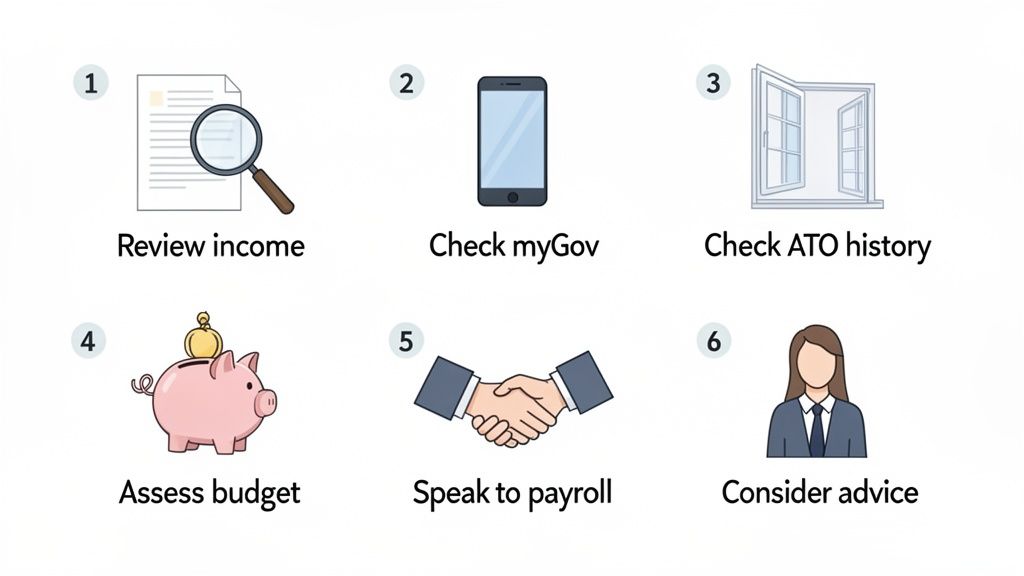
Moving from theory to thoughtful action is where real financial progress begins. To help you take that step with confidence, here is a practical checklist.
Think of it as your financial due diligence. Each step is designed to give you a clear, accurate picture, so you can make a well-grounded decision on how much you may be able to comfortably salary sacrifice into your super.
Your Financial Review Checklist
Get Clear on Your Income and SG: The first step is to gather your recent payslips. You need to confirm your exact Ordinary Time Earnings and the precise amount of Superannuation Guarantee (SG) your employer is contributing. This is a crucial starting point for your calculations.
Confirm Your Total Super Balance: Log in to your myGov account and link through to the ATO’s online services. Here, you should find your current Total Super Balance. This figure is critical for confirming your eligibility for strategies like using the carry-forward rule.
Find Your Unused Cap Space: While you’re in the ATO portal, look for your concessional contributions history. The ATO provides a year-by-year breakdown of any unused carry-forward cap amounts from the past five financial years that may be available for you to use.
Review Your Household Budget: With a firm grasp on your income, it is time to look at your personal cash flow. A careful review of your household budget will help you determine a sacrifice amount that may boost your super without putting a strain on your everyday financial commitments.
Talk to Your Employer: Approach your payroll or HR department to discuss putting a formal salary sacrifice agreement in place. It is important to understand their specific processes, paperwork, and the cut-off dates for each pay cycle.
Seek Professional Guidance: If your situation involves multiple income streams, a business, or you simply want a second opinion, professional advice may be appropriate. A qualified adviser can bring clarity and help tailor a strategy to your unique circumstances.
Taking these measured steps is about more than just crunching numbers. It’s about taking deliberate ownership of your financial future. This process builds discipline and helps ensure your strategy is built on a solid foundation of accurate, up-to-date information.
Embarking on a salary sacrifice strategy is a long-term commitment. It requires patience and a clear-eyed view of both the opportunities and your responsibilities. The goal is to build enduring prosperity, and that begins with these practical, foundational steps.
If you would like clarity on how these principles may apply to your own circumstances, you may wish to speak with a qualified adviser. You can contact Everglow on 1300 913 929 or email contact@everglow.au to arrange a discussion.
General Advice Warning: The information provided in this article is general in nature and does not take into account your personal objectives, financial situation, or needs. Before acting on any information, you should consider the appropriateness of the information in regard to your own objectives, financial situation, and needs, and you should seek personal advice from a qualified financial adviser.
