

Understanding how a trust operates is often the first step toward more considered financial stewardship. At its core, a trust is not a company or a separate legal entity, but a formal relationship. It is an arrangement where a person or a company (the Trustee) holds assets for the benefit of other people or entities (the Beneficiaries), guided by a specific set of rules outlined in a foundational document called the Trust Deed.
This structure is a well-established feature of Australian financial and legal practice, used by families and business owners to manage assets with clear purpose and foresight.
The Core Roles and Framework of a Trust

A trust operates by separating the legal ownership of an asset from its beneficial ownership. The Trustee is the legal owner, responsible for managing the asset, while the Beneficiaries are entitled to benefit from it. This arrangement is established by a Settlor, who provides the initial asset to formally create the trust.
This unique structure allows assets such as property, investments, or business interests to be managed with a distinct purpose. Depending on individual circumstances, this purpose could range from asset protection and tax planning to facilitating the orderly transfer of wealth to the next generation.
The People and the Rulebook Guiding a Trust
To appreciate how a trust functions, it is helpful to understand the distinct roles involved, each governed by Australian law and the trust’s own rulebook, the Trust Deed.
- The Settlor: This is the individual or entity that initiates the trust, typically by contributing a nominal sum of money (often as little as $10) to form the initial trust property. Once this action is complete, the Settlor’s role concludes, and they generally have no further involvement.
- The Trustee: As the legal owner of the trust’s assets, the Trustee is charged with its management. This role carries significant legal responsibilities, known as fiduciary duties, which legally oblige the Trustee to act in the best interests of the beneficiaries. A Trustee can be an individual or a company (a corporate trustee), with the latter often preferred for continuity and clear separation of assets.
- The Beneficiaries: These are the individuals or entities for whose benefit the trust was established. They may receive distributions of income or capital from the trust, as determined by the Trustee in accordance with the Trust Deed.
For many Australian professionals and families, a trust provides a formal framework for managing wealth. For example, a medical professional operating a practice may use a trust to separate business assets from personal assets. Similarly, a family holding investment properties might use a trust to flexibly distribute rental income. If these concepts seem relevant to your situation, you may find it useful to learn more about what a family trust is in Australia.

The Trust Deed itself is the essential operations manual. This legal document meticulously defines the trust’s purpose, the Trustee’s powers, the identity of the beneficiaries, and the rules governing distributions. It is the active guide for every decision the Trustee makes, ensuring clarity and compliance for years to come.
A well-structured trust is not a short-term tactic but a long-term strategy. It requires patient stewardship, diligent administration, and a clear understanding of both the opportunities and the enduring responsibilities involved.
How a Trust Manages Assets and Distributes Income
The day-to-day operation of a trust involves active management by the Trustee. This stewardship role is guided by the Trust Deed and the Trustee’s legal duties to manage the trust’s assets—be they property, shares, or a business—prudently.
A critical part of this management is the annual process of distributing income. This disciplined cycle hinges on a formal decision known as the Trustee Resolution.
The Annual Rhythm of Trustee Resolutions
Before the end of each financial year on 30 June, the Trustee must make a formal, written resolution. This document specifies exactly how the trust's net income for that year will be distributed among the eligible beneficiaries.
This is not a casual agreement; it is a legally significant decision that must be clearly recorded. Failure to make a valid resolution in time can have material tax consequences under Australian law. If income is left undistributed, the Trustee may become liable for tax on that income at the highest marginal rate.
For example, consider a family trust established by new migrants to hold their Australian investments. Each year, the Trustee (perhaps a corporate trustee directed by the parents) would assess the family's financial situation. Before 30 June, they would resolve to distribute the investment income, perhaps directing some to a young adult child at university to help with living expenses, who would then pay tax at their lower personal tax rate.
This discretionary power allows a trustee to adapt to the changing financial circumstances of the beneficiaries each year. The ability to "stream" income is a primary reason trusts are a common structure in Australia. According to ATO data for the 2022-23 financial year, over one million trusts reported net income, a significant portion of which was distributed to individuals, highlighting their role in family wealth management.
Sometimes, a trustee might resolve to make a beneficiary ‘presently entitled’ to income but pay it to a company owned by that beneficiary. This strategy, using what is often called a 'bucket company', may cap the tax rate on that income at the prevailing corporate tax rate. For tailored guidance on structuring or reviewing trust arrangements, our specialised advisory services may be of assistance.
Opportunities and Responsibilities
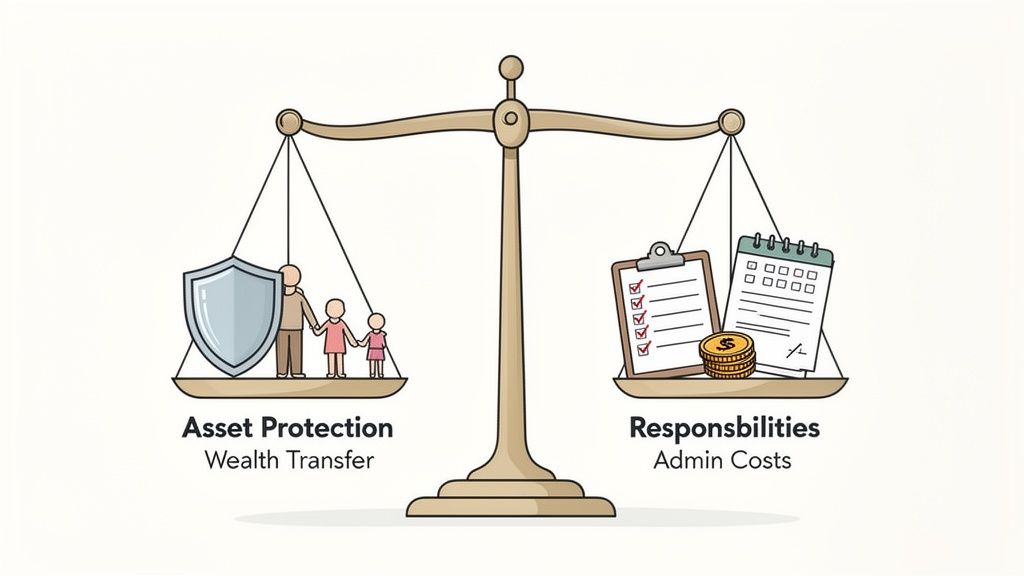
To understand how a trust operates, one must weigh its potential benefits against its inherent responsibilities. A well-managed trust may offer significant advantages, but these opportunities are balanced by the legal and administrative duties a trustee must uphold.
A key opportunity for many is asset protection. Because assets held in a trust legally belong to the Trustee, not the beneficiaries, they may be shielded from claims against a beneficiary’s personal finances. For a business owner, this could mean that business assets held in a trust for their family could remain protected if their personal financial circumstances change.
However, these benefits are accompanied by significant responsibilities. A trust is not a passive structure; it requires diligent, ongoing administration to remain compliant and effective. A trustee’s duties under Australian law are extensive and legally binding. These include:
- Prudent Management: A trustee must manage the trust’s assets in the best interests of all beneficiaries, with care and diligence.
- Meticulous Record-Keeping: Every decision, transaction, and distribution must be accurately documented to comply with ATO and legal requirements.
- Annual Compliance: This includes preparing financial statements, lodging a trust tax return, and making a timely Trustee Resolution each year.
- Ongoing Costs: Professional advice, accounting, and compliance are necessary components of proper stewardship and involve real costs.
The ATO pays close attention to trust structures, particularly arrangements that could be perceived as being primarily for tax avoidance. Provisions such as Section 100A of the tax act target arrangements where income is formally distributed to a low-tax-rate beneficiary, while the financial benefit flows to someone else. This underscores the importance of ensuring all distributions are genuine and that the trust is managed with integrity.
Sound financial decisions come from understanding risks as well as potential benefits. The true strength of a trust lies not just in its structure, but in the diligent and responsible stewardship of the trustee.
Practical Next Steps
The decision to establish a trust should be a considered one, made with a clear view of both the long-term objectives and the responsibilities involved. It is a commitment to patient and disciplined stewardship over time.
For those considering this path, the first steps generally involve seeking professional guidance to ensure the chosen structure aligns with your specific circumstances. Whether for managing a family business, protecting assets for the next generation, or structuring joint venture investments, clarity from the outset is paramount.
Key Takeaway: A trust operates as a formal relationship where a Trustee manages assets for Beneficiaries according to a Trust Deed. Its effectiveness depends on diligent administration, a clear understanding of legal duties, and prudent decision-making in line with Australian law.
If you would like clarity on how these principles may apply to your own circumstances, you may wish to speak with a qualified adviser. You can contact our team on 1300 913 929 or email contact@everglow.au to arrange a discussion.
General Advice Warning: The information provided in this article is general in nature and does not take into account your personal objectives, financial situation, or needs. Before acting on any information, you should consider the appropriateness of the information having regard to your own objectives, financial situation, and needs and seek personal advice from a qualified financial adviser.
Want help applying this to your situation?
Every situation is different. Book a time with our team to talk it through, or call us on 1300 913 929.