

If you work from home in Australia, you may be able to claim a portion of your household running costs as a tax deduction. It is important to understand that this is a specific provision requiring you to meet clear criteria set by the Australian Taxation Office (ATO). Navigating this area with care is a key part of sound financial management.
Understanding Your Home Office Tax Deduction
With remote and hybrid work now a common feature of the professional landscape, the home office tax deduction has become a focus for many Australian employees and business owners. It is a provision that acknowledges the costs associated with earning income from home, but it is also an area the ATO reviews closely. Understanding the rules before making a claim is a prudent first step.
There are two primary methods for calculating a potential claim. Each has distinct requirements for record-keeping and eligible expenses, so choosing the appropriate one for your circumstances is an important decision.
- The Fixed Rate Method: This is a simplified approach. You may claim a set rate for each hour worked from home, which is designed to cover common running costs like electricity, internet, and stationery in a single figure.
- The Actual Cost Method: This method involves calculating the actual work-related portion of specific home office expenses. It requires more detailed records but could be more suitable if you have significant, dedicated costs.
The Evolution of Home Office Rules
The rules governing working from home deductions have evolved. The ATO’s fixed rate, for instance, has been adjusted over time to reflect changing work patterns, moving from 52 cents per hour in 2020–21 to 67 cents for the 2022–23 and 2023-24 financial years, and 70 cents from 1 July 2024.
Early pandemic-era rules offered more flexibility. However, post-2022 revisions introduced stricter requirements. To be eligible, you must now be performing substantive duties from home; simply checking emails after hours may not be sufficient to qualify.
This summary from the ATO's official guidance illustrates the current framework.
As the image shows, the rate covers specific expenses and highlights the importance of maintaining an accurate record of hours worked. Making a thoughtful, informed decision on which method to use is a crucial first step in responsible tax planning.
You can explore a comparison of these methods in our guide to claiming working from home expenses. For a broader perspective on how business expenses can affect taxable income, this guide on sole trader tax deductions may be a useful resource.
If you would like clarity on how these principles may apply to your own circumstances, you may wish to speak with a qualified adviser. You can contact Everglow on 1300 913 929 or email contact@everglow.au to arrange a discussion.
General Advice Warning: The information provided in this article is general in nature and does not take into account your personal objectives, financial situation, or needs. Before acting on any information, you should consider the appropriateness of the information having regard to your own objectives, financial situation, and needs and seek personal advice from a qualified financial adviser.
Choosing Your Claim Method: Fixed Rate vs Actual Cost
Once you have determined your eligibility to claim home office expenses, the next step is to decide how to calculate your deduction. The Australian Taxation Office (ATO) provides two distinct pathways: the fixed rate method and the actual cost method.
Each route has its own rules and record-keeping requirements. The most suitable choice often depends on your specific work arrangements and your capacity for administrative tasks. The objective is not merely to pursue the largest possible deduction, but to select a method you can substantiate with clear evidence, ensuring your claim is both reasonable and compliant.
The Revised Fixed Rate Method
The fixed rate method is designed for simplicity. It may save you the task of calculating the work-related portion of individual utility bills. Instead, you can claim a set amount for each hour you work from home, which covers several common running costs.
From 1 July 2024 (the 2024–25 income year onwards), the ATO has set this rate at 70 cents per hour (it was 67 cents for 2022–23 and 2023–24). This rate is intended to cover your electricity and gas for heating and cooling, phone and internet usage, plus stationery and computer consumables.
It is important to note that you cannot claim these specific expenses separately if you use this method. However, you may still be able to make separate claims for the decline in value (depreciation) of assets like an office desk, chair, or computer.
A key requirement for using the fixed rate method is keeping a comprehensive record of the hours you work from home. This could be a timesheet, diary, or logbook, but it must cover the entire financial year. Without this substantiation, a claim may not be accepted by the ATO.
The Actual Cost Method
The actual cost method is more detailed and requires a granular approach to tracking your expenses. This approach involves calculating the genuine work-related portion of each home office running cost. While it demands more effort, for those with a dedicated and significant home office setup, it could potentially result in a larger deduction.
To use this method, you generally need to:
- Keep meticulous records of all relevant expenses, including utility bills, phone and internet bills, and receipts for items like stationery.
- Calculate the work-related percentage of your expenses. This is often done by measuring your dedicated office space as a percentage of your home's total floor area.
- Apportion the costs based on that percentage. For shared household bills like electricity, you would apply your calculated work-use percentage to determine the deductible amount.
For example, a freelance architect with a dedicated studio that occupies 15% of her home's total floor area could potentially claim 15% of her electricity and heating bills. For assets like a high-performance computer used exclusively for work, she may be able to claim the full depreciation. For more detail on specific calculations, we have resources on topics like understanding the laptop depreciation rate that may assist your planning.
This flowchart provides a visual guide to help you weigh your circumstances and decide on the appropriate method.
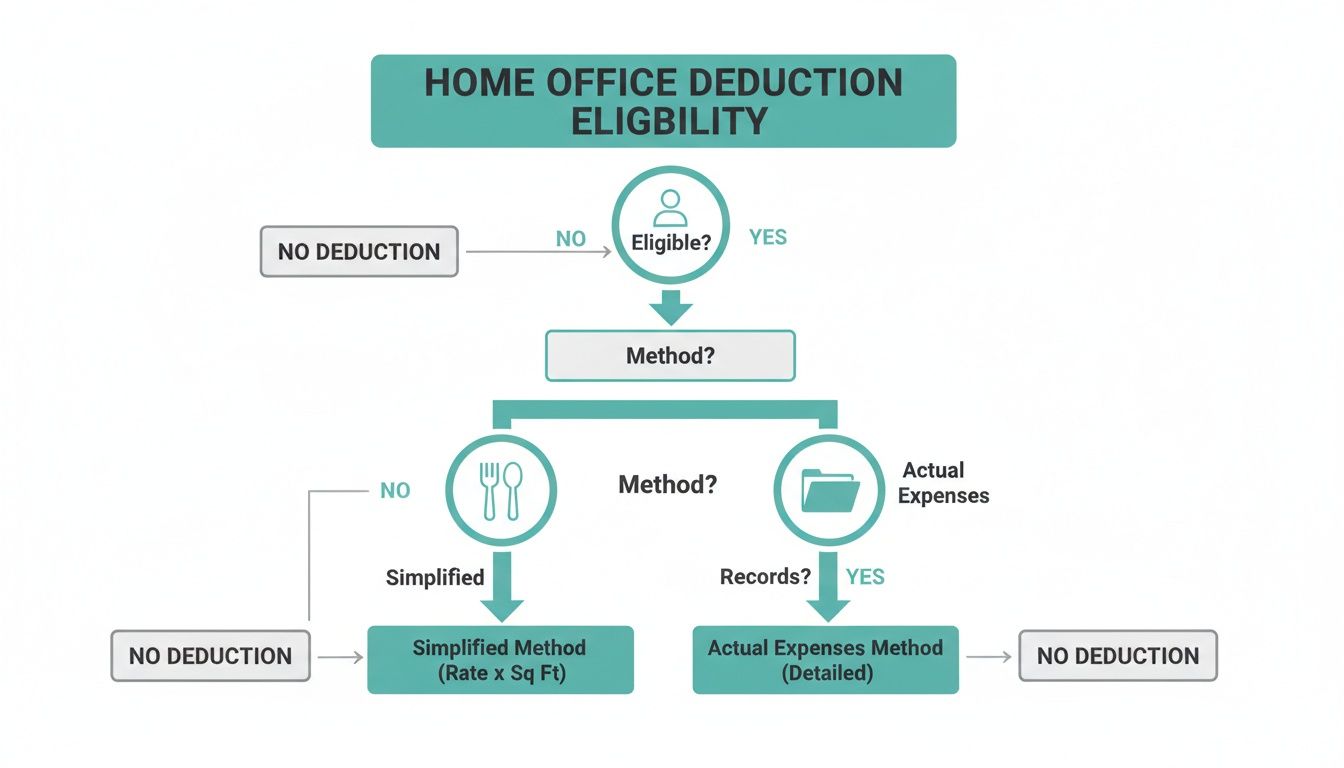
As the decision tree illustrates, the path you choose directly influences the type of records required to substantiate your claim.
A Quick Comparison
To help clarify the choice, here is a straightforward breakdown of the two methods.
Comparison of Claim Methods for Home Office Expenses
| Feature | Fixed Rate Method (Revised) | Actual Cost Method |
|---|---|---|
| Calculation | Claim 70 cents per hour worked from home (67 cents before 2024–25). | Calculate the actual work-related portion of each expense. |
| What's Covered | Electricity, gas, phone, internet, stationery, and computer consumables. | All running expenses, plus depreciation on office furniture and equipment. |
| Depreciation | Claimed separately for furniture and technology. | Claimed separately for furniture, technology, and other assets. |
| Record-Keeping | Must keep a log of all hours worked from home. Receipts for depreciating assets needed. | Requires detailed receipts for all expenses and a clear basis for apportionment (e.g., floor area). |
| Best For | Employees or those who work from home occasionally and prefer simplicity. | Business owners or anyone with a dedicated, high-cost home office setup. |
Ultimately, weighing your options involves balancing convenience against potential financial outcomes.
Making an Informed Choice
The choice between the fixed rate and actual cost methods depends on individual circumstances. The fixed rate offers convenience and may be a good fit for employees who work from home part-time. The actual cost method, while more demanding, is often more suitable for business owners or professionals with a dedicated, well-equipped home office where running costs are significant.
It is wise to review your expenses and be realistic about your capacity to maintain detailed records. Patience and disciplined action in this area can contribute to a sound financial outcome.
Essential Record Keeping For ATO Compliance
A home office tax deduction is only as sound as the records that support it. For the Australian Taxation Office (ATO), a claim without substantiation is simply a figure on a form. Diligent record-keeping is not just a compliance exercise; it is a core discipline of good financial management, helping to ensure every dollar claimed is legitimate and defensible.
This practice moves a potential claim from estimation to fact. Whether you use the fixed rate method or the more detailed actual cost method, your records are the evidence that provides confidence in your deduction.
Records For The Fixed Rate Method
The primary requirement for the fixed rate method is non-negotiable: you must keep a complete log of the hours you worked from home for the entire income year. This forms the basis of your calculation.
The ATO requires this record to be an accurate reflection of your work pattern. A diary, timesheet, or digital logbook can serve this purpose. The key is to maintain it contemporaneously, as reconstructing a full year of hours from memory can lead to errors.
In addition to your hours, you will also need to keep receipts for any depreciating assets you claim separately, such as office furniture or a new laptop. These items are not covered by the hourly rate, so their cost must be supported by proof of purchase. The principles of documentation are discussed further in our guide to claiming work-related travel expenses without receipts.
Records For The Actual Cost Method
The actual cost method, as its name implies, demands a more detailed approach to record-keeping. You are substantiating each expense individually, which requires careful organisation throughout the year, not just at tax time.
Your records should generally include:
- Receipts and invoices for every expense you intend to claim, from electricity and internet bills to stationery and minor repairs.
- Detailed calculations showing how you determined the work-related portion of shared expenses. This usually involves documenting your home's total floor area and the specific size of your home office to arrive at a reasonable work-use percentage.
- A logbook or diary to show the work-related use of items like a mobile phone, particularly if it is also used for personal purposes.
An organised system is invaluable when using the actual cost method. Digital tools, such as receipt-scanning apps and spreadsheets, can simplify the process of capturing and categorising expenses as they occur.
To feel confident claiming home office expenses, having your records in order is essential. It may be worthwhile exploring the best ways to organize receipts to find a system that suits you.
Establishing A System For Success
The key to compliant record-keeping is consistency. Rather than a significant effort in June, it is about the small habit of setting aside time each week or month to update logs and file receipts. This can transform a daunting annual task into a manageable routine.
Consider establishing a dedicated digital folder or physical file for all your home office documents. This small act of organisation can provide peace of mind and ensure you are prepared should the ATO request substantiation for your claim. It is an investment in your own financial clarity.
If you would like clarity on how these principles may apply to your specific situation, you may wish to speak with a qualified adviser. You can contact Everglow on 1300 913 929 or email contact@everglow.au to arrange a discussion.
General Advice Warning: The information provided in this article is general in nature and does not take into account your personal objectives, financial situation, or needs. Before acting on any information, you should consider the appropriateness of the information having regard to your own objectives, financial situation, and needs and seek personal advice from a qualified financial adviser.
Practical Examples For Australian Professionals
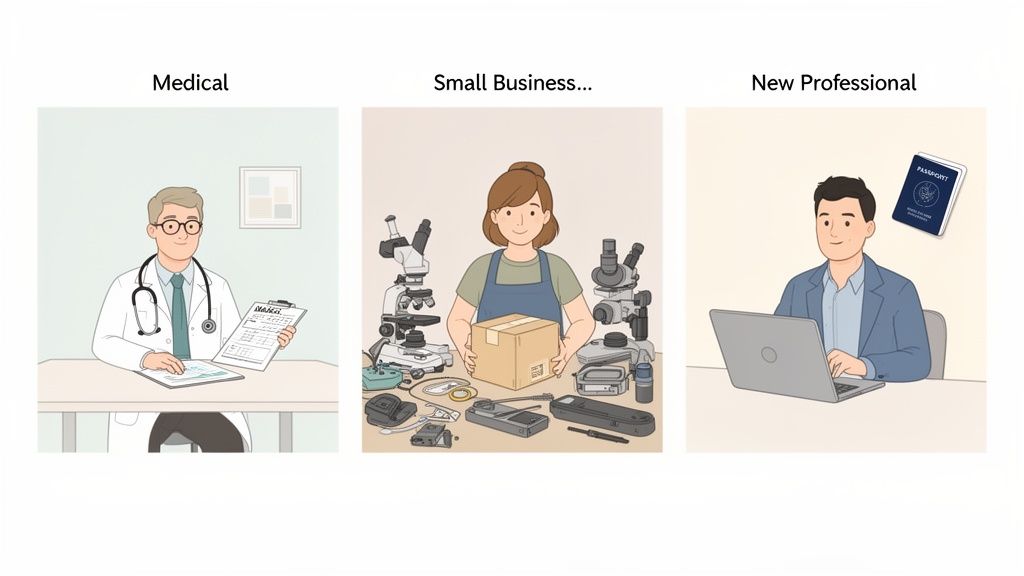
Understanding how tax rules apply in practice can provide valuable clarity. Let’s consider a few scenarios to see how different Australian professionals might approach their home office claims.
These are illustrations of a thought process, not a guarantee of a specific outcome. Each individual's situation is unique, but the objective here is to demonstrate how different working arrangements can shape tax options, allowing you to apply similar logic to your own circumstances.
A Medical Specialist Earning PSI
Dr. Anya is a surgeon whose practice operates through a company, placing her under the Personal Services Income (PSI) rules. Two days a week, she works from a dedicated home office, managing administration, reviewing patient files, and conducting telehealth consultations.
Over the year, she worked from home for 48 weeks, averaging 16 hours per week. This gives her a total of 768 hours worked from home.
Fixed Rate Method: This is a straightforward option. At 70 cents per hour, her potential deduction would be $537.60 (768 hours x $0.70). This method is simple and requires a log of her hours.
Actual Cost Method: Dr. Anya’s home office occupies 10% of her home's total floor area. Her annual electricity and internet bills total $4,800, making the work-related portion $480 (10% of $4,800). She also purchased a new ergonomic chair for $800 used exclusively in her office. With this method, her total claim could be $1,280 ($480 + $800).
For Dr. Anya, depending on her circumstances, the actual cost method could yield a higher deduction. The additional record-keeping effort may be justified, which can often be the case for professionals with a dedicated, well-equipped workspace.
A Small Business Owner
Ben runs an e-commerce business from a converted garage used exclusively for storing inventory, packing orders, and managing his website. The garage constitutes 20% of his home’s total floor area.
He works approximately 40 hours a week for 50 weeks a year, totalling 2,000 hours.
Fixed Rate Method: Ben’s claim would be $1,340 (2,000 hours x $0.67). While simple, this figure may not fully reflect his actual expenses.
Actual Cost Method: Ben’s annual costs for electricity, heating, insurance, and internet are $7,000. His business portion is $1,400 (20% of $7,000). He also spent $500 on shelving and is depreciating a $2,000 packing machine. His total claim using this method would likely be substantially higher, better reflecting the portion of his home dedicated to the business.
When a business is significantly integrated into a home, like Ben’s, the actual cost method may provide a more accurate representation of the expenses incurred to generate income.
A Professional New To Australia
Priya, a software engineer, recently migrated to Australia and works for a tech company with a hybrid model. She works from her rented apartment three days a week, using a desk in the corner of her living room.
She worked from home for 45 weeks, averaging 24 hours per week, for a total of 1,080 hours.
Fixed Rate Method: Priya could claim $723.60 (1,080 hours x $0.67). This is a simple, straightforward option, which can be helpful for someone navigating a new tax system.
Actual Cost Method: This may be more complex for Priya. As her workspace is not a separate room, calculating a floor area percentage could be difficult to substantiate. The ATO generally requires a dedicated workspace for certain occupancy expense claims. Therefore, apportioning costs like electricity and internet could be challenging to justify. For Priya, the fixed rate method is likely the more practical and defensible choice.
These scenarios illustrate that there is no single "best" method. The decision often involves a trade-off between the potential size of a deduction and the time and effort required for compliant record-keeping.
Different professions have varied requirements. A healthcare worker, for example, will have unique claimable items and record-keeping needs. To see what this might look like, you can learn more about what a nurse can claim on tax in our detailed guide.
If you are unsure how these principles may apply to you, speaking with a qualified adviser can provide clarity. You can contact Everglow on 1300 913 929 or email contact@everglow.au to arrange a discussion.
General Advice Warning: The information provided in this article is general in nature and does not take into account your personal objectives, financial situation, or needs. Before acting on any information, you should consider the appropriateness of the information having regard to your own objectives, financial situation, and needs and seek personal advice from a qualified financial adviser.
Navigating Common Pitfalls and Responsibilities
Claiming a home office deduction offers an opportunity to reduce taxable income, but it comes with responsibilities. A thoughtful and disciplined approach to tax affairs is a cornerstone of sound financial stewardship.
To navigate these rules with confidence, it is important to be aware of common errors. This helps ensure your claim is not only appropriate for your circumstances but also defensible should the Australian Taxation Office (ATO) make an inquiry.
Miscalculating Apportionment and Double-Dipping
One common pitfall is incorrectly calculating the work-related portion of shared household expenses. When using the actual cost method, it is important that the percentage of your home claimed for work use is reasonable and based on a logical method, such as floor area. Keeping a clear record of how you arrived at your percentage is crucial.
Another frequent error is "double-dipping." If you use the fixed rate method, you cannot then claim separate deductions for electricity, internet, or stationery, as an allowance for these is already included in the 70 cents per hour rate. Claiming these costs twice may attract ATO attention.
A compliant tax claim is grounded in accuracy, not aggression. The goal is to claim what you are reasonably entitled to—supported by clear evidence—rather than pushing the boundaries of what is acceptable.
The Critical Distinction: Running vs. Occupancy Expenses
It is vital to understand the difference between running expenses and occupancy expenses. This distinction has significant long-term consequences, particularly for homeowners.
Running Expenses: These are the costs of using your home office. This may include electricity and gas for heating and cooling, phone and internet bills, stationery, and the depreciation of a desk and computer. These are generally claimable by both employees and business owners, provided other criteria are met.
Occupancy Expenses: These are the costs associated with owning or renting your home, such as mortgage interest, rent payments, council rates, and home insurance. As a general rule, these are only claimable if your home is your principal place of business—a high threshold to meet. For most employees working from home, claiming occupancy expenses is not an option.
Understanding Capital Gains Tax Implications
For homeowners, claiming occupancy expenses can have Capital Gains Tax (CGT) implications upon the sale of the home. A main residence is normally exempt from CGT. However, if you claim a portion of your home as a place of business and deduct occupancy costs, that portion of your home may lose its CGT exemption for the period it was used for business purposes.
This could result in a significant tax liability in the future, potentially outweighing the benefit received from the deductions. This is a serious financial consideration that often requires professional guidance. It highlights the importance of looking beyond immediate tax outcomes to potential future responsibilities.
To build a stronger foundation in this area, our educational resource on general tax compliance for individuals and businesses may be a helpful starting point.
If you would like clarity on how these principles may apply to your own circumstances, a conversation with a qualified adviser can make all the difference. You can contact Everglow on 1300 913 929 or email contact@everglow.au to arrange a discussion.
General Advice Warning: The information provided in this article is general in nature and does not take into account your personal objectives, financial situation, or needs. Before acting on any information, you should consider the appropriateness of the information having regard to your own objectives, financial situation, and needs and seek personal advice from a qualified financial adviser.
Your Next Steps for a Confident Tax Return
Claiming a home office deduction is fundamentally about good record-keeping. The method you choose—whether the straightforward fixed rate method or the more detailed actual cost method—directly determines your documentation requirements. The foundation of a sound claim is not aggressive calculation, but diligent and consistent paperwork.
Good financial stewardship is a habit developed over time, not an annual event. By keeping clear records of your hours and expenses as you incur them, tax time can become a smoother, more manageable process. That quiet confidence is a hallmark of being in control of one's financial affairs.
Home Office Deduction Preparation Checklist
To begin with clarity, it may be helpful to work through a few practical steps. Consider this a preparatory checklist to ensure you have what you need to assess your claim properly.
| Task | Status (To Do / Complete) |
|---|---|
| Review Eligibility | Confirm you meet the ATO's criteria for working from home. |
| Choose Your Method | Weigh whether the fixed rate or actual cost method is more suitable for you. |
| Log Your Hours | If using the fixed rate, ensure your log is complete and accurate for the year. |
| Gather Receipts | For the actual cost method, collate all relevant invoices and bills. |
| Calculate Apportionment | Document your floor area percentage or another reasonable basis for your claim. |
| Review CGT Impact | Consider any Capital Gains Tax implications if claiming occupancy costs. |
This checklist provides a solid framework, helping to ensure no critical step is missed.
While this guide offers a foundation, every situation has its own nuances and may benefit from tailored advice. To stay informed about key lodgement dates, you might find our guide on the Australian tax return deadline helpful.
If you wish to gain clarity on how these rules may apply to you, the next step could be a conversation with a qualified adviser. You can contact Everglow on 1300 913 929 or email contact@everglow.au to arrange a discussion.
General Advice Warning: The information provided in this article is general in nature and does not take into account your personal objectives, financial situation, or needs. Before acting on any information, you should consider the appropriateness of the information having regard to your own objectives, financial situation, and needs and seek personal advice from a qualified financial adviser.
Still Have Questions? Let’s Clear Things Up
When it comes to home office deductions, the details are important. It is natural for specific questions to arise as you consider your own situation. Here are some of the most common inquiries we receive, with practical, straightforward answers.
Can I Claim Anything If I Just Use My Dining Table?
This is a frequent question. While the ATO generally expects a dedicated office area to claim certain running costs under the actual cost method, this does not mean you are unable to claim anything.
If you are performing substantive work duties from home—even at the kitchen bench—you may be able to use the fixed rate method. The key eligibility factor is not having a separate room, but being able to demonstrate that you were actually working. This is why maintaining a log of your hours is non-negotiable.
What If I Only Work From Home Once In a While?
Even if you only work from home occasionally, you may still be able to claim a deduction, provided you meet the basic eligibility rules.
The fixed rate method is well-suited for this scenario. It is designed for simplicity, allowing you to claim a set amount for the hours you do work from home without engaging in complex calculations for infrequent use.
Do I Really Need Receipts For The Fixed Rate Method?
The answer depends on what you are claiming. You do not need to retain every electricity or internet bill specifically for the hourly rate component of the claim.
However, you must have a complete and accurate record of the hours you worked from home. This could be a simple diary, a spreadsheet, or official timesheets. Additionally, you will need receipts for any larger assets purchased for your home office, such as a new computer or desk, as you may claim the decline in value for those items separately. Our team can help provide clarity on your record-keeping obligations through our tax and accounting services.
A home office deduction is not defined by the size of the claim, but by the quality of the records that support it. Thoughtful documentation is the cornerstone of responsible financial stewardship and ATO compliance.
Ultimately, understanding which path is appropriate for your circumstances is the key to lodging a compliant claim.
If you would like clarity on how these principles may apply to your own circumstances, you may wish to speak with a qualified adviser. You can contact Everglow on 1300 913 929 or email contact@everglow.au to arrange a discussion.
General Advice Warning: The information provided in this article is general in nature and does not take into account your personal objectives, financial situation, or needs. Before acting on any information, you should consider the appropriateness of the information having regard to your own objectives, financial situation, and needs and seek personal advice from a qualified financial adviser.
Want help applying this to your situation?
Every situation is different. Book a time with our team to talk it through, or call us on 1300 913 929.
Book a free meetingAustralian tax guide →Estimate your fees →
Keep exploring