
In the landscape of Australian finance, few concepts are as foundational as your tax residency status. It is the framework upon which your tax obligations are constructed. This status, however, is not determined by your passport or visa but by a specific set of tests administered by the Australian Taxation Office (ATO) to establish if you are a foreign resident for tax purposes.
Misunderstanding this classification can lead to unforeseen financial consequences. A clear grasp of the rules is a cornerstone of sound financial stewardship.
Why Your Tax Residency Status Matters
Your tax residency status acts as the lens through which the ATO assesses your financial world. It dictates which rules apply to your income and assets, and for a foreign resident, these rules are distinctly different.
This single classification may have a ripple effect across your financial life:
- Income tax rates could be higher, and the tax-free threshold generally does not apply.
- Capital Gains Tax rules may change, potentially removing access to the 50% discount for assets held for over 12 months.
- Withholding obligations may arise, for example, when selling Australian property.
- Double Tax Agreements may become crucial in mitigating the risk of being taxed twice on the same income by two different countries.
The Real-World Impact on Your Finances
Let’s consider the practical implications. A clear understanding of how these rules operate may help you manage your financial obligations more effectively.
The most immediate difference for a foreign resident is often the loss of the $18,200 tax-free threshold. While Australian residents typically do not pay tax on their first $18,200 of income, a foreign resident is generally taxed from the first dollar earned from an Australian source.
Then there is Capital Gains Tax. If an Australian resident sells an asset held for more than a year, the 50% discount on the capital gain can be a significant advantage. For a foreign resident, this discount is generally not available, which could result in a higher tax liability on the profit.
A Practical Example
Consider a software engineer based in Singapore who owns Australian shares. Each year, those shares pay a dividend.
Because she is classified as a foreign resident for tax purposes, those dividends may have a withholding tax applied before the funds reach her Singaporean bank account. The rate can depend on whether a tax treaty is in place between Australia and Singapore.
Correctly identifying your residency status from the outset is about navigating your tax obligations with foresight and avoiding unexpected liabilities.
If you are interested in how other jurisdictions approach this, a foreigner's guide to taxes in Spain can illustrate how varied international tax rules can be.
For those focused on the Australian context, our guide on taxes in Australia for expats offers further detail.
Establishing Your Position
What practical steps can be taken? A good starting point is to maintain meticulous records. Your travel dates, where you have lived, and your financial ties are all crucial pieces of information that help build a clear picture of your residency status.
Depending on your circumstances, professional advice may be appropriate to help navigate the ATO’s tests—such as the resides test, the domicile test, and the 183-day rule.
- Review your physical presence in, and connections to, Australia.
- Document relevant details: visa status, travel itineraries, and living arrangements.
- Consider how tax treaties might apply to your circumstances to prevent double taxation.
- Plan for how tax will be managed on any income you earn from Australian sources.
With a clear understanding of your residency, you may approach other financial matters—from lending and superannuation to broader financial strategy—with greater confidence.
The Benefit of Clarity
Correctly classifying your residency status is not just about avoiding penalties. It ensures you pay the tax you are legally required to, in the jurisdiction where it is owed.
It also brings clarity to other financial matters, such as loan applications and superannuation contributions, by demonstrating clear ties (or a lack thereof) to Australia. While the rules can seem complex, thoughtful planning can make a significant difference.
In the next section, we will break down the four key tests the ATO uses to determine whether an individual is an Australian resident for tax purposes.
The Four Residency Tests Used by the ATO
Determining whether you are an Australian resident or a foreign resident for tax purposes is not a matter of personal choice. The Australian Taxation Office (ATO) uses a series of well-defined, legally established tests to make this determination.
It is important to understand that you only need to satisfy one of these four tests to be considered an Australian resident for tax purposes.
Grasping these tests is a foundational element of managing your financial affairs appropriately. They are not merely administrative hurdles; they form the very framework that defines your tax obligations in Australia. Let's walk through each one in practical terms.
This flowchart provides a high-level overview of the logic the ATO applies when determining residency status.
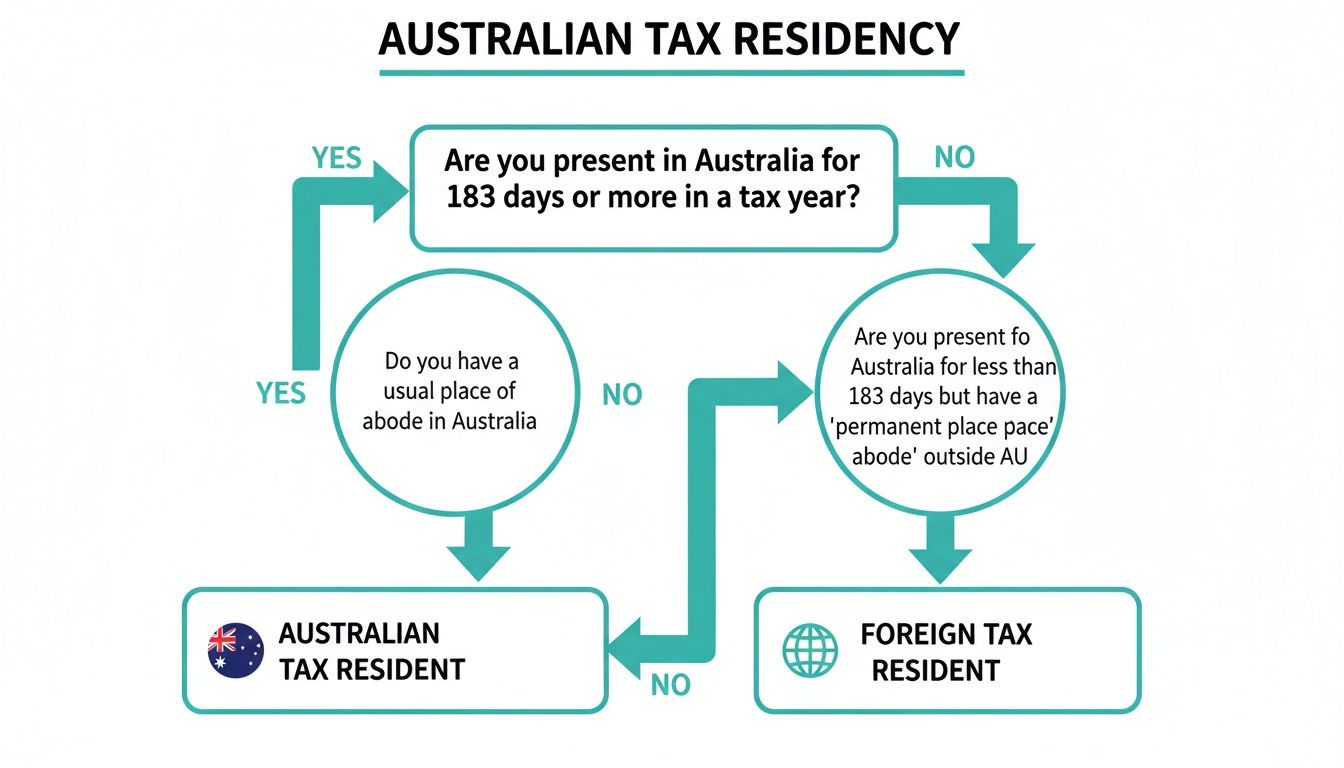
As shown, satisfying any one of the four tests is sufficient to be classified as a resident. This is why it is important to assess your own circumstances against each test carefully.
To help clarify these concepts, here is an overview of the four tests and what they consider.
Quick Guide to Australian Tax Residency Tests
The ATO uses four key tests to determine an individual's tax residency status. Each test examines different aspects of your life and connection to Australia. Understanding the focus of each is the first step in assessing your own position.
| Residency Test | What It Considers | A Practical Example for an Australian Professional |
|---|---|---|
| The Resides Test | Your overall pattern of life, physical presence, intentions, and social or family ties. | A marketing executive from the UK moves to Melbourne on a four-year sponsored visa, leases an apartment, and enrols her children in a local school. |
| The Domicile Test | Your "permanent home" by law, unless you have established a new permanent place of abode elsewhere. | An Australian-born architect who relocates to Singapore for a long-term project but maintains financial ties and family connections in Australia. |
| The 183-Day Rule | Whether you are physically present in Australia for more than half the financial year (183 days). | A freelance IT consultant from Canada who spends seven months in Sydney working on a major project for an Australian client. |
| The Commonwealth Superannuation Test | Your membership in a specific public sector superannuation scheme. | An Australian public servant on a diplomatic posting in another country who is a member of the Commonwealth Superannuation Scheme. |
These tests can be complex, with decades of case law shaping their interpretation. Let's explore each one in more detail.
The Resides Test (Common Law Test)
This is the primary—and often most interpretive—of the four tests. It looks beyond a simple count of days in the country and asks a more fundamental question: do you reside in Australia?
To answer this, the ATO considers the quality and character of your physical presence. Factors that may suggest you reside in Australia include:
- Physical Presence: While there is no "magic number" of days, being in Australia for a significant and continuous period can be a strong indicator.
- Intention and Purpose: The reason for your presence in Australia is considered. For instance, are you here for a temporary holiday or have you relocated with a degree of permanence?
- Family and Business Ties: The location of your immediate family, as well as your employment or business, carries significant weight.
- Maintenance of a Home: Having a dwelling in Australia that is available for your use, whether owned or rented, is a classic sign of residency.
- Social and Living Arrangements: Other relevant factors include where your personal belongings are kept, any memberships in local clubs or associations, and generally where your day-to-day life is conducted.
The core principle of the resides test is to determine if your behaviour, viewed as a whole, is consistent with that of someone who has made Australia their home.
For example, a doctor from the UK who moves to Sydney on a two-year specialist contract, brings her family, enrols her children in a local school, and leases a house in Paddington would very likely be considered a resident under this test. Her actions demonstrate a clear intention to live in Australia, not merely visit.
The Domicile Test
Your domicile is the country that the law considers your permanent home. For most people, this is their country of birth.
Under this test, you may be considered an Australian resident if your domicile is in Australia, unless the ATO is satisfied that your permanent place of abode is outside Australia.
This test often applies to Australians who move overseas. An Australian-born engineer taking a job in Dubai, for instance, will retain her Australian domicile. To be considered a foreign resident for tax purposes, she would need to demonstrate that she has established a new permanent home in Dubai and has, in effect, abandoned her Australian one.
This usually involves more than simply renting an apartment; it could include severing financial ties, closing Australian bank accounts, and showing a clear intent to live abroad for a significant period.
It is important to understand the distinction between being a resident and a non-resident for tax purposes in Australia. Each status carries different tax outcomes that require careful management.
The 183-Day Rule
This is a more quantitative test. You may be considered a resident if you are physically present in Australia for more than half the income year—that is, 183 days or more—whether continuously or intermittently.
However, an exception may apply. You might not be a resident under this test if the ATO is satisfied that:
- Your usual place of abode is outside Australia, AND
- You do not have an intention of taking up residence here.
Imagine a business owner from New Zealand who spends seven months in Melbourne overseeing the launch of a new venture. Although she has been in Australia for more than 183 days, her family, primary home, and long-term business interests all remain in Auckland. In this case, she could potentially argue she is a foreign resident because her usual home is clearly outside Australia and she does not intend to relocate permanently.
The Commonwealth Superannuation Test
This is the most specific of the four tests and applies to a narrow group of individuals, generally Australian Government employees working overseas.
You are automatically considered an Australian resident if you are a member of the Public Sector Superannuation Scheme (PSS) or the Commonwealth Superannuation Scheme (CSS). This status also extends to your spouse and any children under 16.
This test ensures that Commonwealth public servants and their immediate families are treated as Australian residents for tax purposes, regardless of where in the world they are posted, reflecting their ongoing connection to Australia.
If you would like clarity on how these principles may apply to your own circumstances, you may wish to speak with a qualified adviser. You can contact Everglow on 1300 913 929 or email contact@everglow.au to arrange a discussion.
General Advice Warning: The information provided in this article is general in nature and does not take into account your personal objectives, financial situation, or needs. Before acting on any information, you should consider the appropriateness of the information having regard to your own objectives, financial situation, and needs and seek personal advice from a qualified professional.
Key Tax Implications for Foreign Residents
Becoming a foreign resident for tax purposes is not just a change in label; it is a fundamental shift in how Australian tax law applies to you. This has tangible impacts on your finances, affecting everything from how your income is taxed to the treatment of your investments.
Understanding these differences is a critical first step. It is about more than compliance—it is about understanding the new framework so you can manage your financial affairs with foresight.
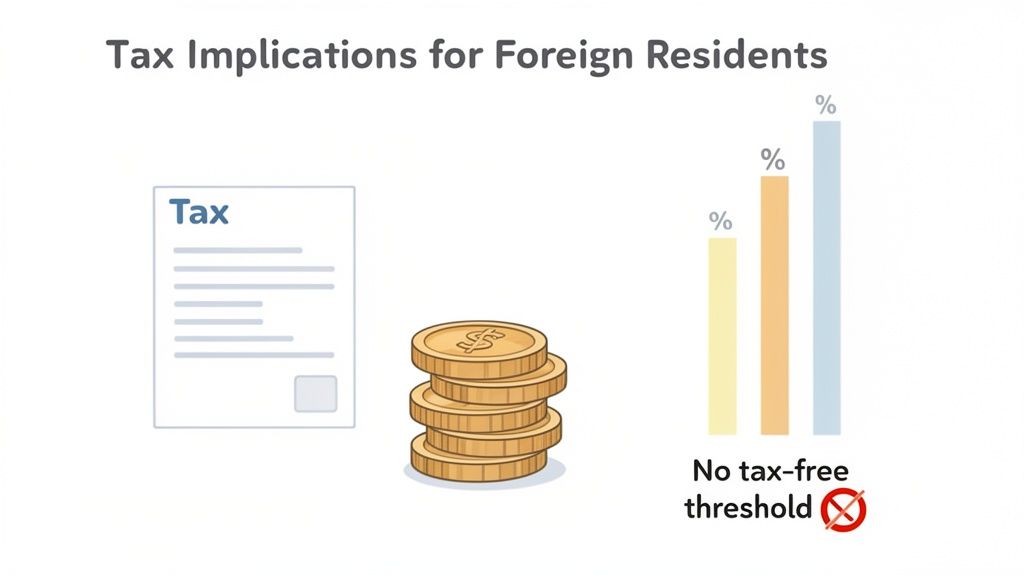
Different Tax Rates and No Tax-Free Threshold
For Australian residents, the first $18,200 of income earned each year is generally tax-free.
As a foreign resident, this advantage is typically not available.
This means you may pay tax on the first dollar of income you earn from an Australian source. The tax rates themselves are also structured differently from those for residents, which may be unexpected if you are not prepared.
For the 2024–25 financial year, for instance, foreign residents are taxed at 32.5% for income up to $120,000. It is always wise to refer to the current rates published by the ATO.
Understanding Capital Gains Tax (CGT) Rules
Capital Gains Tax (CGT) is another area where your residency status can make a significant difference. When an Australian resident sells an asset, such as shares or property, that they have held for over 12 months, they may be eligible for a 50% CGT discount, effectively halving their taxable gain.
For a foreign resident, this discount is generally not available for assets acquired after 8 May 2012. As a result, the entire capital gain is usually assessable for tax, which could lead to a larger tax bill.
The absence of the 50% CGT discount is a key consideration for foreign residents holding Australian assets. This rule highlights the importance of understanding your residency status at the time of both acquiring and disposing of an asset.
Imagine a business owner living overseas who sells shares in an Australian company they have held for three years. Their entire capital gain would likely be assessed for tax. A resident in the same position could potentially halve their taxable gain, illustrating the financial significance of this one rule. This principle also extends to investment income; understanding the rules around tax on dividends in Australia helps complete the picture.
Withholding Tax on Certain Payments
When certain types of income are paid from Australia to a foreign resident, a withholding tax may be applied. This is a system where the entity paying you is required by law to withhold a portion of the payment and remit it directly to the ATO.
It is a mechanism for ensuring tax is collected on funds leaving the country. This commonly applies to income such as:
- Interest from Australian bank accounts.
- Unfranked dividends paid by Australian companies.
- Royalties for the use of intellectual property.
The withholding tax rate can vary. It may be influenced by a Double Tax Agreement (DTA) that exists between Australia and your country of residence. While the responsibility to withhold the tax lies with the Australian payer, it directly affects the final amount you receive.
If you would like clarity on how these principles may apply to your own circumstances, you may wish to speak with a qualified adviser. You can contact Everglow on 1300 913 929 or email contact@everglow.au to arrange a discussion.
General Advice Warning: The information provided in this article is general in nature and does not take into account your personal objectives, financial situation, or needs. Before acting on any information, you should consider the appropriateness of the information having regard to your own objectives, financial situation, and needs and seek personal advice from a qualified professional.
Understanding Capital Gains Withholding Rules
When you are considered a foreign resident for tax purposes, dealing with Australian assets involves specific compliance obligations. One of the most significant is the Foreign Resident Capital Gains Withholding (FRCGW) framework. If you are selling certain Australian assets, particularly real estate, this is a rule you need to understand.
At its core, the FRCGW is a straightforward system. It was implemented by the ATO to ensure that when foreign residents dispose of valuable Australian assets, any potential tax on the capital gain is accounted for. It acts as a collection mechanism, requiring a portion of the sale price to be set aside to cover potential tax liabilities.

Under these rules, the purchaser of your asset is legally required to withhold a percentage of the purchase price and pay it directly to the ATO. It is important to understand that this is not a final tax. It is best thought of as a prepayment. You will still need to lodge an Australian tax return to declare the capital gain, calculate the final tax you owe, and claim a credit for the amount that was withheld.
How the Withholding Rules Work
For contracts entered into from 1 July 2017, the FRCGW rules apply to the sale of certain assets where the market value is $750,000 or more. The withholding rate is 12.5%.
These rules apply to what is known as 'taxable Australian real property', which includes land, buildings, and residential or commercial property.
Imagine a foreign resident selling an investment unit in Brisbane for $800,000. Because the sale price is over the threshold, a withholding of $100,000 (12.5% of $800,000) would be deducted at settlement and sent directly to the ATO. The seller still needs to lodge a tax return to declare any gain, which is generally taxed without the 50% CGT discount available to residents.
A Practical Example of Withholding in Action
Let's put this into context. Consider a professional living in Hong Kong who decides to sell an investment apartment in Melbourne for $900,000. Under the rules, the purchaser is legally required to withhold 12.5% of the sale price.
- Purchase Price: $900,000
- Withholding Amount (12.5%): $112,500
At settlement, the purchaser’s conveyancer will remit that $112,500 directly to the ATO. The seller from Hong Kong receives the remaining $787,500. This can have a significant and immediate impact on the cash flow from your sale, so it is vital to factor this withholding into your financial planning from the outset.
The FRCGW is a non-negotiable part of the property settlement process for foreign residents. Being prepared for this deduction is a key element of a smooth and predictable transaction.
Managing the Withholding Amount
While the withholding is mandatory, it may be possible to manage the impact if the standard rate is significantly higher than your actual tax liability. A foreign resident can apply to the ATO for a variation to reduce the withholding rate.
This may be an appropriate course of action if:
- You expect to make a capital loss on the sale.
- You have carried-forward capital losses you can use to offset the gain.
- The actual tax on the gain will be substantially less than the standard withholding amount.
Applying for a variation requires careful preparation and robust supporting documentation. Our guide on Foreign Resident Capital Gains Withholding offers a closer look at this process. It can also be helpful to consult broader resources on liabilities, such as this guide on Capital Gains Tax Foreign Property.
Conversely, if you are an Australian resident selling a property valued at $750,000 or more, you can apply for a clearance certificate from the ATO. You provide this to the purchaser to prove your residency status for tax purposes, which exempts them from the obligation to withhold any amount.
If you would like clarity on how these principles may apply to your own circumstances, you may wish to speak with a qualified adviser. You can contact Everglow on 1300 913 929 or email contact@everglow.au to arrange a discussion.
General Advice Warning: The information provided in this article is general in nature and does not take into account your personal objectives, financial situation, or needs. Before acting on any information, you should consider the appropriateness of the information having regard to your own objectives, financial situation, and needs and seek personal advice from a qualified professional.
How Double Tax Agreements Affect Your Status
When your financial life spans more than one country, you may find yourself considered a resident for tax purposes in two places at once. This is where Australia’s network of Double Tax Agreements (DTAs) becomes particularly important. These are formal treaties between Australia and other nations, designed to prevent the same income from being taxed twice and to create clear, predictable rules.
If you meet the residency criteria in both Australia and another country, a DTA provides a mechanism to resolve this conflict. It does not change Australia's domestic residency tests, but its "tie-breaker" rules can override their outcome for treaty purposes, ensuring you are treated as a resident of only one country for tax.
This process can provide much-needed clarity, helping to untangle complex international obligations so you can plan your financial life with greater confidence.
The Role of DTA Tie-Breaker Rules
When you are a resident of both countries under their domestic laws, the DTA applies a series of ‘tie-breaker’ tests. These are applied sequentially until a single country of residence is determined. This country then has the primary right to tax your worldwide income.
The tests are generally considered in this order:
- Permanent Home: In which country do you have a permanent home available to you? If it is in only one of the countries, that is likely the country of residence.
- Centre of Vital Interests: If you have a home in both countries, the test moves to where your personal and economic ties are closer. This is a practical assessment of where your life is centred—your family, social connections, and business interests.
- Habitual Abode: If your centre of vital interests is unclear, the focus shifts to where you have a habitual abode—the place you live more regularly.
- Nationality: If the previous tests are inconclusive, your country of nationality may be the deciding factor.
This structured process helps establish a single country of residence, preventing the complications of dual tax residency. For further context on these international tax matters, you may find our educational resources on tax residency useful.
The tie-breaker rules in a DTA act as a logical flowchart. They methodically assess your connections to each country to arrive at a single, definitive answer for tax purposes, bringing certainty to your financial obligations.
Opportunities and Responsibilities for Foreign Residents
Even if a DTA determines you are a resident of another country, your obligations to the ATO do not necessarily disappear. As a foreign resident for tax purposes, you still have key responsibilities for any income you earn from Australian sources.
Sound financial stewardship means being diligent with these duties. Your key responsibilities will generally include:
- Lodging an Australian Tax Return: You are typically required to lodge a return to declare any income sourced in Australia. This could be rental income from an Australian property, capital gains on Australian assets, or certain employment income.
- Diligent Record-Keeping: It is vital to maintain thorough records of your Australian-sourced income and any related expenses. This documentation is essential for preparing your tax return accurately and substantiating your position if the ATO has questions.
- Understanding Withholding: Be aware of any withholding tax obligations that apply to payments you receive from Australian sources, as this directly affects your cash flow and compliance.
Navigating these international complexities requires careful attention to detail. Our specialist services for tailored advice are designed to assist individuals and businesses in understanding and managing these cross-border financial matters.
If you would like clarity on how these principles may apply to your own circumstances, you may wish to speak with a qualified adviser. You can contact Everglow on 1300 913 929 or email contact@everglow.au to arrange a discussion.
General Advice Warning: The information provided in this article is general in nature and does not take into account your personal objectives, financial situation, or needs. Before acting on any information, you should consider the appropriateness of the information having regard to your own objectives, financial situation, and needs and seek personal advice from a qualified professional.
Charting Your Course with Confidence
Understanding your tax residency status is the first step, but what you do next is equally important. Moving forward with confidence requires a clear, organised approach to your financial affairs, built on solid information and an honest assessment of your situation.
This process starts with piecing together the story of your connection to Australia. It is not just about administrative tasks; it is about building a clear narrative of your life, your movements, and your financial footprint.
Your Document Checklist
To gain a firm grasp on your position, it is wise to gather and review the key documents that tell this story. A sound starting point includes:
- A detailed travel history, showing all dates of entry and departure for Australia and other countries.
- Records of property ownership or lease agreements, both in Australia and overseas.
- Information on your family's location, particularly where your spouse and children reside and attend school.
- Details of your business, employment, and economic interests, noting where the centre of your financial world truly is.
- Statements showing the location of your key personal assets, such as vehicles, bank accounts, and other valuable belongings.
This collection of information is the foundation for properly assessing your residency against the ATO’s tests and making well-informed decisions.
Good financial stewardship begins with understanding your responsibilities as well as the opportunities. A well-organised record is the first step towards confident planning.
With an increasing number of individuals navigating Australia's system as foreign residents, staying informed has never been more critical. Policy changes, such as those related to Foreign Resident Capital Gains Withholding (FRCGW), can have a significant financial impact. For those considering establishing a business, understanding these rules from the outset is particularly important—our insights on starting a business in Australia as a foreigner may offer useful context.
Where a situation involves complex international ties, major transactions, or the application of a Double Tax Agreement, professional advice may be appropriate to ensure all obligations are met correctly.
If you would like clarity on how these principles may apply to your own circumstances, you may wish to speak with a qualified adviser. You can contact Everglow on 1300 913 929 or email contact@everglow.au to arrange a discussion.
General Advice Warning: The information provided in this article is general in nature and does not take into account your personal objectives, financial situation, or needs. Before acting on any information, you should consider the appropriateness of the information having regard to your own objectives, financial situation, and needs and seek personal advice from a qualified professional.
Frequently Asked Questions
When it comes to the rules around being a foreign resident for tax purposes, it is common for specific questions to arise. This area of financial management requires careful thought, and clarity on the finer points is essential for sound planning.
Here are answers to some common queries to provide further insight into the principles discussed. These responses offer general guidance, and it is important to remember that every individual's circumstances are unique.
If I Work Remotely for an Australian Company, Am I a Resident?
This is a common question in a globalised workforce. Your tax residency is not determined solely by who pays your salary; it depends on the four residency tests.
If you are living and working entirely outside Australia and do not meet any of the residency tests (such as the resides or domicile test), you would likely be considered a foreign resident for tax purposes. In this case, income you earn for work performed overseas is generally not subject to Australian tax, even if paid by an Australian employer. Professional advice may be appropriate to confirm this for your specific situation.
Can My Visa Status Determine My Tax Residency?
While your visa is a relevant factor, it is not the sole determinant. It is possible to be on a temporary visa and be a resident for tax purposes, while someone with permanent residency living abroad could be a foreign resident.
The Australian Taxation Office (ATO) looks beyond your immigration status to your actual circumstances. The four residency tests are applied, focusing on factors like your physical presence, social and economic ties, and where you genuinely live. Your visa helps build a picture of your intentions, but it is just one piece of the puzzle. For a deeper understanding of this distinction, you can explore our educational resources on tax residency.
Do I Still Need to Lodge a Tax Return as a Foreign Resident?
Yes, in many cases, this is a requirement. A foreign resident for tax purposes must still lodge an Australian tax return if they have earned income from an Australian source. This is the mechanism for declaring that income and ensuring the correct amount of tax is paid.
Common examples of Australian-sourced income include:
- Rental income from an Australian property.
- Capital gains from selling Australian assets.
- Certain employment income or business profits generated in Australia.
This responsibility highlights the importance of diligent record-keeping. If you are uncertain about your obligations, our specialist services for tailored advice can help provide clarity.
Being a foreign resident does not remove your Australian tax obligations; it changes their nature. The focus shifts to your Australian-sourced income and assets.
This distinction is fundamental to staying compliant and managing your financial duties responsibly.
If you would like clarity on how these principles may apply to your own circumstances, you may wish to speak with a qualified adviser. You can contact Everglow on 1300 913 929 or email contact@everglow.au to arrange a discussion.
General Advice Warning: The information provided in this article is general in nature and does not take into account your personal objectives, financial situation, or needs. Before acting on any information, you should consider the appropriateness of the information having regard to your own objectives, financial situation, and needs and seek personal advice from a qualified professional.
