

In Australia, the question of when to register for Goods and Services Tax (GST) is a matter that most business owners will eventually consider. It represents a significant step in the life of an enterprise, and understanding the requirements is fundamental to sound financial stewardship and maintaining compliance with the Australian Taxation Office (ATO).
For most businesses, the key figure is a GST turnover of $75,000. Once your gross business income reaches this amount within any 12-month period, registration may be required. For not-for-profit organisations, this threshold is generally higher, at $150,000. However, for those providing taxi or ride-sharing services, the rules are different—registration is typically required from the first dollar earned.
Understanding Your GST Registration Obligations
Determining your GST obligations depends on understanding a specific term: ‘GST turnover’. This figure is not the same as your total sales or annual profit. It is a specific calculation used by the ATO, based on your gross business income (excluding certain sales) over any rolling 12-month period.
This means it may be prudent to monitor not only what you have already earned but also what you are likely to earn in the near future. A common approach involves reviewing the past 11 months of turnover and adding the projected income for the current month. If that total appears likely to cross the threshold, it may be time to consider registration. This is a forward-looking test that encourages disciplined awareness of your revenue.
Key Registration Thresholds
The ATO provides clear guidelines for when GST registration becomes compulsory. Familiarising yourself with these is a sensible first step.
- Standard Business Threshold: $75,000 or more in GST turnover.
- Not-for-Profit (NFP) Threshold: $150,000 or more in GST turnover.
- Taxi & Ride-Sharing Services: No threshold. Registration is generally required from $1 of income.
This decision tree may help visualise the thought process. It breaks down the core questions to help clarify your potential obligations.
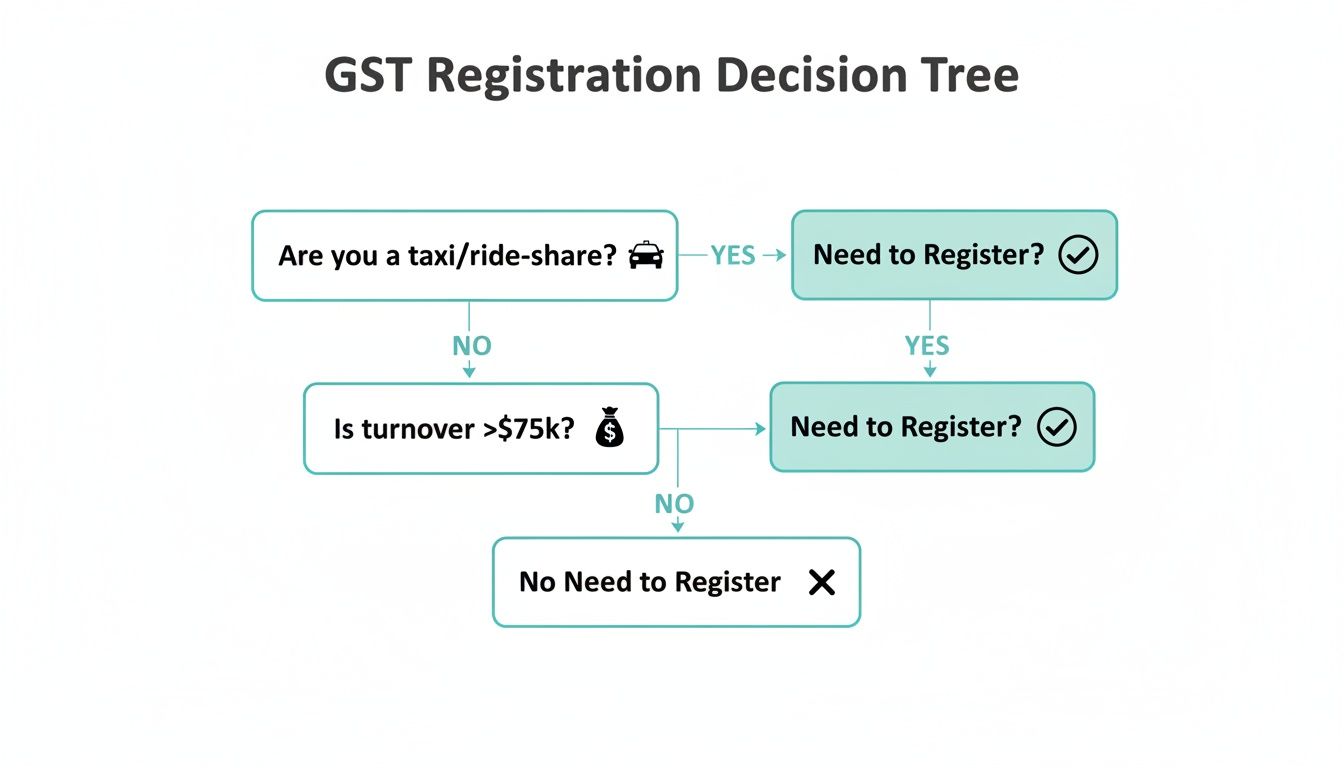
As the flowchart illustrates, the path is often straightforward. You may start by identifying your business type and then assessing your turnover. If you are a freelancer or sole trader, these rules typically apply to you just as they would to a larger company.
To help you quickly assess where you might stand, this table summarises the core rules at a glance.
GST Registration at a Glance
This table breaks down the main GST registration rules, helping you quickly identify your potential obligations based on your specific situation.
| Entity Type | GST Turnover Threshold | Key Consideration |
|---|---|---|
| Most Businesses | $75,000 | This is the most common threshold for sole traders, companies, and partnerships. |
| Not-for-Profit Organisations | $150,000 | Charities and other NFPs may have a higher threshold before registration is mandatory. |
| Taxi & Ride-Sharing | $0 | If you provide taxi, limousine, or ride-sharing services, registration is generally required from day one. |
This summary provides a quick reference, but it is important to remember that GST is more than just a tax—it is a fundamental part of your business's financial engine.
GST is more than just a tax; it's an integral part of your business's financial structure. How you manage it could influence your pricing, cash flow, and compliance standing with the ATO.
Understanding the mechanics of this tax is essential. For a deeper dive, our guide on how GST works breaks down its practical application. With thoughtful planning and awareness, you can manage your obligations with confidence, helping ensure your business remains on solid financial ground.
Calculating Your GST Turnover
Developing a clear understanding of ‘GST turnover’ is a critical step in determining if you need to register for GST. This is not simply your total sales or profit. It is a specific calculation defined by the Australian Taxation Office (ATO) that measures your gross business income to assess your position regarding GST obligations.
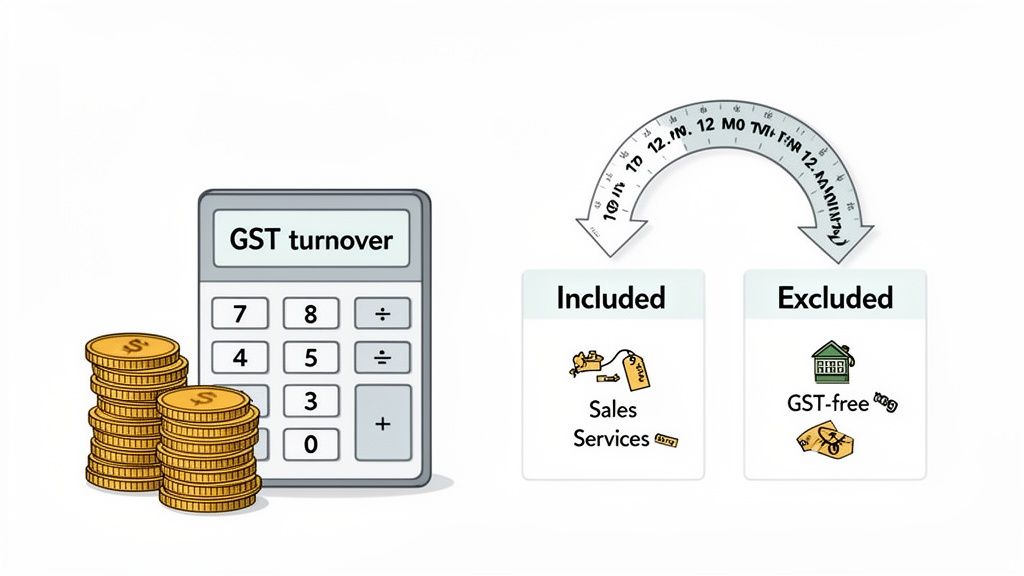
It may be helpful to think of it as a running tally of your taxable and GST-free sales. A prudent approach is to monitor this figure over a rolling 12-month period. At the end of each month, you can look back at the previous 11 months and add the current month's turnover. This process can indicate if you have crossed the registration threshold.
What to Include in Your Calculation
Your GST turnover is your gross business income, not your profit. It is the total of payments received for sales of goods and services connected with Australia.
- Sales of Goods and Services: This includes all revenue from your business’s daily operations.
- Export Sales: Although exports are often GST-free, their value may still need to be included when calculating your GST turnover.
- Certain Asset Sales: If you sell a business asset, the value of that sale might also need to be included.
For example, a property developer would likely include the full sale price of the apartments they have sold. A consultant would add up all invoiced fees. For sole traders, understanding how your income fits into this calculation is vital.
What to Exclude from Your Calculation
Knowing what to leave out is just as important. The ATO is quite specific about certain types of income that do not count towards your GST turnover.
- The 10% GST you may have included in your sale prices.
- Sales that have no connection to your business (such as selling a personal car).
- Sales that are ‘input-taxed’, such as residential rent or financial supplies like interest.
- Sales that are not for payment (unless you are a not-for-profit organisation).
The discipline of calculating your GST turnover each month can turn a regulatory requirement into a proactive financial management tool. It allows you to plan with foresight rather than react under pressure, which is a cornerstone of good financial stewardship.
Many businesses choose to register for GST well before they reach the mandatory threshold, primarily to claim back the GST paid on their business expenses. This is a strategic decision that depends on individual circumstances.
Special Registration Rules and Circumstances
While the $75,000 threshold is a guiding rule for most, Australian GST law includes specific provisions for certain industries and situations. It is not a one-size-fits-all system. Understanding where you fit is a crucial part of responsible financial management.
Taxi and Ride-Sharing Services
If you provide taxi, limousine, or ride-sharing services, the GST rules are quite direct. The standard turnover threshold does not apply.
This means if you decide to drive for a platform like Uber, Didi, or Ola, you may be required to have an Australian Business Number (ABN) and be registered for GST from the first dollar you earn. This is a longstanding rule that now fully includes the modern app-based economy, placing the compliance responsibility on the driver.
Not-for-Profit Organisations
In recognition of their community-focused work, not-for-profit (NFP) organisations are given a higher GST registration threshold. An NFP is generally only required to register for GST once its GST turnover reaches or exceeds $150,000 per year.
To be eligible for this higher threshold, the organisation typically needs to be one of the following:
- A charity registered with the Australian Charities and Not-for-profits Commission (ACNC).
- Another type of NFP that is not a charity, such as a community sports club.
- A government-related entity, such as a local council.
Many NFPs with turnover below $150,000 still choose to register voluntarily. This can be a considered strategic move, especially if the organisation has significant expenses that include GST, as it allows them to claim those GST credits back. Our resources on tax and accounting for NFPs offer further insights into making these decisions.
New Migrants and Foreign Enterprises
Australia's tax system has clear provisions for non-residents and new migrants doing business here. If you are running a foreign enterprise that makes sales connected with Australia, you may need to register for GST, even without a physical presence on our shores.
This typically applies if your GST turnover from Australian sales is $75,000 or more.
Navigating the intersection of international and local tax law requires careful attention. A key principle is that if you are making 'sales connected with Australia', you may fall within the scope of Australian tax law, including GST obligations.
An overseas company selling digital products to Australian customers, for example, could meet this threshold. These rules are designed to create a level playing field between local and foreign businesses. For new migrants starting a business in Australia, the standard $75,000 threshold applies once their enterprise is operational. If your situation is complex, it may be appropriate to arrange a discussion with an adviser.
Professionals Earning Personal Services Income
Specialist doctors, IT contractors, engineers, and other professionals who earn what the ATO calls Personal Services Income (PSI) are also subject to the standard GST rules.
If your business—whether you are a sole trader or operate through a company—has a GST turnover of $75,000 or more from your personal skills and efforts, registration may be required. The key is to correctly calculate your GST turnover, which is based on the income your expertise generates. Managing PSI and GST involves diligent record-keeping and a clear understanding of your obligations.
The Strategic Choice of Voluntary GST Registration
For many growing Australian businesses, the prospect of GST registration can seem like an administrative task. However, deciding to register before you are legally required to can be a considered strategic move. It is not just about compliance; it is a calculated decision that warrants a clear-eyed look at your business model, your expenses, and your future direction.
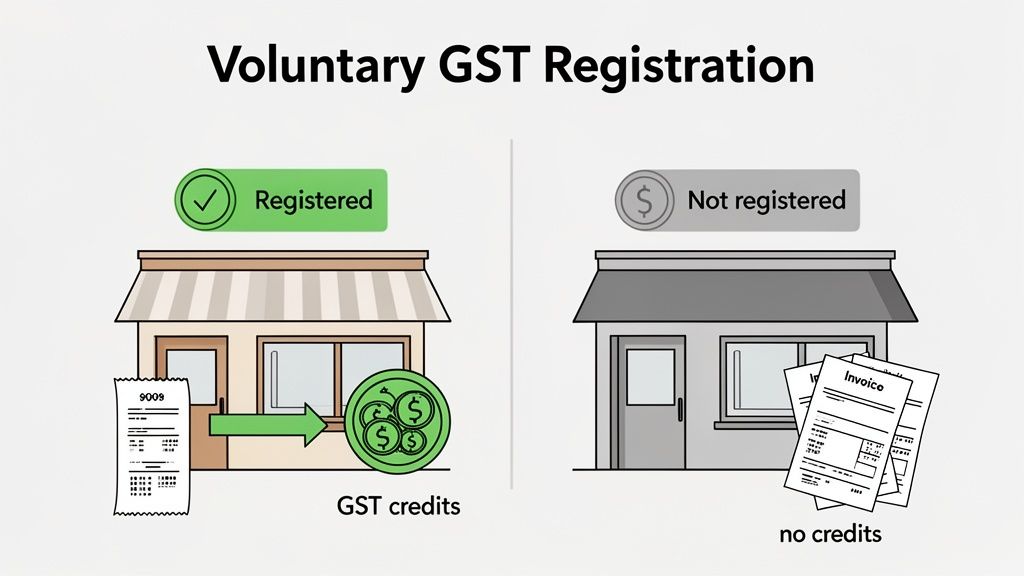
The primary motivation for early registration is often the ability to claim back the GST paid on business purchases. These are known as GST credits (or input tax credits). If your business has significant upfront costs or ongoing expenses, this could have a material impact on your cash flow.
Weighing the Opportunities and Responsibilities
Choosing to register for GST is a classic case of balancing opportunity against responsibility. On one hand, you may gain a direct financial benefit. On the other, you take on new administrative duties. It is a decision that could directly impact your cash flow and how you are perceived in the market.
Potential advantages of voluntary registration may include:
- Claiming GST Credits: This is a key benefit. You can claim credits for the GST paid on many things you buy for your business—from equipment and materials to rent and professional services. This may effectively reduce your costs.
- Projecting a More Established Image: An ABN that is registered for GST can sometimes signal to larger clients and suppliers that a business is established and operating at a certain scale. Some large organisations may even prefer or require their suppliers to be registered.
Potential disadvantages and responsibilities to consider:
- Increased Prices: You must add 10% GST to your taxable sales. For customers who are not registered for GST themselves (like the general public), this makes your prices higher. This is a crucial factor if you are in a price-sensitive, business-to-consumer market.
- Administrative Workload: You will need to lodge Business Activity Statements (BAS) with the ATO, usually quarterly or monthly. This means more paperwork, more deadlines, and the need for diligent record-keeping.
A Practical Comparison
Let’s see how this might play out. Imagine two new graphic designers, both expecting to turn over $60,000 this year.
Consultant A (Not Registered): She bills a client $1,000 for a new logo design. That $1,000 is her gross income. When she buys a new computer for $4,400 (including $400 of GST), that $400 is simply part of the computer's cost. It is a business expense, but the GST cannot be claimed back.
Consultant B (Voluntarily Registered): He also quotes $1,000 for the same job, but his invoice must add GST. The final bill is $1,100 ($1,000 income + $100 GST). He owes that $100 to the ATO. However, when he buys the same $4,400 computer, he can claim the $400 GST component back as a credit on his BAS. The computer’s net cost to his business is now $4,000.
Choosing to register for GST is an exercise in foresight. It may require you to weigh the immediate cash flow benefit of claiming credits against the administrative duty of collecting and remitting the tax.
This decision is tied directly to the financial rhythm of your business. Ultimately, there is no single right answer—it all depends on your unique circumstances, your customer base, and the nature of your expenses.
Responsibilities and Risks of Non-Compliance
Managing GST correctly is not just about fulfilling an obligation to the tax office; it is an act of good financial stewardship. When compliance is viewed as a core component of your business’s financial health, rather than a burden, you can navigate your responsibilities with confidence and mitigate the risk of future complications. Being proactive is essential for long-term stability.
The consequences of failing to register for GST when required can be significant. It is a business owner's responsibility to monitor turnover and act when the threshold is met. Overlooking this responsibility, whether by accident or by design, can attract unwelcome attention from the Australian Taxation Office (ATO).
Potential Consequences of Non-Compliance
The risks of not registering for GST on time are both financial and administrative. The ATO has robust systems to protect the integrity of the tax system and does not take non-compliance lightly.
Here is what a business could face:
- ATO-Issued Penalties: The ATO has the authority to impose financial penalties for failing to register on time. These can add an unwelcome financial strain.
- Liability for Past GST: This can be a major concern. You could be held liable for 1/11th of all the income earned since the date you were required to register. This applies even if you did not charge GST to your customers, meaning that debt must come from your own pocket.
- Interest Charges: On top of penalties and back-dated GST, the ATO can also apply interest charges on the outstanding amount, calculated from the date it was originally due.
These consequences can put immense pressure on a business’s cash flow and create a significant administrative burden to resolve.
The ATO's Compliance and Data-Matching Focus
The ATO's capabilities are continually advancing. Sophisticated data-matching programs cross-reference information from banks, other government agencies, and digital platforms to identify discrepancies between reported income and GST registration status.
Viewing compliance as a foundational pillar of your business strategy, rather than an afterthought, reinforces financial discipline. It is an act of good stewardship that protects your enterprise from future risk and builds a resilient financial structure.
At the end of the day, embracing your responsibilities with foresight and care is always the wisest path forward.
Common GST Registration Questions
When running a business, navigating your Goods and Services Tax obligations can raise specific, practical questions. What happens if the timing is off? How might a mistake be rectified? Seeking clear answers helps build the confidence to manage finances with prudence.
Let's walk through some of the most common queries we hear from business owners. The answers can have a real impact on cash flow and financial standing.
What Happens if I Cross the Threshold and Do Not Register?
If your turnover exceeds the GST threshold and you do not register within the required 21 days, you could find yourself in a difficult position. The Australian Taxation Office (ATO) may impose penalties for late registration, but the larger issue is often the tax liability itself.
You could become responsible for paying GST on all taxable sales made from the date you were required to be registered. This could mean you owe 1/11th of your relevant income to the ATO, even if you never charged or collected GST from your customers. That amount would need to be paid from your existing cash flow, which can place a serious strain on a business. This is why careful monitoring of turnover is so important.
Can I Backdate My GST Registration?
In some situations, yes, it may be possible to request that the ATO backdate your GST registration. This often arises when a business has made large purchases before registering and wishes to claim the GST credits on those items.
A decision to backdate your registration should be approached with careful consideration. While it can unlock past GST credits, it simultaneously creates a GST liability on all taxable sales from that earlier date.
This is a classic cost-benefit scenario. You would need to weigh the value of the credits you might gain against the GST you would then owe on past sales. It may be wise to have a professional run the numbers with you to see which path leaves you in a better financial position before making a final decision.
Can I Cancel My GST Registration?
Yes, you can apply to cancel your GST registration, but only under specific conditions. Generally, you need to have been registered for at least 12 months, and both your current and projected GST turnover must be below the relevant threshold ($75,000 for most businesses).
When you cancel, you will need to lodge a final GST return. As part of that final return, you may have to repay some of the GST credits you previously claimed on business assets you still hold. Because there can be financial implications, professional advice on the best way to navigate the cancellation process may be appropriate.
If you would like clarity on how these principles may apply to your own circumstances, you may wish to speak with a qualified adviser. You can contact Everglow on 1300 913 929 or email contact@everglow.au to arrange a discussion.
General Advice Warning
The information provided in this article is general in nature and does not take into account your personal objectives, financial situation, or needs. Before acting on any information, you should consider the appropriateness of the information, having regard to your own objectives, financial situation, and needs, and seek personal advice from a qualified professional.
Want help applying this to your situation?
Every situation is different. Book a time with our team to talk it through, or call us on 1300 913 929.