

Investing in property is a significant financial commitment, one that may reward careful and disciplined management. For Australian investors, one of the most powerful tools available may be property depreciation—a non-cash tax deduction that acknowledges the natural wear and tear of a building and its fixtures over time. This is an established and legitimate part of Australian tax law, as guided by the Australian Taxation Office (ATO).
Understanding Property Depreciation for Your Financial Strategy
For many Australian professionals, business owners, and new migrants, an investment property may form a cornerstone of their long-term wealth plan. Most investors are diligent about claiming immediate expenses like loan interest and council rates, but depreciation often remains an overlooked area.
Put simply, the ATO recognises that your building and the assets inside it—like carpets, ovens, and air conditioners—gradually lose value as they age. A depreciation schedule for an investment property is the formal document that allows you to claim this gradual loss as an annual tax deduction, even though no cash actually leaves your bank account.
This process may deliver two key benefits, depending on your circumstances:
- Improved Annual Cash Flow: By reducing your taxable income, depreciation deductions could lead to a larger tax refund or a smaller tax bill. This may directly improve your ability to hold the property.
- Support for Long-Term Goals: Better cash flow can make a property investment more sustainable, supporting a wealth-building journey with patience and financial discipline.
To meet ATO requirements, this schedule should be prepared by a qualified quantity surveyor. They are recognised experts in assessing construction costs and asset values, and they can produce a comprehensive forecast of your potential claims for up to 40 years. For landlords wanting to explore the topic further, understanding the differences between capital allowance and capital works provides additional context.
A depreciation report may be considered an investment in your financial strategy. It can transform a theoretical tax concept into a practical tool that may enhance cash flow. As you build your knowledge, you may also find our guide on broader strategies for your investment property tax helpful.
The Two Pillars of Depreciation: Division 43 and Division 40
To understand the potential of an investment property, it may be helpful to see it the way the Australian Taxation Office (ATO) does. For tax purposes, a property is not just one single item; it is a collection of assets that wear out over time.
The ATO splits these assets into two distinct categories, which form the two pillars of any depreciation claim. A simple way to think about them is as the ‘bones’ and the ‘appliances’ of your property. Understanding this distinction is key to identifying your potential entitlements.
This is not just an exercise for your tax return; it can be a core component of a thoughtful property investment strategy.
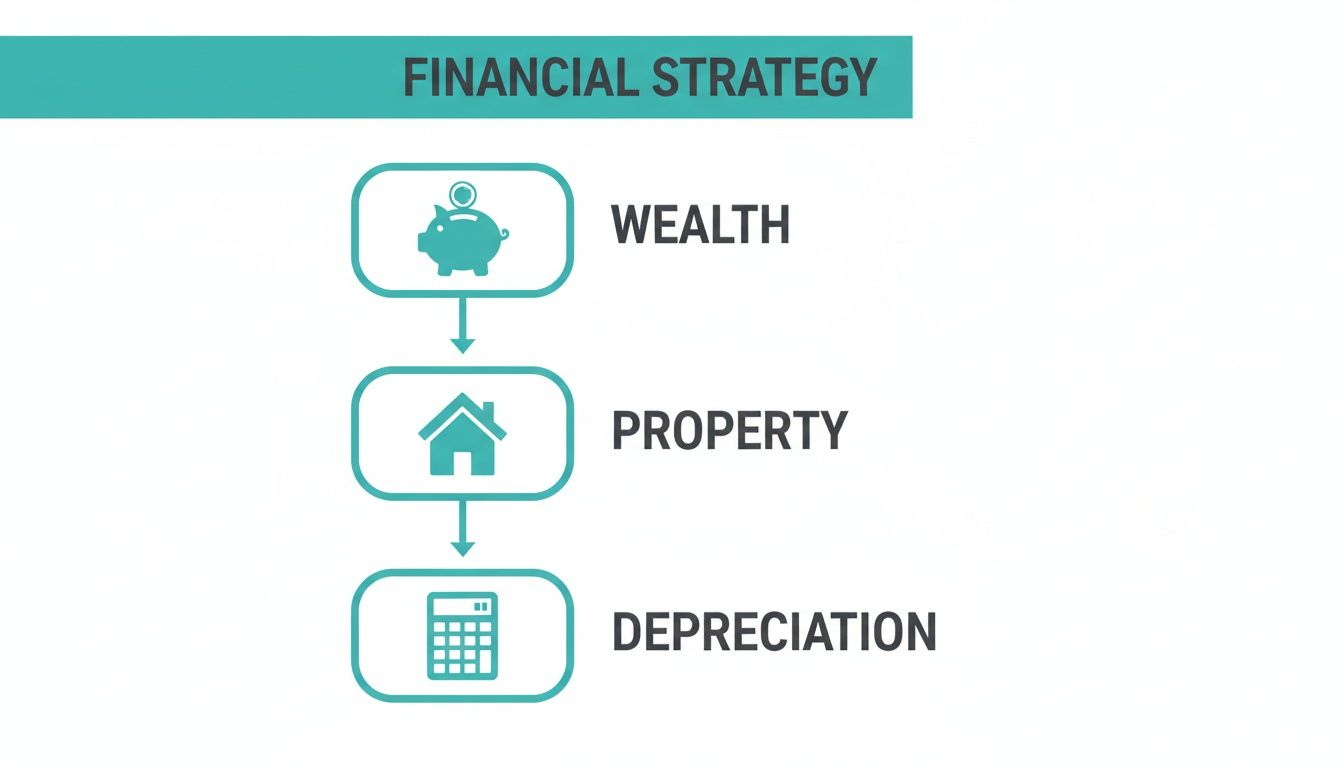
As you can see, depreciation is not an afterthought. It is a foundational concept that may support the wealth-building potential of your investment.
Division 43 Capital Works: The Building’s Bones
The first pillar is Division 43, which covers what are known as capital works. These are the large, structural parts of the building—the elements that are fixed in place and give the property its permanent form.
Think of it as the property’s skeleton and shell:
- Foundations, brickwork, and retaining walls
- Roofing, gutters, and permanent flooring like tiles
- Walls, windows, and doors
For a residential property built after 15 September 1987, you may be able to claim the decline in value of these structural elements at a rate of 2.5% per year over 40 years.
This is where a quantity surveyor may be indispensable. They have the expertise to estimate the original construction costs, even for renovations done by previous owners, to help form the correct cost base for your claims.
Division 40 Plant & Equipment: The Property’s Appliances
The second pillar is Division 40, which covers all the plant and equipment. These are the items inside the property that are not part of the permanent structure and can be more easily removed or replaced.
Because these assets have a shorter effective life than the building itself, the ATO allows them to be depreciated at a faster rate, depending on the specific asset.
Common examples of plant and equipment include:
- Carpets and blinds
- Ovens, cooktops, and rangehoods
- Air conditioning units and hot water systems
- Ceiling fans and smoke alarms
Each of these items has an ‘effective life’ set by the ATO, which dictates how quickly you may be able to claim its value.
To help clarify the roles these two divisions play, here’s a simple breakdown:
| Attribute | Division 43 (Capital Works) | Division 40 (Plant & Equipment) |
|---|---|---|
| What It Covers | The building's structure and fixed items. | Removable fixtures and fittings. |
| Examples | Walls, roof, foundations, windows. | Carpets, ovens, air conditioners. |
| Depreciation Rate | Typically 2.5% per year (prime cost method). | Varies based on the asset's 'effective life'. |
| Lifespan | 40 years from the construction date. | Shorter, item-specific lifespans (e.g., 8-15 years). |
Understanding both is essential, as a complete schedule may maximise claims from each category, year after year.
A professionally prepared depreciation schedule is designed to last for the life of the property (up to 40 years). It separates all of these assets and calculates the deductions for both Division 43 and Division 40 year by year, giving your accountant the information they need.
The value here may lie in having a 40-year forecast that captures the ongoing wear and tear on every qualifying asset. Many investors may miss out on potential deductions simply because they are not aware of the detail involved.
For example, a packaged air conditioner might have a specific depreciation rate, while light fittings could have another. A professional report identifies and calculates these specific rates, ensuring nothing is overlooked.
How a Depreciation Schedule May Impact Your Cash Flow
Theory is one thing, but seeing how a depreciation schedule may impact your finances is what truly matters. For many Australian investors, especially professional families and business owners, strong cash flow can be the lifeblood of a successful portfolio. A depreciation schedule is not just another document for your accountant; it can be a tool for improving your ability to hold property long-term.
Let’s look at a common scenario. A business owner buys a new investment property. After adding up all the cash expenses—loan interest, rates, strata fees—it appears the property is negatively geared. This initial calculation, however, may be missing the significant, non-cash deductions that a depreciation schedule could unlock.
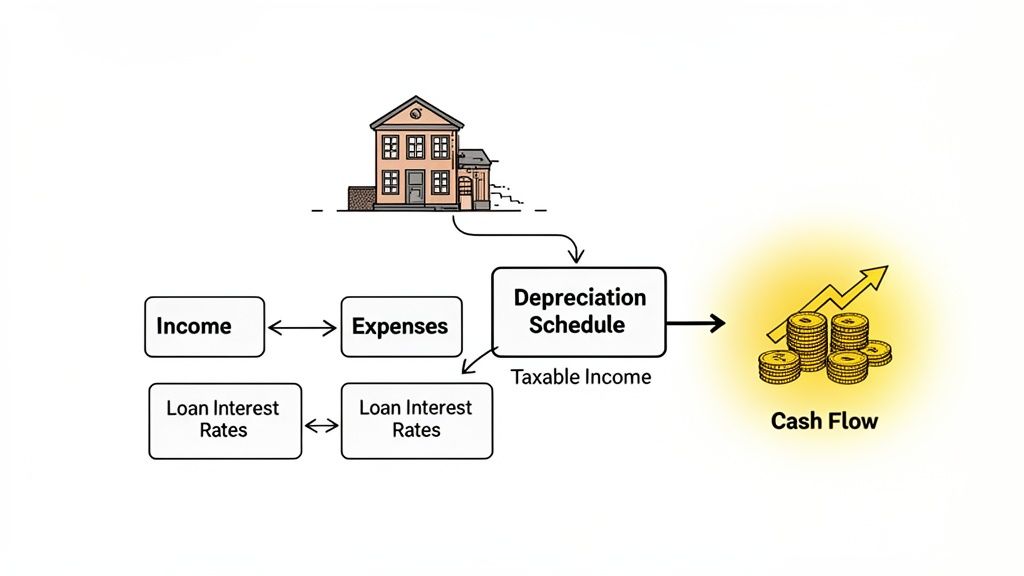
As this shows, depreciation is a key lever that could change the financial story of an investment, potentially turning a cash flow strain into a more sustainable position.
A Practical Australian Example
Imagine a newly built two-bedroom apartment purchased for $750,000. The property is rented out, bringing in income, but the costs of holding it are also significant.
Here’s a simplified snapshot of the property’s finances before factoring in depreciation:
- Gross Annual Rental Income: $31,200 ($600 per week)
- Total Annual Cash Expenses: $35,000
- Loan Interest: $28,000
- Council & Water Rates: $3,000
- Strata Fees: $2,500
- Repairs & Maintenance: $1,500
Based on these numbers alone, the property appears to have a pre-tax cash loss of $3,800 for the year ($31,200 – $35,000). This is a familiar situation for many investors and can put pressure on a household budget.
The Potential of Depreciation
Now, let's bring in a professionally prepared depreciation schedule. A quantity surveyor has inspected the property and mapped out a 40-year forecast of the available deductions.
For this $750,000 property, let's say the construction cost (Division 43) was identified as $400,000, and the plant and equipment (Division 40) were valued at $30,000.
- Capital Works (Division 43) Deduction: $400,000 x 2.5% = $10,000
- Plant & Equipment (Division 40) Deduction (Year 1): An estimated $4,500 (using the diminishing value method, which may accelerate early-year claims).
The total first-year depreciation claim could be $14,500. This is a non-cash deduction, meaning no actual money has left the owner’s pocket. It is simply the ATO’s way of recognising the building's wear and tear.
We add this "on-paper" deduction to the initial cash loss:
New Tax-Deductible Loss: $3,800 (cash loss) + $14,500 (depreciation) = $18,300
This larger on-paper loss may now be used to reduce the owner's taxable income from their salary. If the owner has a marginal tax rate of 37% (plus the Medicare levy), this deduction could generate a tax refund of around $7,137 ($18,300 x 39%). This refund could fundamentally change the property's real-world cash flow.
This example shows how a property that seemed cash-flow negative can become far more manageable. That tax refund could be put towards the mortgage or set aside as a financial buffer, strengthening your position as an investor.
Risks and Responsibilities
Claiming depreciation can be a powerful strategy, but like any aspect of property investing, it comes with a clear set of rules and responsibilities. Maximising a depreciation schedule is not just about claims; it is about understanding the ATO framework you are working within and being aware of your obligations.
This is what disciplined financial management looks like in practice. It means making sound, defensible decisions today that align with a long-term strategy, while preparing for future obligations. Navigating these rules correctly is a hallmark of a seasoned investor.
The 9 May 2017 Legislation Change
A significant rule change for property investors occurred on 9 May 2017. This federal budget announcement altered how depreciation could be claimed on plant and equipment in second-hand residential properties.
Before this date, a new owner of an existing residential property could continue to claim depreciation on the fixtures and fittings (Division 40 assets) that were already in the home.
However, for property contracts signed after that date, the rules were tightened:
- Previously Used Assets: If you buy a second-hand residential property, you generally can no longer claim depreciation on existing plant and equipment assets. This includes items like the ovens, carpets, or air conditioners that were in place when you bought it.
- New Assets Are Different: If you, as the new owner, buy and install brand-new assets, you can claim depreciation on them. So, if you replace an old dishwasher with a new one, the cost of that new unit is depreciable.
- Capital Works Was Not Affected: Crucially, these changes did not affect claims for capital works (Division 43). You can still claim depreciation on the building's structure for qualifying properties, whether new or second-hand.
This change highlights why a professionally prepared depreciation schedule is so important. A qualified quantity surveyor can ensure a report is compliant, correctly excluding any ineligible claims while identifying deductions you may be entitled to for new assets you install.
Capital Gains Tax Implications When You Sell
While depreciation may deliver an annual tax deduction, it is essential to understand how it connects with Capital Gains Tax (CGT) when you eventually sell your property. This is where foresight is valuable.
Each time you claim a capital works (Division 43) deduction, you are reducing the ‘cost base’ of your property for tax purposes.
The cost base is essentially what the property cost you to acquire and improve. It starts with the purchase price and includes other costs like stamp duty and legal fees. When you sell, your capital gain is calculated as the selling price minus this adjusted cost base.
Because annual capital works deductions lower the cost base over time, the calculated capital gain may be larger when you sell. This is not a penalty; it is simply a balancing mechanism within the tax system where the tax benefit received each year is accounted for when the property is sold. Understanding this long-term effect is vital for making informed decisions.
Practical Next Steps
Knowing the theory behind depreciation is one thing, but putting that knowledge into practice is where real value may be found. For most investors, the path forward is a simple, methodical review of their own portfolio. It is about taking a clear-eyed look at your properties and seeing where opportunities might lie.
This often starts with good organisation. Getting key documents in order—like the purchase contract, settlement statements, and any receipts for capital improvements—is an excellent first step. Having this information ready makes any conversation with a professional far more productive.
- Portfolio Review: Look at each property you own. The greatest opportunities often come from newer residential properties (built after September 1987) or those you've significantly renovated.
- Document Collection: Find and organise your purchase contracts, settlement figures, and every receipt for capital works or new plant and equipment assets you have installed.
- Professional Assessment: Consider engaging a qualified quantity surveyor. They can provide a clear picture of whether a report may be worthwhile, and their fee is typically 100% tax-deductible, making it an investment in your property's financial performance.
True financial progress is rarely about grand gestures. It is more often the result of quiet, consistent, and well-informed decisions made over time. Moving from understanding to action is the most important step. The goal is not to rush, but to move forward with clarity, ensuring each decision you make serves your long-term goals.
If you would like clarity on how these principles may apply to your own circumstances, you may wish to speak with a qualified adviser. You can contact Everglow on 1300 913 929 or email contact@everglow.au to arrange a discussion.
General Advice Warning: The information provided is general in nature and does not take into account your personal objectives, financial situation, or needs. You should seek personal advice from a qualified professional before making any financial decisions.
Concise Takeaway
A depreciation schedule for an investment property, prepared by a qualified quantity surveyor, is a key document that may help you claim legitimate, non-cash tax deductions for the wear and tear on your building and its assets. While it provides an annual benefit by potentially improving cash flow, it also has long-term implications for Capital Gains Tax. For Australian professionals, business owners, and families, understanding both the opportunities and responsibilities of depreciation is a mark of a disciplined and well-stewarded investment strategy.
If you would like clarity on how these principles may apply to your own circumstances, you may wish to speak with a qualified adviser. You can contact Everglow on 1300 913 929 or email contact@everglow.au to arrange a discussion.
General Advice Warning: The information provided is general in nature and does not take into account your personal objectives, financial situation, or needs. You should seek personal advice from a qualified professional before making any financial decisions.
Want help applying this to your situation?
Every situation is different. Book a time with our team to talk it through, or call us on 1300 913 929.