

If you are one of the millions of Australians now working from home, you are likely incurring costs that could reduce your taxable income. The Australian Taxation Office (ATO) provides clear guidelines for claiming working from home expenses, which means with careful planning, you may be able to claim a deduction for a portion of these costs.
Understanding what you may be eligible to claim and the records you need to keep is the first step toward responsible tax management. This guide is designed to provide clarity on the current rules.
Your Guide to Home Office Deductions
The shift toward remote and hybrid work has been significant for many Australian professionals. While the flexibility can be a benefit, it also means your home serves as a workspace, and this comes with associated running costs.
If you work from home, even periodically, you are almost certainly incurring expenses for which you may be able to claim a deduction on your tax return. The ATO has established several methods for this, allowing you to claim your entitlements in a compliant manner. This guide will walk you through these options, explaining the rules in simple terms.
Who Is Eligible to Claim?
First, it is important to determine your eligibility. You may be able to make a claim if you are working from home and personally incurring expenses that directly relate to earning your income. This generally includes:
- Employees who have an arrangement with their employer to work from home.
- Business owners, from sole traders to those running a small company. For anyone establishing their business structure, our article on the advantages of a sole trader offers foundational insights.
- Personal Services Income (PSI) earners who meet the relevant criteria.
The guiding principle is that the expense must be directly linked to your income-earning activities, and you must have sufficient records to substantiate your claim.
The Growing Importance of Home Office Claims
This is no longer a niche deduction; it is a significant aspect of the modern economy. Recent research from Roy Morgan indicates that over 6.7 million Australians now work from home at least some of the time. This highlights how widespread this practice has become.
The data also suggests that higher-income earners are more likely to have remote work arrangements. While this offers considerable freedom, it has also shifted costs such as electricity, internet, and office supplies from the employer to the individual. This makes understanding and correctly claiming home office deductions more crucial than ever. You can review the statistics in the full Roy Morgan research findings.
Choosing Your Claim Method: Fixed Rate vs. Actual Cost
When claiming working from home expenses, the Australian Taxation Office (ATO) offers two primary methods. The appropriate choice depends on your individual circumstances—including the amount you have spent, the nature of your home office, and your capacity for record-keeping.
One option is the revised fixed rate method, and the other is the actual cost method. Neither is universally superior; the most suitable method is the one that provides the largest legitimate claim based on your records. Let's break down how each one works so you can make an informed decision.
The Revised Fixed Rate Method: A Simpler Approach
The revised fixed rate method is the ATO's streamlined option. It has become a common choice for many people working remotely since the rules were updated in July 2022.
Instead of tracking every individual running cost, you can claim a set rate for each hour you work from home. For the 2024–25 financial year, this rate has not yet been announced, but for the 2023-24 year it was 67 cents per hour. It is designed to cover common running costs like additional electricity and gas, internet and phone usage, stationery, and computer consumables. For example, if you worked 843 hours from home during a financial year at a rate of 67 cents, you could claim a deduction of $564.81 ($0.67 x 843).
The main advantage here is reduced paperwork. You do not need to keep receipts for every utility bill, but you absolutely must maintain a record of the hours you worked from home. For the most up-to-date information, it is always wise to check the ATO's current stance on home office claims.
Even when using this method, you may be able to make separate claims for depreciating assets not covered by the hourly rate. These could include:
- The decline in value (depreciation) of office equipment such as your desk, chair, and computer.
- The cost of repairing and maintaining that equipment.
- Other specific work-related expenses that are not day-to-day running costs.
This infographic provides a quick visual guide to help you assess your eligibility.
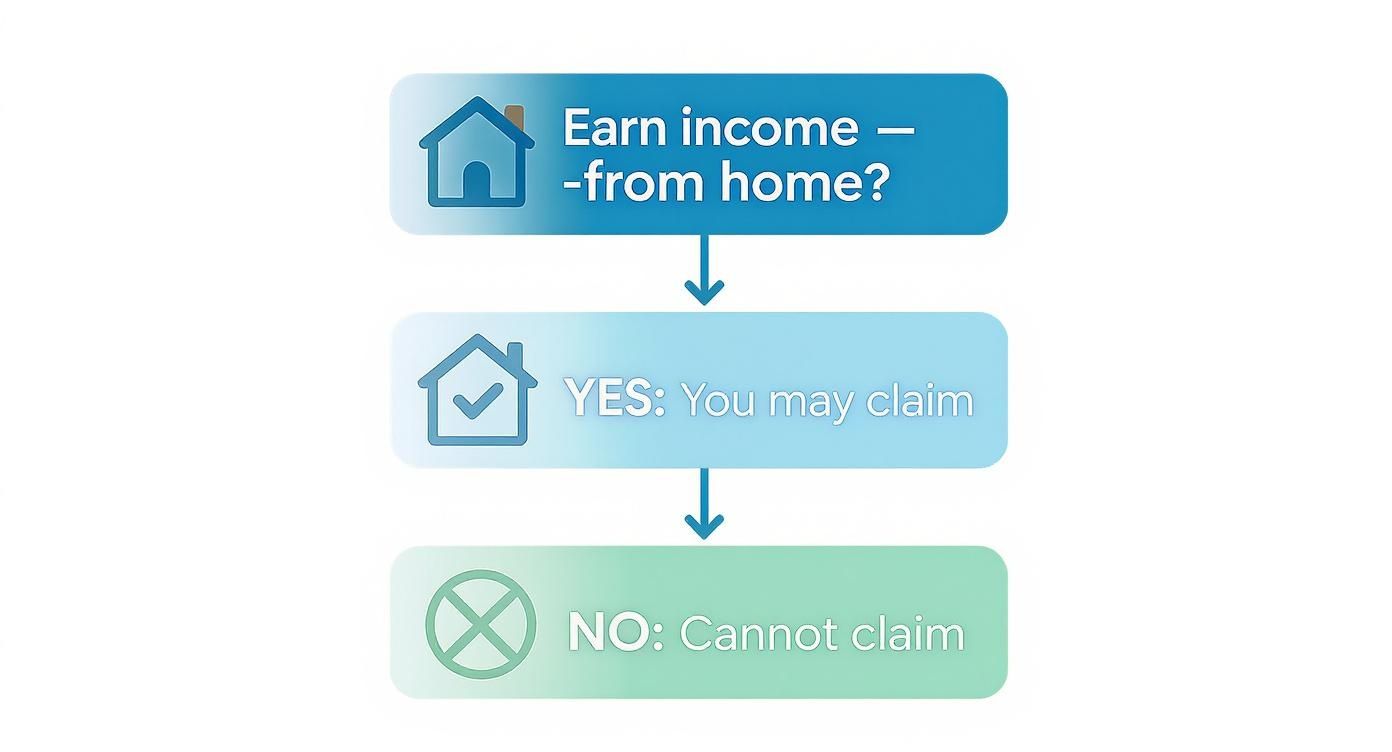
As it shows, the fundamental requirement is that you must be incurring expenses to earn your income from home.
The Actual Cost Method: A Detailed Calculation
For those who are diligent with administration, the actual cost method could result in a larger tax deduction, particularly if you have significant working-from-home expenses. With this approach, you calculate the actual work-related portion of each individual home office cost.
This means you must maintain meticulous records, including receipts, invoices, and bank statements for everything you intend to claim. For shared utilities like electricity and internet, you need a reasonable basis for apportioning the personal and work-related use.
This apportionment may be calculated by:
- Floor area: Determining the percentage of your home's total floor space that your dedicated office occupies.
- Usage diary: Keeping a logbook for a representative four-week period to track the work-related use of shared services like your phone and internet.
An example could be a local architect who runs their practice from a dedicated room at home. They can measure their office's floor area against the total area of their house. If the office is 10% of the total space, they may be able to claim 10% of their household electricity and gas bills. This requires measurement and consistent tracking, but the outcome may be worthwhile.
This method allows you to claim the work-related portion of a wider range of expenses, including cleaning costs for your office space and the depreciation of furniture. It is often a more suitable choice for individuals who have invested significantly in their home setup or operate a business from home. The principles of apportioning costs are similar to those used in real estate; our guide on smart moves for managing an investment property offers related insights.
To help you see the differences clearly, here is a simple comparison.
Comparison of ATO Working From Home Claiming Methods
| Feature | Revised Fixed Rate Method | Actual Cost Method |
|---|---|---|
| Claim Rate | A set rate per hour worked from home (e.g., 67 cents for 2023-24). | Claim the actual work-related portion of each expense. |
| What's Covered | Electricity, gas, phone/internet usage, stationery, and computer consumables. | All running expenses plus cleaning, depreciation of office furniture, etc. |
| Record Keeping | Must keep a complete record of hours worked. No need for receipts for expenses covered by the rate. | Meticulous records needed for all expenses (receipts, bills) plus calculations for apportionment (e.g., floor area, diary). |
| Separate Claims | Can still claim depreciation on equipment, repairs, and other direct work costs separately. | All work-related costs are calculated and claimed directly; nothing is bundled into a rate. |
| Best For | Employees with lower running costs or those who prefer simplicity and less paperwork. | Individuals with a dedicated home office, high running costs, or business owners seeking to maximise their claim, depending on their circumstances. |
Ultimately, this table highlights the trade-off between simplicity and the potential for a higher deduction.
Making an Informed Decision
Choosing a method is a personal cost-benefit analysis. A prudent approach is to perform a preliminary calculation using both methods before lodging your return. This may take a little extra time but ensures you are making a considered choice. Remember that your circumstances can change from one year to the next, so a review of your approach each year is a component of good financial stewardship. If you also manage other assets, you will find similar principles of tracking and claiming in our holiday home tax deductions guide.
The Discipline of Diligent Record Keeping
When it comes to your tax return, estimates are not sufficient. A compliant, well-supported claim is built on a foundation of good records. This is not merely a compliance burden but a form of financial prudence—the evidence needed to confidently claim your entitlements should the Australian Taxation Office (ATO) request substantiation.
The specific records you need to retain will depend entirely on which method you use to claim your expenses. Each approach has its own strict rules, so let’s outline what is required for each.
Records for the Fixed Rate Method
If you are using the fixed rate method, your primary obligation is to prove the number of hours you worked from home. The ATO requires a complete record covering the entire income year.
A simple, consistent system is all that is needed. Many find one of the following methods works well:
- A basic spreadsheet to log daily start and finish times, along with any breaks.
- A traditional diary or notebook with daily entries of your hours.
- Copies of employer-provided timesheets or rosters that clearly show your remote work days.
In addition to your hours, you will also need to keep receipts for any larger assets you claim separately, such as a new ergonomic chair or computer monitor.
Records for the Actual Cost Method
Opting for the actual cost method requires a higher level of detail. It involves more administrative effort, but for those with significant home office costs, the potentially larger deduction can make it a sound choice.
You are not just proving you spent the money; you must also be able to justify your calculation for the work-related portion of that expense.
The core principle here is substantiation. You need to be able to show the ATO not only that you paid a bill, but that your method for calculating the work-related percentage is reasonable and based on evidence, not an arbitrary estimate.
Your record-keeping system for this method should be thorough. It needs to include:
- Receipts and invoices for every expense you plan to claim—from electricity and gas bills to stationery and cleaning supplies.
- A diary or logbook kept for at least a four-week continuous period. This helps establish a representative pattern of use for ongoing costs like your phone and internet, which you can then apply across the year, provided your work habits do not materially change.
- Your apportionment calculations. For instance, if you are claiming electricity based on the floor area of your home office, you should have the measurements of both your dedicated workspace and your entire home recorded.
This level of detail is particularly important for contractors and business owners, where the distinction between business and personal can be less clear. These principles of separating finances are universal, and anyone with an investment property might see parallels with our advice on managing your investment property.
Practical Tips for Staying Organised
The key to manageable record-keeping is forming good habits. A small amount of effort each week is far easier than searching for receipts in June.
Consider setting up a simple digital system. A dedicated folder on your cloud storage for scanned receipts and bills can be effective. Many accounting applications also allow you to capture a photo of a receipt and categorise it immediately. The most important thing is to find a system that suits you and use it consistently.
Ultimately, keeping good records is about more than satisfying ATO requirements. It brings clarity to your finances, providing a clear picture of your expenses and empowering you to make wiser decisions.
Seeing the Numbers in Action: Real-World Scenarios
Theory provides a foundation, but seeing how the numbers apply in practice can offer greater clarity. Let's walk through a few illustrative examples to show how these calculations work. This should give you a better idea of how your own situation might compare and help you choose between the fixed rate and actual cost methods.
Please note, these are simplified examples using typical figures. Your own claim will always depend on your specific costs and the quality of your records.
Scenario One: A Salaried Employee in a Hybrid Role
Let’s consider Anika, a marketing manager in Sydney. Her employer has a hybrid model, so she works from home three days a week. She uses a desk in the corner of a spare room, which is also used as a guest room.
Anika maintained a record of her hours throughout the year. She worked from home for 46 weeks, after accounting for annual and sick leave.
First, let's calculate her total hours:
3 days/week × 7.6 hours/day × 46 weeks = 1,048.8 hours
Anika’s Claim Using the Fixed Rate Method
For many employees like Anika, the fixed rate method is often the most straightforward option. (Using the 2023-24 rate for this example).
- Deduction: 1,048.8 hours × 67 cents per hour = $702.70
In addition to this, Anika bought a new ergonomic chair for $450. This is a capital expense, so she can claim its depreciation separately. The ATO gives office chairs an effective life of 10 years.
- Depreciation Claim: $450 / 10 years = $45 per year
Adding these together, Anika’s total claim using the fixed rate method is $747.70.
Anika’s Claim Using the Actual Cost Method
To compare, Anika gathers her relevant bills. Her spare room office space measures 10 square metres, and her apartment is 80 square metres total. This means her office takes up 12.5% of the home's floor area.
Here’s how her costs break down:
- Electricity: $1,800 for the year. Work portion: $1,800 × 12.5% = $225
- Gas (for heating): $700 for the year. Work portion: $700 × 12.5% = $87.50
- Internet: $960 for the year. She kept a four-week diary and found her work usage was 40%. Work portion: $960 × 40% = $384
- Mobile Phone: $480 for the year. Her diary showed 25% work use. Work portion: $480 × 25% = $120
- Depreciation on chair: The same $45 as calculated previously.
Tallying these costs, her total claim under this method is $861.50. For Anika, the effort to track her actual costs resulted in a moderately higher deduction. Depending on her circumstances, the additional administrative effort may or may not be worthwhile.
Scenario Two: A Small Business Owner Operating From Home
Now let’s look at David, a freelance graphic designer operating as a sole trader. He runs his entire business from a dedicated home office. The room takes up 15% of his house's total floor area.
Because his home is his principal place of business, the rules are different, and he may be able to claim a wider range of expenses than an employee.
David’s Claim Using the Fixed Rate Method
David works full-time from home. He tracked his hours and logged an average of 40 hours per week for 48 weeks of the year.
- Hours Calculation: 40 hours/week × 48 weeks = 1,920 hours
- Deduction: 1,920 hours × 67 cents per hour = $1,286.40
He also has significant business assets he can depreciate separately:
- Desk ($800): $800 / 10-year effective life = $80
- High-End Computer ($4,500): $4,500 / 4-year effective life = $1,125
- Printer ($600): $600 / 4-year effective life = $150
With the fixed rate method, his total potential claim comes to $2,641.40.
David’s Claim Using the Actual Cost Method
For a business owner like David, the actual cost method will often be the more appropriate choice as it can better reflect the true cost of running the business from home.
Here is a look at his annual business-related costs:
- Electricity & Gas: $3,200 × 15% work-use portion = $480
- Home Internet: $1,200 × 80% work use (based on his detailed diary) = $960
- Stationery & Consumables: Direct business cost = $450
- Depreciation on Assets: Same calculation as above = $1,355
- Cleaning: $2,600 per year for a weekly cleaner × 15% work area = $390
With this method, David's total claim is $3,635. The difference is significant, highlighting why the actual cost method can be powerful for home-based businesses with varied expenses. The principles of apportioning costs based on area or usage can be applied elsewhere, too—for instance, our holiday home tax deductions guide delves into similar concepts for property investors.
A Note on Capital Gains Tax
When a business owner claims occupancy expenses (such as a portion of mortgage interest or rent), it can trigger Capital Gains Tax (CGT) when the property is eventually sold. This is a complex area of tax law, and seeking personal advice is essential if your circumstances fall into this category.
These scenarios make it clear that there is no single "best" method. The right choice depends entirely on your situation. Your most effective strategy is to keep good records throughout the year, which gives you the flexibility to calculate your claim using both methods and confidently choose the one that provides the best legitimate outcome for you.
Common Mistakes and When to Seek Professional Advice
It is easy to make errors when claiming work-from-home expenses. While the ATO’s rules are logical, a few common misunderstandings can lead to an incorrect claim. Most of these mistakes are avoidable with careful attention to detail.
Knowing what to look for before you prepare your tax return is a key part of responsible financial management.
https://www.youtube.com/embed/HRcIddDGQdM
Avoiding Common Errors in Your Claim
Even the most organised individuals can make mistakes. The most frequent errors usually arise from a misunderstanding of what constitutes a legitimate work expense versus a personal one, or confusion about what each claim method covers.
Here are a few common mistakes to avoid:
Claiming private expenses: This is a critical point. An expense must have a direct connection to earning your income. Attempting to claim a portion of household groceries or a personal streaming subscription is not permissible under ATO rules.
Double-dipping with the fixed rate method: If you use the revised fixed rate method, you cannot then make separate claims for expenses covered by that rate, such as internet, phone, or stationery. The hourly rate is an all-inclusive figure for those specific running costs.
Failing to correctly apportion shared costs: When using the actual cost method, you need a reasonable, logical basis for dividing shared household bills. An arbitrary guess that 50% of your internet is for work is unlikely to be sufficient if the ATO requests substantiation. A logbook or detailed diary is required to support your claim.
Overlooking employer reimbursements: You cannot claim a deduction for an expense for which your employer has already reimbursed you. If they paid you back the full $400 for a new monitor, you are not out of pocket, and therefore there is nothing to claim.
A tax claim is a formal declaration. Preparing it correctly is an exercise in responsible financial stewardship. Diligence now is an investment in your peace of mind later.
These are common traps, but with good records and a careful review before you lodge, they can be sidestepped.
Knowing When to Engage a Professional
While this guide provides a roadmap, some situations have inherent complexities. Tax law can be intricate, especially where business and personal finances intersect. Attempting to navigate this alone may mean missing out on legitimate deductions or, conversely, making a costly compliance error.
You should strongly consider seeking advice from a registered tax agent if you are in any of the following situations:
Running a business from home: This is a significant consideration. If your home is your principal place of business, you may be able to claim occupancy expenses (like a portion of your rent or mortgage interest). However, this can have serious Capital Gains Tax (CGT) consequences when you sell, so you must proceed with caution and professional guidance.
Significant capital expenditure: If you have invested heavily in a high-end office setup, a professional can help you structure your depreciation claims correctly, ensuring you claim the appropriate deduction over the life of the assets.
Uncertainty about your eligibility: If you are unsure whether you can claim, or how to fairly apportion your costs, a consultation with an expert can provide clarity and reduce stress.
Engaging a professional is not a sign of failure; it is a wise, strategic decision. The fee you pay for tax advice is generally tax-deductible. It is an investment in ensuring your tax obligations are met correctly, both now and in the future.
Got Questions About Home Office Deductions? We've Got Answers
When it comes to claiming your working from home expenses, it's natural to have questions. Let's address some of the most common queries we receive, so you can feel more confident about your claim.
As an Employee, Can I Claim My Rent or Mortgage Interest?
For most employees, the answer is no. The ATO classifies costs like rent, mortgage interest, insurance, and council rates as private occupancy expenses. These are costs you would incur to live in your home, regardless of your work arrangements.
Attempting to claim these could also have Capital Gains Tax (CGT) implications in the future. If you declare to the ATO that part of your home was used to produce income, you may lose a portion of the main residence exemption when you sell the property. This is a significant risk for a deduction that is unlikely to be allowed for an employee in the first place.
The rules may differ if your home is genuinely your principal place of business, but this is a high threshold to meet and typically applies to business owners, not employees. If you believe your circumstances are unusual, seeking personal professional advice is essential.
What Happens if My Boss Pays Me a WFH Allowance?
It is helpful when employers contribute to costs, but it is important to understand how a working from home allowance is treated for tax purposes. An allowance is considered assessable income, so you must declare it on your tax return.
You can then claim a deduction for the home office expenses you incurred, using either the revised fixed rate or the actual cost method. It is a common misconception that the allowance is the deduction; that is not correct.
Consider the distinction: An allowance is income you receive, against which you may claim your deductible expenses. A reimbursement, however, is when your employer repays you for a specific item you purchased, like a monitor. You cannot claim a deduction for a reimbursed expense because you were not personally out of pocket.
Do I Need a Separate Room to Claim Anything?
No, a separate, dedicated room is not required to be eligible, particularly if you are using the revised fixed rate method. This method was designed to accommodate the reality of modern work, where many people use a space in a common area like a kitchen or living room.
As long as you are genuinely working from home and incurring additional running costs as a result, you may use the cents-per-hour rate, provided you meet the record-keeping requirements.
However, if you are using the actual cost method, having a dedicated space simplifies the calculations. It is much easier to determine the percentage of your utility bills to claim when you can base it on the floor area of a specific work zone.
Can I Claim the Full Cost of My New Laptop Straight Away?
Generally, no. For capital items like a laptop, monitor, or office chair, you must claim the cost over time through a process known as depreciation (or decline in value).
Here is the general principle:
- For items costing over $300: You claim the decline in value for the work-related portion of the cost over the asset's 'effective life'. For a $1,500 laptop used 80% for work, you would depreciate $1,200 of its value over its effective life (the ATO generally sets this at two years for a laptop).
- For items costing $300 or less: You may be able to claim an immediate deduction for the work-use percentage in the year of purchase, provided the item is used predominantly for work.
This process ensures the expense is matched to the period during which the asset helps you earn income. It is a fundamental principle of Australian tax law. The key is to claim what you are entitled to in the correct manner, based on sound records and an understanding of your obligations.
At Everglow Prosperity, we believe that building long-term financial stability starts with clear, reliable guidance. Whether you are navigating personal tax obligations, structuring a business, or managing complex investments, our integrated team is here to provide the steady advice you need for every life stage. Discover how we can help you build enduring prosperity by visiting us at https://everglow.au.
General Advice Warning: The information in this article is general in nature and does not take into account your objectives, financial situation or needs. Before acting on it, consider whether it is appropriate for you and seek personal advice. Tax and superannuation rules can change. Financial advice is provided by Everglow Wealth Pty Ltd, a Corporate Authorised Representative (No. 1254987) of PGW Financial Services Pty Ltd (AFSL 384713). Tax advice is provided by Everglow Accounting Pty Ltd.
Want help applying this to your situation?
Every situation is different. Book a time with our team to talk it through, or call us on 1300 913 929.
Book a free first meetingAustralian tax guide →Estimate your fees →